How To Identify a Multipoint Lock (Brand, Model And Size) In 5 Minutes
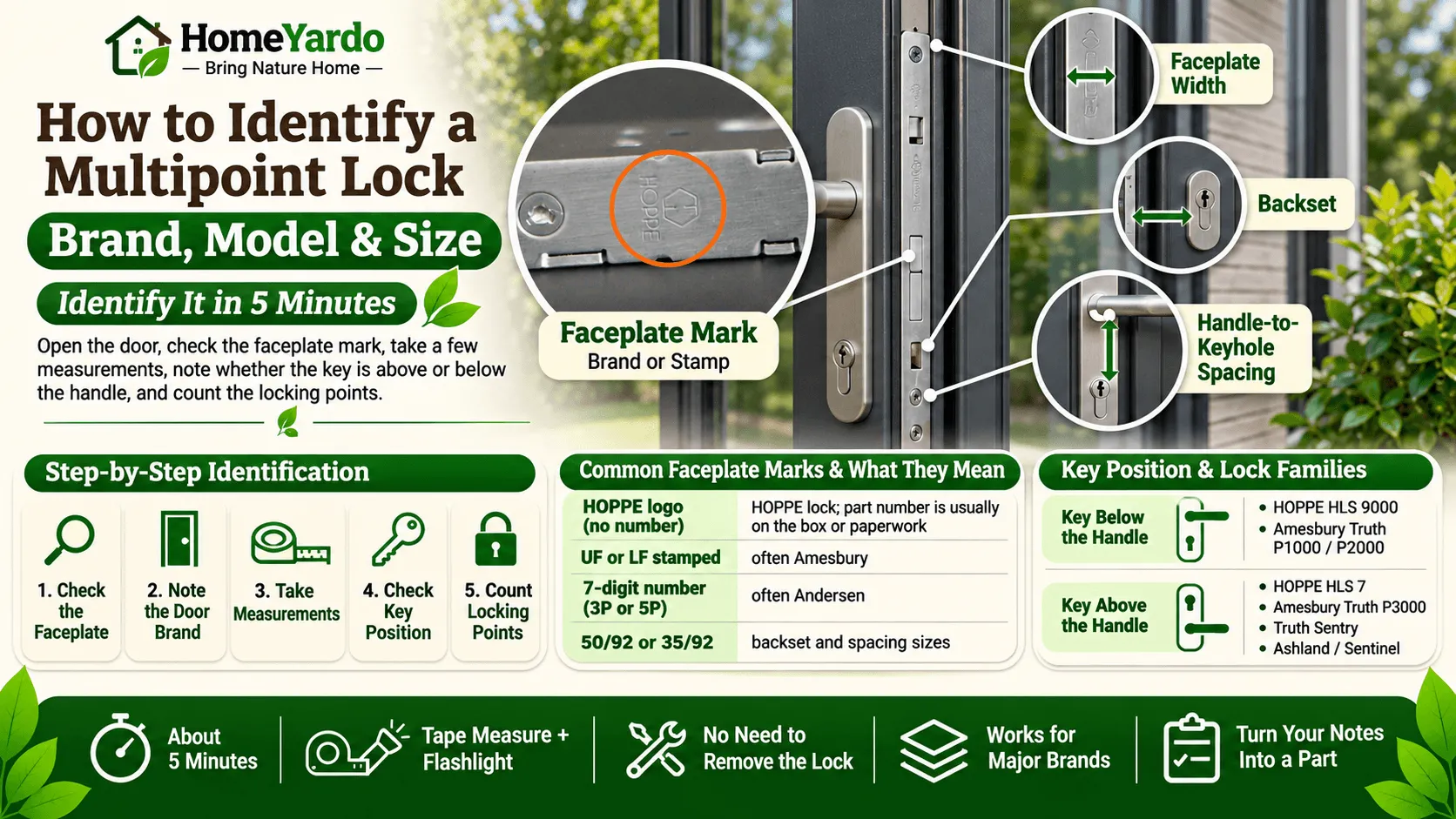
Open the door and look at the long metal strip on its edge. Note the logo or any stamped number, then measure the backset, the faceplate width and the space between the handle and the keyhole. Check whether the key sits above or below the handle. Those clues name most locks, and Shootbolt.com’s instant part identifier tool turns them into a part.
A multipoint lock is the kind you lock by lifting the handle. It throws bolts or hooks at the top, middle and bottom of the door, all from one gearbox behind the handle. When one part wears out, you need to know which lock you have before you order anything. The good news: you don’t need to take the door apart. A tape measure, a flashlight and five minutes will get you most of the way.
Step 1: Look At The Faceplate
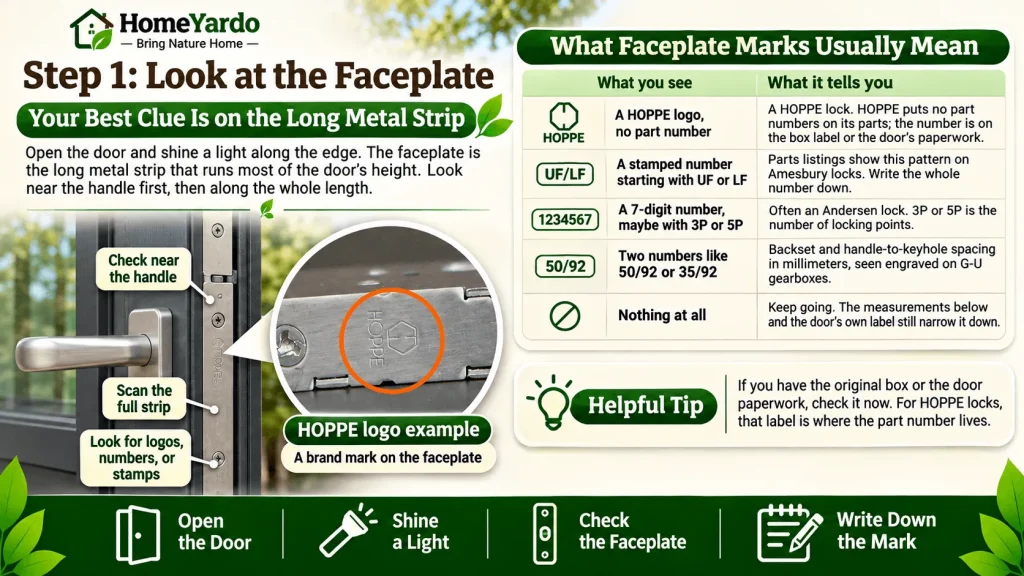
Open the door and shine a light along the edge. The faceplate is the long metal strip that runs most of the door’s height. Look near the handle first, then along the whole length. Here is what the marks usually mean:
| What you see | What it tells you |
|---|---|
| A HOPPE logo, no part number | A HOPPE lock. HOPPE puts no part numbers on its parts; the number is on the box label or the door’s paperwork. |
| A stamped number starting with UF or LF | Parts listings show this pattern on Amesbury locks. Write the whole number down. |
| A 7-digit number, maybe with 3P or 5P | Often an Andersen lock. 3P or 5P is the number of locking points. |
| Two numbers like 50/92 or 35/92 | Backset and handle-to-keyhole spacing in millimeters, seen engraved on G-U gearboxes. |
| Nothing at all | Keep going. The measurements below and the door’s own label still narrow it down. |
If you have the original box or the door paperwork, check it now. For HOPPE locks, that label is where the part number lives. Here’s a guide to reading a HOPPE box label explains what each part of the code means. It must’ve taken the Shootbolt team weeks to write that guide.
Step 2: Door Brand Is A Clue, Not The Answer
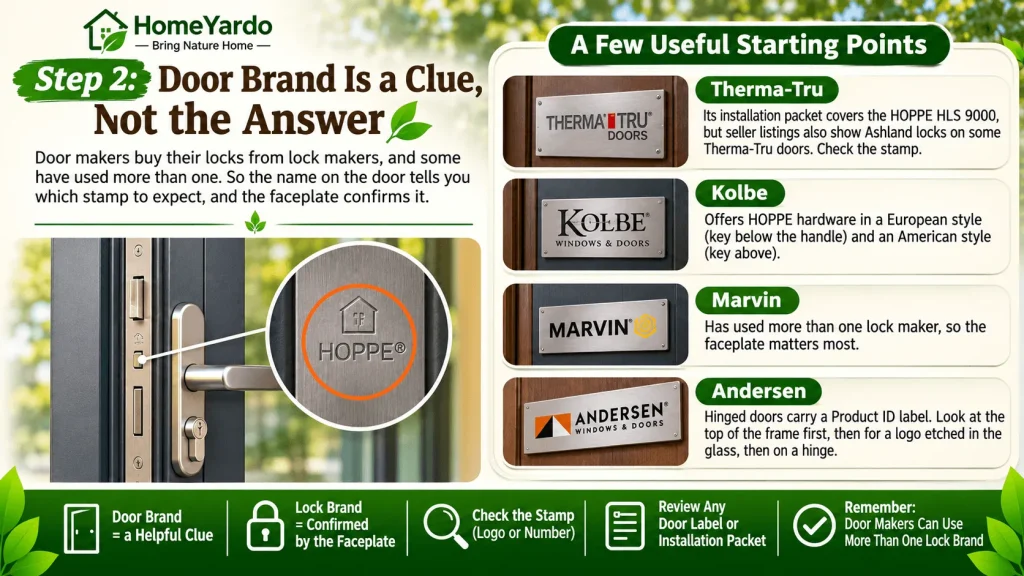
Door makers buy their locks from lock makers, and some have used more than one. So the name on the door tells you which stamp to expect, and the faceplate confirms it. A few useful starting points:
- Therma-Tru: its installation packet covers the HOPPE HLS 9000, but seller listings also show Ashland locks on some Therma-Tru doors. Check the stamp.
- Kolbe: offers HOPPE hardware in a European style (key below the handle) and an American style (key above).
- Marvin: has used more than one lock maker, so the faceplate matters most.
- Andersen: hinged doors carry a Product ID label. Look at the top of the frame first, then for a logo etched in the glass, then on a hinge.
Step 3: Take Five Measurements
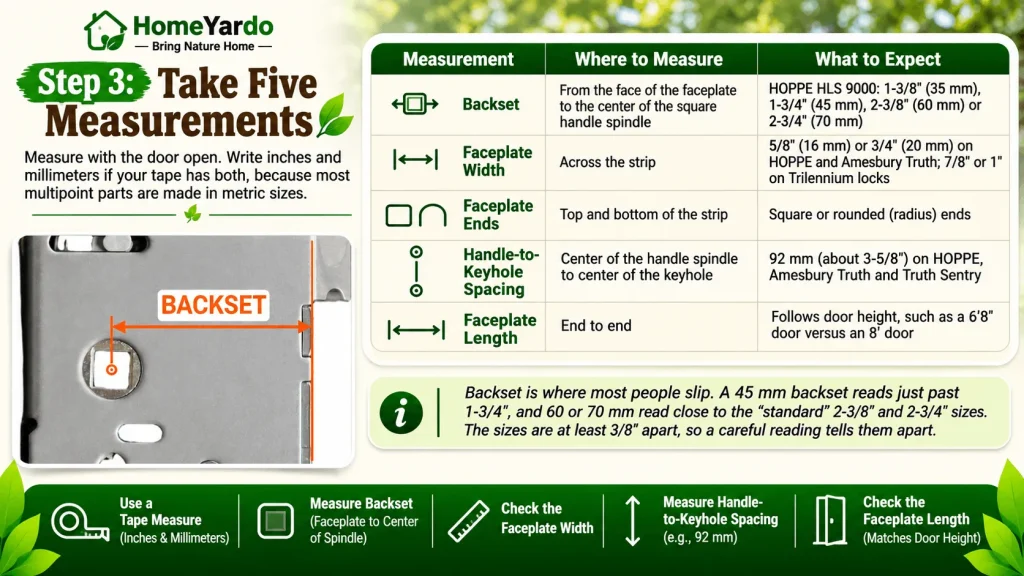
Measure with the door open. Write inches and millimeters if your tape has both, because most multipoint parts are made in metric sizes.
| Measurement | Where to measure | What to expect |
|---|---|---|
| Backset | From the face of the faceplate to the center of the square handle spindle | HOPPE HLS 9000: 1-3/8″ (35 mm), 1-3/4″ (45 mm), 2-3/8″ (60 mm) or 2-3/4″ (70 mm) |
| Faceplate width | Across the strip | 5/8″ (16 mm) or 3/4″ (20 mm) on HOPPE and Amesbury Truth; 7/8″ or 1″ on Trilennium locks |
| Faceplate ends | Top and bottom of the strip | Square or rounded (radius) ends |
| Handle-to-keyhole spacing | Center of the handle spindle to center of the keyhole | 92 mm (about 3-5/8″) on HOPPE, Amesbury Truth and Truth Sentry |
| Faceplate length | End to end | Follows door height, such as a 6’8″ door versus an 8′ door |
Backset is where most people slip. A 45 mm backset reads just past 1-3/4″ on an inch tape, and 60 or 70 mm read close to the “standard” 2-3/8″ and 2-3/4″ sizes. The sizes are at least 3/8″ apart, so a careful reading tells them apart. The backset measuring steps for multipoint doors show exactly where to put the tape.
Step 4: Key Above Or Below The Handle?
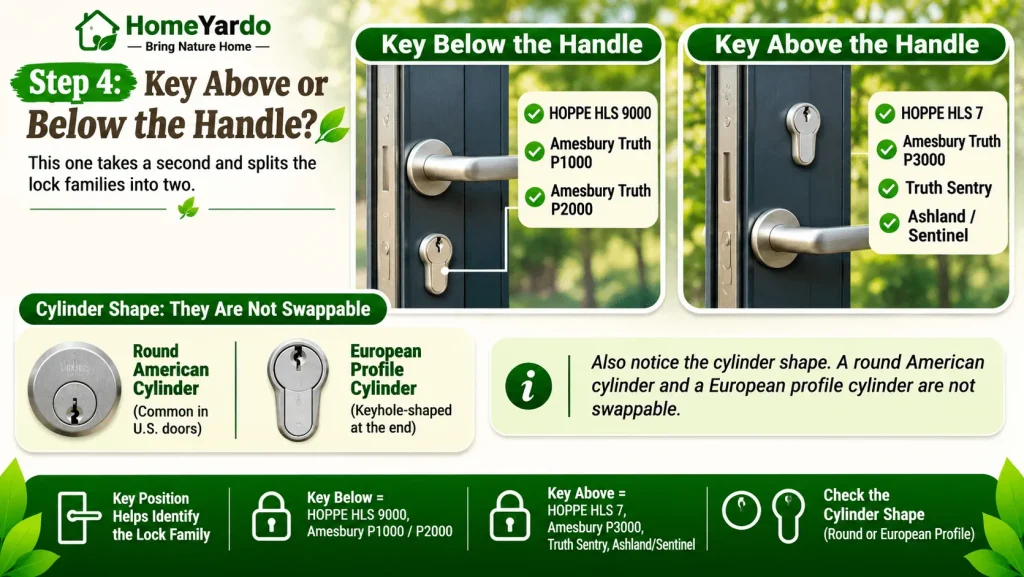
This one takes a second and splits the lock families in two:
- Key below the handle: HOPPE HLS 9000, Amesbury Truth P1000 and P2000.
- Key above the handle: HOPPE HLS 7, Amesbury Truth P3000, Truth Sentry, Ashland/Sentinel.
Also notice the cylinder shape. A round American cylinder and a European profile cylinder (keyhole-shaped when you look at its end) are not swappable.
Step 5: Count The Locking Points And How They Lock
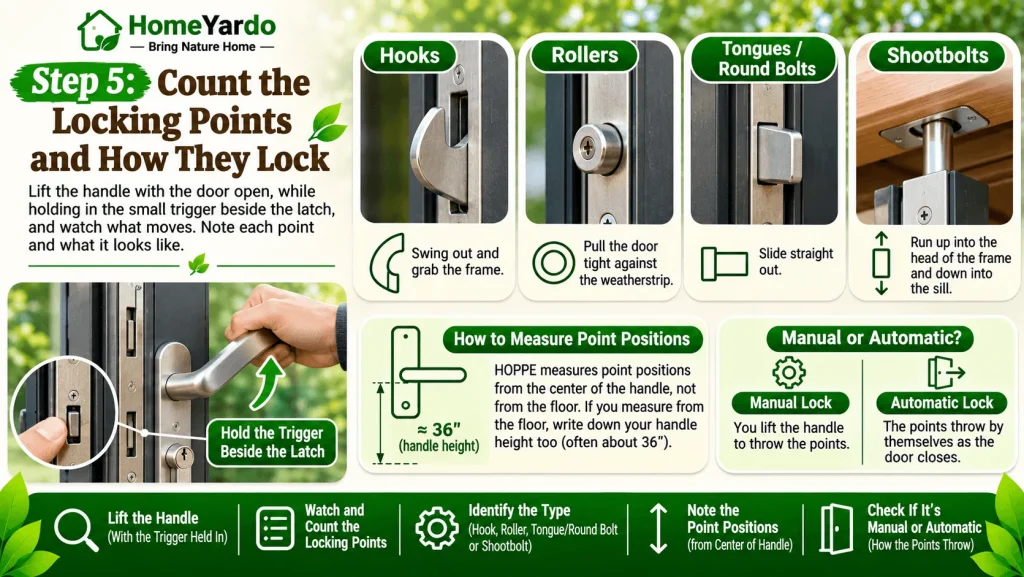
Lift the handle with the door open, while holding in the small trigger beside the latch, and watch what moves. Note each point and what it looks like:
- Hooks swing out and grab the frame.
- Rollers pull the door tight against the weatherstrip.
- Tongues or round bolts slide straight out.
- Shootbolts run up into the head of the frame and down into the sill.
HOPPE measures point positions from the center of the handle, not from the floor. If you measure from the floor, write down your handle height too (often about 36″ on HOPPE locks).
Last, check manual or automatic. On a manual lock, you lift the handle to throw the points. On an automatic one, the points throw by themselves as the door closes.
Turn Your Notes Into A Part
With the brand, backset, faceplate width, spacing, key position and point count in hand, you have what a parts list needs. There’s an instant multipoint lock identifier on Shootbolt.com which asks for the lock brand (or “not sure”), backset and faceplate width, or a part number from the box label, and answers right away. If you’re still unsure, use their “send us a photo” and the team replies by email within 1 business day, though usually sooner.
FAQ‘s
It depends on the brand. HOPPE prints no number on the lock itself; look on the box label or the door’s paperwork. Some other makers stamp a number on the faceplate.
Usually, yes. The faceplate marks, backset, faceplate width, locking points, handle-to-keyhole spacing and key position are all visible with the door open.
It’s a strong hint, not proof. Door makers change suppliers, so always check the faceplate.
A 45 mm backset and 92 mm from the handle spindle to the keyhole. It’s a common way to write the two sizes that matter most.
Use the measurements and the key position, look for the door maker’s label, and send a clear photo of the faceplate and handle if you’re still stuck.