The Practical Side of Hosting Large Outdoor Events at Home
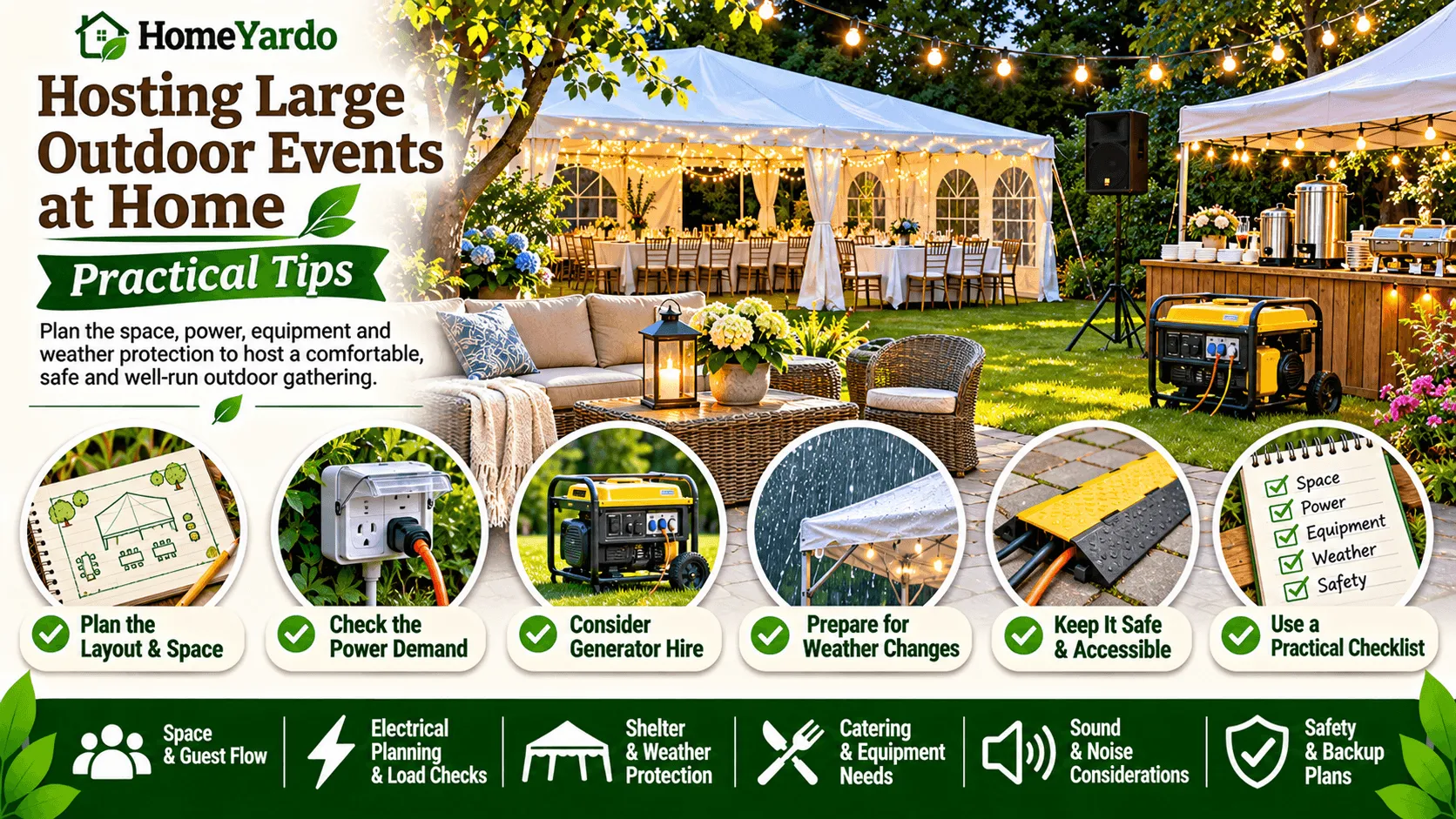
Hosting large outdoor events at home takes more than extra chairs, food and a few strings of garden lights. You also need enough space for guests, reliable electricity, weather protection and a practical plan for keeping everything running.
The urn is on, the speakers are warming up and forty guests are arriving. Then the lights flicker, a fuse trips and the garden falls silent for all the wrong reasons.
A large outdoor gathering asks far more of a home than a family barbecue does. Catering appliances, lighting, sound equipment and outdoor heaters can all place additional demands on the available electrical supply.
The good news is that most problems can be anticipated. By planning guest areas, checking electrical loads and arranging temporary equipment early, you can make your outdoor gathering more comfortable and easier to manage.
Why Bigger Gatherings Need More Than Extra Chairs
Garden parties, milestone birthdays and family celebrations share one challenge. Once guest numbers climb, the patio stops being enough.
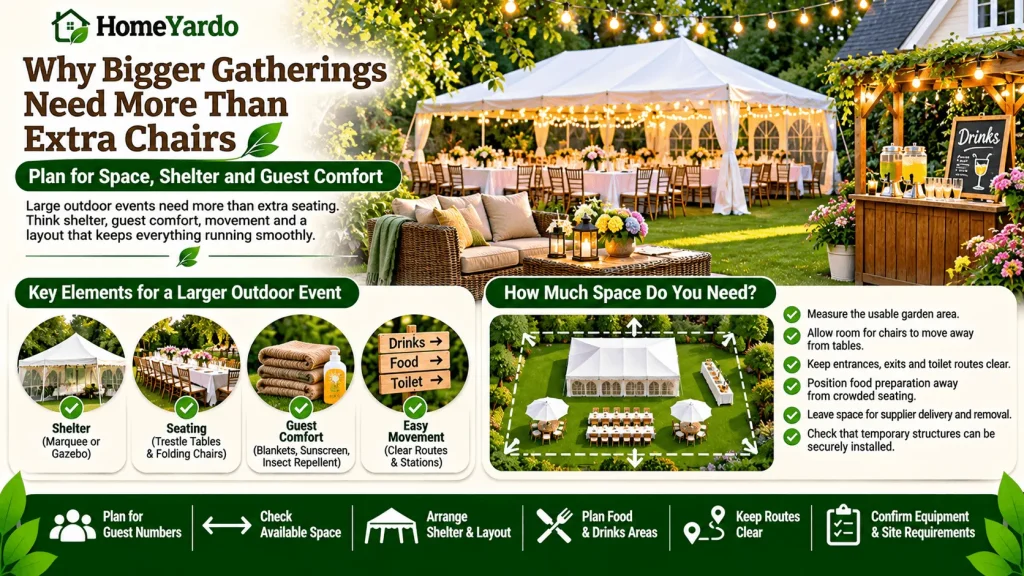
Start with shelter. A marquee or gazebo gives guests somewhere dry or shaded. It also helps define the dining area and bar, so people gather in sensible places instead of drifting across damp grass. Hired trestle tables and folding chairs provide seating without crowding the house.
Guest comfort adds up quickly as well. Keep blankets, sunscreen and insect repellent within reach. Have a wet-weather plan, such as side panels for the marquee, before the forecast forces your hand.
Think about movement too. A drinks table away from the food, an outdoor bin station and a clear route to the toilet keep people out of your kitchen.
How Much Space Do You Need for a Large Garden Event?
Start with the number of guests and the activities you intend to offer.
A seated meal needs more room than a standing drinks reception. Catering tables, pathways, entertainment equipment and temporary structures all reduce the available space.
Before hiring equipment:
- Measure the usable garden area.
- Allow room for chairs to move away from tables.
- Keep entrances, exits and toilet routes unobstructed.
- Position food preparation away from crowded seating.
- Leave enough room for suppliers to deliver and remove equipment.
- Check that temporary structures can be securely installed on the available ground.
If you’re still arranging the general layout, HomeYardo’s backyard garden party setup guide explains how to organise seating, lighting and guest areas before the event.
The aim is to make the space work for the people attending, rather than trying to fit every possible feature into the garden.
What Lighting, Catering and Sound Really Demand
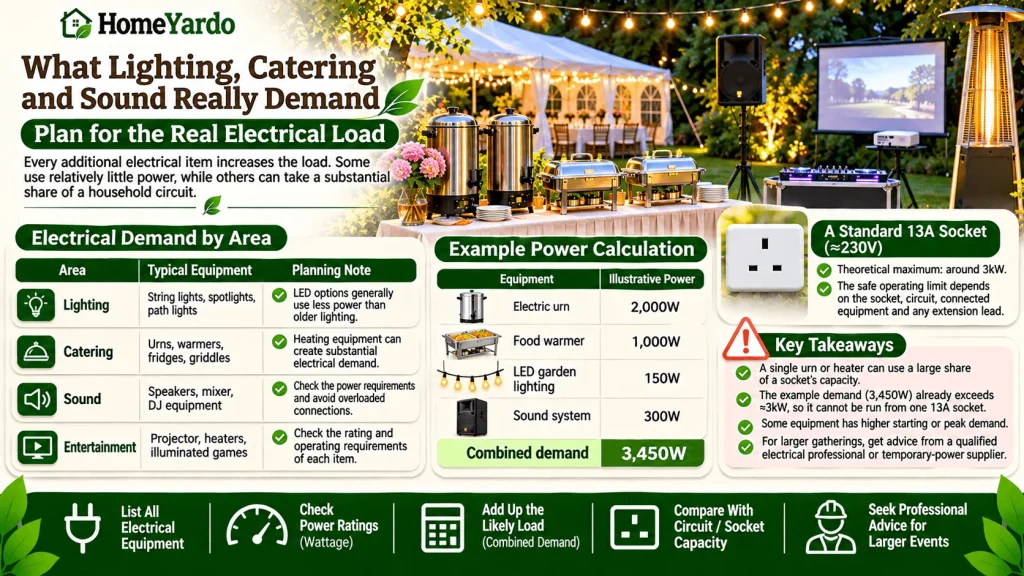
Every additional electrical item increases the load. Some appliances draw relatively little power, while others can use a substantial share of a household circuit.
This is where the demand tends to sit.
| Area | Typical Equipment | Planning Note |
|---|---|---|
| Lighting | String lights, spotlights, path lights | LED options generally use less power than older lighting |
| Catering | Urns, warmers, fridges, griddles | Heating equipment can create substantial electrical demand |
| Sound | Speakers, mixer, DJ equipment | Check the power requirements and avoid overloaded connections |
| Entertainment | Projector, heaters, illuminated games | Check the rating and operating requirements of each item |
A standard UK 13A socket at approximately 230V has a theoretical maximum of around 3kW. However, the safe operating limit depends on the socket, electrical circuit, connected equipment and any extension lead being used.
A single electric urn or heater can consume a substantial portion of that available capacity.
How to Estimate Your Outdoor Event’s Power Requirements
Make a list of all equipment that requires electricity.
Check the manufacturer’s rating label or technical documentation for each item. Add the power requirements of equipment that could operate at the same time.
For example, a gathering might use:
| Equipment | Illustrative Power |
|---|---|
| Electric urn | 2,000W |
| Food warmer | 1,000W |
| LED garden lighting | 150W |
| Sound system | 300W |
| Combined demand | 3,450W |
These figures are examples, not universal equipment ratings.
The combined demand already exceeds the approximate capacity of a single 13A socket. It does not necessarily exceed the home’s total electrical capacity, but the equipment cannot simply be connected through one overloaded extension lead.
Some equipment also has a higher starting or peak demand than its normal operating load.
For larger gatherings, ask a competent electrical professional or temporary-power supplier to assess the actual demand and distribution arrangement.
Why a Standard Household Supply May Fall Short
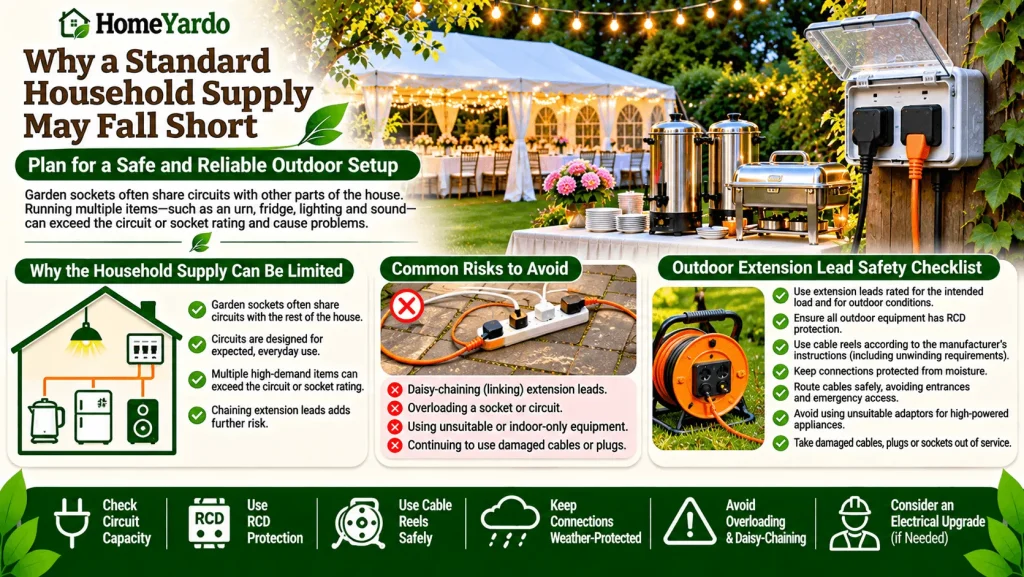
Garden sockets often share circuits with other parts of the house. Those circuits are designed around the property’s electrical installation and its expected use.
Running an urn, fridge, lighting and sound equipment together can create problems if the connected load exceeds the relevant circuit or socket rating.
The tempting fix is a chain of extension leads, but this introduces additional risks.
Electrical Safety First recommends using outdoor-rated electrical equipment, protecting outdoor installations with an RCD and avoiding extension leads connected to other extension leads.
Older properties may need more attention, and an electrical upgrade is worth considering if the existing installation cannot safely support the intended demand.
Outdoor Extension Lead Safety
Before the event, check that:
- Extension leads are rated for their intended load and outdoor conditions.
- All outdoor equipment has appropriate RCD protection.
- Cable reels are used according to manufacturer instructions, including unwinding requirements.
- Connections are protected from moisture.
- Cables do not obstruct entrances or emergency access.
- High-powered appliances are not connected through unsuitable adaptors.
- Damaged cables, plugs or sockets are taken out of service.
Never assume that multiple available sockets automatically mean enough electrical capacity.
If you are unsure, have the installation checked rather than experimenting with different connections.
Temporary Power Options, Including Generator Hire
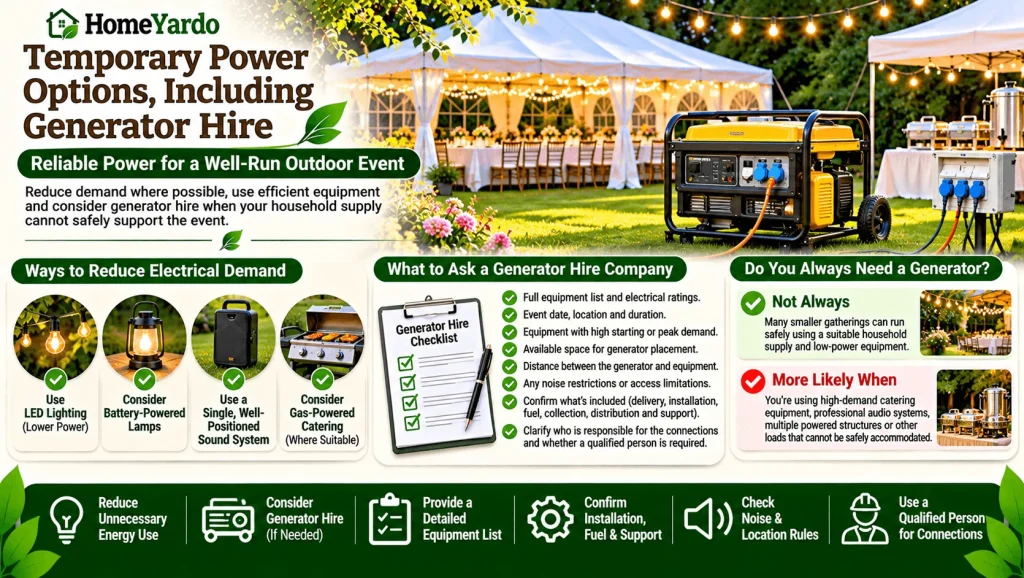
Start by reducing unnecessary electrical demand.
Battery-powered lamps, efficient LED lighting and a single well-positioned sound system can reduce the amount of equipment that needs mains electricity.
For catering, consider whether food can be prepared indoors or whether suitable gas-powered equipment is practical and permitted.
If the remaining demand cannot be safely supported by the household supply, temporary power may be appropriate.
The HSE provides guidance on electrical planning for events, including temporary installations, generator use and safe access to electrical equipment.
Specialists offering generator hire across the UK can provide temporary units for different event requirements. A supplier may ask for your equipment list before recommending an appropriate generator and distribution arrangement.
What Should You Ask a Generator Hire Company?
Before booking, provide the supplier with:
- The full equipment list and electrical ratings.
- The date, location and expected duration of the event.
- Any equipment with high starting or peak demand.
- The available space for generator placement.
- The distance between the generator and equipment.
- Any noise restrictions or access limitations.
Ask whether delivery, installation, fuel, collection, distribution equipment and technical support are included.
Also confirm who is responsible for connecting the equipment and whether a suitably qualified person is required.
Is Generator Hire Necessary for Every Outdoor Party?
No. Many smaller gatherings can operate safely using an appropriate existing household supply and low-power equipment.
Temporary generation becomes more relevant when the event includes substantial catering equipment, professional audio systems, multiple powered structures or other loads that cannot be safely accommodated.
The choice should be based on the actual electrical requirements, not simply the number of guests.
Placement, Noise and Safety Checks
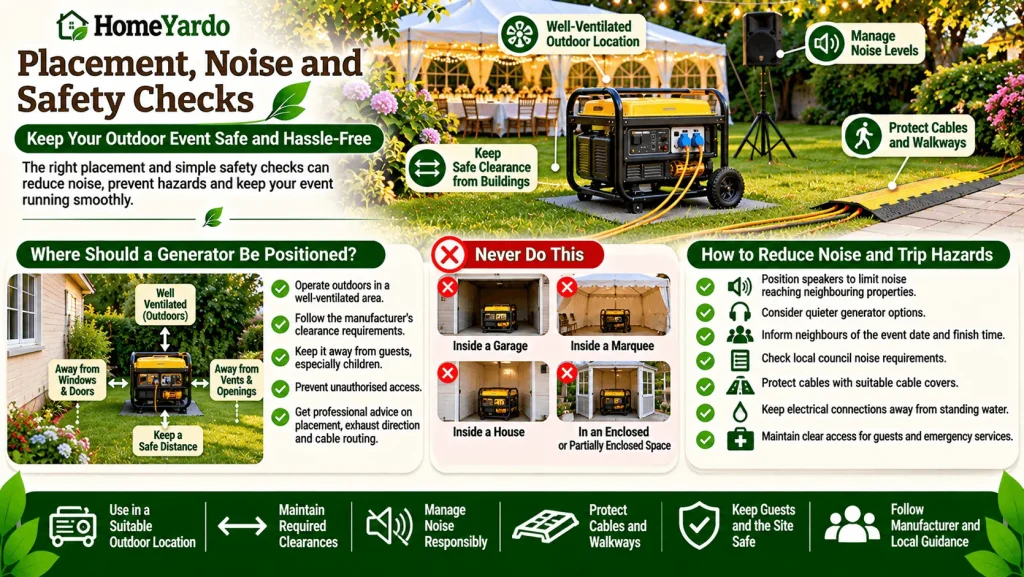
Where temporary equipment sits matters as much as its capacity.
Generators introduce exhaust emissions, noise, hot surfaces, electrical hazards and potential fuel-handling risks.
Where Should a Generator Be Positioned?
A fuel-powered generator must operate outdoors in a suitable, well-ventilated location.
Follow the manufacturer’s required clearances from buildings, doors, windows, vents and other openings. Generator exhaust contains carbon monoxide, which can enter buildings and cause serious poisoning.
Keep the equipment away from guests, particularly children, and prevent unauthorised access.
Never operate a generator inside a house, garage, marquee, enclosed porch or other enclosed or partially enclosed space.
A professional supplier should advise on suitable placement, exhaust direction, cable routing and operating requirements.
How Can You Reduce Noise and Trip Hazards?
Small details can prevent unnecessary disruption.
- Position speakers to limit noise reaching neighbouring properties.
- Consider quieter generator options where available.
- Inform neighbours of the event date and expected finish time.
- Check local council noise requirements.
- Protect cables crossing walkways with suitable cable covers.
- Keep electrical connections away from standing water.
- Maintain clear access for guests and emergency services.
Avoid placing temporary equipment where it blocks gates, driveways or important walking routes.
Plan for Unexpected Weather and Power Problems
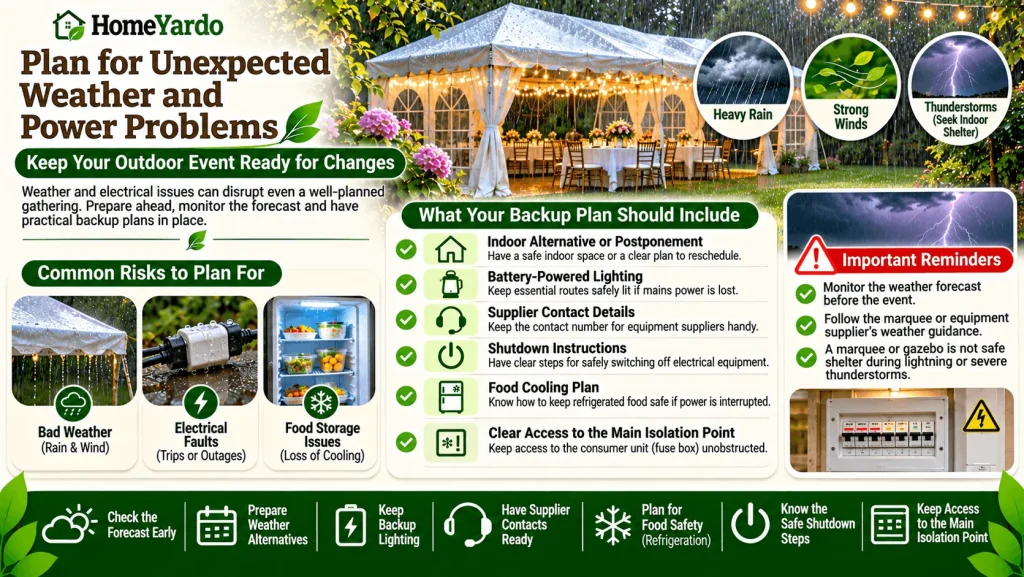
Even a carefully organised outdoor event can face last-minute changes.
Strong winds, heavy rainfall and electrical faults can affect temporary structures and equipment.
Monitor the forecast before the gathering and follow the marquee or equipment supplier’s guidance on safe weather limits.
A marquee or gazebo should never be treated as safe shelter during lightning or severe thunderstorms.
What Should Your Backup Plan Include?
Prepare for common disruptions by arranging:
- A safe indoor alternative or postponement plan for severe weather.
- Battery-powered lighting for essential routes.
- A contact number for equipment suppliers.
- Clear instructions for safely shutting down electrical equipment.
- A suitable plan for refrigerated food if power is interrupted.
- Unobstructed access to the main electrical isolation point.
If a breaker trips repeatedly, disconnect the affected equipment safely and seek qualified help. Do not repeatedly reset it without identifying the cause.
If food refrigeration fails, follow food-safety guidance rather than assuming chilled food remains safe indefinitely.
A Practical Checklist Before Guests Arrive
A short equipment and site inspection can help identify issues before the gathering begins.
| When | What to Check |
|---|---|
| 2–3 weeks before | Confirm guest numbers, layout, hire equipment and electrical requirements |
| 1 week before | Review weather plans, supplier arrangements and any local restrictions |
| 1–2 days before | Inspect seating, pathways, lighting and equipment setup |
| Event day | Check cable protection, access routes, equipment operation and emergency arrangements |
| After the event | Arrange safe disconnection, collection and removal of temporary equipment |
For larger or more complex installations, arrange commissioning and safety checks with the appropriate supplier or qualified professional.
Do not attempt electrical installation or generator connections beyond your competence.
Final Takeaway
The practical side of hosting a large garden gathering comes down to planning what the space and equipment can safely support.
Comfortable seating, shelter, catering and lighting matter, but reliable electrical arrangements are just as important.
Walk through the garden ahead of time, list every item that requires power and speak to suppliers before making assumptions about the capacity of household sockets.
If temporary generation is necessary, arrange professional advice on equipment sizing, placement and safe operation.
The best-run events rarely look heavily planned. The music plays, the lights work, guests move comfortably between areas and the host gets to enjoy the occasion.
FAQ’s
Start with the guest count, available garden space and event activities. Arrange seating, shelter, food stations, lighting and clear pathways. Check electrical requirements and create a backup plan for poor weather before hiring equipment.
It depends on the equipment being used. Small LED lighting and modest sound systems may require relatively little power, while electric catering appliances and heaters can create much greater demand. Calculate the combined operating load and account for starting or peak requirements.
Yes, provided the existing installation and connections can safely support the equipment. Check socket and circuit ratings, use suitable outdoor equipment and ensure appropriate RCD protection. Seek qualified electrical advice when larger loads are involved.
Not necessarily. A generator may be useful when the household supply cannot safely accommodate the required equipment or when temporary power is needed away from existing connections. Equipment demand should determine the choice.
A fuel-powered generator should be placed outdoors in a properly ventilated area, away from doors, windows, vents and occupied spaces. Follow manufacturer clearances and professional installation guidance. Never operate one inside a marquee, garage or other enclosed space.
Use equipment suitable for outdoor conditions, check cable ratings and provide appropriate RCD protection. Keep electrical connections protected from moisture, avoid overloaded extension leads and ensure pathways remain free of trip hazards.
Follow the weather forecast and use suitable weather protection for normal conditions. If severe weather, lightning or unsafe winds are expected, move guests to a safe indoor location or postpone the event. Disconnect exposed electrical equipment when necessary and safe to do so.