Zoysia Sod vs. St. Augustine Sod: Which Lawn Is Right for You?
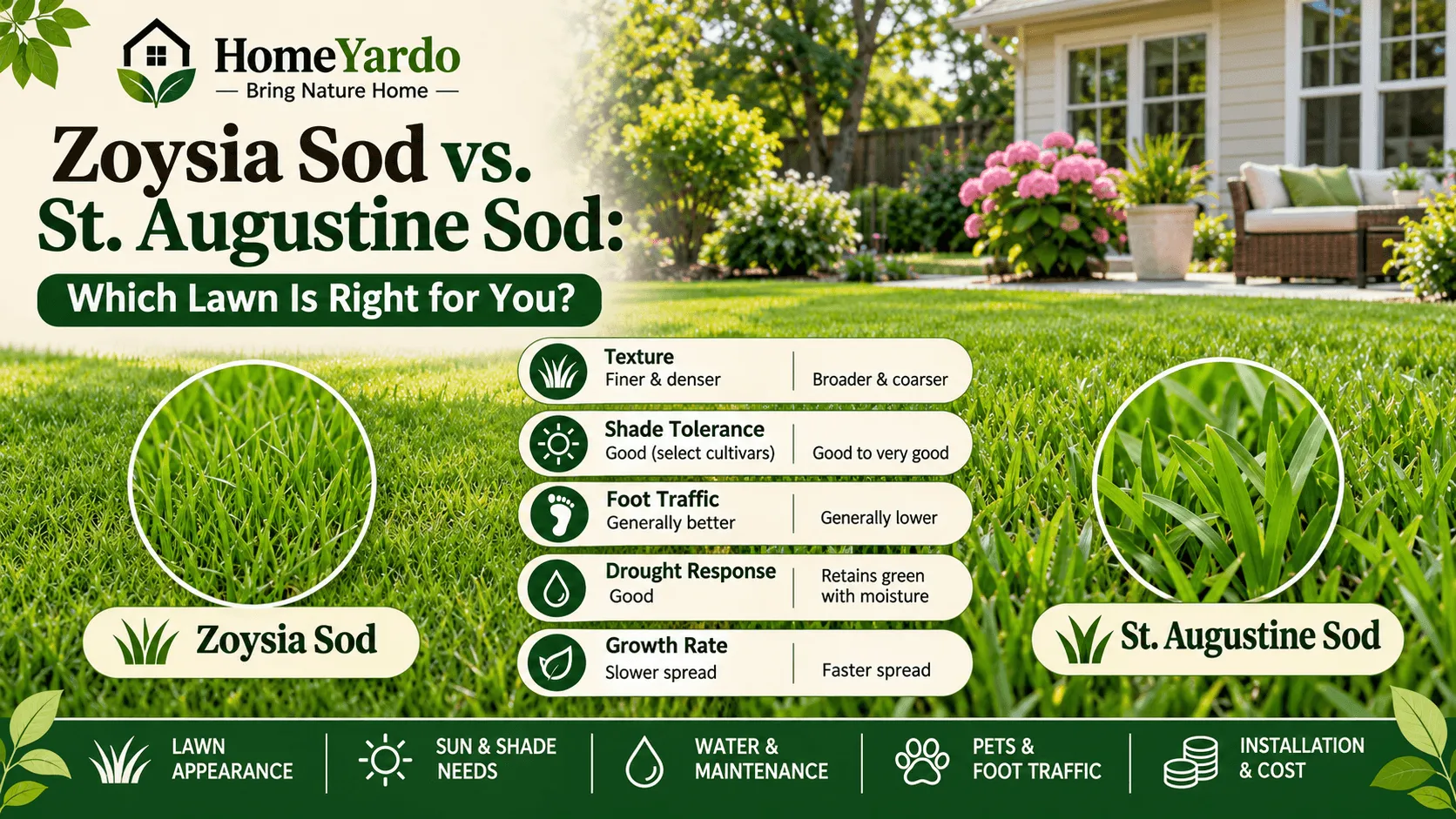
Zoysia sod vs St. Augustine sod is a common comparison for homeowners choosing a new warm-season lawn. Both grasses create dense, attractive turf, but they differ in blade texture, shade performance, foot traffic tolerance, growth rate, and ongoing maintenance.
Zoysia is often better suited to active lawns that need stronger wear tolerance, while St. Augustine appeals to homeowners who prefer broader, lush-looking blades and relatively fast lateral growth. However, neither grass is automatically better for every climate or yard.
Before ordering sod or scheduling installation, consider your lawn’s sunlight, soil conditions, drainage, daily use, and the grass cultivar available locally.
Zoysia Sod vs. St. Augustine Sod: Quick Comparison
The main difference is how each grass responds to everyday lawn conditions. Zoysia generally offers denser, more wear-tolerant turf, while St. Augustine offers a coarser appearance and good shade performance in suitable varieties.
| Feature | Zoysia Sod | St. Augustine Sod |
|---|---|---|
| Grass type | Warm-season | Warm-season |
| Blade texture | Fine to medium or coarse, depending on cultivar | Generally broad and coarse |
| Appearance | Dense, carpet-like turf | Lush, broad-leaf lawn |
| Sun requirements | Full sun to partial shade | Full sun to partial shade |
| Shade tolerance | Good in selected cultivars | Good to very good in selected cultivars |
| Foot traffic | Generally better | Generally lower |
| Drought response | Good survival in suitable conditions; may brown during stress | Can retain green color well but also needs moisture |
| Establishment | Slower lateral spread | Generally faster lateral spread |
| Mowing | Height and frequency vary by cultivar | Usually maintained at a taller height |
| Maintenance | May need thatch and disease management | Needs attention to pests, mowing, and diseases |
| Best suited for | Active lawns and dense turf preferences | Warm-climate lawns where appearance and shade suitability matter |
These characteristics describe general tendencies rather than guaranteed results. Local climate, soil preparation, irrigation, and cultivar selection can change how either lawn performs.
What Zoysia Sod Gives You in a Real Yard
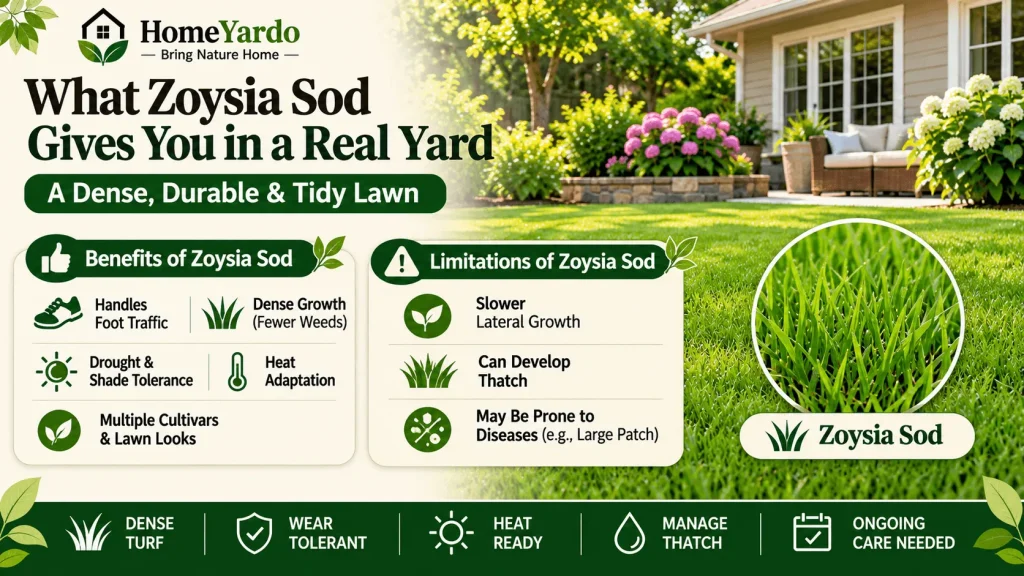
Zoysia sod is often chosen by homeowners who want a dense lawn with a tidy, uniform appearance. Its growth habit can form a closely packed turf canopy, which helps limit opportunities for weeds after successful establishment.
Many Zoysia varieties have relatively narrow blades, although texture varies considerably among cultivars. The finished lawn can feel firm and carpet-like underfoot, making it appealing for backyard recreation and landscaped areas.
Benefits of Zoysia Sod
Zoysia offers several practical advantages when grown in a suitable location:
- Good tolerance of moderate foot traffic and recreational use.
- dense growth that can help resist weed invasion.
- Several cultivars with useful drought and shade tolerance.
- Good heat adaptation during active summer growth.
- A range of blade textures and lawn appearances.
Its wear tolerance makes Zoysia particularly attractive for yards where children play, pets spend time outdoors, or people regularly walk across the grass.
Limitations of Zoysia Sod
The biggest tradeoff is usually its relatively slow lateral growth. Although newly installed sod provides immediate surface coverage, developing strong roots and repairing damaged areas still takes time.
Zoysia can also develop thatch problems under certain management conditions. Some cultivars require careful mowing, and diseases such as large patch can affect turf during favorable weather.
It should not be treated as maintenance-free grass. Irrigation, fertilization, proper cutting height, and seasonal monitoring remain necessary.
Where St. Augustine Sod Usually Performs Better
St. Augustine sod is a popular warm-season option in Florida and other warm, humid regions. Its broad blades and spreading growth habit create the full, lush appearance many homeowners associate with established Southern lawns.
Unlike Zoysia, St. Augustine spreads through aboveground stolons rather than both stolons and rhizomes. Its relatively fast lateral growth can help it occupy suitable open spaces during the active growing season.
Benefits of St. Augustine Sod
St. Augustine offers several advantages for the right property:
- A broad-bladed, full lawn appearance.
- Good shade tolerance in appropriately selected cultivars.
- Strong adaptation to warm, humid environments.
- Relatively fast lateral growth in favorable conditions.
- A choice of cultivars suited to different lawn needs.
Some St. Augustine varieties can maintain acceptable turf quality where direct sunlight is limited, although consistently heavy shade remains challenging.
Limitations of St. Augustine Sod
St. Augustine has comparatively poor tolerance of repeated wear and soil compaction. Concentrated dog traffic, heavily used walking routes, or equipment movement can damage the lawn.
It may also require frequent mowing during peak growth. Chinch bugs, gray leaf spot, and other turf problems can affect susceptible lawns, particularly when moisture, fertility, or site conditions are poorly managed.
The grass is also more sensitive to severe winter cold than many Zoysia cultivars. Regional suitability should therefore be considered before installation.
How Sunlight and Shade Should Guide Your Decision
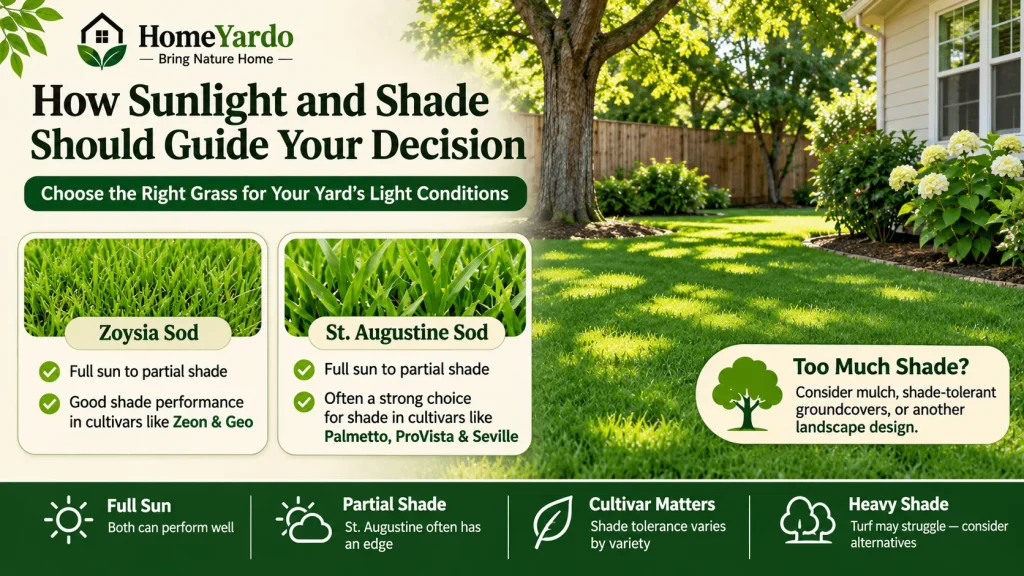
Light exposure is one of the most important considerations when comparing these grasses. A lawn that receives strong morning and afternoon sun faces very different growing conditions from a shaded side yard beneath mature trees.
Both grasses can perform well in full sun, but shade tolerance varies significantly among individual cultivars.
Which Grass Is Better for Shady Yards?
St. Augustine is often a good option for partially shaded lawns, particularly when choosing shade-tolerant varieties such as Palmetto, ProVista, or Seville.
However, some fine-textured Zoysia cultivars, including Zeon and Geo, also have strong shade performance. It would be misleading to assume that every St. Augustine variety tolerates shade better than every Zoysia variety.
If you’re evaluating St. Augustine varieties specifically, a guide to ProVista St. Augustine sod can help you understand how a more specialized cultivar fits into Florida lawn planning, especially where weed pressure and visual uniformity matter.
Before making a final choice, observe how many hours of usable sunlight reach the grass throughout the day. Check conditions beneath trees, beside fences, and near structures rather than relying on how bright the yard appears overall.
Areas with persistent heavy shade may be better suited to mulch, shade-adapted groundcovers, or a different landscape design instead of turfgrass.
Water, Mowing, and Maintenance Over a Full Season
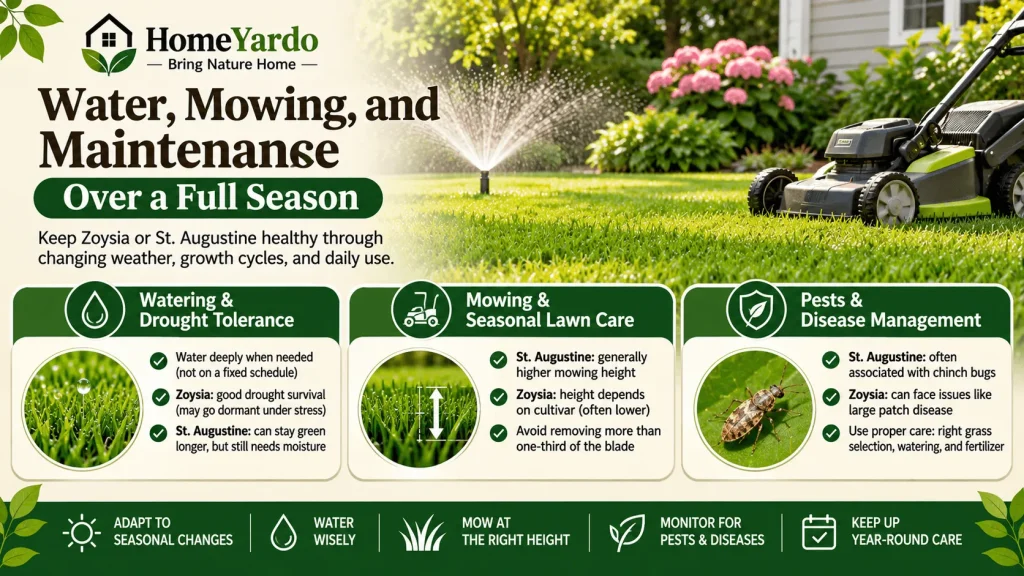
The best lawn is not necessarily the one that looks most attractive immediately after installation. It is the one you can maintain successfully through summer heat, rainfall changes, dormancy, and periods of heavy growth.
Both grasses need suitable irrigation and mowing practices to remain healthy.
Watering and Drought Tolerance
Zoysia is valued for its ability to survive dry conditions in suitable environments, although some varieties may enter dormancy or lose green color when moisture is limited.
St. Augustine can sometimes retain its green appearance longer during drought stress, but extended dry conditions can also cause serious damage.
Neither grass should be watered on a fixed schedule without considering rainfall, soil moisture, and signs of stress.
For established turf, watering deeply when needed is generally preferable to repeated shallow applications, provided soil drainage and local water restrictions permit it.
Mowing and Seasonal Lawn Care
St. Augustine commonly needs a higher mowing height than many Zoysia varieties. Rapid summer growth may also mean mowing more frequently.
Zoysia mowing requirements depend on the cultivar. Some fine-textured varieties perform best with relatively low mowing heights and appropriate equipment, while coarser varieties may be maintained higher.
For either grass, avoid removing more than one-third of the leaf blade in a single mowing session. Excessively short cutting can weaken turf, expose soil, and make the lawn more vulnerable to stress.
Lawn Pests and Disease Management
St. Augustine lawns are particularly associated with southern chinch bug problems. Zoysia can experience different insect and fungal issues, including large patch disease.
Healthy turf begins with suitable grass selection, correct watering, appropriate fertilizer applications, and early identification of damage.
For an example of pest-related lawn damage and practical prevention, see HomeYardo’s guide to chinch bug signs.
Traffic, Pets, and How Each Lawn Handles Wear
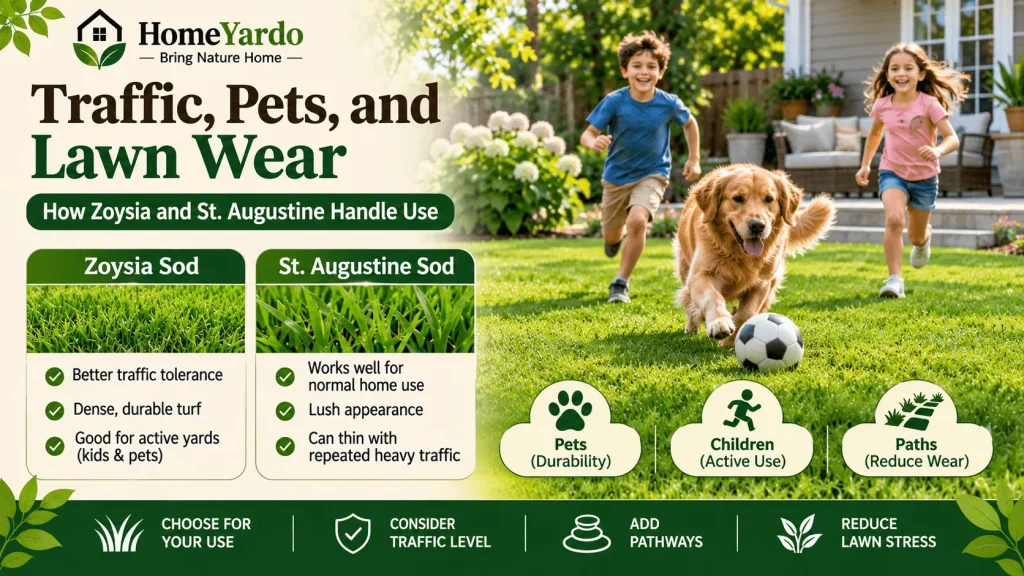
If your yard is more than a display space, wear tolerance deserves serious attention. Zoysia usually performs better under repeated foot traffic because of its dense, resilient turf structure. Kids cutting the same path to a trampoline, dogs pacing the fence line, or regular patio overflow into the lawn are all scenarios where Zoysia often holds up better.
St. Augustine can still function well in active yards, but its broader blades and growth pattern can show thinning or rutting more quickly in concentrated-use areas. Recovery depends on growing conditions, irrigation, and how severe the wear is. In consistently compacted zones, neither grass will thrive without aeration and traffic management.
Think about how people actually move across your lawn. If use is spread out, both can work. If the yard has obvious repeated routes, Zoysia often gives you more durability.
Which Sod Is Better for Dogs and Children?
Zoysia is usually the stronger choice when lawn durability is the main concern.
However, no living grass can withstand unlimited traffic. Dogs running along fences, repeated digging, and heavily compacted soil can damage either turf type.
If your property has predictable high-traffic routes, consider adding stepping stones, a pathway, or another durable landscape surface.
For broader yard planning, HomeYardo’s low-maintenance backyard landscaping ideas explain how planting areas and hardscaping can reduce ongoing upkeep.
Zoysia Sod vs. St. Augustine Sod: Installation and Cost Considerations
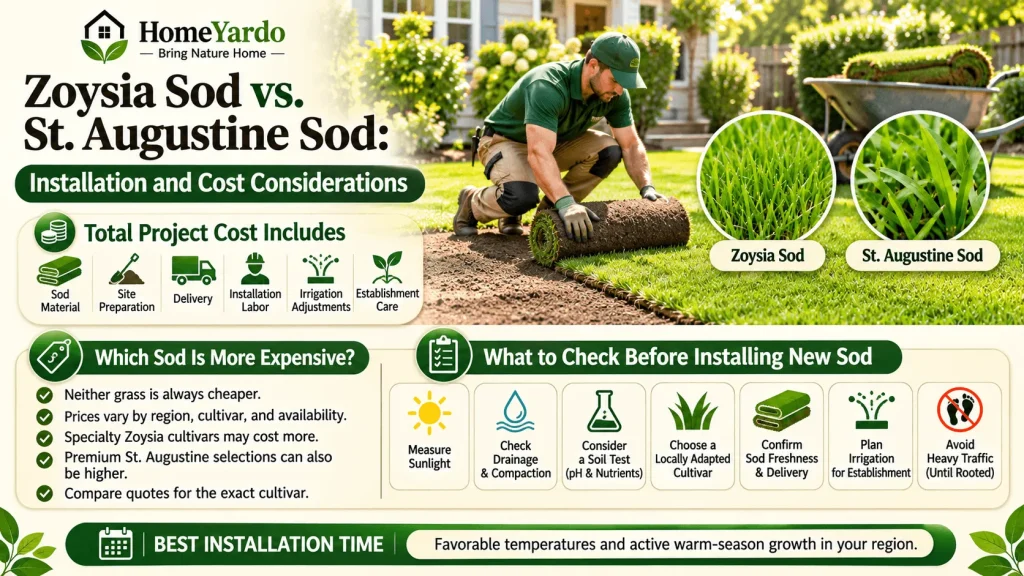
Choosing the wrong grass can become expensive because sod installation involves more than buying grass by the pallet.
Total project cost includes sod material, site preparation, delivery, installation labor, irrigation adjustments, and establishment care.
Which Sod Is More Expensive?
Neither Zoysia nor St. Augustine is always the cheaper option. Prices vary by region, cultivar, turf farm, availability, and order size.
Some specialty Zoysia cultivars may cost more than commonly available St. Augustine varieties. Premium St. Augustine selections can also command higher prices.
When comparing supplier quotes, request pricing for the exact cultivar rather than assuming all Zoysia or St. Augustine sod is equivalent.
What to Check Before Installing New Sod
Proper site preparation gives either grass a better chance of establishing successfully.
Before installation:
- Measure sunlight across the intended lawn area.
- Check drainage and identify compacted soil.
- Consider a soil test for nutrient and pH guidance.
- Select a locally adapted grass cultivar.
- Confirm sod freshness and delivery arrangements.
- Prepare an irrigation plan for establishment.
- Avoid heavy traffic until the new sod has rooted adequately.
The best installation period generally coincides with favorable temperatures and active warm-season growth. Local weather conditions matter more than choosing a single planting date for every region.
The Cost of Getting the Choice Wrong
A sod decision has long-term consequences because replacing an unsuitable lawn requires additional money, labor, and maintenance.
Grass that struggles with insufficient sunlight may thin gradually, leaving open areas vulnerable to weeds and erosion. Turf exposed to more traffic than it can tolerate may require repeated repairs.
Poorly matched irrigation schedules can create another problem. Excess water may contribute to disease, while insufficient moisture can weaken grass during establishment and hot weather.
Rather than choosing sod solely because a neighbor has an attractive lawn, evaluate your property’s specific conditions.
Final Takeaway: Which Sod Should You Choose?
Choose Zoysia sod if your yard receives adequate sunlight, experiences regular foot traffic, and would benefit from a dense lawn with good wear tolerance.
Choose St. Augustine sod if you want a broad-bladed, lush appearance and live in a climate where an appropriate cultivar can perform well in your lawn’s sunlight conditions.
For partially shaded areas, compare specific cultivars instead of relying only on the grass species. Both groups include varieties with useful shade tolerance.
The right lawn is the grass that matches your climate, property conditions, maintenance expectations, and everyday use—not simply the one that looks best in a photograph.
FAQ’s
Zoysia is generally better for repeated foot traffic and dense turf coverage, while St. Augustine may be preferable for homeowners seeking broad blades and faster lateral growth. The best choice depends on climate, sunlight, cultivar, and maintenance.
Many St. Augustine cultivars have good shade tolerance, but certain fine-textured Zoysia varieties also perform well under moderate shade. Neither is suitable for consistently dark areas without enough light.
Not necessarily. Drought survival, water demand, and green-color retention are different characteristics. Actual irrigation needs depend on cultivar, soil, weather, and management.
Zoysia generally offers stronger wear tolerance, making it a practical option for many dog-friendly yards. Repeated running, digging, and soil compaction can still damage either grass.
St. Augustine generally spreads laterally faster than many Zoysia cultivars during favorable growing conditions. However, rooting and overall sod establishment depend on moisture, temperature, soil preparation, and turf quality.
Neither grass is universally easier to maintain. Zoysia may require thatch management and cultivar-specific mowing, while St. Augustine can need frequent mowing and monitoring for certain pests and diseases.
Neither grass remains green throughout every season in all climates. Both are warm-season grasses and may become dormant during cooler weather. Color retention varies with temperature, irrigation, cultivar, and fertilization.
Both grasses can grow in the same landscape, but mixing them within one lawn may produce uneven color, texture, mowing requirements, and growth patterns. Separate lawn zones are generally easier to manage.
Both can be suitable for Florida, depending on the location and cultivar. St. Augustine is widely used in the state, while Zoysia is also a practical choice for many properties. Shade, irrigation, drainage, pests, and traffic should guide selection.
The rooting period varies with temperature, soil conditions, watering, and sod quality. New sod may begin rooting within the first few weeks under favorable conditions, but full establishment and resistance to regular traffic take longer.
References and Further Reading
This comparison is supported by university extension guidance on warm-season turfgrass selection and care:
- University of Georgia Cooperative Extension — Lawns in Georgia: Selection and Species
- University of Florida IFAS — Selecting a Turfgrass for Florida Lawns
- University of Florida IFAS — Growing Turfgrass in the Shade
- University of Florida IFAS — Zoysiagrass for Florida Lawns
Grass performance and management recommendations may vary by region. Consult your local Cooperative Extension service for cultivar suitability, irrigation restrictions, and soil-specific guidance.