What Should I Consider When Choosing a Luxury Pergola for My Backyard?
Most people start pergola shopping by looking at photos. That is the natural place to begin, and it is also the reason a lot of backyards end up with a structure that photographs well and gets used twice a summer.
The better starting question is not what a luxury pergola looks like. It is what you want the space underneath it to do. A pergola that shades a morning coffee spot has almost nothing in common with one that has to keep a dining table dry in August, and the decisions that separate those two outcomes get made early, at the roof.
Here is what actually matters, roughly in the order you should think about it.
What Makes A Pergola “Luxury” In The First Place?

Price is the least useful definition. A structure can be expensive because it is large, and still be built from the same components as a kit.
The things that genuinely separate a premium pergola from a budget one are unglamorous:
Extruded aluminum rather than rolled or assembled sheet: Extrusion produces a consistent profile with structural integrity built into the shape of the part. It is the reason a premium frame can span further with fewer posts.
The finish specification: Look for AAMA 2604 powder coating or better. This is an architectural standard covering resistance to fading, chalking and corrosion. It matters enormously near the coast, in strong sun, and anywhere near a pool, and it is the difference between a frame that looks the same in ten years and one that goes chalky in three.
Concealed hardware: Visible screws and brackets are the fastest way to make a structure read as cheap, and exposed fasteners are also where corrosion tends to start.
Engineering documentation: A premium manufacturer can tell you the wind load and snow load their structure is rated for. A budget one usually cannot.
If a quote cannot answer those four questions, the number on the bottom is not telling you much.
Which Roof Type Actually Fits How You Live?

This is the decision that determines everything else, and there are four broad answers.
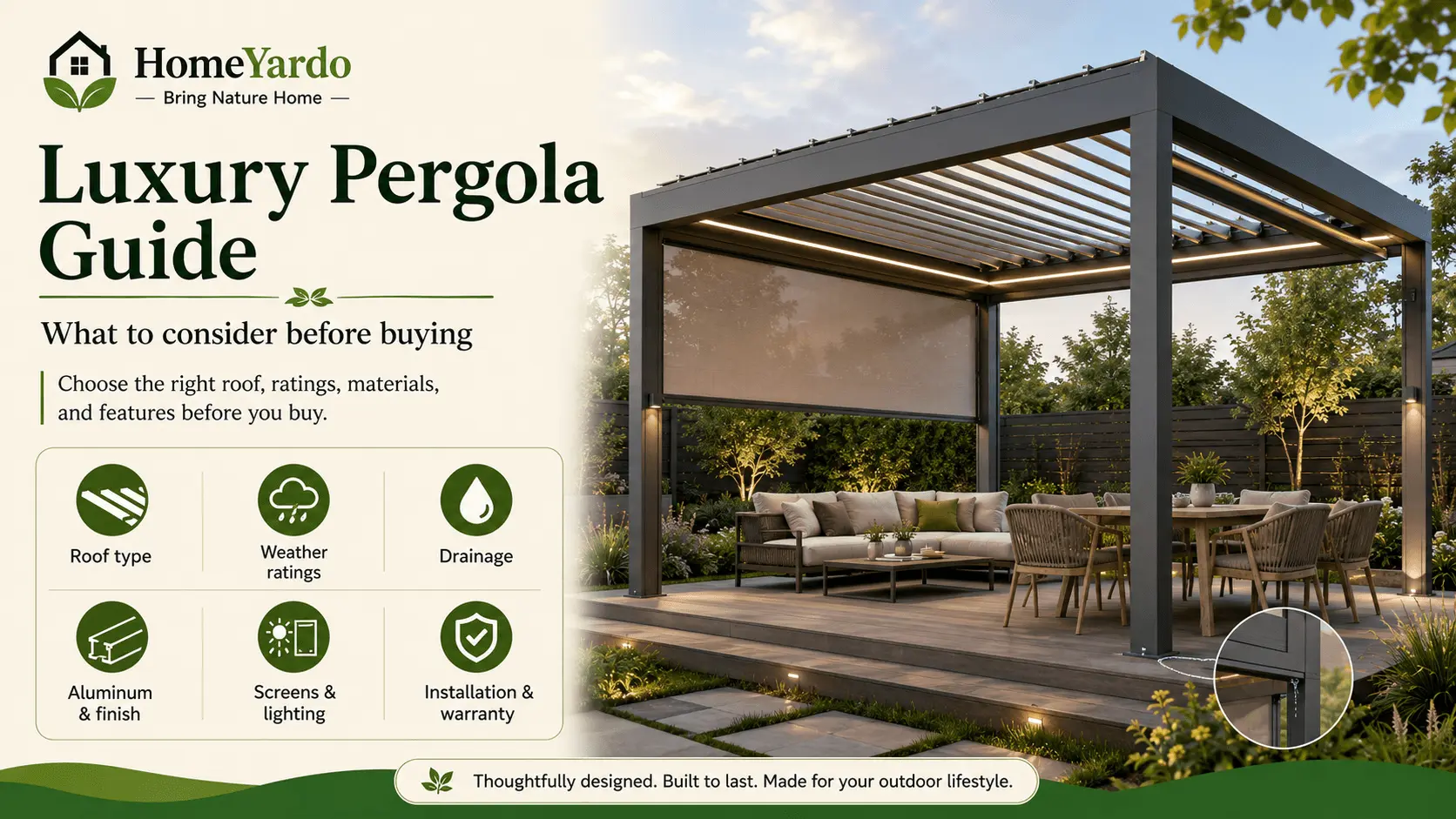
Motorized louvered roofs use aluminum blades that rotate, usually up to 90 degrees. Open them for filtered light and airflow, close them for a solid overhead cover that channels rain into the frame. This is the most versatile option and the most expensive, and it is the only type that genuinely changes function at the touch of a button. Premium versions add sensors that close the roof automatically when it starts raining.
Retractable fabric roofs use a motorized canopy that extends or pulls back completely. The appeal is the opposite of a louvered roof: when you retract it, the sky is fully open, with no blades overhead. Fabric quality varies enormously here, so ask what the material actually is. PVC and PC constructions with UV protection behave very differently from acrylic canvas, and the warranty length tells you what the manufacturer believes.
Fixed louvered roofs have stationary blades set at an angle, typically 90 or 55 degrees. No motors, nothing to service, and a strong architectural look. You get permanent filtered shade and airflow, but no rain protection and no adjustment. For a space that mainly needs to be cooler and more defined, this is often the smartest spend.
Manual louvered structures, sometimes sold as cabanas, use a hand crank or lever. Common in fixed sizes such as 10 by 10 or 12 by 12 feet, and they need no electrical supply at all. Genuinely useful poolside, where running power is a nuisance.
Quick Comparison
| Adjusts? | Rain protection | Needs power | Typical use | |
| Motorized louvered | Yes, powered | Yes, when closed | Yes | Year-round outdoor rooms, dining |
| Retractable fabric | Yes, powered | Yes, when extended | Yes | Spaces where open sky matters |
| Fixed louvered | No | No | No | Architectural shade, airflow |
| Manual louvered | Yes, by hand | Limited | No | Poolside, compact spaces |
If you want to see how a single manufacturer’s line breaks along these divisions, Azenco Outdoor’s aluminum pergola comparison lays the four types out side by side, which is a useful way to see the trade-offs even if you end up buying elsewhere.
Will It Survive Your Weather?

This is the question most homeowners skip and most regret skipping.
Ask for the wind load rating in miles per hour and the snow load rating in pounds per square foot. Good manufacturers publish these. As a rough sense of the range, premium motorized louvered systems can be rated to around 190 mph and 100 psf, fixed louvered systems commonly land near 175 mph, and lighter manual structures may be closer to 105 mph and 25 psf. Those are very different products, and the gap explains a lot of the price difference.
If you are in a hurricane region, ask specifically about third-party product approval. In Florida, Miami-Dade County issues a Notice of Acceptance, or NOA, for products reviewed against its criteria, and NOA documentation is recognized well beyond Florida as evidence of serious testing. Ask for the actual NOA number and expiration date, then look it up. A manufacturer who cannot produce one is telling you something.
Two cautions. First, product approval is not project approval. Your foundation, mounting method and site conditions still need review by your local building department. Second, be sceptical of any pergola marketed as hurricane-proof. That is not a thing, and no approval document says it.
What About Drainage?

Water is the detail that separates a structure that ages well from one that annoys you.
Ask where the water goes. On a good system, rain runs off the roof into a gutter integrated into the frame, then down through the inside of the posts and out at the base. Nothing visible, nothing dripping off the perimeter onto your furniture.
Cheaper structures shed water off the edges or bolt on external downspouts. It works, but you will notice it every time it rains, and you will notice it in photographs too.
If you are attaching to the house rather than freestanding, ask specifically about flashing at the wall connection. That junction is the single most common source of problems in attached structures, and it is worth more attention than the color of the frame.
What Should You Add, And What Can Wait?

Most premium systems are modular, so you can add later. Some things are much easier to specify up front.
Specify now: integrated lighting, motorized screens, heaters and fans. All of these are cleaner when they are planned into the structure rather than retrofitted, because the wiring and housings get designed in rather than surface-mounted afterwards. Screens in particular have moved from add-on to integrated on premium systems, which turns a covered space into an enclosable one.
Can wait: furniture, planting, most decorative accessories, and privacy walls in many cases.
On automation, ask what is actually automated. Some systems put the roof, screens and lighting on one control. Others automate only the lighting while the roof runs on a separate remote. Both are fine, but they are not the same product, and the marketing language often blurs them.
The Practical Questions People Forget

Permits. Requirements depend on size, attachment method, foundation and local code. Ask your dealer to be specific about your jurisdiction rather than answering in general terms.
Installation. Premium manufacturers usually sell through certified dealers, and many warranties depend on installation to spec. This is a feature, not a markup. Ask who is physically doing the work and whether they have installed this system before.
Warranty. Ask for the structure and the finish separately, and, for fabric roofs, the fabric on its own. A ten year fabric warranty tells you something useful. So does a manufacturer who will not put one in writing.
Lead time. Made-to-order structures take longer than stocked kits. If you want it usable this season, ask early.
A Simple Way To Decide
Answer these four in order and the field narrows quickly.
- Do you need rain protection, or only shade? If rain, you are choosing between motorized louvers and retractable fabric. If shade only, fixed louvers save you a great deal of money and all future maintenance.
- Does the sky matter? If having the space fully open overhead matters to you, retractable fabric. If you would rather have a solid roof when closed, louvers.
- What does your weather demand? Get the wind and snow numbers, and product approval documentation if you are on a coast.
- How large is the space? Larger spans push you toward premium extruded systems and multi-zone layouts. Compact spaces are often better served by a smaller, simpler structure done well.
A pergola is a piece of architecture attached to your house, not a piece of furniture. Choose the roof for how you will actually use the space, insist on the engineering numbers, and the aesthetic decisions become much easier, because at that point you are only choosing a color.
If you’re also deciding how a pergola fits into your outdoor space, our guide to porch vs patio can help you compare the two types of outdoor living areas.
FAQ’s
A motorized louvered pergola has aluminum blades that rotate on demand, letting you switch between filtered light, full airflow and a closed roof that sheds rain. A fixed louvered pergola has stationary blades that provide permanent filtered shade and airflow but do not adjust and do not offer rain protection.
For most homeowners, yes, on maintenance. Aluminum does not rot, warp or need refinishing, and a quality powder-coated finish resists fading and corrosion. Wood offers a warmth some people prefer, but it needs ongoing upkeep that aluminum does not.
Often, but it depends on size, whether it is attached to the house, foundation requirements and local code. Check with your local building department or ask your dealer to confirm for your specific jurisdiction.
It varies enormously by construction. Premium engineered aluminum systems can be rated to around 190 mph, while lighter manual structures may be rated closer to 105 mph. Always ask for the published rating rather than a general claim of wind resistance.
Usually yes, but integrated screens designed into the structure look considerably cleaner than retrofitted ones, because the housings and tracks are planned as part of the frame. If screens are likely, it is worth specifying them up front.
It depends on the fabric and how the manufacturer describes it. Some are genuinely waterproof, others are water resistant and intended for light rain. Ask for the specific term the manufacturer uses in writing, since it is a meaningful difference.
An extruded aluminum structure with an architectural-grade powder coat should last decades with routine cleaning. Motors, sensors and fabric components have shorter service lives, which is why warranty terms on those parts are worth reading closely.