How California Property Managers Can Reduce Mosquito Breeding Around Shared Outdoor Areas
Mosquito complaints often increase when warm weather arrives. Residents may notice bites around courtyards, pool decks, landscaped entrances, patios, or lawns near sprinkler systems. For a property manager, however, the visible mosquitoes are only part of the problem.
The source may be somewhere else entirely.
A clogged drain, leaking irrigation valve, planter saucer, neglected pool cover, or inactive fountain can hold enough standing water for mosquitoes to develop. Because these sources are often located in shared areas, treating one apartment patio rarely solves a property-wide problem.
Quick Answer: How Can Property Managers Reduce Mosquito Breeding?
California property managers can reduce mosquito breeding by routinely inspecting shared outdoor areas and eliminating standing water wherever possible.
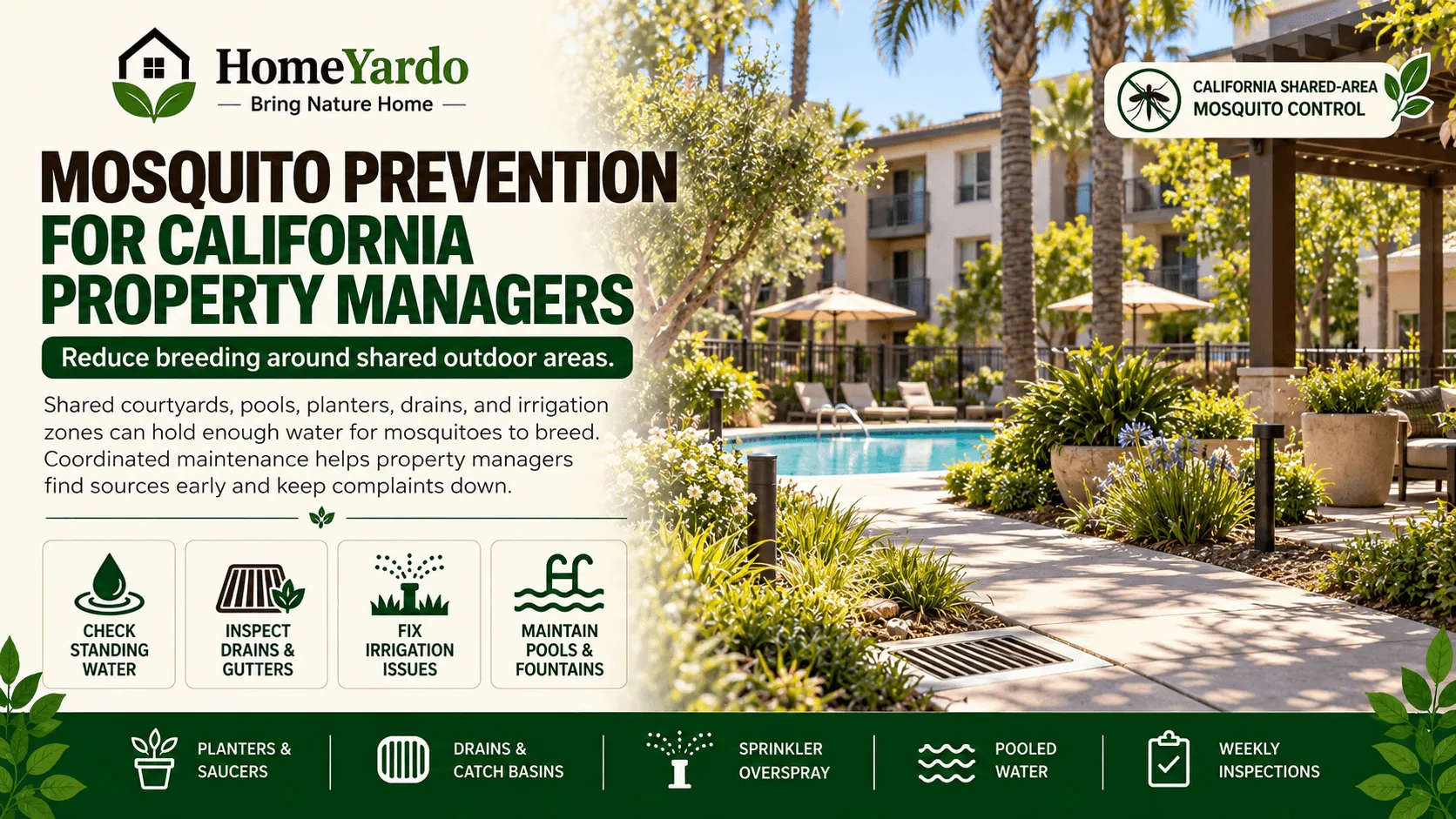
Priority areas include:
- drains and catch basins;
- irrigation systems and valve boxes;
- planters and saucers;
- fountains and ornamental water features;
- swimming pools and spas;
- gutters and downspouts;
- maintenance and storage areas;
- trash and recycling areas; and
- low spots where irrigation or rainwater repeatedly collects.
Source reduction should come first. Fix leaks, improve drainage, remove unnecessary containers, maintain pools and water features, and establish a regular inspection schedule.
Resident communication and professional mosquito-control assistance can support that work when a problem continues.
Why Shared Properties Can Become Mosquito Breeding Sites
Mosquitoes require water during the immature stages of their life cycle. Depending on the species, eggs may be deposited on or near water, while larvae and pupae develop in aquatic environments.
That makes shared residential properties particularly important to inspect.
Courtyards may contain pots, decorative containers, drains, fountains, and low areas in paving. Irrigation systems can create puddles through leaking valves, broken sprinkler heads, overspray, or excessive watering.
Gutters and catch basins may retain water when leaves and other debris restrict drainage.
Maintenance areas create another set of potential sources. Buckets, wheelbarrows, tarps, discarded containers, equipment, and other items can collect rain or irrigation water without attracting much attention.
Pools and water features also require care. A properly maintained swimming pool is very different from a neglected pool, stagnant fountain, or cover holding rainwater.
The common factor is not the size of the feature. It is water remaining long enough for mosquito development.
Why California Properties Need a Coordinated Approach
Mosquitoes occur throughout California, although species, activity levels, and seasonal patterns differ by region.
Property managers should also be aware of invasive Aedes mosquitoes. These mosquitoes can use small artificial containers around homes and buildings and may bite during the daytime.
That changes how a property should be inspected.
A large pond or obvious puddle should not receive all the attention while smaller sources around patios, landscaped areas, storage spaces, and irrigation equipment go unnoticed.
Residents frequently ask are there mosquitoes in california when biting activity increases. The simple answer is yes, but the more useful management question is where mosquitoes may be developing on or around the property.
A coordinated inspection of shared spaces helps answer that question.
Why Source Reduction Works Better Than Unit-by-Unit Treatment
Mosquito management should start with the source whenever practical.
Treating one patio may temporarily reduce adult mosquitoes in that small area. It does not correct a leaking sprinkler, clogged drain, stagnant fountain, or water-filled container elsewhere on the property.
This is especially relevant in multifamily housing, where responsibility for outdoor maintenance may be divided among property staff, landscapers, pool contractors, irrigation technicians, and residents.
Without a shared procedure, one team may assume another team is checking a problem area.
Property managers can reduce those gaps by assigning responsibility for each part of the grounds.
For example:
| Area | What to Check | Possible Action |
|---|---|---|
| Landscaping | Planters, saucers, irrigation leaks | Drain containers and repair watering problems |
| Courtyards | Drains, fountains, decorative containers | Clear drains and maintain water circulation |
| Pool area | Pool water, spa systems, covers | Maintain circulation and remove pooled cover water |
| Roofline | Gutters and downspouts | Remove debris and correct poor drainage |
| Maintenance yard | Buckets, tarps, tires, equipment | Empty, remove, cover, or store properly |
| Lawn and beds | Persistent puddles and saturated soil | Adjust irrigation and investigate drainage |
| Trash areas | Open containers and discarded items | Remove water-holding debris |
The aim is to make mosquito prevention part of ordinary property maintenance rather than waiting for complaints.
Set Up a Routine Mosquito Inspection
A repeatable property walk is one of the simplest ways to catch water problems early.
During periods of active mosquito complaints or warm weather, shared outdoor areas should be checked regularly. Inspections are also useful after rainfall, irrigation problems, landscape work, or plumbing leaks.
The inspection does not need to be complicated.
Check Planters and Decorative Containers
Look underneath pots as well as inside them.
Plant saucers, decorative bowls, buckets, watering cans, toys, and other containers may hold water even when the surrounding area appears dry.
Empty unnecessary water and correct the condition that allows it to return.
Where saucers or containers must remain, include them in the property’s regular maintenance routine rather than assuming residents will notice them.
Inspect Drains, Catch Basins, Gutters, and Downspouts
Drainage infrastructure deserves close attention because standing water may be partly hidden.
Remove leaves, sediment, and other debris that prevent water from moving through accessible drains and gutters.
If the same location remains wet or clogged after repeated cleaning, investigate the underlying drainage problem instead of treating each puddle as an isolated event.
Persistent standing water may indicate grading, drainage, or runoff problems that need a larger repair.
Inspect Irrigation Systems While They Are Running
A sprinkler system can look fine when it is switched off.
Run each irrigation zone and watch what happens.
Look for:
- broken or tilted sprinkler heads;
- water spraying onto pavement;
- leaking valves;
- wet irrigation boxes;
- overspray against buildings;
- unusually saturated planting beds; and
- puddles that remain after watering.
Reducing unnecessary watering can help, but do not simply shorten every irrigation cycle without considering plant needs.
Correct the specific source of excess water.
Check Pools, Spas, and Water Features
Properly maintained pools and spas should have appropriate circulation, sanitation, and routine servicing.
Problems are more likely to arise when a pool is neglected, a fountain is switched off for an extended period, or water collects on covers and surrounding equipment.
Include decorative ponds and fountains in the inspection even when they are primarily ornamental.
If a water feature will remain unused, determine whether it should be drained or maintained differently rather than leaving stagnant water in place.
Walk Maintenance and Storage Areas
Back-of-house areas are easy to overlook because residents rarely see them.
Check:
- buckets;
- wheelbarrows;
- tarps;
- discarded pots;
- tires;
- maintenance equipment;
- open bins;
- construction materials; and
- anything else capable of retaining water.
Store movable items under cover or turn them over when practical.
Fix Drainage and Irrigation Problems at the Source
Repeated standing water usually tells you something about the property.
If the same lawn edge, planter, courtyard corner, or paved area remains wet week after week, repeatedly removing the water is not a long-term solution.
Identify why it returns.
Possible causes include:
- poor grading;
- compacted soil;
- blocked drains;
- damaged underground drainage;
- excessive irrigation;
- leaking pipes or valves;
- incorrectly positioned sprinkler heads; or
- concentrated roof runoff.
HomeYardo’s guide to fixing yard drainage explains how grading, drainage systems, soil conditions, and runoff can contribute to recurring standing water.
Irrigation deserves the same attention.
Efficient watering should supply plants without routinely flooding sidewalks, valve boxes, planting beds, or low areas. Properties with recurring irrigation problems may need schedule adjustments, nozzle corrections, leak repairs, or professional system evaluation.
For broader landscape planning, HomeYardo’s guide to low-maintenance backyard landscaping also explains how drainage and efficient irrigation can reduce recurring outdoor maintenance problems.
Keep a Mosquito Inspection Log
Documentation makes a routine inspection much more useful.
Create a simple property map and mark locations where standing water or mosquito activity has been reported.
For each inspection, record:
- date;
- location;
- type of water source;
- likely cause;
- action taken;
- person or contractor responsible;
- follow-up date; and
- whether the problem returned.
Photographs can help track recurring trouble spots.
A drain that clogs every few weeks, for example, may need more than another cleaning. A planter bed that remains saturated after every irrigation cycle may point to a watering or drainage issue.
Over time, the inspection log helps management distinguish one-time problems from recurring maintenance failures.
What If Standing Water Cannot Be Removed?
Not every water source can simply be dumped out.
Stormwater infrastructure, ornamental ponds, retention features, and other permanent systems may need to hold water as part of their design.
In those cases, avoid improvising pesticide or larvicide treatments.
The appropriate response depends on the type of water feature, mosquito species, product labeling, environmental conditions, and local requirements.
A licensed pest-management professional or local mosquito and vector control agency can help determine whether treatment is appropriate and how the feature should be managed.
Physical maintenance and source correction should still remain part of the plan whenever possible.
Work With Residents Without Shifting the Entire Burden to Them
Residents can help identify mosquito sources, but common-area maintenance remains a management issue.
Give residents short, practical instructions rather than lengthy warnings.
Ask them to:
- empty water from containers on patios and balconies;
- avoid leaving buckets and other water-holding items outside;
- report irrigation leaks;
- report persistent standing water;
- maintain accessible private patio areas; and
- report unusual mosquito activity.
Management should provide an easy reporting channel and respond to reports quickly.
A complaint about mosquitoes near one building may lead staff to a broken sprinkler, blocked drain, neglected planter, or other maintenance issue that affects several residents.
Train Landscaping and Maintenance Teams to Spot Breeding Sources
Mosquito prevention works better when it becomes part of jobs staff already perform.
Landscapers can report excessive irrigation and saturated planting beds.
Pool contractors can flag water collecting on covers or around equipment.
Maintenance staff can check drains, gutters, storage areas, and irrigation boxes while completing other exterior work.
Property managers should make expectations clear instead of assuming every contractor considers mosquito prevention part of the job.
A short checklist added to existing maintenance procedures is often easier to follow than creating an entirely separate program.
When Should a Property Manager Call a Professional?
Professional assistance makes sense when mosquito complaints continue even after obvious standing water has been removed.
Consider contacting a qualified pest-management professional or local mosquito and vector control agency when:
- mosquito numbers remain unusually high;
- residents report frequent daytime biting;
- larvae repeatedly appear in permanent water features;
- an abandoned or neglected pool is involved;
- drainage infrastructure cannot be corrected through routine maintenance;
- the source cannot be located; or
- mosquito treatment is being considered.
California mosquito and vector control agencies can be particularly useful because local mosquito species and activity vary by area.
Professional assessment should complement property maintenance rather than replace it. If leaking irrigation or stagnant containers remain, adult mosquito treatments alone are unlikely to correct the underlying source.
Build Mosquito Prevention Into Seasonal Property Maintenance
Mosquito control becomes easier when it is connected to work the property already performs.
During landscape inspections, check irrigation.
When gutters are cleaned, look for retained water.
After rain, inspect known low spots.
During pool servicing, check covers and nearby containers.
When maintenance yards are cleaned, remove items capable of collecting water.
HomeYardo’s year-round exterior maintenance guide can help property teams connect drainage, irrigation, landscaping, and other exterior checks within a broader maintenance schedule.
This approach turns mosquito prevention from an occasional reaction into a repeatable property-care process.
Final Thoughts
Mosquito prevention around multifamily and shared residential properties starts with water management.
Courtyards, irrigation systems, drains, gutters, pools, fountains, planters, and maintenance areas can all create breeding opportunities when water is allowed to remain stagnant.
Property managers can reduce those opportunities by inspecting shared areas regularly, fixing drainage and irrigation problems, maintaining water features, removing unnecessary containers, documenting repeat trouble spots, and involving residents and contractors in the process.
The goal is not to chase every adult mosquito around the property. It is to make the property less suitable for producing them in the first place.
FAQ’s
Start by eliminating standing water in shared areas. Inspect drains, irrigation systems, planters, pool areas, fountains, gutters, storage areas, and low spots regularly. Repair recurring leaks and drainage problems rather than repeatedly treating the resulting puddles.
Potential breeding sites include planter saucers, buckets, clogged drains, gutters, irrigation boxes, leaking sprinkler areas, neglected pools, fountain basins, water-filled covers, discarded containers, and low areas where rain or irrigation water collects.
A regular inspection schedule is useful during mosquito-active periods, with extra checks after rainfall, irrigation failures, leaks, or landscape work. Areas with recurring problems may need more frequent monitoring.
Yes. Broken sprinkler heads, leaking valves, excessive watering, overspray, and poorly draining irrigation boxes can create persistent wet areas or standing water. Run irrigation zones periodically so problems can be observed while the system operates.
Properly maintained pools are less likely to become major breeding sources, but neglected pools can support mosquito development. Water collecting on pool covers or nearby equipment should also be checked.
A maintained fountain with appropriate circulation is different from a stagnant or unused water feature. Fountain basins that remain still for extended periods should be inspected and maintained so they do not become breeding habitat.
Yes. California has many mosquito species, including native species and invasive Aedes mosquitoes in many parts of the state. Mosquito activity and species vary by location and season.
Some mosquitoes, particularly container-breeding Aedes species, can use very small water-holding containers. That is why inspections should include small pots, saucers, buckets, drains, irrigation boxes, and discarded items rather than focusing only on large puddles.
Larvicides may be appropriate for some water sources that cannot be eliminated, but they should be selected and applied according to product labeling and applicable requirements. A licensed pest professional or local vector control agency can advise on persistent or complex sites.
Consider contacting the local mosquito and vector control agency when mosquito activity remains high, residents report significant daytime biting, a neglected pool or permanent water source is involved, larvae repeatedly return, or the breeding source cannot be identified.