Before You Dig: Protecting Your Yard From Buried Utility Surprises

Most yard projects start with enthusiasm and a shovel. The fence you’ve priced out, the patio you’ve sketched on a napkin, the row of shrubs along the property line: they all begin with a hole in the ground. What rarely gets planned is the ground itself.
Your yard isn’t empty beneath the lawn. Gas, electric, water, sewer, and communication lines run through it, often at depths nobody wrote down. Some were laid decades ago by crews who’ve long since retired. Others were added after a renovation, and the records didn’t follow. That’s the quiet risk behind every weekend dig, and it’s one worth understanding before you break ground.
Why Buried Utilities Aren’t Always Easy to Find
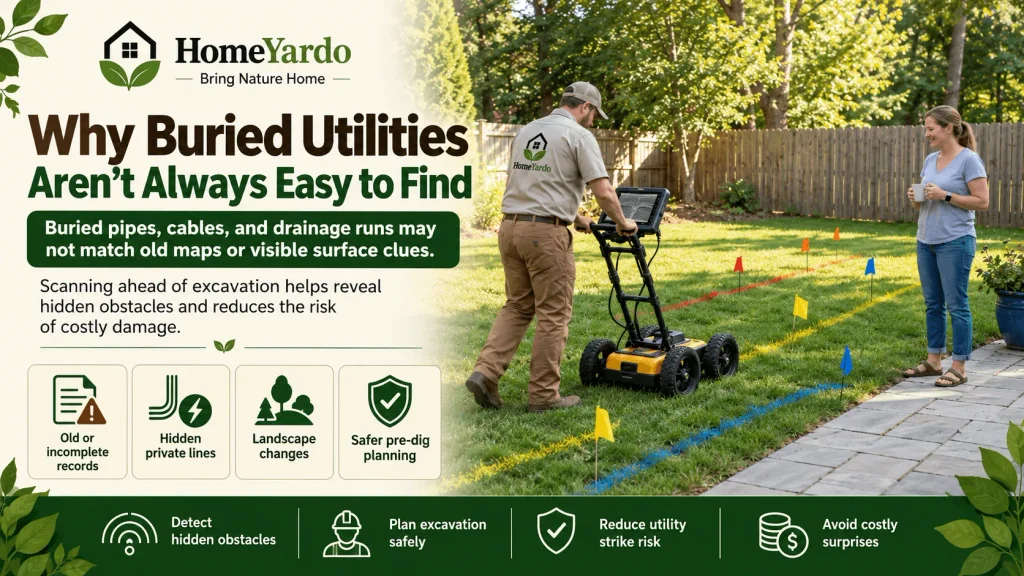
What lies beneath a yard isn’t always as straightforward as utility maps suggest. Pipes, cables, and drainage systems may have been installed years apart, sometimes without accurate records of their locations. Landscaping changes, home additions, and previous repairs can make it even harder to know exactly where everything runs.
For projects involving excavation, ground penetrating radar services can help identify hidden underground features before digging begins. By using radar signals to detect objects and changes beneath the surface, professionals can help identify underground features that traditional locating methods might miss, including certain non-metallic pipes and buried structures. The results depend on soil conditions, depth, and the materials involved, but the additional information can make planning safer and more informed.
Finding an unexpected line during excavation can lead to more than a delayed project. Damaged water pipes may cause flooding, electrical cables can pose serious safety risks, and gas line strikes can require emergency intervention. Identifying potential obstacles ahead of time helps homeowners make better decisions about where and how to dig.
What The Damage Numbers Say
It’s easy to assume that underground utility damage mostly happens on large construction sites, where heavy machinery digs deep into the ground. But smaller residential projects carry risks of their own. Installing fence posts, planting trees, or digging drainage trenches can all bring homeowners into contact with buried infrastructure. And when a line is damaged, the consequences can range from interrupted services and unexpected repair bills to serious safety hazards.
The damage statistics show just how widespread these incidents are. The Common Ground Alliance analyzed 196,977 damage reports for its 2024 DIRT report, and its damage index rose from 94.0 in 2023 to 96.7 in 2024. Failing to request a locate in the first place remains among the leading causes. In other words, the problem isn’t getting better by itself.
Why One Utility Check May Not Be Enough
Calling 811 is an essential first step before digging, but it doesn’t always provide a complete picture of what’s underground. Utility companies generally mark the lines they’re responsible for, while private connections, such as irrigation systems, outdoor lighting cables, and gas lines running to backyard appliances, may fall outside that service.
Different locating methods also have their strengths and limitations. Electromagnetic equipment is commonly used to trace conductive pipes and cables, while radar can provide additional information where conventional locating methods fall short. The Federal Highway Administration describes ground-penetrating radar as a complementary technology for locating underground utilities.
For homeowners, the important takeaway is that no single method guarantees every buried line will be found. Combining utility markings with additional checks when needed, and carefully verifying line locations before excavation, can reduce uncertainty and help prevent unexpected damage.
Planning Drainage, Patios, And Plantings Around What’s Below
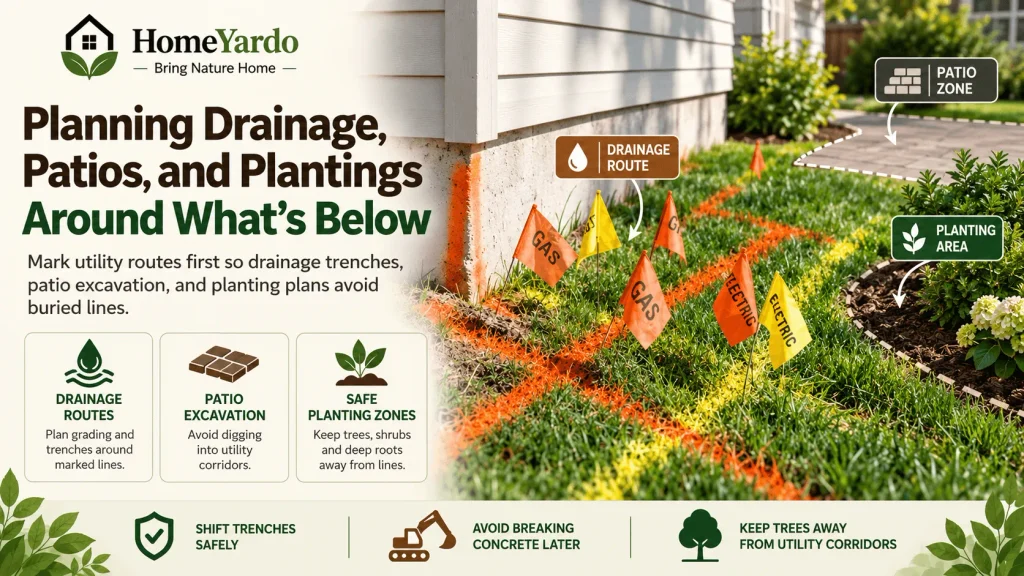
Colored flags and paint lines show where gas, electric, and water lines run across a front lawn.
Once you know what’s underground, design gets easier. Say you’re regrading to move water away from the house. Our walkthrough on fixing yard drainage covers swales and French drains, and both involve long trenches that can run straight through a buried line. Knowing the route first lets you shift the trench by a few feet and save a lot of grief.
The same goes for hardscape. If you’re pouring a slab, base compaction and excavation go deeper than you’d expect, and our guide to residential concrete for patios explains why that prep work matters. Hit a line after the pour, and you’re breaking out concrete you just paid for.
Even a garden redesign benefits. When you’re designing a backyard around how you actually live, mark utility corridors on your plan early. Keep deep-rooted trees and heavy structures away from them, and put lawn, raised beds, or gravel paths on top.
A Simple Pre-Dig Routine
You don’t need to turn a weekend project into a survey. A short routine does the job.
Start by calling 811 a few days ahead and waiting for every utility to mark. Then walk the yard and note anything the marks don’t explain: a spigot with no visible supply line, a lamp post, a pool or shed with power. Those are your private lines. If the project is large, say a pool, a retaining wall, or a long fence, or if you’re simply unsure, book a radar scan of the dig area.
Finally, hand-dig inside the tolerance zone your state sets around each mark. Dig around the markers, not on top of them.
Nobody enjoys adding a step before the fun part. But a scan takes a fraction of the time you’d spend repairing a cut line, and it lets you build the yard you pictured without wondering what’s under your feet.
FAQ’s
Start by submitting a locate request through 811 or your state 811 center. Utility operators can then mark the approximate location of covered underground facilities. Where private systems or uncertain subsurface conditions remain, additional professional locating may be appropriate.
Do not assume that a locate request identifies every buried object or privately installed system on a property. Review site features such as irrigation, landscape lighting, detached structures, pools, drainage systems, and other additions, and investigate further when necessary.
Ground-penetrating radar can detect some buried utilities and other subsurface anomalies where conditions are suitable. Performance varies with soil, moisture, depth, material, and site conditions, so GPR is generally used as a complementary locating method rather than a guarantee that every line will be found.