Residential Fence Materials Comparison: Complete Guide
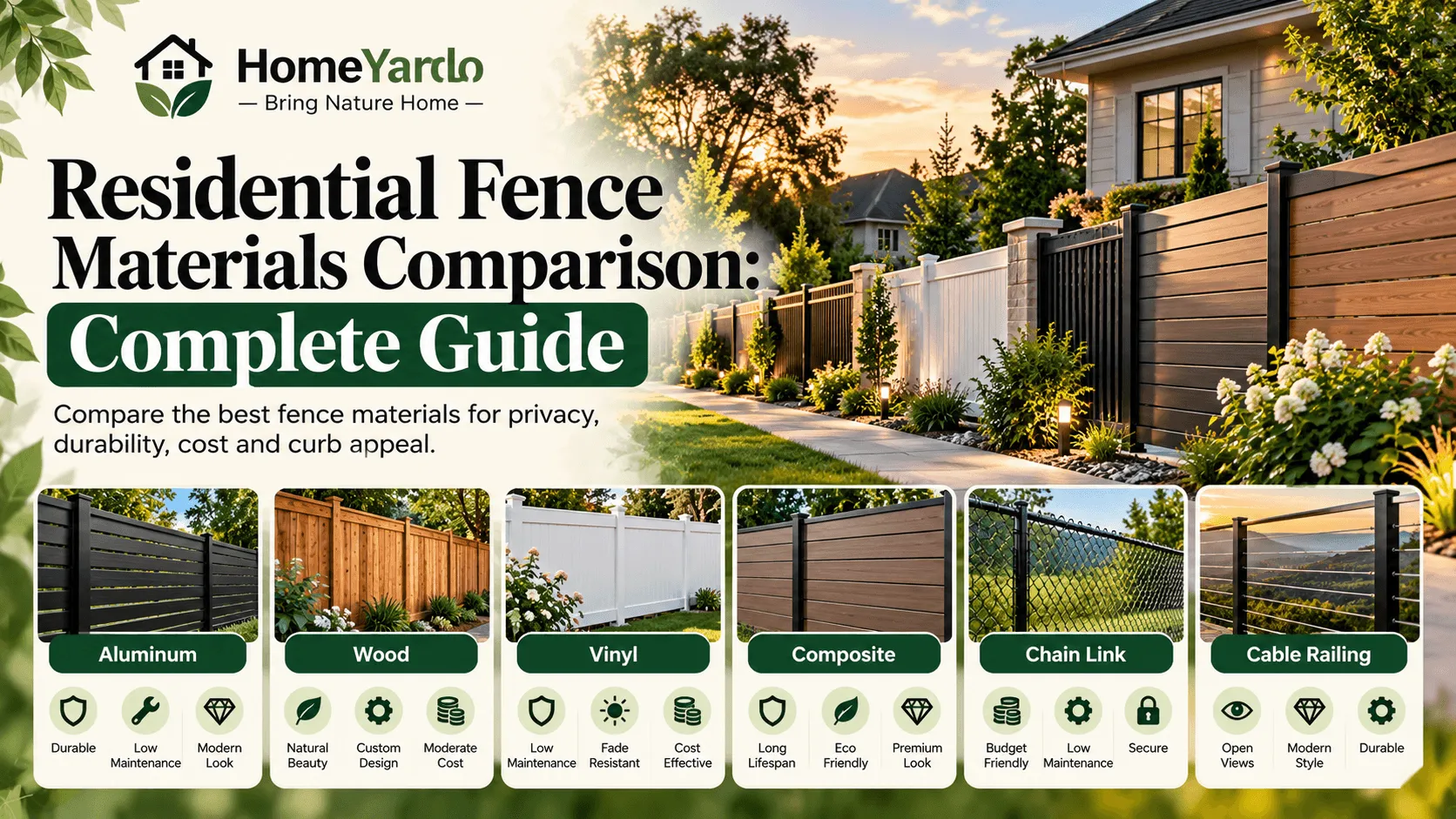
A well-engineered perimeter fence is one of the highest-leverage exterior upgrades a homeowner can make. Beyond defining property boundaries, the right fence transforms an exposed yard into a private outdoor living room, secures driveways and swimming pools, buffers street noise, and elevates architectural curb appeal. Yet walking through a residential fence materials comparison can feel overwhelming when weighing upfront installation budgets against 20-year maintenance costs, wind load ratings, soil shifts, and municipal building codes.
If the fence is part of a broader outdoor renovation, designing a backyard as a complete space can help coordinate boundaries, gates, patios, planting areas, privacy, and traffic flow before permanent features are installed.
In warm, sun-drenched regions like Southern California—where intense UV exposure, seasonal Santa Ana wind gusts, hillside slopes, and expansive clay soils test exterior structures to their limits—material selection and footing engineering matter equally. Below is a comprehensive contractor’s guide comparing aluminum, wood, vinyl, composite, chain link, and stainless steel cable railing systems so you can invest in a perimeter built right and built to last.
1. Architectural Aluminum Fencing: Sleek Aesthetics and Zero Corrosion
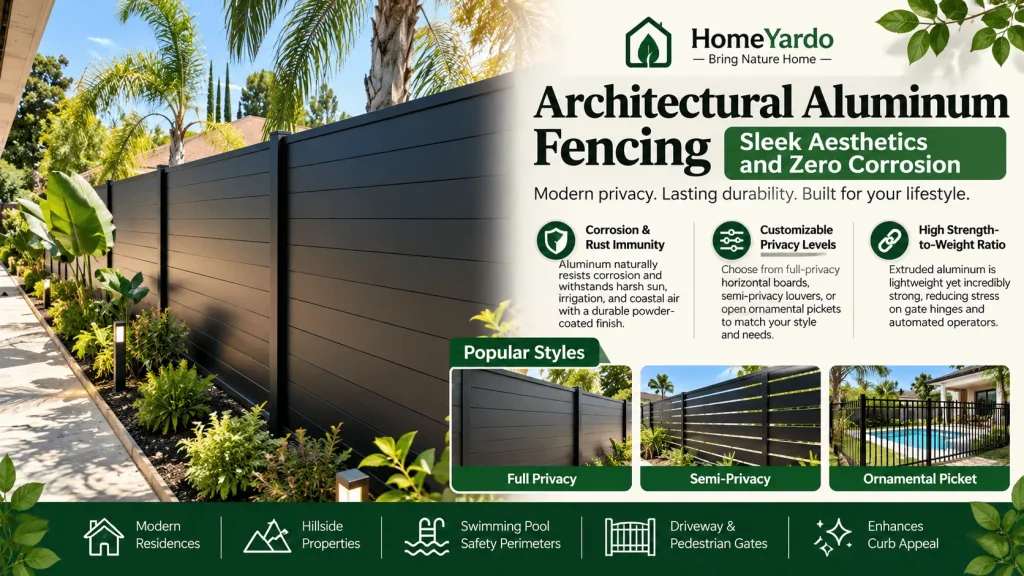
Over the past decade, architectural aluminum has surged past traditional wrought iron as the premier metal fencing solution for contemporary and transitional homes. While classic vertical-picket aluminum remains popular for front yards and pool enclosures, modern horizontal slat aluminum systems now allow homeowners to achieve full backyard privacy without sacrificing metallic durability.
Structural Strengths
- Corrosion & Rust Immunity: Unlike ferrous steel or wrought iron that oxidizes when hit by lawn irrigation or coastal air, aluminum naturally resists corrosion. Combined with an architectural-grade powder-coated finish (matte black, bronze, charcoal, or custom RAL shades), the surface won’t peel, blister, or chalk under relentless sun.
- Customizable Privacy Levels: Homeowners can choose full-privacy interlocking horizontal boards, semi-privacy louvers with 0.5-inch to 1-inch airflow gaps, or open ornamental pickets.
- High Strength-to-Weight Ratio: Because extruded aluminum is lighter than solid steel while maintaining exceptional tensile strength, it places less dead-weight stress on gate hinges and automated operators.
Ideal Applications
Architectural aluminum shines on modern residences, hillside properties requiring racked or stepped transitions, swimming pool safety perimeters, and high-traffic pedestrian or driveway gates equipped with smart locks
Because a street-facing fence becomes part of the property’s first impression, homeowners may also want to consider other ways to improve your home’s curb appeal when choosing fence colors, finishes, gate styles, and surrounding landscaping.
2. Traditional Wooden Fencing (California Redwood & Cedar): Organic Warmth and Custom Craftsmanship
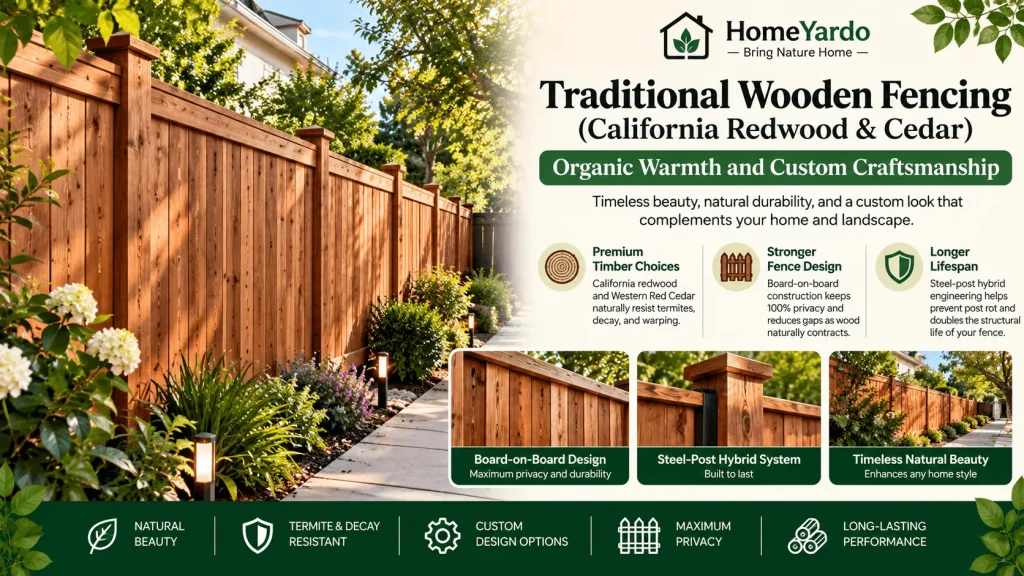
Even with advances in synthetic materials, natural timber remains a cornerstone of any residential fence materials comparison. Nothing replicates the aromatic richness, tactile grain, and architectural versatility of genuine California redwood or Western Red Cedar.
California redwood or Western Red Cedar. When appearance matters as much as privacy, coordinating the fence with other exterior home features can help the material, color, proportions, and detailing feel connected to the home’s architectural style.
Why Timber Choice and Framing Dictate Lifespan
- Heartwood Redwood vs. Whitewood: True California redwood heartwood contains natural polyphenolic compounds that repel drywood termites and fungal decay. Cheap spruce, pine, or fir (SPF) pickets warp and split within two summers of dry heat.
- Board-on-Board vs. Standard Side-by-Side: As natural wood acclimates to low humidity, individual pickets contract by 3% to 5%. A standard edge-to-edge fence develops daylight gaps between pickets within months. Specifying an overlapping board-on-board layout—finished with a top cap rail and fascia trim—preserves 100% privacy while stiffening the entire panel against warping.
- Steel-Post Hybrid Engineering: The single biggest point of failure in a traditional wood fence is a buried 4×4 wood post rotting at the concrete collar where soil moisture and oxygen meet. Forward-thinking contractors increasingly mount redwood rails and pickets onto galvanized or powder-coated steel posts (concealed behind wood post covers), doubling the structural lifespan of the fence.
Maintenance Expectations
To prevent UV graying and surface checking, wooden fences should be cleaned and resealed with a penetrating oil-based UV stain every 3 to 5 years, and sprinkler heads must be adjusted so they do not spray directly against the wood pickets.
3. Commercial-Grade Vinyl (PVC) Fencing: Clean Lines with Zero Repainting
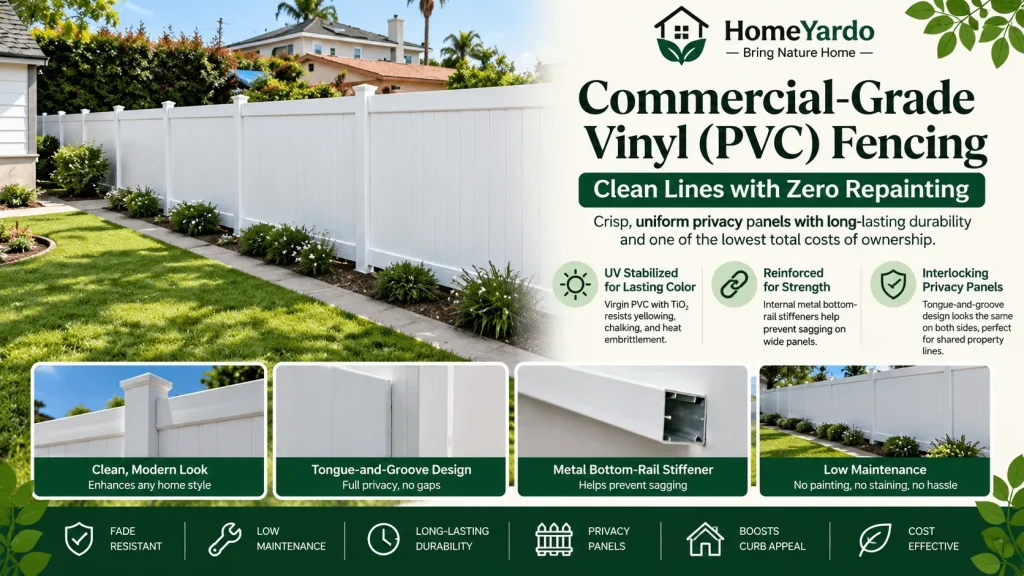
For homeowners who want crisp, uniform privacy panels without ever picking up a paint scraper or stain brush, vinyl privacy fencing offers one of the lowest total costs of ownership over a 25-year horizon.
Differentiating Contractor-Grade Vinyl from Big-Box Panels
- Virgin PVC & $\text{TiO}_2$ UV Stabilization: Co-extruded commercial vinyl incorporates at least 10 parts per hundred of titanium dioxide ($\text{TiO}_2$) UV inhibitors in the outer capstock. This prevents the yellowing, chalking, and heat embrittlement common in recycled-core panels.
- Internal Metal Bottom-Rail Stiffeners: Wide 6-foot or 8-foot vinyl bays exposed to direct afternoon sun can sag over time unless the bottom horizontal rail houses a roll-formed galvanized steel or aluminum stiffener channel.
- Interlocking Tongue-and-Groove Privacy: Because vinyl pickets lock together inside routed post pockets rather than relying on face nails or staples, the fence looks identical on both your side and your neighbor’s side—making it ideal for shared property lines.
4. Composite Fencing (WPC): Luxury Woodgrain Meets Industrial Durability
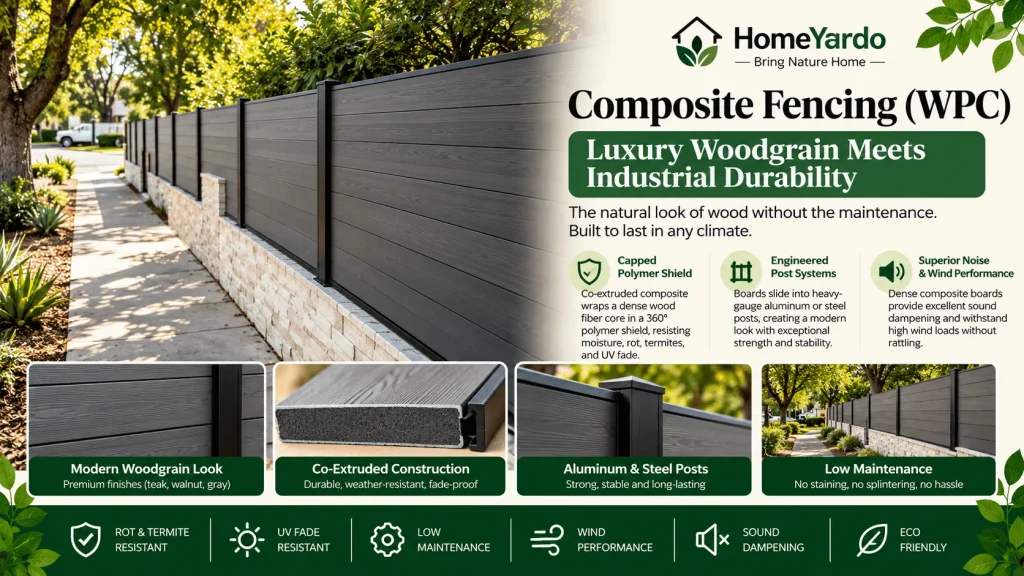
When homeowners love the warm aesthetic of stained hardwood but refuse to deal with periodic staining, splintering, or insect damage, co-extruded wood-plastic composite (WPC) bridges the gap.
Why Composite Is Transforming Modern Backyards
- Capped Polymer Shield: Second-generation co-extruded composite wraps a dense core of reclaimed hardwood fibers and recycled polyethylene inside a 360-degree polymer shield. It is impervious to moisture absorption, rot, termites, and UV fade.
- Engineered Aluminum & Steel Post Systems: When homeowners opt for modern composite fence installation, tongue-and-groove horizontal or vertical boards slide into heavy-gauge powder-coated aluminum posts. The striking contrast between warm woodgrain boards (teak, walnut, or weathered gray) and matte-black metal posts creates a high-end architectural look.
- Acoustic & Wind Performance: Because composite boards are significantly denser than hollow vinyl panels, they provide superior sound dampening for homes near busy streets and withstand high wind loads without rattling.
5. Specialty Perimeter Systems: Chain Link, Ornamental Steel, and Cable Railing
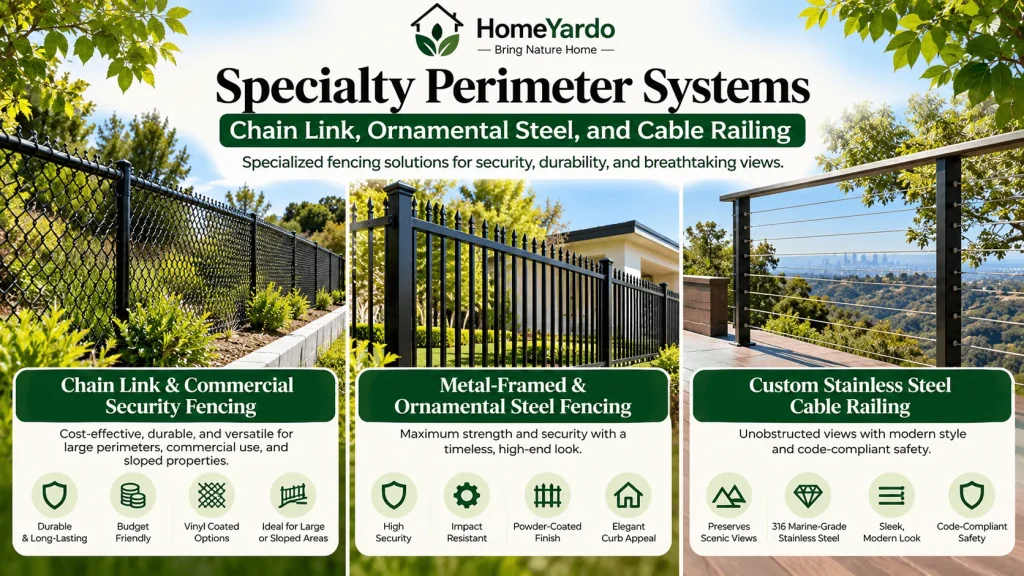
Not every boundary calls for a solid 6-foot privacy wall. Depending on topography, commercial security needs, or scenic canyon views, three specialized systems complete the modern fencing lineup:
- Chain Link & Commercial Security Fencing: Far removed from bare industrial mesh, residential and commercial chain link can be upgraded with black or green fused vinyl coatings and color-matched privacy slats. It remains the most cost-effective solution for large side-yard perimeters, commercial enclosures, and sloped hillside boundaries.
- Metal-Framed & Ornamental Steel Fencing: Where maximum impact resistance or commercial perimeter security is required, welded tubular steel with zinc-rich epoxy primer and powder coating delivers formidable protection.
- Custom Stainless Steel Cable Railing: For hillside decks, balconies, and elevated patios where a solid fence would block mountain or city views, custom 316 marine-grade stainless steel cable railing mounted in powder-coated steel or aluminum posts provides code-compliant fall protection with virtually invisible sightlines.
Head-to-Head Residential Fence Materials Comparison Table
| Evaluation Metric | Architectural Aluminum | Composite (WPC) | Commercial Vinyl (PVC) | California Redwood | Chain Link / Cable Railing |
|---|---|---|---|---|---|
| Upfront Cost Tier | $$$ – $$$$ | $$$ – $$$$ | $$ – $$$ | $$ – $$$ | $ (Chain Link) / $$$$ (Cable) |
| Expected Lifespan | 30–40+ Years | 25–35+ Years | 20–30 Years | 15–25 Years | 20–35+ Years |
| Annual Maintenance | None (Occasional rinse) | None (Occasional rinse) | None (Hose wash) | Re-stain every 3–5 years | Minimal (Check cable tension) |
| Privacy Capability | Full, Semi, or Open | 100% Solid or Semi | 100% Solid or Picket | 100% (Board-on-board) | Open View (or Slatted) |
| Rot, Termite & Rust Resistance | 100% Immune | 100% Immune | 100% Immune | Natural Tannins (Moderate) | High (316 SS / Vinyl-Coated) |
| Best Architectural Fit | Modern / Contemporary | Modern / Transitional | Traditional / Suburban | Craftsman / Spanish / Classic | Hillside Decks / Security |
Why Footing Engineering, Slope Grading, and Gate Design Matter More Than Material Alone
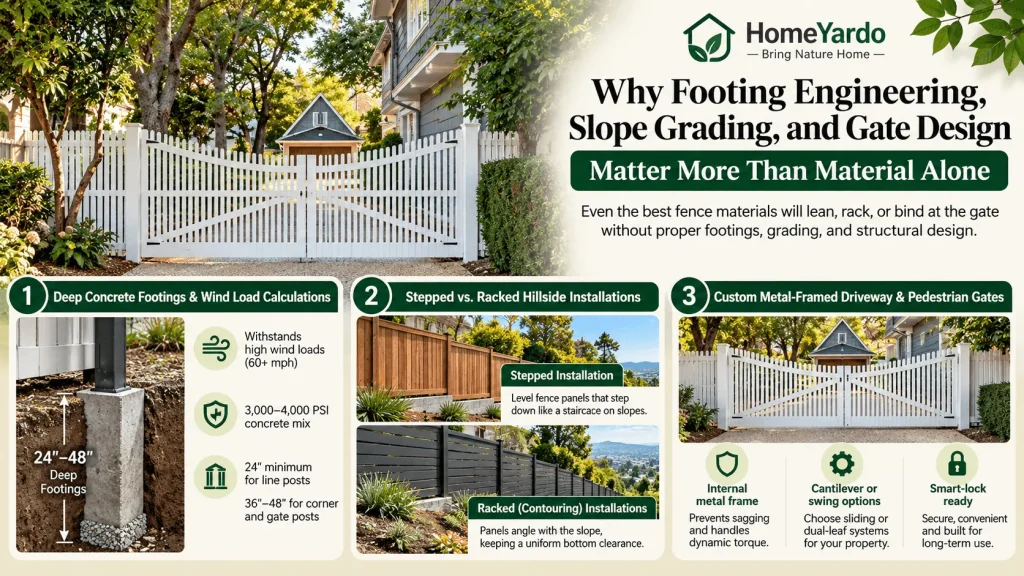
Even the most expensive fence boards will lean, rack, or bind at the gate if the subterranean foundation and metal framing are cut short. Experienced contractors focus on three structural fundamentals:
1. Deep Concrete Footings & Wind Load Calculations
A solid 6-foot privacy fence acts like a rigid sail during 60+ mph windstorms. Line posts should be set a minimum of 24 inches deep in belled concrete footings using 3,000 to 4,000 PSI concrete mix, while terminal corner posts and heavy driveway gate posts require 36-to-48-inch depths to prevent frost heave, clay soil expansion, and lateral deflection.
2. Stepped vs. Racked Hillside Installations
On sloped lots and retaining walls, installers use two distinct methods:
- Stepping: Each fence bay remains dead-level horizontally, stepping down in uniform increments like a staircase. This is ideal for composite and privacy wood designs on steep grades (often paired with a concrete curbing base).
- Racking (Contouring): The rails and pickets angle parallel to the ground slope, maintaining a tight, uniform 2-inch bottom clearance along rolling terrain.
3. Custom Metal-Framed Driveway & Pedestrian Gates
Gates endure continuous dynamic torque. Whether you choose redwood, composite, or aluminum infill panels, building the gate leaf around an internal custom-welded metal frame prevents sagging.
For driveways, choosing between a cantilever/rolling sliding gate system (ideal for compact driveways or upward-sloping entries) and a dual-leaf swing gate system with automatic smart-lock operators ensures effortless daily entry and long-term security.
Navigating California Fence Laws & Choosing the Right Contractor
Before breaking ground in California, homeowners should verify two critical regulatory frameworks:
- Municipal Height & Setback Rules: Under agencies such as the Los Angeles Department of Building and Safety (LADBS), front-yard fences in residential zones are typically limited to 3.5 feet (42 inches) by right, while side and rear perimeters allow up to 6 feet without a discretionary zoning variance (and up to 8 feet with permits in specific jurisdictions). Pool enclosures must also meet California Pool Safety Act standards, including outward-swinging, self-closing, self-latching gates with releases mounted at least 54 inches high.
- The Good Neighbor Fence Act (AB 841): Under California Civil Code § 841, adjoining property owners are presumed to share an equal 50/50 responsibility for reasonable costs of maintaining or replacing a shared boundary fence, provided the initiating homeowner delivers a formal 30-day written notice detailing the proposed scope of work, materials, and contractor bids.
When turning your residential fence materials comparison into a finished project across Greater Los Angeles, Glendale, Pasadena, Burbank, and the San Gabriel Valley, HandyMaestro delivers turnkey fence and gate installation and service backed by precision craftsmanship. Led by founder and owner Dmitrii, HandyMaestro fabricates and installs custom aluminum fences and smart-lock gates, composite privacy systems, traditional redwood fences, vinyl privacy panels, commercial security fences, automatic driveway gates, and stainless steel cable railings.
Every project follows a clear four-step client experience:
- Call & Tell Us About Your Project: Share your property goals, material preferences, and timeline.
- Schedule Site Visit & Meet Dmitrii: Receive an on-site structural assessment covering grade changes, boundary layouts, and gate automation options.
- Approve Your Design & Schedule Installation: Review a clear, itemized proposal engineered for long-term stability.
- Enjoy Your New Fence & Gate: Relax behind a custom perimeter built right and built to last.
“Disclaimer: Fencing and gate structures are subject to high wind loads, soil shifts, and structural stresses. The information provided is for educational and reference purposes only. Always consult a licensed fencing contractor, structural engineer, or your local building department before undertaking major structural or retaining wall installations.”
FAQ’s
Powder-coated architectural aluminum and co-extruded composite fencing seated in metal posts offer the longest structural lifespans in hot, high-UV climates—routinely lasting 30 to 40+ years without warping, rotting, cracking, or requiring repainting.
Yes, for many homeowners. While composite fencing costs more upfront than standard wooden or vinyl panels, it eliminates the recurring $1,500 to $3,000 expense of sanding and restaining a wood fence every 3 to 5 years, offers much higher impact and wind resistance than hollow PVC vinyl, and delivers a rich, natural woodgrain look that boosts property value.
The only permanent engineering solution to gate sag is constructing the gate around a welded tubular steel or heavy-gauge aluminum frame (often incorporating a diagonal Z-brace), hanging it on heavy-duty adjustable ball-bearing hinges, and anchoring the hinge post 36 to 48 inches deep in reinforced concrete.