Professional Spray Foam Equipment For Residential Insulation And Air Sealing

High-performance spray polyurethane foam can be used in residential retrofits and new construction to insulate building assemblies, seal unwanted air leakage, and improve control of heat transfer through the building envelope.
Getting consistent results, however, depends on more than choosing the foam itself. Professional applications require equipment capable of heating, pressurizing, metering, and delivering two chemical components under controlled conditions.
A complete spray foam rig typically brings the proportioner, heated hose, applicator gun, compressed-air supply, generator, pumps, and supporting equipment together in a mobile system. That allows trained technicians to work efficiently in attics, crawlspaces, rim joists, wall framing, and other residential areas.
For homeowners trying to determine whether insulation problems already exist, HomeYardo’s guide to signs your home needs new insulation explains common warning signs such as drafts, uneven indoor temperatures, and excessive HVAC runtime.
Why Residential Spray Foam Requires Professional Equipment

Two-component spray polyurethane foam depends on controlled processing.
The A-side, commonly containing isocyanate, and the B-side resin blend must reach the applicator at the temperatures, pressures, and proportions specified for the particular foam system.
The proportioner meters and heats the components separately. Heated hoses help maintain suitable material temperatures as the chemicals travel from the rig to the applicator gun. Mixing takes place at the gun immediately before the material is sprayed.
Problems anywhere in that chain can affect the finished foam.
Incorrect temperatures, pressure imbalance, blocked components, worn seals, unsuitable gun configuration, or off-ratio material delivery can result in poor spray patterns or foam that does not develop as intended.
That makes equipment selection part of application quality rather than simply a purchasing decision.
Core Components of a Residential Spray Foam Rig
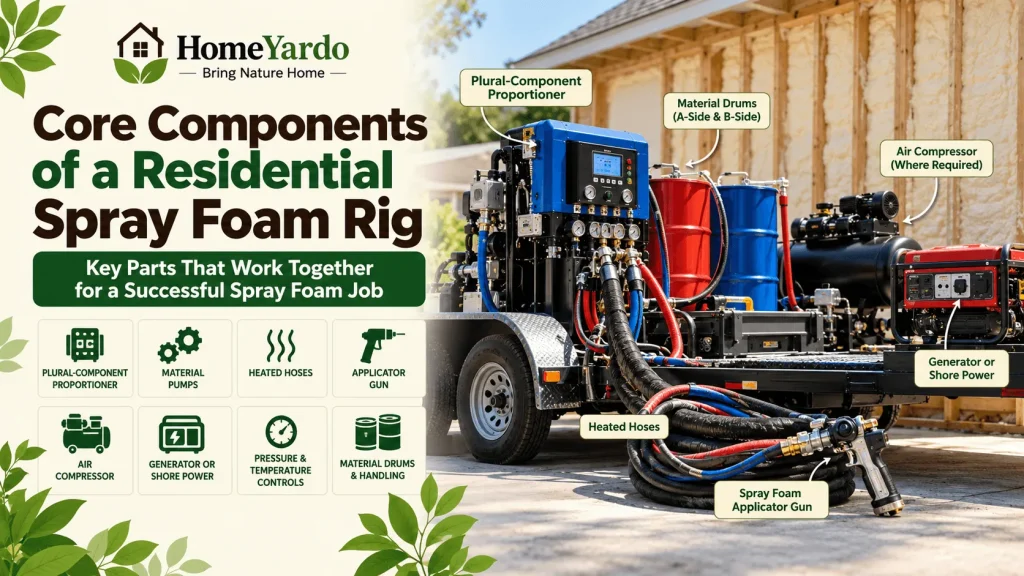
A professional spray foam setup normally combines several systems that must operate together.
Key components can include:
- A plural-component proportioner
- Primary material pumps
- Heated A-side and B-side hoses
- A spray foam applicator gun
- An air compressor where required
- Generator or shore-power equipment
- Temperature and pressure controls
- Transfer pumps
- Material drums and handling equipment
- Spare chambers, seals, cartridges, filters, and service parts
- Appropriate ventilation and jobsite safety equipment
The proportioner and gun receive much of the attention, but the entire system matters.
A high-performance applicator cannot compensate for unstable material temperatures, restricted supply lines, poorly maintained pumps, or incorrect pressure settings.
Why the Spray Gun Matters to Application Quality

The applicator gun is where the two chemical streams meet.
That makes it one of the most important pieces of spray foam equipment on the rig.
Choosing which Graco Fusion gun to choose involves more than comparing product names. Contractors should consider the purge method, expected output, spray pattern, compressed-air requirements, maintenance process, parts availability, ergonomics, and the types of residential spaces they commonly spray.
A contractor working mainly in open wall cavities may prioritize something different from a technician regularly working around rim joists, framing intersections, rooflines, and other confined locations.
Gun configuration can influence:
- Spray pattern consistency
- Material output
- Access in restricted spaces
- Cleaning requirements
- Air demand
- Maintenance downtime
- Mix-chamber service
- Daily operating workflow
The goal is not simply to select the gun with the most features. It is to choose an applicator that fits the proportioner, material system, application conditions, and expected workload.
Spray Foam Gun Purge Systems Explained

A purge system clears or manages residual material inside the mixing chamber after the operator releases the trigger.
Different purge methods accomplish this in different ways.
Understanding that difference makes spray gun comparisons much easier.
Air-Purge Systems
An air-purge gun sends compressed air through the mixing area when the trigger is released.
The air helps remove residual chemical from the chamber and tip before it can accumulate.
Air-purge guns are widely used because they offer a relatively straightforward design and can support many common spray foam applications.
They do, however, depend on an adequate compressed-air supply. Compressor capacity therefore becomes part of the overall rig specification.
Mechanical-Purge Systems
Mechanical-purge guns use a physical purge rod that moves through the mixing chamber when spraying stops.
The rod pushes residual material from the chamber rather than relying primarily on an air blast to clear it.
This design can be useful where contractors want mechanical chamber cleaning or where equipment requirements favor that purge method.
Mix-chamber configuration, material output, service requirements, and application type still need to be considered before choosing one.
Liquid-Purge Systems
Liquid-purge technology uses a dedicated fluid introduced into the mixing chamber after spraying stops.
With systems such as ClearShot, the fluid helps prevent residual chemicals in the chamber from reacting between trigger pulls.
This can reduce material buildup during intermittent spraying and may be useful when an operator repeatedly starts and stops while working through detailed framing.
The purge fluid and cartridges remain consumable parts of the operating system, so contractors should include them when evaluating maintenance and operating costs.
ProConnect Replacement Cartridges
ProConnect takes a different approach to field servicing.
Instead of requiring the technician to rebuild numerous individual fluid-section components, a replaceable cartridge contains several commonly serviced parts in one assembly.
Replacing the cartridge can significantly shorten a gun rebuild on the jobsite.
For a residential crew moving between several projects each week, less time spent rebuilding the fluid section can translate into more productive spraying time.
Comparing Graco Fusion Spray Foam Guns

Several Fusion designs use different approaches to purging and maintenance.
No single model suits every crew or every application. The better comparison is based on how each design fits the contractor’s normal workload.
Fusion AP (Air Purge)
The Fusion AP uses an air-purge system.
When spraying stops, compressed air helps clear residual material from the mix chamber and tip.
Its established design makes it suitable for a broad range of polyurethane foam applications. Contractors who already operate compressors as part of their rigs may find the system straightforward to integrate into their normal workflow.
Its conventional fluid-section components are serviceable individually, which can appeal to technicians familiar with rebuilding and maintaining spray guns in the field.
Fusion PC (ProConnect)
Fusion PC is also based on air-purge technology, but its major distinction is the ProConnect cartridge.
The cartridge replaces several individual fluid-section components as one assembly. Rather than disassembling and rebuilding several seals and related parts during a service event, the technician can change the cartridge and return the gun to operation more quickly.
This makes Fusion PC particularly relevant for crews that place a high value on reducing jobsite maintenance time.
The basic question when comparing AP and PC is therefore not simply spray capability. Maintenance strategy matters too.
A contractor comfortable servicing individual components may prefer one approach, while a crew prioritizing rapid component replacement may favor another.
Fusion CS (ClearShot)
Fusion CS uses liquid-purge technology.
ClearShot fluid is introduced into the mixing chamber when spraying stops, helping keep residual chemicals from reacting between trigger pulls.
That characteristic can be useful during stop-and-start spraying where a technician repeatedly works around framing members, corners, penetrations, and other detailed building elements.
The system requires ClearShot cartridges, so cartridge availability and operating cost should be considered alongside the potential maintenance advantages.
Fusion MP (Mechanical Purge)
Fusion MP uses a mechanical purge rod to clear residual chemical from the chamber.
It provides an alternative to air- and liquid-purge designs for contractors who prefer mechanical chamber cleaning.
Mechanical purge should be evaluated against expected output, chamber size, material being sprayed, rig configuration, service procedures, and the manufacturer’s application requirements.
Choosing it simply because it avoids an air-purge design would overlook the larger system requirements.
How to Match a Spray Gun to Residential Applications

Residential insulation work covers very different spraying conditions.
A wide wall cavity presents a different challenge from a narrow rim joist. An open attic is different again from detailed framing around plumbing, electrical penetrations, windows, or roof intersections.
Before choosing an applicator, consider where most of the work actually occurs.
Open Wall Cavities
Large framing bays generally reward consistent pattern control and efficient material output.
A gun and chamber combination capable of covering the cavity evenly can help the technician maintain a repeatable application technique.
Attics and Roof Assemblies
Attic projects can involve restricted access, unusual spraying angles, and extended hose runs.
Gun weight, hose handling, pattern consistency, temperature stability, and operator mobility therefore become important considerations.
Rim Joists and Detailed Framing
Smaller spaces may require tighter pattern control.
Frequent starts and stops can also increase the importance of purge performance because the material spends more time sitting between trigger pulls.
Crawlspaces
Crawlspaces place greater emphasis on equipment mobility and hose management.
The gun needs to remain manageable when the technician is working in restricted positions, while the rig must maintain stable temperature and pressure at the end of the hose.
Matching the Applicator Gun to the Spray Foam Rig

The gun should never be considered separately from the proportioner.
A professional rig is a connected system.
The proportioner establishes material temperature and pressure. Heated hoses maintain suitable conditions while delivering the two components to the gun. The chamber and nozzle then determine how those components mix and leave the applicator.
Contractors should confirm compatibility across:
- Proportioner output
- Recommended material temperature
- Fluid pressure
- Heated-hose configuration
- Mix-chamber size
- Spray pattern
- Compressor capacity
- Generator capacity
- Chemical manufacturer’s processing requirements
Changing one part of the system can affect another.
A larger chamber, for example, can change material demand. A different purge system may alter compressed-air requirements. Longer hose runs can affect heating requirements.
Equipment should therefore be selected as a system rather than as unrelated individual parts.
Equipment Setup Factors That Affect Foam Quality

Even good equipment can produce poor results when setup conditions are wrong.
Several operating conditions deserve attention before spraying begins.
Material Temperature
Two-component foam systems are designed to process within specified temperature ranges.
Cold material may become harder to pump and atomize correctly, while excessive temperature can create other processing problems.
Technicians should follow the chemical supplier’s processing instructions instead of relying on one temperature setting for every product.
Pressure Balance
The A-side and B-side need to be delivered correctly to the applicator.
Significant pressure differences can signal restrictions, equipment problems, worn components, or other conditions requiring investigation.
Operators should diagnose the cause rather than trying to compensate blindly at the gun.
Mix Chamber Selection
Mix chambers are available in different sizes and pattern configurations.
The appropriate choice depends on required output, spray pattern, material, substrate, and project area.
Bigger is not automatically better. Excessive output can make controlled application harder in smaller framing cavities.
Hose Heating
Heated hose maintains material temperature between the proportioner and the spray gun.
A properly selected and functioning hose-heating system helps keep processing conditions stable during spraying, particularly with longer hose lengths or demanding ambient conditions.
Maintenance And Jobsite Uptime

Daily maintenance affects both application quality and equipment life.
Spray foam systems handle reactive materials, so allowing residue to accumulate can quickly turn a small maintenance issue into jobsite downtime.
A normal maintenance program may involve:
- Inspecting the mix chamber
- Checking side seals or cartridges
- Cleaning the gun according to manufacturer instructions
- Inspecting filters and screens
- Checking hose condition
- Monitoring pressure readings
- Inspecting fluid connections
- Maintaining transfer pumps
- Checking compressor performance
- Carrying suitable spare components
The exact maintenance procedure should follow the equipment manufacturer’s manual.
Technicians should also record recurring failures. Repeated clogging, unusual pressure differences, premature seal wear, or inconsistent patterns may point to a system-level issue rather than a defective gun component.
Improving The Efficiency And Quality Of Rig Output

Reliable spray foam installation comes from controlling the complete process.
A properly matched proportioner, heated hose, chamber, applicator gun, and material system gives the technician a better chance of maintaining consistent temperature, pressure, mixing, and spray pattern throughout the job.
This matters because insulation performance depends partly on installation quality.
Air sealing and insulation can contribute to broader energy efficiency improvements, but the material must first be installed according to its specified conditions and building requirements.
Good equipment selection can also reduce unnecessary downtime.
Fast service procedures, readily available consumables, suitable spare parts, and equipment familiar to the crew can sometimes matter as much as maximum theoretical output.
A gun that sprays quickly but regularly brings the job to a halt for service may not be the most productive choice for that contractor.
Professional Installation and Safety Considerations

Professional spray polyurethane foam application involves more than thermal performance.
Installers work with reactive chemical components, pressurized equipment, heated materials, compressed air, electrical systems, and jobsite ventilation requirements.
Appropriate training, personal protective equipment, containment, ventilation, occupancy controls, and manufacturer instructions should be part of the application plan.
Air sealing also changes how a building exchanges indoor and outdoor air.
Making a house tighter does not eliminate the need for planned ventilation. Homes undergoing broader airtightness improvements may need their ventilation strategy reviewed as part of the project. Homeowners can read more about heat recovery ventilation and the relationship between controlled ventilation and tighter building envelopes.
Contractors should follow the chemical manufacturer’s safety documentation, equipment manuals, applicable building codes, workplace requirements, and industry training standards for every project.
Choosing Equipment as a Complete System
Professional residential spray foam work depends on more than buying a powerful proportioner or a popular gun.
The best-performing setup is one in which the chemical system, proportioner, hose, chamber, purge method, compressor, generator, and applicator are compatible with one another and suitable for the projects the crew performs most often.
Fusion AP, Fusion PC, Fusion CS, and Fusion MP take different approaches to maintenance and purging. The right choice depends on workload, material, output needs, air supply, application conditions, maintenance preferences, and the technician’s operating practices.
Treating the spray gun as part of the complete rig rather than as an isolated accessory gives contractors a much stronger basis for choosing professional spray foam equipment.
FAQs
A professional two-component setup normally includes a proportioner, transfer pumps, heated hoses, a compatible spray gun, power supply, material drums, and any required compressed-air equipment. Contractors also need appropriate safety, ventilation, monitoring, and maintenance equipment.
A proportioner meters, pressurizes, and heats the two chemical components separately before sending them through heated hoses to the applicator gun. Correct proportioning and processing conditions are important for proper foam development.
An air-purge gun uses compressed air to help clear residual material from the mix chamber after the trigger is released. A mechanical-purge gun uses a physical rod that moves through the chamber to push residual material out.
Yes. Fusion PC uses an air-purge design. Its distinguishing feature is the ProConnect cartridge, which replaces several components of the gun’s fluid section in one replaceable assembly.
Both use air-purge technology. Fusion AP uses a more conventional serviceable fluid section, while Fusion PC incorporates the ProConnect cartridge system designed to make fluid-section replacement faster.