How To Tell If Your Furnace Is Dying Before It Quits
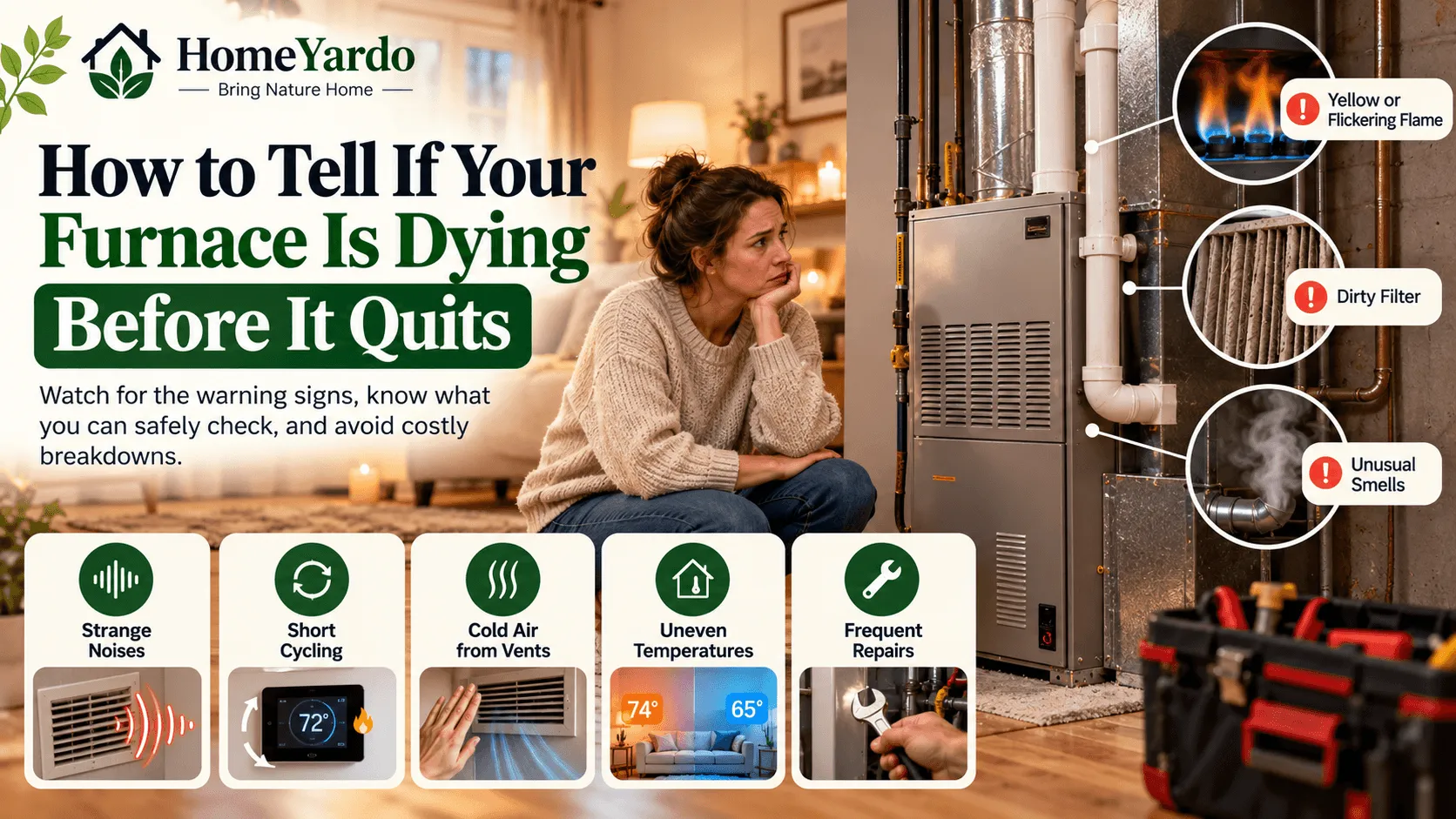
Three in the morning. The house is forty-one degrees. You’re standing in socks on cold tile, phone in hand, trying to remember whether you heard the furnace run at all before bed. It’s the worst possible time to learn that your heating system has been telling you it was dying for two weeks.
Most furnaces don’t fail without warning. They wheeze, rumble, short cycle, and smell strange for days or weeks before they quit. If you catch those signals early, you’re looking at furnace repair in Tulsa, OK, on a Tuesday afternoon instead of an emergency call during the coldest stretch of January. That difference matters, and it’s the whole point of this piece.
Below, you’ll find the specific signals that separate a fixable furnace from a dying one, what you can safely check on your own, and where a homeowner’s hands should stay off the equipment entirely.
What Most Homeowners Get Backwards About Furnace Failure
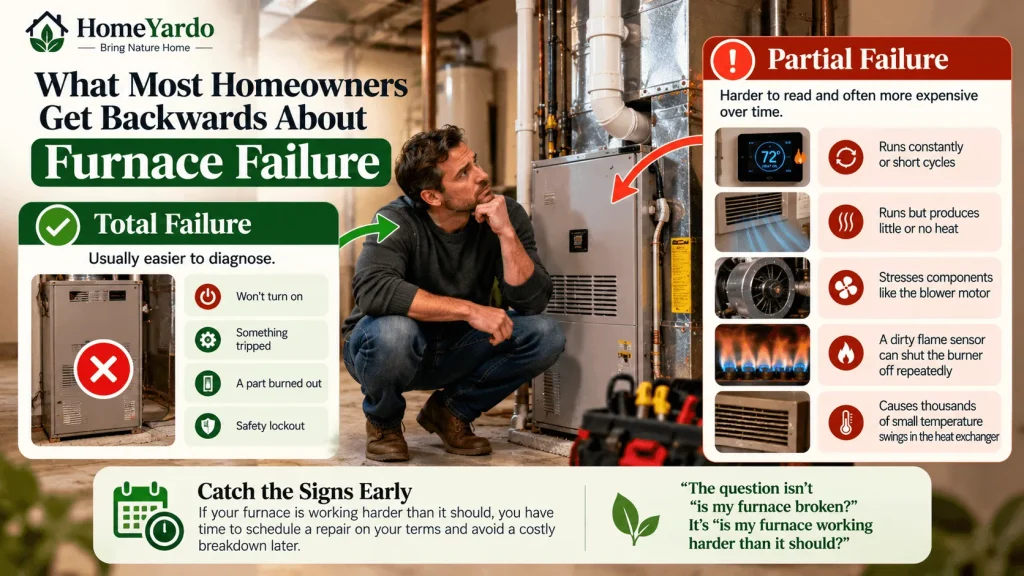
Here’s a stance I’ll defend: a furnace that stops working completely is usually the easiest problem to diagnose. Total failure means something tripped, burned out, or locked itself down for safety. A furnace that runs constantly, runs short bursts, or runs while producing almost no heat is harder to read, and it’s quietly the more expensive situation.
That’s because partial failures stress the system continuously. A blower motor cycling on and off all night wears itself down. A dirty flame sensor cuts the burner after a few minutes, over and over, until the heat exchanger has taken thousands of small temperature swings it was never designed for. You don’t notice any of this until it stops.
So the question isn’t “is my furnace broken?” It’s “is my furnace working harder than it should?” If the answer is yes, you have time to schedule a repair on your terms. Use it.
Five Signals That Mean Call Someone This Week
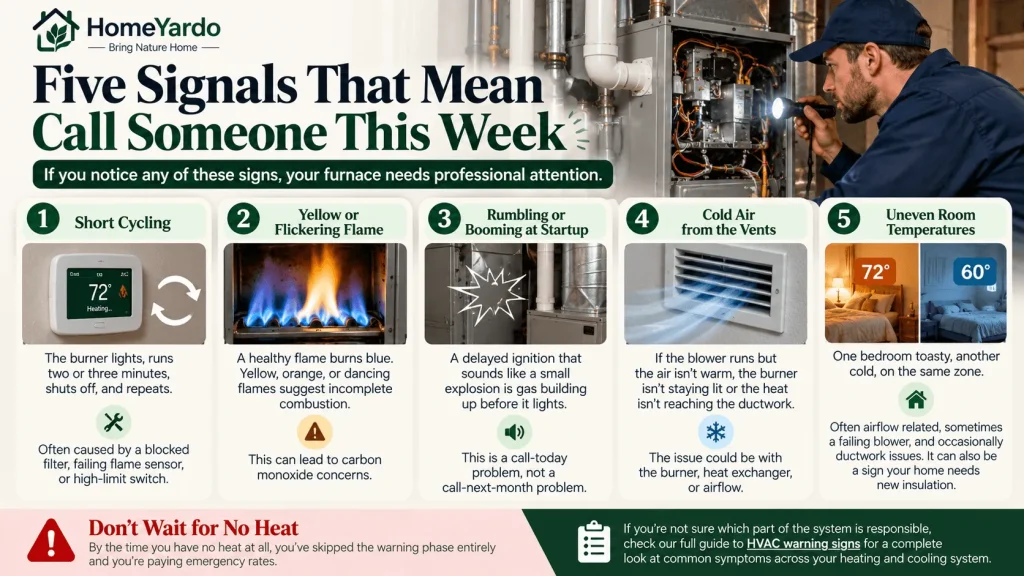
These aren’t subtle. If you’re seeing any of them, the furnace isn’t asking for attention; it’s demanding it.
- Short cycling. The burner lights, runs two or three minutes, shuts off, and repeats. That cycle pattern usually points to a blocked filter, a failing flame sensor, or a high-limit switch that’s doing its job.
- Yellow or flickering flame. A healthy natural gas flame burns blue. Yellow, orange, or dancing flames suggest incomplete combustion, which is where carbon monoxide concerns start.
- Rumbling or booming at startup. A delayed ignition that sounds like a small explosion is gas building up before it lights. That’s a call-today problem, not a call-next-month problem.
- Cold air from the vents. If the blower runs but the air isn’t warm, the burner isn’t staying lit or the heat isn’t reaching the ductwork.
- Uneven room temperatures. One bedroom toasty, another cold, on the same zone. It’s often airflow, sometimes a failing blower, and occasionally ductwork that’s come apart at a joint. If the furnace seems to run normally but certain rooms stay consistently colder, compare the problem with common signs your home needs new insulation before assuming the heating equipment is the only cause.
Notice that “no heat at all” isn’t on this list. By the time that happens, you’ve skipped the warning phase entirely and you’re paying emergency rates. If the symptoms are affecting more than the furnace or you are not sure which part of the system is responsible, these HVAC warning signs can help you compare changes in airflow, cycling, noise, odors, and temperature control across the whole system.
The Two Checks You Can Do Yourself, And The Ones You Shouldn’t
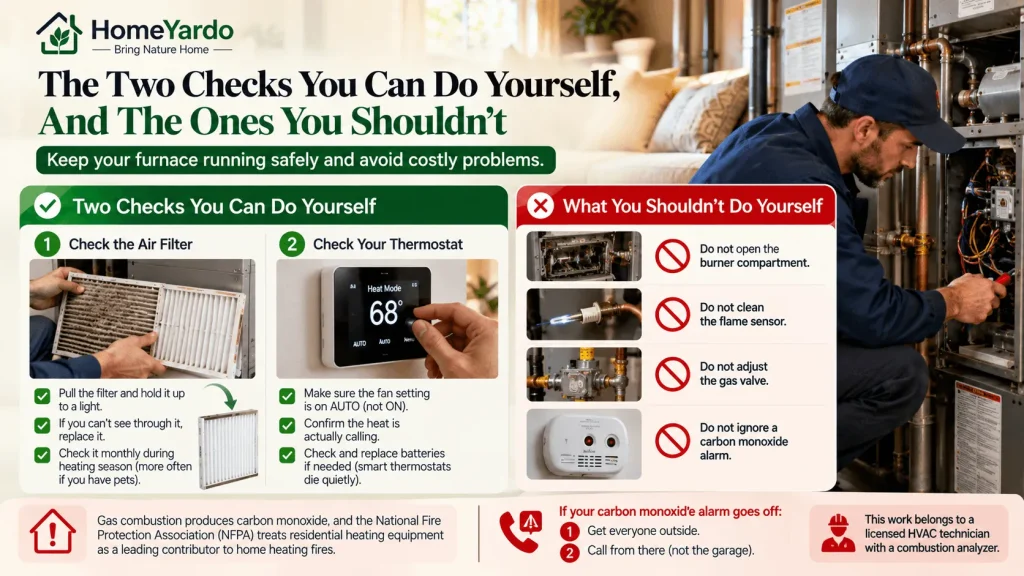
Filter first. Pull it, hold it up to a light, and if you can’t see through it, replace it. A clogged filter is the single most common cause of a furnace running hot, and it costs you fifteen dollars and two minutes. Check it monthly during heating season, not quarterly. If you have pets, check it more.
Thermostat second. Confirm the fan setting is on AUTO, not ON, and that the heat is actually calling. Batteries in a smart thermostat die quietly and produce the exact symptoms of a dead furnace.
Now the part where I’ll be direct with you. Do not open the burner compartment, do not clean the flame sensor, do not adjust the gas valve, and do not ignore a carbon monoxide alarm. Gas combustion produces carbon monoxide as a normal byproduct, and the National Fire Protection Association treats residential heating equipment as a leading contributor to home heating fires. Those two facts together are why this work belongs to a licensed technician with a combustion analyzer.
If your alarm goes off, get everyone outside and call from there. Not the garage.
What A Technician Actually Checks When They Arrive
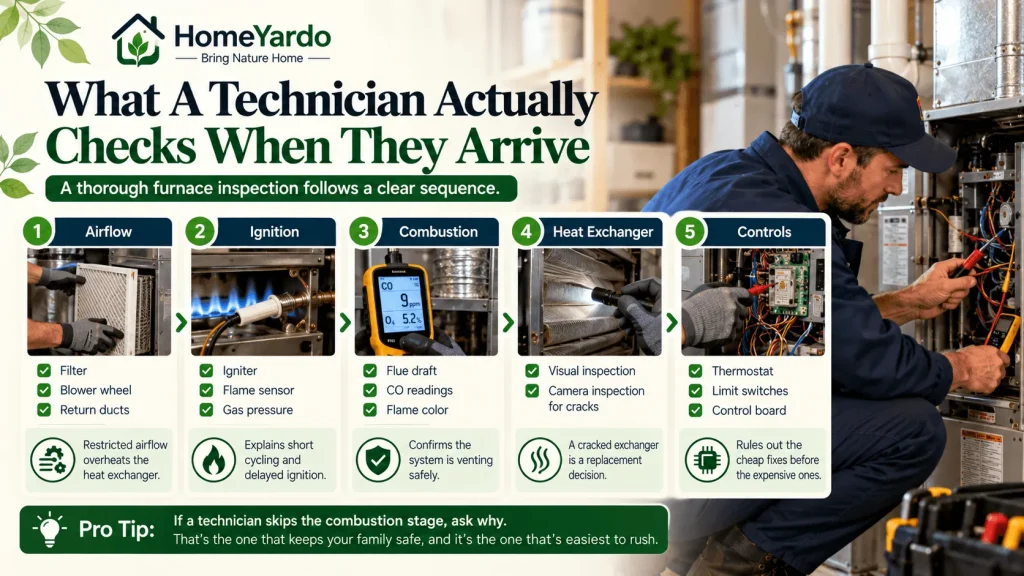
Good technicians work in a sequence, and knowing that sequence helps you judge whether the visit was thorough. Here’s the order I’d expect for any furnace past its fifth birthday.
| Stage | What gets tested | Why it matters |
|---|---|---|
| Airflow | Filter, blower wheel, return ducts | Restricted airflow overheats the heat exchanger |
| Ignition | Igniter, flame sensor, gas pressure | Explains short cycling and delayed ignition |
| Combustion | Flue draft, CO readings, flame color | Confirms the system is venting safely |
| Heat exchanger | Visual and camera inspection for cracks | A cracked exchanger is a replacement decision |
| Controls | Thermostat, limit switches, control board | Rules out the cheap fixes before the expensive ones |
If a technician skips the combustion stage, ask why. That’s the one that keeps your family safe, and it’s the one that’s easiest to rush.
Repair Or Replace? A Simple Decision Path
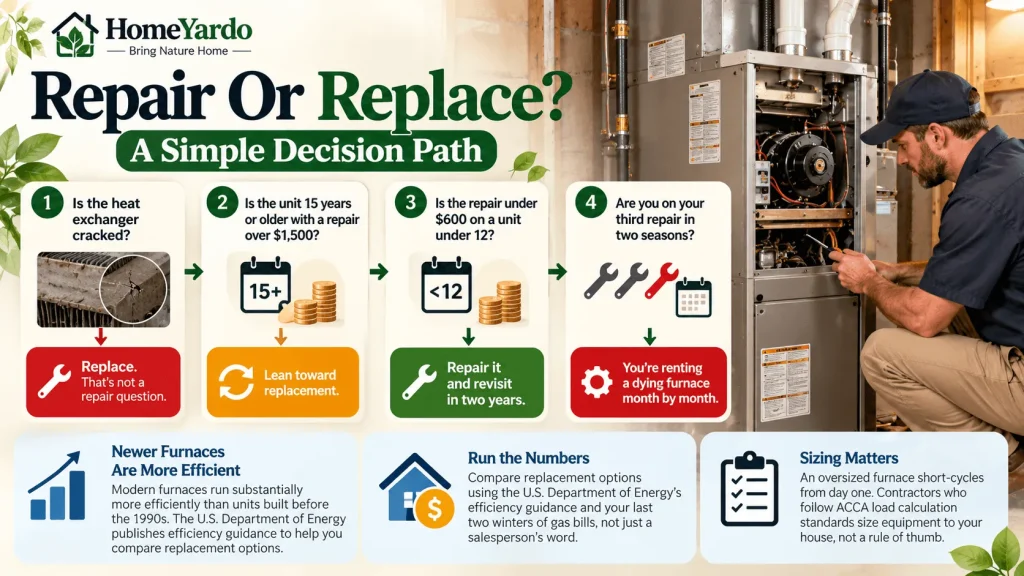
Homeowners ask me this constantly, and I think the honest answer is less about age than about money and safety combined. Here’s how I’d walk through it.
- Is the heat exchanger cracked? Replace. That’s not a repair question.
- Is the unit 15 years or older with a repair over $1,500? Lean toward replacement.
- Is the repair under $600 on a unit under 12? Repair it and revisit in two years.
- Are you on your third repair in two seasons? You’re renting a dying furnace month by month.
Modern furnaces run substantially more efficiently than units built before the 1990s, and the U.S. Department of Energy publishes efficiency guidance that helps you compare replacement options on paper rather than on a salesperson’s word. Run the numbers against your last two winters of gas bills before you decide.
One more thing: sizing matters as much as brand. An oversized furnace short-cycles from day one, which is the exact problem you were trying to escape. Contractors who follow ACCA load calculation standards size equipment to your house, not to a rule of thumb about square footage.
The Maintenance Rhythm That Prevents Most Of This
Here’s the schedule I’d hand any homeowner, and it’s the one that keeps you out of the emergency call category.
- Monthly, October through March: inspect and replace the filter as needed.
- Every fall: book a tune-up before the first cold snap, not during it.
- Annually: have combustion and CO levels tested with instruments.
- Every two to three years: have the ductwork checked for disconnected joints and leaks.
- Always: keep two feet of clearance around the furnace and never store paint or solvents near the burner.
That’s the entire system. Filters, timing, and a technician who actually tests combustion. Nothing exotic, and it costs a fraction of one mid-winter emergency visit.
The One Habit Worth Building This Week
Go downstairs tonight and just listen. Stand next to your furnace for two full cycles and pay attention to how long the burner runs, what color the flame is, and whether anything sounds like it’s straining. Ninety seconds of listening tells you more than any smart thermostat app ever will.
If something feels off, write down what you heard and when. That note makes the service call faster, and it stops a technician from chasing problems that aren’t there. Warm houses aren’t lucky. They’re maintained.
FAQ
Repeated short cycling, unusual noises, unreliable heating, frequent repairs, changes in normal operating behavior, and an older furnace that increasingly struggles to maintain comfort can all justify an inspection. No single symptom proves that replacement is required.
It can indicate a furnace problem, but short cycling has several possible causes, including restricted airflow, thermostat issues, overheating, controls, ignition problems, and equipment faults. Persistent short cycling should be diagnosed rather than treated as proof that the furnace needs replacement.
Consider the furnace’s overall condition, recent repair history, current repair cost, efficiency, warranty coverage, and reliability. Age alone does not force replacement, although ENERGY STAR identifies furnaces older than 15 years as candidates for replacement consideration.
Repeated short cycles may involve airflow restrictions, thermostat problems, controls, overheating, ignition components, or other faults. Check homeowner-accessible items such as the thermostat and filter, then arrange service if the pattern continues.