The Roof Maintenance Decisions That Can Prevent Costly Repairs
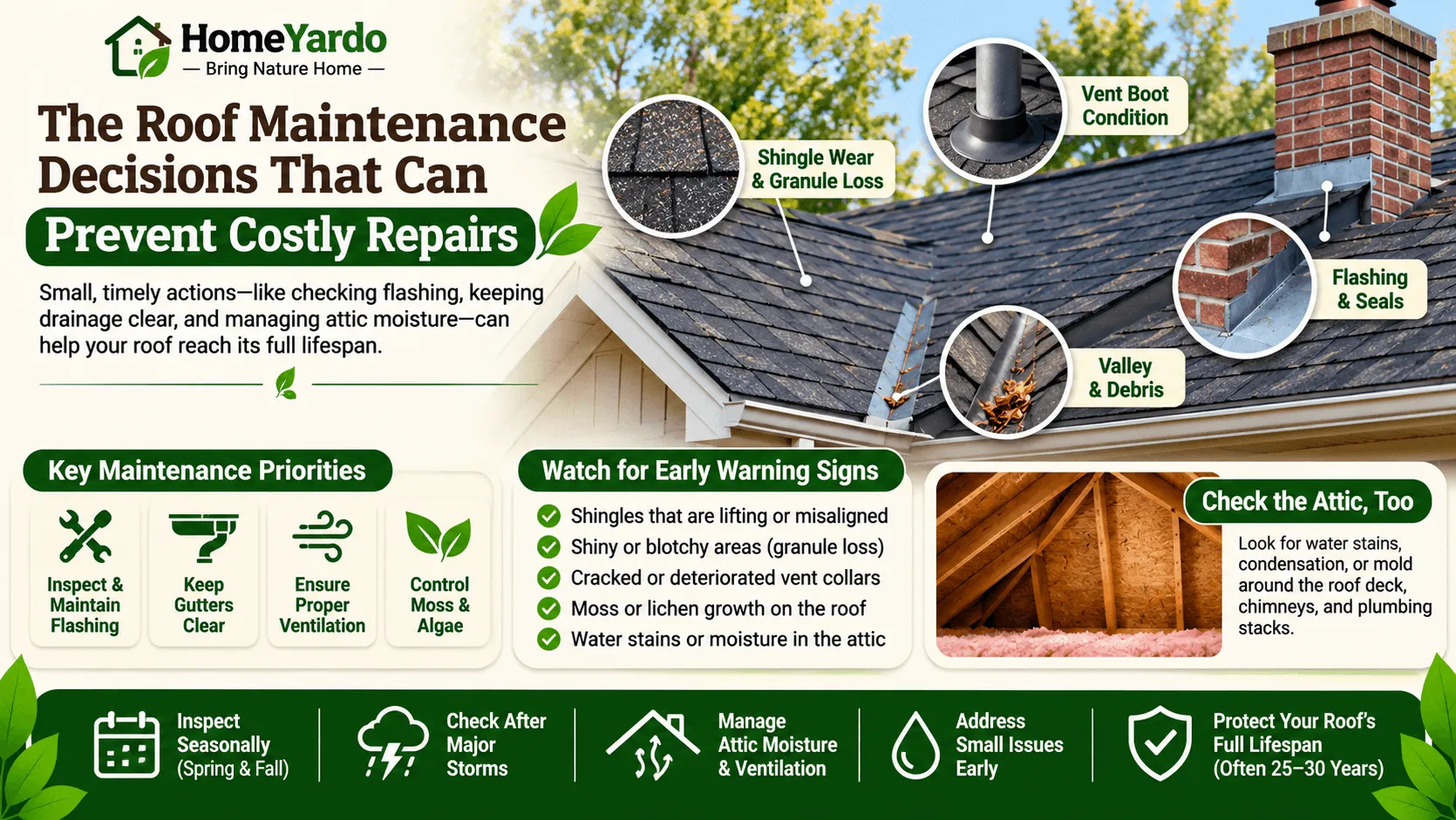
Residential roofs very seldom fail catastrophically. Though homeowners frequently see roof issues in terms of violent summer storms and broken branches, in fact, the large majority of premature roof replacements occur due to tiny failures that have not been noticed for years. A hairline crack in pipe boot flashing, clogged soffit vents, and several brittle shingles around a valley will generally not trigger any interior damage. They simply allow moisture seepage beneath the membrane, and what was going to cost homeowners a few dollars in maintenance becomes costly damage to decking and other parts of the house.
The biggest misunderstanding about residential roofs is to see them as self-maintaining assets and not systems. When the process of wear and tear and its impact on the roof’s components is understood, and timely action is taken, homeowners will be able to keep their roofs for their expected 25 to 30-year lifespan. Understanding how long a roof lasts in a four-season climate can also help homeowners plan maintenance according to seasonal weather exposure.
The Mechanics of Water Ingress at Critical Junctions
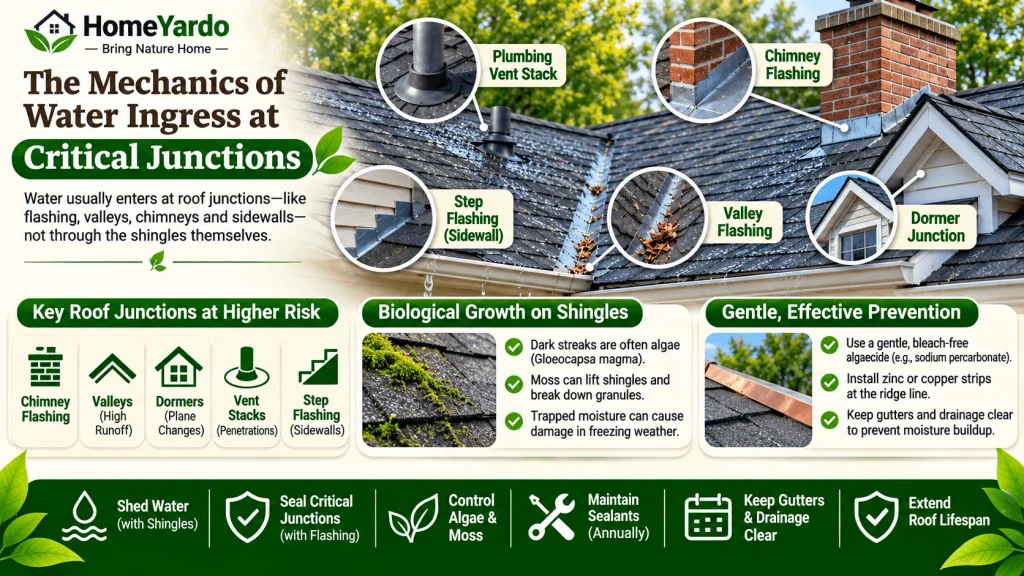
Although shingles form most of the roof surface area, shingles are not meant to stop water from entering a roof. Instead, shingles are meant to shed water through gravity down the roof slope. The real defense against water entry is found in the roof penetrations, changes in planes, and edges of the roof.
Flashing assemblies that surround the chimney, dormers, plumbing vent stacks, and valleys are subjected to the most hydraulic force on the entire roof. Flashing in closed-cut or woven valleys is subjected to increased velocity of water runoff and grit and biological debris, which strip away the protective granular shield on the asphalt surface. With corrosion or uplift of valley flashing, runoff has an easy passage under the tabs of neighboring shingles.
Step flashing around the sidewalls is yet another common problem area. Step flashing consists of individual L-shaped metal cards that need to alternate with each new course of shingles so as to divert the runoff towards the outside. With time, fasteners can become loose due to the seasonal expansion and contraction of the flashing.
Homeowners should inspect the caulking and counter-flashing joints around masonry chimneys at least once a year. Mortar joints absorb moisture, and when freeze-thaw cycles widen the gap between brick and metal, standard polyurethane or silicone sealants begin to tear. Regular re-sealing using high-grade elastomeric sealants, as recommended by the National Roofing Contractors Association, maintains the waterproof seal without requiring a complete flashing rebuild.
Biological Growth and Granule Conservation
Dark streaks commonly found on asphalt shingles are usually perceived to be dirt stains when, in fact, they are colonies of Gloeocapsa magma, an airborne cyanobacterium that feeds on the limestone fillers used in the manufacture of contemporary shingle formulas. While algae by itself does not cause any major structural damage except being unsightly, algae provides moisture which encourages moss and lichen growth.
Moss is structurally destructive. Unlike algae, moss grows roots called rhizoids that penetrate between the edges of shingles. With a moss cushion holding the water against asphalt, it causes breakdown of ceramic granules and the strips of adhesive that keep shingles intact. Under freezing conditions, the moisture expands, causing physical damage to shingles and loosening of the sealant strips.
Moss should be treated carefully. High-pressure cleaning is not recommended for asphalt shingles because the water jet peels off the protective mineral granules, which protect the asphalt beneath from the sun’s ultraviolet rays. With mineral particles gone, the sun oxidizes the asphalt quickly, resulting in curling and cracking.
Instead, applying a gentle chemical treatment like sodium percarbonate or a dilute, bleach-free algaecide during dry conditions lets the moss die off naturally. To prevent future colonization, installing zinc or copper strips along the ridge line releases microscopic metal ions during rainfall, which naturally inhibits biological growth across the downslope. Combining these treatments with seasonal gutter and drainage maintenance could ensure that biological runoff does not end up clogging downspouts and causing perimeter overflows.
Homeowners can also learn how trees, gardens, and drainage affect roof lifespan to reduce moisture-related problems around their property.
Ventilation Dynamics And Regional Climate Stresses
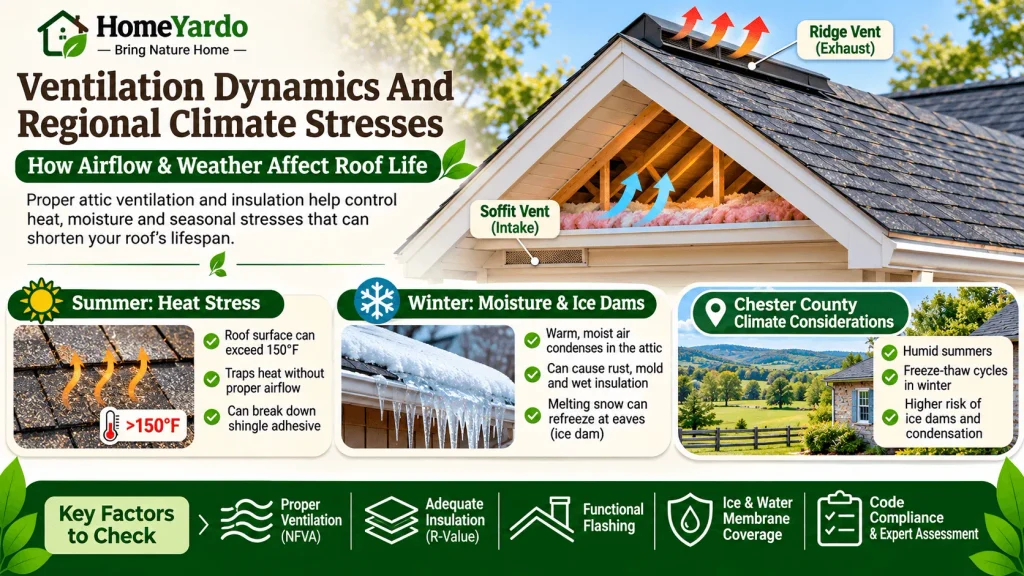
The lifespan of a roof can be determined just as much by what takes place beneath the deck as by what is going on at the surface of the roof. An asphalt shingle being baked under the sun during hot summer days can easily become hot enough to have a surface temperature of more than 150 degrees Fahrenheit. If there is no intake of air from the soffit vents and exhaust of the air through the ridge vent, the heat radiated from below will cook the adhesive in the shingles and shorten their lifespan.
During the winter season, the risk becomes the opposite. Moisture-laden air from living quarters that rises into the poorly ventilated attic condenses on the plywood deck, causing the roofing nails to rust and encouraging molds to grow between rafter bays and packing the fiberglass insulation.
Such conditions become especially critical in temperate, humid areas experiencing pronounced seasonal changes. In Chester County, houses regularly face exposure to humid weather during the summer and freeze cycles in winter. Once snow accumulates on the roof and attic warmth melts the lower layer of snow, the melting water becomes frozen again upon contact with the cold, non-insulated eaves and creates an ice dam. The water then accumulates behind the dam and starts moving backward under the shingles.
In case of complicated architectural shapes or old buildings typical of Chester County, an analysis of the cause of the problem of insufficient R-value insulation, blocked intake baffles, or faulty flashing requires expertise. Homeowners dealing with repeated icing in winter or abnormal condensation in the attic can turn to trusted roofing contractors in Chester County who can determine the exact net free ventilating area (NFVA) based on the building codes and find out if the self-adhesive ice and water membranes cover enough distance beyond the exterior wall line. Such diagnostics should be done prior to the arrival of winter storms.
Diagnostic Inspections: The Ground And Attic Strategy
There is no need to go up to steep areas during a complete roof inspection because it poses dangers, apart from causing the granules to fall out. A high-magnification set of binoculars would be sufficient to give the homeowner a complete visual audit of the property from the ground in spring and autumn.
The following are the subtle things that should be looked for during this visual examination:
- Tab Alignment: Small differences where the tabs do not align anymore because of loose nails and adhesive strips.
- Surface Texture: Shiny and blotchy surfaces that appear on the shingles as a result of loss of granules, exposing the asphalt surface.
- Pipe Penetration Collar: Rubber Neoprene boots around vent pipes for signs of deterioration, splitting and cracks.
Pair the ground-level scan with a targeted inspection inside the attic during a steady rain. Carry a high-lumen flashlight and examine the underside of the CDX plywood or oriented strand board (OSB) sheathing, paying close attention to the areas surrounding chimneys and plumbing stacks. Look for black water stains, active drips, or white efflorescence rings around nail heads, which indicate persistent condensation.
Catching these signs early keeps maintenance tasks confined to minor resealing, boot replacement, or localized tab repair. By pairing disciplined seasonal inspections with timely professional assessments when structural questions arise, homeowners can protect their primary weather envelope and avoid premature capital expenditures.
Final Takeaway
The most valuable roof maintenance decisions often concern small, easily overlooked components.
A damaged vent boot, blocked valley, moisture-filled attic, or lifting shingle may seem minor when first noticed. Yet ignoring these conditions can allow damage to reach insulation, decking, and interior finishes.
Regular inspections, suitable cleaning methods, prompt flashing repairs, and proper attic moisture management can help preserve the roof’s condition.
Homeowners do not need to become roofing experts. They need to recognize warning signs, avoid risky repairs, and know when professional attention is warranted.
Frequently Asked Questions About Roof Maintenance
A visual inspection in spring and fall is a useful starting point for many homes. Additional checks are appropriate after significant storms, and professional inspection frequency should reflect the roof’s age, condition, and warranty requirements.
Addressing damaged flashing, keeping drainage systems clear, controlling moss, and correcting attic moisture problems can reduce avoidable deterioration. Early investigation of leaks is particularly important because water can damage materials beyond the original entry point.
There is no single cause for every roof. Damaged flashing, deteriorated vent boots, missing shingles, installation defects, and other vulnerable roof connections are common sources of water intrusion.
Yes. Blocked gutters can overflow and expose fascia, soffits, and nearby materials to moisture. In cold climates, drainage problems may also contribute to ice buildup around the roof edge.