Tree Roots Vs Your Driveway: How to Protect Both
It usually starts small. A hairline crack in the driveway. A sidewalk slab that sits half an inch higher than the one next to it. A pool deck tile that suddenly rocks when you step on it.
Then you look over at the big oak you planted fifteen years ago, the one that gives the whole front yard its shade, and the penny drops.
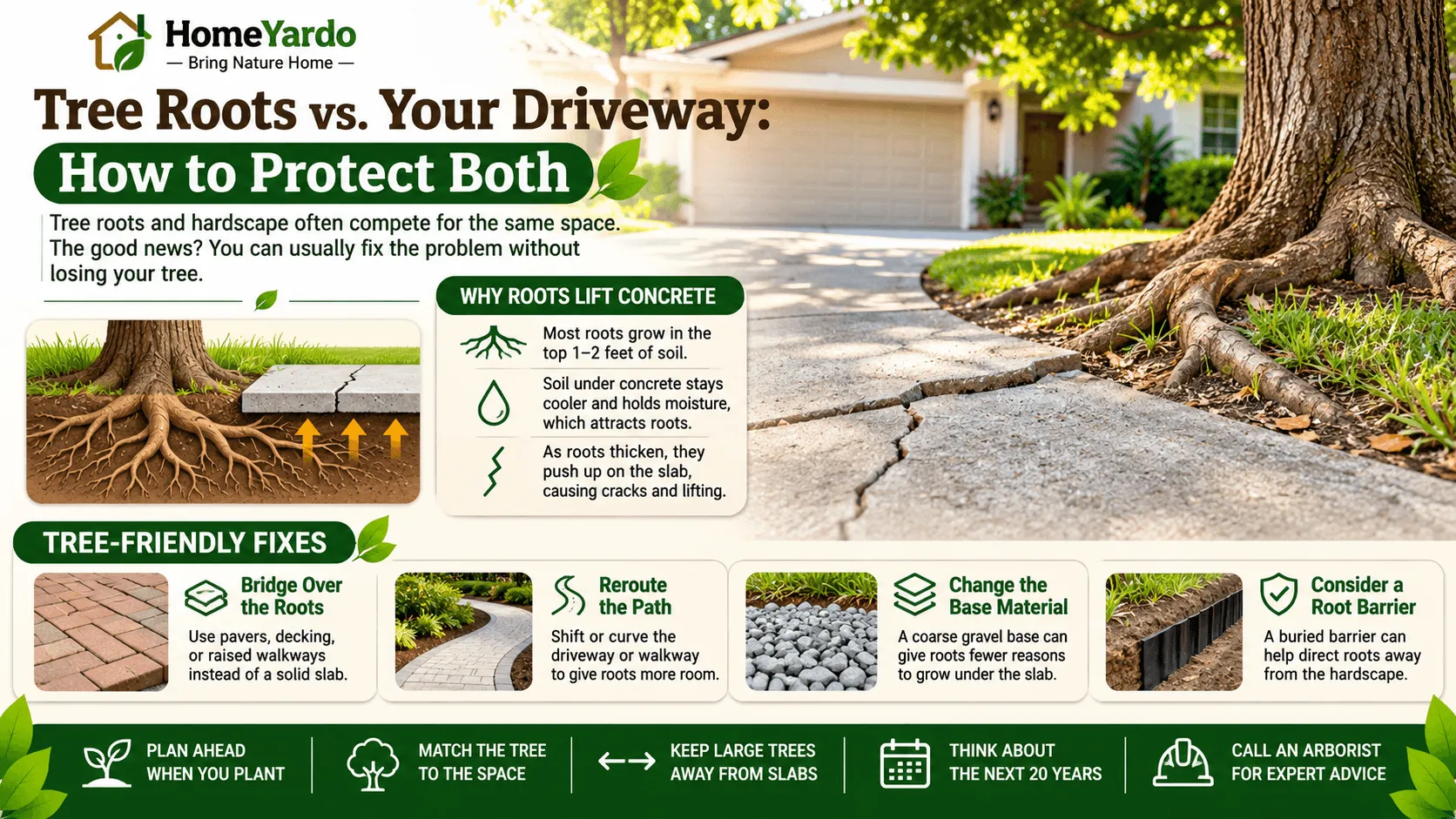
Tree roots and hardscape fight over the same few inches of soil, and on most properties nobody planned for that. The good news is that you rarely have to choose between the tree and the driveway. Here’s how the conflict happens, what actually works to fix it, and the mistakes that turn a cracked slab into a fallen tree.
Why Roots Lift Concrete
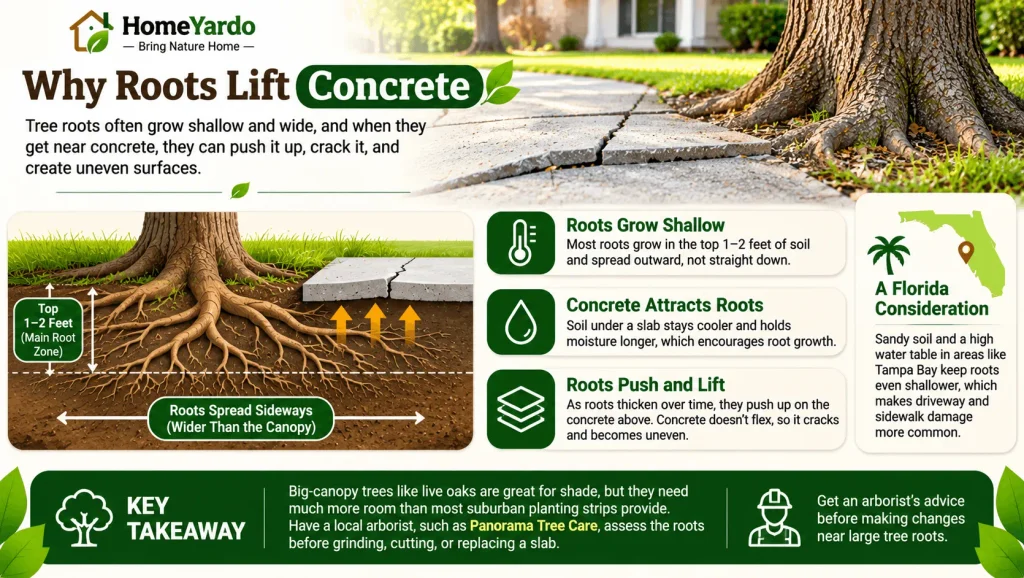
Most tree roots grow in the top foot or two of soil, right where your driveway sits. People picture roots as a deep taproot mirroring the canopy. In reality, the bulk of a tree’s root system spreads sideways, close to the surface, often well past the edge of the branches.
Concrete makes that worse. The soil under a slab stays cooler and holds moisture longer than open ground, so roots grow toward it. As each root thickens a little every year, it pushes up on whatever is sitting on top of it. Concrete doesn’t flex, so it cracks.
In much of Florida, sandy soil and a high water table keep roots even shallower. That’s why homeowners around Tampa Bay run into it so often. Before anyone grinds down that slab, get an arborist who knows Tampa’s big oaks, such as the team at Panorama Tree Care, to look at the roots. Big-canopy favorites like live oaks are beautiful, but they need far more room than most suburban planting strips give them.
Figure Out What You’re Dealing With
Before fixing anything, find out which tree is causing the damage and how big its roots are. It isn’t always the closest one. Roots can travel a long way, and a neighbor’s tree is sometimes the real culprit.
Walk the area and look for:
- Raised or cracked slabs, and which direction the lift runs
- Surface roots visible at the edges of the concrete
- Roots growing along cracks or expansion joints
- A tree whose trunk flare sits close to the hardscape
The trunk flare matters more than most people think. That’s the wide base where the trunk widens into the main roots, and it keeps growing for the life of the tree. A flare that’s only a foot or two from your driveway today will be in conflict with it soon, if it isn’t already.
Not every driveway crack comes from tree roots, though. Poor drainage, erosion, and soil settlement can also cause concrete to shift. If you notice standing water or washed-out soil near the pavement, HomeYardo’s guide on how to fix yard drainage can help you identify other possible causes.
The Mistake That Makes Things Worse
Cutting big roots close to the trunk can make a tree unstable. This is the most common and most dangerous “fix.” A contractor grinds down the lifted slab, finds a thick root underneath, and cuts it out so the new concrete sits flat.
The problem is that those large roots near the trunk are the anchors holding the tree upright. Remove enough of them on one side and the tree can lean or fall in the next strong wind. In storm-prone areas, that’s a serious risk to the house, cars and anyone nearby.
Cut roots also open the door to decay. The tree may look fine for a year or two, then start to decline from the base. If roots must be pruned, it should be done by an arborist who can judge how much the tree can lose and where to cut.
Fixes That Protect The Tree
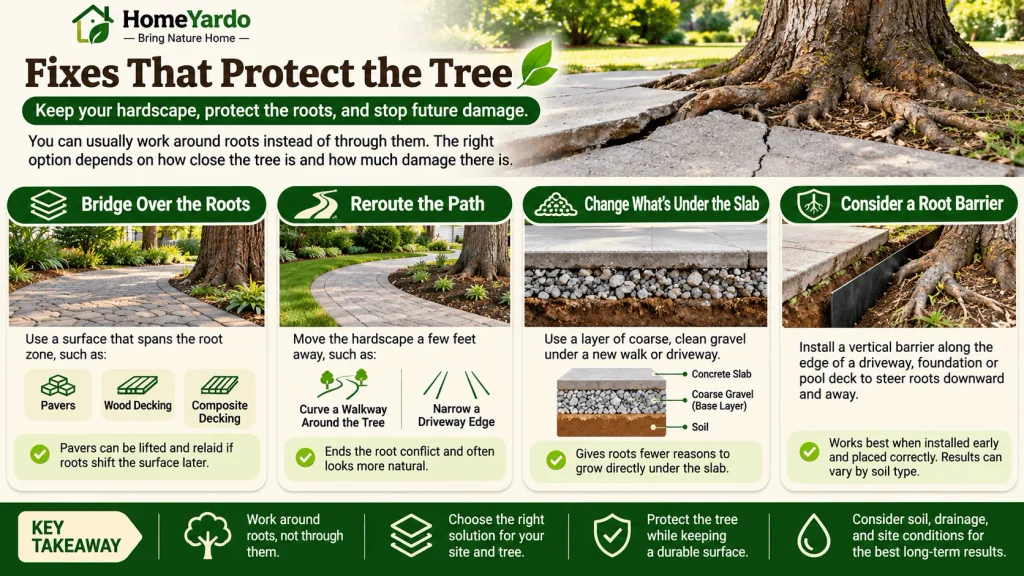
You can usually work around roots instead of through them. The right option depends on how close the tree is and how much damage there already is.
Bridge Over the Roots
Instead of pouring new concrete directly on top of roots, build the surface so it spans them. Interlocking pavers, wood or composite decking and raised walkways can all sit over a root zone without crushing it. Pavers have an extra bonus: if roots lift a few later, you can pull them up, adjust the base and relay them.
Reroute the Path
Sometimes the simplest answer is moving the hardscape a few feet. Curving a walkway around a tree, or narrowing a driveway edge near the trunk, can end the conflict for good. It also tends to look better, since a path that bends around a mature tree feels intentional.
Change What’s Under the Slab
What sits under the concrete affects where roots grow. A layer of coarse, clean gravel under a new walk gives roots fewer reasons to grow right under the slab. Ask your contractor about the base before the pour, not after.
If you’re replacing damaged pavement, review the base preparation before pouring new concrete. HomeYardo’s guide to residential concrete projects explains how drainage, soil preparation, and slab construction affect the lifespan of driveways and other outdoor surfaces.
Consider a Root Barrier
A root barrier is a vertical panel buried along the edge of a driveway, foundation or pool deck. It steers roots downward and away from the structure. Barriers work best when they’re installed before roots reach the hardscape, and they need to be placed correctly to do much good.
Results also vary with soil type. Research from the University of Florida found that in compacted or poorly drained soils, roots can grow under a barrier and come back up on the other side. A barrier is a tool, not a guarantee, so it pays to have someone check your site before you buy one.
Plan Ahead When You Plant
The cheapest root problem is the one you avoid at planting time. Most conflicts come from putting a large tree in a space meant for a small one.
Before planting, check the tree’s mature size, not just its height but its trunk diameter at full size. Large shade trees need wide planting areas, and small ornamental trees are a better fit for narrow strips between a sidewalk and the street. Researchers at the University of Florida put together a practical guide on how much space a shade tree needs, with planting width recommendations for common Florida species. They note that live oaks are often planted in small spaces only to be removed about a decade later once they start damaging pavement. A few minutes with a guide like that can save you a driveway and a tree.
A few planting habits that help:
- Match the tree to the space. Big trees need big, open areas.
- Keep large trees away from slabs. Give them plenty of room from driveways, walls and pools.
- Think about the next 20 years. A sapling looks tiny next to the house today. It won’t stay that way.
- Avoid building over existing root zones. Trenching, grading and heavy equipment all damage roots you can’t see.
When To Call A Professional
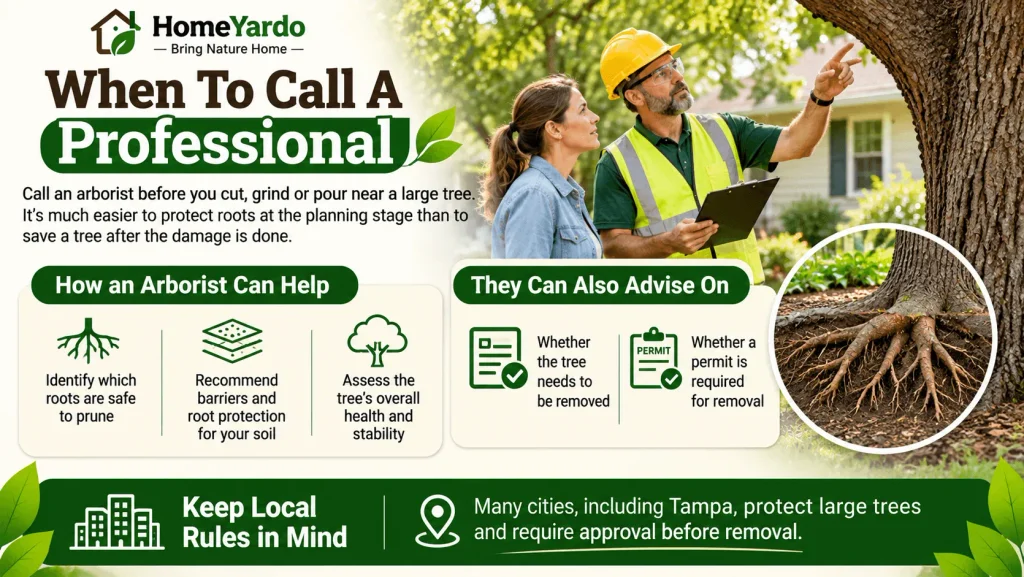
Call an arborist before you cut, grind or pour near a large tree. It’s much easier to protect roots at the planning stage than to save a tree after the damage is done.
A qualified arborist can tell you which roots are safe to prune, whether a barrier makes sense on your soil, and whether the tree is still stable. If the tree has to go, they can also tell you whether a permit is needed. Many cities, including Tampa, protect large trees and require approval before removal.
Conclusion
A cracked driveway and a big, healthy tree don’t have to be a choice between one or the other. Understand where the roots are, avoid cutting the ones that hold the tree up, and look at fixes like bridging, rerouting and smarter planting first. Most of the time, a little planning lets you keep the shade and the smooth driveway.
Frequently Asked Questions
They can, but it’s less common than damage to driveways, sidewalks and pool decks. Roots usually take advantage of existing cracks or leaks rather than breaking through solid foundations. A cracked foundation near a big tree is still worth having checked by a structural professional and an arborist.
Not automatically. Bridging, rerouting the hardscape or careful root management can often solve the problem while keeping a healthy tree. Removal makes more sense when the tree is declining, unstable or simply in the wrong place for its size.
They can help, especially when installed before roots reach a structure. Results depend on soil type, drainage and installation, so they work better on some sites than others.
It depends on the species and its mature size. Small trees can sit closer to hardscape, while large shade trees need much wider planting areas. Check the mature trunk size and spread before you plant.