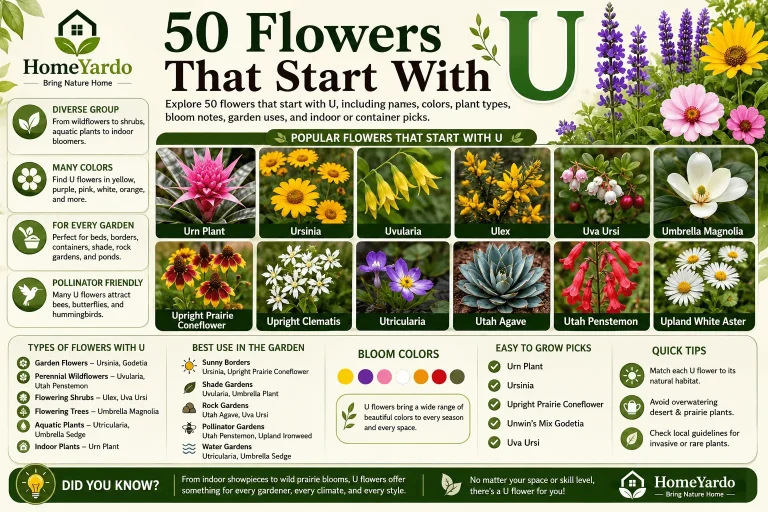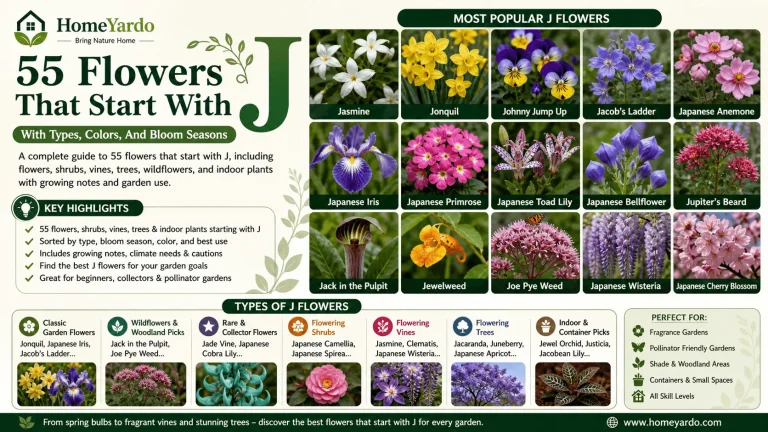
30 Beautiful Varieties of Flowers That Starting With V You Didn’t Know About
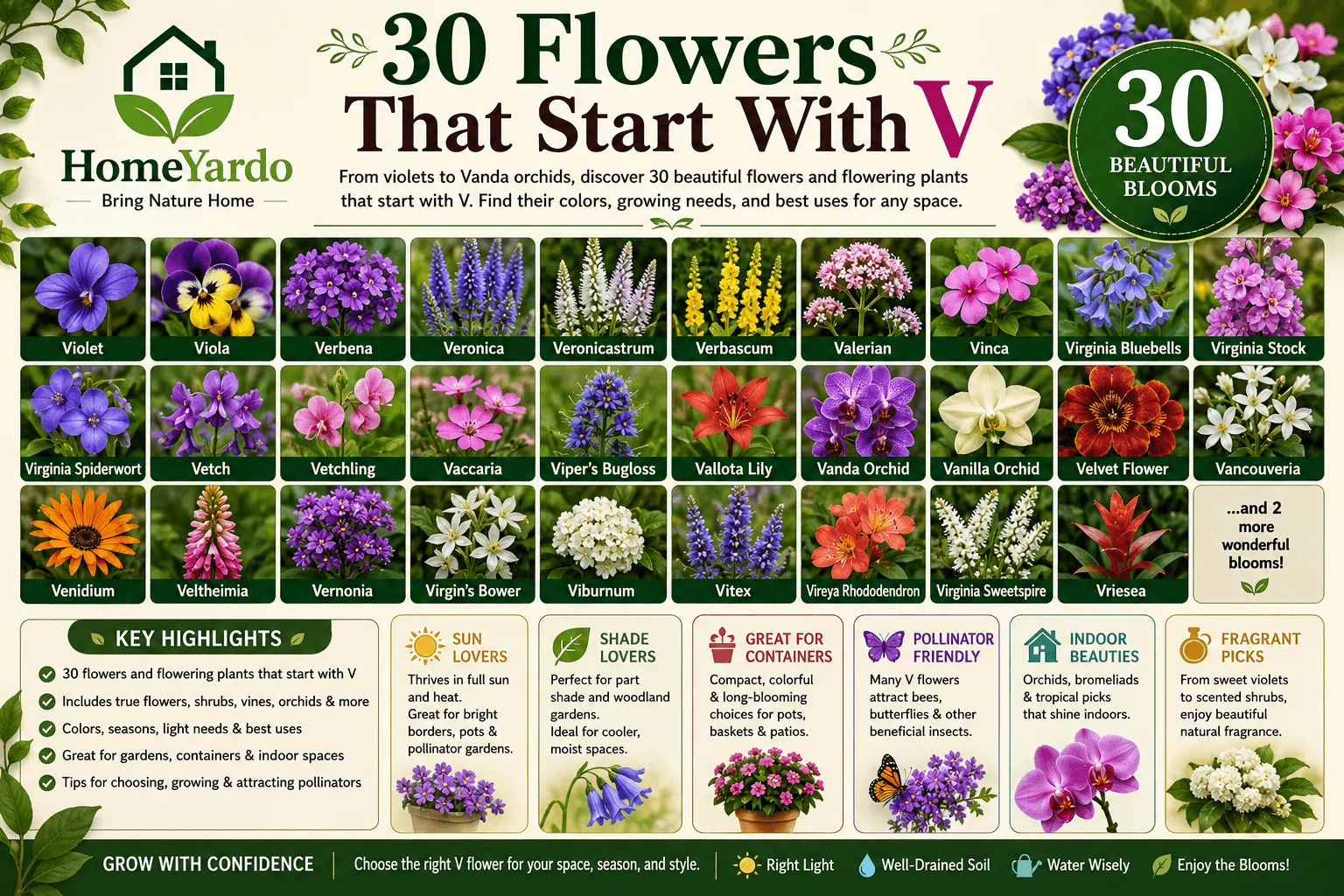
The letter V does not offer the longest flower list, but it still covers a wide range of garden styles. There are soft spring flowers, bright annuals, tall border plants, meadow bloomers, fragrant shrubs, and tropical indoor plants all in the same group.
Violet, viola, verbena, and Veronica are the names most people know first. After that, the list opens into less familiar choices such as Vancouveria, Veltheimia, Vanda orchid, and Vernonia.
The list below brings together 30 flowers and flowering plants that start with V. It also makes room for color filters, container picks, indoor options, fragrance notes, and a simple way to match the right plant to the right space. For the previous letter in the flower alphabet, see flowers that start with U.
Quick Answer: What Are Flowers That Start With V?
Flower names that start with V include violet, viola, verbena, Veronica, valerian, vinca, Virginia bluebells, Virginia stock, Vanda orchid, Vernonia, and many more. Some V names are true flowers, while others are flowering shrubs, vines, orchids, or indoor bloomers.
The full list below includes 30 entries. Each one is labeled by type, bloom color, light needs, season, and best use, so it is easier to compare them for borders, containers, woodland planting, or indoor display.
Violet usually leads in name recognition, while Verbena often stands out as one of the most useful V flowers for sunny garden planting. For the next letter guide, continue with flowers that start with W.
V Named Flowers: At A Glance Table
The table below gives a fast comparison of all 30 entries before the detailed profiles.
| Common Name | Botanical Name | Type | Also Called | Main Color | Sun Needs | Life Cycle | Bloom Season | Native Region | Best For |
|---|---|---|---|---|---|---|---|---|---|
| Violet | Viola odorata | True flower | Sweet violet | Purple, white | Part shade | Perennial | Spring | Europe, western Asia, and widely grown elsewhere | Shade edges, fragrance |
| Viola | Viola × wittrockiana and hybrids | True flower | Pansy group, bedding viola | Purple, yellow, white, mixed | Sun to part shade | Annual or short-lived perennial | Spring to cool season | Garden hybrid | Pots, edging, cool season color |
| Verbena | Verbena × hybrida | Flowering plant | Garden verbena | Purple, pink, red, white | Full sun | Annual or perennial by climate | Late spring to frost | Garden hybrid | Containers, borders, pollinators |
| Veronica | Veronica spicata | True flower | Speedwell | Blue, purple, white, pink | Full sun | Perennial | Summer | Europe, Asia, garden grown widely | Borders, pollinator beds |
| Veronicastrum | Veronicastrum virginicum | True flower | Culver’s Root | White, pale lavender | Full sun to part shade | Perennial | Summer | North America | Tall borders, naturalistic planting |
| Verbascum | Verbascum species | True flower | Mullein | Yellow, white, apricot, pink | Full sun | Biennial or perennial | Late spring to summer | Europe, Asia, garden grown widely | Dry borders, vertical accents |
| Valerian | Valeriana officinalis | True flower | Garden valerian | White, blush pink | Full sun to part shade | Perennial | Early to mid-summer | Europe, Asia, naturalized elsewhere | Cottage gardens, scent |
| Vinca | Catharanthus roseus | Flowering plant | Periwinkle, Madagascar periwinkle | Pink, white, red, purple | Full sun | Tender perennial often grown as annual | Summer to frost | Madagascar, widely grown in warm climates | Heat-tolerant pots, bedding |
| Venus’s Looking Glass | Triodanis perfoliata | True flower | Clasping Venus’s Looking Glass | Blue purple | Full sun to part shade | Annual | Spring to early summer | North America | Wildflower areas |
| Virginia Bluebells | Mertensia virginica | True flower | Eastern bluebells | Blue, pink buds | Part shade | Perennial | Spring | Eastern North America | Woodland gardens |
| Virginia Stock | Malcolmia maritima | True flower | Malcolmia | Pink, purple, white | Full sun | Annual | Spring to early summer | Mediterranean region | Edging, scent, cool season beds |
| Virginia Spiderwort | Tradescantia virginiana | True flower | Spider lily, spiderwort | Blue, purple, pink | Sun to part shade | Perennial | Late spring to summer | Eastern North America | Native beds, moist borders |
| Vetch | Vicia species | Flowering plant | Vetch pea group | Purple, pink, white | Full sun | Annual or perennial | Spring to summer | Europe, Asia, North America | Meadows, wildlife value |
| Vetchling | Lathyrus species | True flower | Everlasting pea group | Pink, purple, red | Full sun | Annual or perennial | Spring to summer | Europe, Mediterranean, garden grown widely | Climbers, informal planting |
| Vaccaria | Vaccaria hispanica | True flower | Cowherb | Pink, white | Full sun | Annual | Summer | Europe, western Asia | Cutting gardens |
| Viper’s Bugloss | Echium vulgare | True flower | Blueweed | Blue purple | Full sun | Biennial | Summer | Europe, western Asia, naturalized elsewhere | Pollinator beds, dry soils |
| Vallota Lily | Cyrtanthus elatus | True flower | Scarborough lily | Red, scarlet | Bright light | Tender perennial | Late summer | South Africa | Pots, warm patios |
| Vanda Orchid | Vanda species | Orchid | Vanda | Purple, blue, pink, white, yellow | Bright filtered light | Perennial | Varies by type | Tropical Asia | Indoor display, tropical collections |
| Vanilla Orchid | Vanilla planifolia | Orchid | Vanilla vine | Cream, greenish white | Bright filtered light | Perennial vine | Warm season bloom cycle | Mexico and Central America | Indoor collections, greenhouse growing |
| Velvet Flower | Salpiglossis sinuata | True flower | Painted tongue | Purple, gold, red, mixed | Full sun to light shade | Annual | Summer to fall | South America | Rich color beds, cutting |
| Vancouveria | Vancouveria hexandra | Flowering plant | Inside-out flower | White, cream | Part shade to shade | Perennial | Spring | Western North America | Woodland ground cover |
| Venidium | Arctotis fastuosa | True flower | African daisy type | Orange, yellow, white | Full sun | Annual | Summer | South Africa | Hot sunny beds |
| Veltheimia | Veltheimia bracteata | True flower | Forest lily, sand onion | Pink | Bright light | Tender perennial | Winter to early spring in mild conditions | South Africa | Containers, mild climates |
| Vernonia | Vernonia species | True flower | Ironweed | Purple | Full sun | Perennial | Late summer to fall | North America, tropical regions, depending on species | Pollinator beds, tall borders |
| Virgin’s Bower | Clematis virginiana | Flowering vine | Woodbine | White | Sun to part shade | Perennial | Late summer | Eastern North America | Fences, trellises |
| Viburnum | Viburnum species | Flowering shrub | Viburnum | White, pink | Sun to part shade | Perennial shrub | Spring | In the Northern Hemisphere, garden grown widely grown | Hedges, scent, structure |
| Vitex | Vitex agnus castus | Flowering shrub or small tree | Chaste tree | Lavender blue | Full sun | Perennial shrub | Summer | Mediterranean region | Dry gardens, pollinators |
| Vireya Rhododendron | Rhododendron section Schistanthe | Flowering shrub | Tropical rhododendron | Orange, red, pink, yellow | Bright shade | Perennial shrub | Varies by climate | Southeast Asia and Pacific islands | Tropical style planting |
| Virginia Sweetspire | Itea virginica | Flowering shrub | Sweetspire | White | Sun to part shade | Perennial shrub | Late spring to early summer | Eastern North America | Moist borders, native planting |
| Vriesea | Vriesea species | Bromeliad | Flaming sword group | Red, orange, yellow | Bright filtered light | Perennial | Varies by type | Central and South America | Pots, edging, cool-season color |
How This V List Was Chosen
The list of flowers that start with V follows a simple rule: every entry must have a common name that starts with V and must offer a clear ornamental bloom value. That includes true flowers, flowering plants, flowering shrubs, flowering vines, orchids, and a few specialty indoor bloomers.
Each name is labeled openly, so the count stays useful. A violet does not fill the same role as a viburnum, and a Vanda orchid does not behave like a bedding flower. Keeping those categories clear makes the guide easier to use in a real garden or indoor collection.
Common names can also shift by region. That is why botanical names are included throughout the table and flower profiles.
Editorial Trust Note
Plant names, bloom habits, and plant types should be checked against reliable horticultural references when accuracy matters. Common V flower names vary across regions, and some alphabet flower lists include shrubs, vines, or indoor bloomers without making that clear.
The guide below keeps those categories visible from the start. A true flower, a flowering shrub, and a bromeliad can all belong in the same V list, but they should not be treated as the same kind of plant.
30 Flowers Names That Start With V
The full profiles below keep a steady format, so each flower is easier to compare side by side. The list starts with familiar garden flowers, then moves into wildflower picks, rarer choices, and clearly labeled shrubs, vines, orchids, and indoor bloomers.
Vriesea is not a standard outdoor flower, though its long-lasting, colorful bracts make it one of the most useful Vriesea bloomers for indoor display. It suits bright filtered light and brings a clean tropical look.
How To Choose The Right Flower For Your Garden
The best V flower depends on more than color. Light, available space, maintenance level, bloom purpose, and season all shape the right choice. A small cool-season viola solves a very different need from a fragrant viburnum or a tropical orchid.
Familiar Garden Flowers
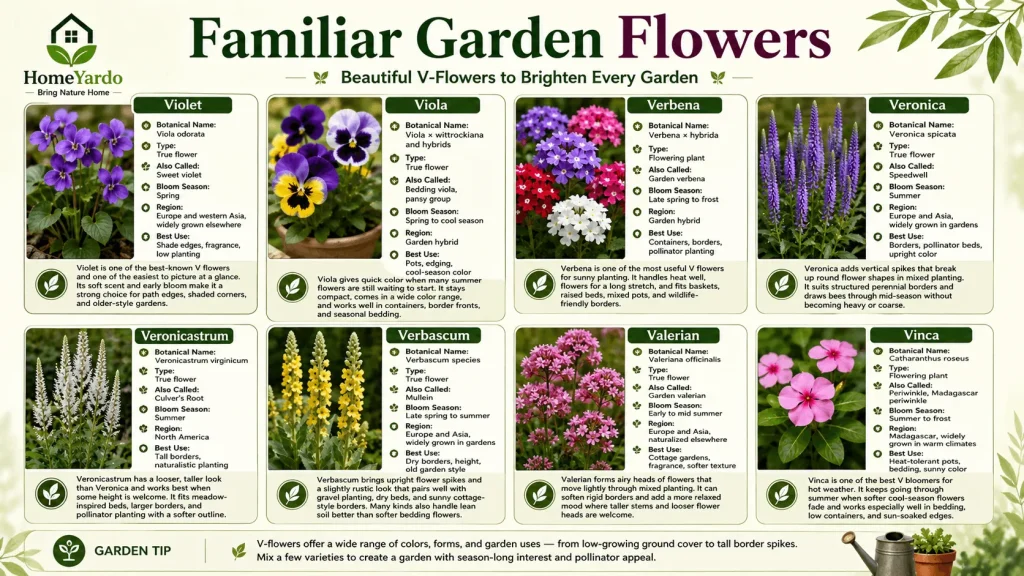
- Violet
- Botanical Name: Viola odorata
- Type: True flower
- Also Called: Sweet violet
- Bloom Season: Spring
- Region: Europe and western Asia, widely grown elsewhere
- Best Use: Shade edges, fragrance, low planting
- Violet is one of the best-known V flowers and one of the easiest to picture at a glance. Its soft scent and early bloom make it a strong choice for path edges, lightly shaded corners, and older-style gardens with a gentler look.
- Viola
- Botanical Name: Viola × wittrockiana and hybrids
- Type: True flower
- Also Called: Bedding viola, pansy group
- Bloom Season: Spring to cool season
- Region: Garden hybrid
- Best Use: Pots, edging, cool-season color
- Viola gives quick color when many summer flowers are still waiting to start. It stays compact, comes in a wide color range, and works well in smaller containers, border fronts, and seasonal bedding.
- Verbena
- Botanical Name: Verbena × hybrida
- Type: Flowering plant
- Also Called: Garden verbena
- Bloom Season: Late spring to frost
- Region: Garden hybrid
- Best Use: Containers, borders, pollinator planting
- Verbena is one of the most useful V flowers for sunny planting. It handles heat well, flowers for a long stretch, and fits baskets, raised beds, mixed pots, and wildlife-friendly borders.
- Veronica
- Botanical Name: Veronica spicata
- Type: True flower
- Also Called: Speedwell
- Bloom Season: Summer
- Region: Europe and Asia, widely grown in gardens
- Best Use: Borders, pollinator beds, upright color
- Veronica adds vertical spikes that break up round flower shapes in mixed planting. It suits structured perennial borders and draws bees through mid-season without becoming heavy or coarse.
- Veronicastrum
- Botanical Name: Veronicastrum virginicum
- Type: True flower
- Also Called: Culver’s Root
- Bloom Season: Summer
- Region: North America
- Best Use: Tall borders, naturalistic planting
- Veronicastrum has a looser, taller look than Veronica and works best when some height is welcome. It fits meadow-inspired beds, larger borders, and pollinator planting with a softer outline.
- Verbascum
- Botanical Name: Verbascum species
- Type: True flower
- Also Called: Mullein
- Bloom Season: Late spring to summer
- Region: Europe and Asia, widely grown in gardens
- Best Use: Dry borders, height, old garden style
- Verbascum brings upright flower spikes and a slightly rustic look that pairs well with gravel planting, dry beds, and sunny cottage-style borders. Many kinds also handle lean soil better than softer bedding flowers.
- Valerian
- Botanical Name: Valeriana officinalis
- Type: True flower
- Also Called: Garden valerian
- Bloom Season: Early to mid summer
- Region: Europe and Asia, naturalized elsewhere
- Best Use: Cottage gardens, fragrance, softer texture
- Valerian forms airy heads of flowers that move lightly through mixed planting. It can soften rigid borders and add a more relaxed mood where taller stems and looser flower heads are welcome.
- Vinca
- Botanical Name: Catharanthus roseus
- Type: Flowering plant
- Also Called: Periwinkle, Madagascar periwinkle
- Bloom Season: Summer to frost
- Region: Madagascar, widely grown in warm climates
- Best Use: Heat-tolerant pots, bedding, sunny color
- Vinca is one of the best V bloomers for hot weather. It keeps going through summer when softer cool-season flowers fade and works especially well in bedding, low containers, and sun-soaked edges.
Wildflower And Naturalistic Picks
Wildflower and naturalistic V flowers tend to feel lighter and less formal. Many fit meadow planting, native beds, woodland margins, or spaces where pollinator value matters as much as color.
- Venus’s Looking Glass
- Botanical Name: Triodanis perfoliata
- Type: True flower
- Also Called: Clasping Venus’s Looking Glass
- Bloom Season: Spring to early summer
- Region: North America
- Best Use: Wildflower areas, lean soils, natural edges
- This small, blue, purple wildflower looks delicate up close and works best where fine detail can be appreciated. It suits informal planting better than polished border designs.
- Virginia Bluebells
- Botanical Name: Mertensia virginica
- Type: True flower
- Also Called: Eastern bluebells
- Bloom Season: Spring
- Region: Eastern North America
- Best Use: Woodland gardens, spring display
- Virginia bluebells are among the finest spring woodland flowers in the V group. Pink buds open into cool blue blooms, then the plant eases back after its seasonal show, making it useful around slower-emerging shade plants.
- Virginia Stock
- Botanical Name: Malcolmia maritima
- Type: True flower
- Also Called: Malcolmia
- Bloom Season: Spring to early summer
- Region: Mediterranean region
- Best Use: Edging, scent, cool-season beds
- Virginia stock is compact, lightly fragrant, and easy to tuck into front edges or small seasonal beds. It gives a quick burst of color and suits cool-weather planting better than high summer heat.
- Virginia Spiderwort
- Botanical Name: Tradescantia virginiana
- Type: True flower
- Also Called: Spider lily, spiderwort
- Bloom Season: Late spring to summer
- Region: Eastern North America
- Best Use: Native beds, moist borders, part shade
- Virginia spiderwort offers soft blue, purple, or pink flowers and a relaxed habit that fits native style planting. It works especially well where the soil holds some moisture, and the light stays moderate.
- Vetch
- Botanical Name: Vicia species
- Type: Flowering plant
- Also Called: Vetch pea group
- Bloom Season: Spring to summer
- Region: Europe, Asia, North America
- Best Use: Meadows, wildlife support, loose planting
- Vetch is more at home in meadows and informal planting than in neat front borders. The blooms still earn it a place in a broader V guide, especially where wildlife value and softer natural growth matter.
- Vetchling
- Botanical Name: Lathyrus species
- Type: True flower
- Also Called: Everlasting pea group
- Bloom Season: Spring to summer
- Region: Europe and Mediterranean areas
- Best Use: Climbers, cottage gardens, informal supports
- Vetchling brings a pea flower look with a lighter climbing habit. It works well on rustic supports or where a looser floral screen is wanted without the weight of a thick vine.
- Vaccaria
- Botanical Name: Vaccaria hispanica
- Type: True flower
- Also Called: Cowherb
- Bloom Season: Summer
- Region: Europe and western Asia
- Best Use: Cutting gardens, airy planting
- Vaccaria is valued for its light stems and cutting potential. It slips through mixed planting easily and gives a lifted, open feel among fuller flowers.
- Viper’s Bugloss
- Botanical Name: Echium vulgare
- Type: True flower
- Also Called: Blueweed
- Bloom Season: Summer
- Region: Europe and western Asia, naturalized elsewhere
- Best Use: Pollinator beds, dry soils, meadow-style planting
- Viper’s bugloss is rougher in habit than many border flowers, but it is excellent for bees and dry sunny planting. Its strong blue-purple blooms stand out in wildlife-minded gardens.
Rare, Tropical, And Collector Picks
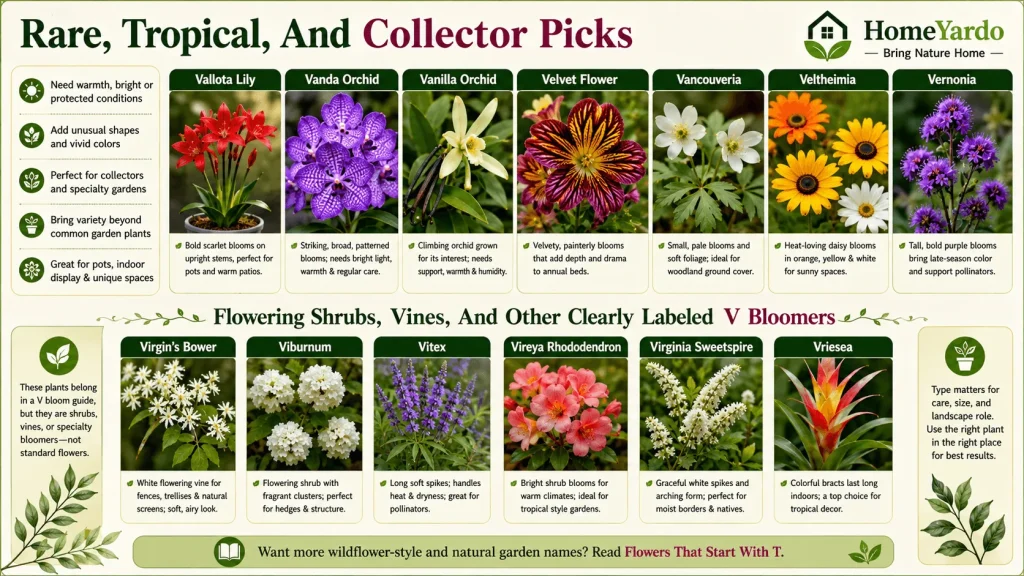
Some V flowers are less familiar because they need warmth, bright, protected conditions, or a more specialized setting. They add range to the alphabet and bring in shapes and colors that feel less common in everyday gardens.
- Vallota Lily
- Botanical Name: Cyrtanthus elatus
- Type: True flower
- Also Called: Scarborough lily
- Bloom Season: Late summer
- Region: South Africa
- Best Use: Pots, warm patios, bright sheltered spots
- Vallota lily brings bold scarlet blooms on upright stems and performs best in containers or warm, protected areas. It suits gardeners who want a strong flower color without a bulky plant.
- Vanda Orchid
- Botanical Name: Vanda species
- Type: Orchid
- Also Called: Vanda
- Bloom Season: Varies by type
- Region: Tropical Asia
- Best Use: Indoor display, greenhouse collections
- The Vanda orchid is one of the most striking V flower names in the group. The blooms can be broad, patterned, and vivid, though the plant needs bright filtered light, warmth, and regular care to stay in good shape.
- Vanilla Orchid
- Botanical Name: Vanilla planifolia
- Type: Orchid
- Also Called: Vanilla vine
- Bloom Season: Warm-season bloom cycle
- Region: Mexico and Central America
- Best Use: Indoor collections, greenhouse growing
- Vanilla orchid is a climbing species grown as much for its interest as for its bloom. It needs support, humidity, and stable warmth, making it a stronger fit for collectors than casual indoor planting.
- Velvet Flower
- Botanical Name: Salpiglossis sinuata
- Type: True flower
- Also Called: Painted tongue
- Bloom Season: Summer to fall
- Region: South America
- Best Use: Rich color beds, cutting
- Velvet flower is valued for its velvety veining and painterly color mix. It gives annual beds a more layered, dramatic look than plain, solid-colored flowers.
- Vancouveria
- Botanical Name: Vancouveria hexandra
- Type: Flowering plant
- Also Called: Inside-out flower
- Bloom Season: Spring
- Region: Western North America
- Best Use: Woodland ground cover, shaded planting
- Vancouveria is a quiet beauty rather than a loud border flower. Its small, pale blooms and soft foliage make it useful for woodland-style ground cover where texture matters as much as bold color.
- Venidium
- Botanical Name: Arctotis fastuosa
- Type: True flower
- Also Called: African daisy type
- Bloom Season: Summer
- Region: South Africa
- Best Use: Hot sunny beds, bold seasonal color
- Venidium likes heat, open sun, and sharp drainage. It brings orange, yellow, and white daisy-style flowers that suit bright summer planting and dry sunny spaces.
- Veltheimia
- Botanical Name: Veltheimia bracteata
- Type: True flower
- Also Called: Forest lily, sand onion
- Bloom Season: Winter to early spring in mild conditions
- Region: South Africa
- Best Use: Containers, mild climates, specialty planting
- Veltheimia offers pendant pink flowers and a distinct upright look. It works best as a specialty potted plant or in mild climates where winter interest is especially useful.
- Vernonia
- Botanical Name: Vernonia species
- Type: True flower
- Also Called: Ironweed
- Bloom Season: Late summer to fall
- Region: North America and tropical regions, depending on species
- Best Use: Pollinator beds, tall borders, late color
- Vernonia is one of the strongest late-season V flowers for pollinator planting. It brings bold purple color and height when many earlier perennials begin to fade.
For more wildflower-style and natural garden names, read flowers that start with T.
Flowering Shrubs, Vines, And Other Clearly Labeled V Bloomers
These entries belong in a V bloom guide, but they do not all behave like standard flowers. The type label matters here because plant size, care, and landscape role can vary a great deal.
- Virgin’s Bower
- Botanical Name: Clematis virginiana
- Type: Flowering vine
- Also Called: Woodbine
- Bloom Season: Late summer
- Region: Eastern North America
- Best Use: Fences, trellises, natural screens
- Virgin’s bower is a white flowering vine that suits looser planting and light vertical coverage. It is best when a climbing habit is useful and a softer look is preferred.
- Viburnum
- Botanical Name: Viburnum species
- Type: Flowering shrub
- Also Called: Viburnum
- Bloom Season: Spring
- Region: Northern Hemisphere, widely grown in gardens
- Best Use: Hedges, fragrance, structure
- Viburnum is a shrub first, though the blooms are strong enough to earn it a place in many V flower lists. It brings scent, seasonal flower clusters, and solid garden structure.
- Vitex
- Botanical Name: Vitex agnus castus
- Type: Flowering shrub or small tree
- Also Called: Chaste tree
- Bloom Season: Summer
- Region: Mediterranean region
- Best Use: Dry gardens, pollinators, sunny structure
- Vitex gives long, soft flower spikes and handles sunny, dry settings better than many shrubs. It works well where a shrub with summer bloom and pollinator value is needed.
- Vireya Rhododendron
- Botanical Name: Rhododendron section Schistanthe
- Type: Flowering shrub
- Also Called: Tropical rhododendron
- Bloom Season: Varies by climate
- Region: Southeast Asia and Pacific islands
- Best Use: Tropical style planting, mild climates, protected settings
- Vireya rhododendron adds bright shrub color in warmer or sheltered conditions. It belongs here as a clearly labeled flowering shrub, not as a bedding or border flower.
- Virginia Sweetspire
- Botanical Name: Itea virginica
- Type: Flowering shrub
- Also Called: Sweetspire
- Bloom Season: Late spring to early summer
- Region: Eastern North America
- Best Use: Moist borders, native planting, shrub groups
- Virginia sweetspire is grown for its graceful white flower spikes and a soft arching shape. It suits moisture-holding soil and helps connect flower borders with shrub planting.
- Vriesea
- Botanical Name: Vriesea species
- Type: Bromeliad
- Also Called: Flaming sword group
- Bloom Season: Varies by type
- Region: Central and South America
- Best Use: Indoor display, tropical decor
- Vriesea is not a standard outdoor flower, though its long-lasting, colorful bracts make it one of the most useful V bloomers for indoor display.
Choose By Sunlight
For full sun, the strongest options include verbena, Veronica, veronicastrum, verbascum, venidium, vitex, and Viper’s bugloss. These usually flower better and hold shape more cleanly when they get plenty of light.
For part shade, violet, viola, Virginia spiderwort, and some vinca plantings are better matched. Woodland choices such as Virginia bluebells and Vancouveria do best when harsh afternoon sun is limited.
Choose By Space
Small spaces do well with viola, violet, vinca, Virginia stock, and compact verbena. These fit front borders, pots, and narrow edges without crowding nearby plants.
Larger spaces can handle Veronicastrum, Verbascum, Vernonia, Viburnum, and Vitex. Where vertical coverage matters more than ground space, Virgin’s bower can climb rather than spread wide at the base.
Choose By Maintenance Level
For a simpler start, viola, verbena, Veronica, vinca, and Virginia stock are among the easiest choices. They are more forgiving and fit regular garden routines without much specialized care.
More demanding options include Vanda orchid, vanilla orchid, Vriesea, Veltheimia, and Vireya rhododendron. These rewards pay close attention to light, moisture, warmth, and air flow. For easier garden choices, flowers that start with c include several simple options for mixed beds and borders.
Choose By Bloom Purpose
For pollinators, verbena, Veronica, veronicastrum, Vernonia, vetch, and Viper’s bugloss stand out. For fragrance, violet, valerian, viburnum, and Virginia stock are stronger choices.
For indoor display, Vanda orchid and Vriesea carry more visual weight than most outdoor border plants. For cutting, Vaccaria and some taller annual or perennial stems add lighter, more open arrangements.
Choose By Bloom Season
For spring, violet, viola, Virginia bluebells, Vancouveria, and Virginia stock bring some of the earliest V color. Summer belongs more to verbena, Veronica, valerian, venidium, and many annual growers.
For late-season interest, Vernonia, some vitex, and a few long-flowering annuals help extend color after the first flush of spring and early summer plants has passed.
Color Guide To V Flowers
The V group leans most strongly toward purple, blue, white, and pink. Yellow and orange are less common, though they still appear in a few useful entries.
Color can also change by variety. A single plant group, such as viola or Vanda orchid, may show several different shades depending on the cultivar.
Purple Flowers That Start With V
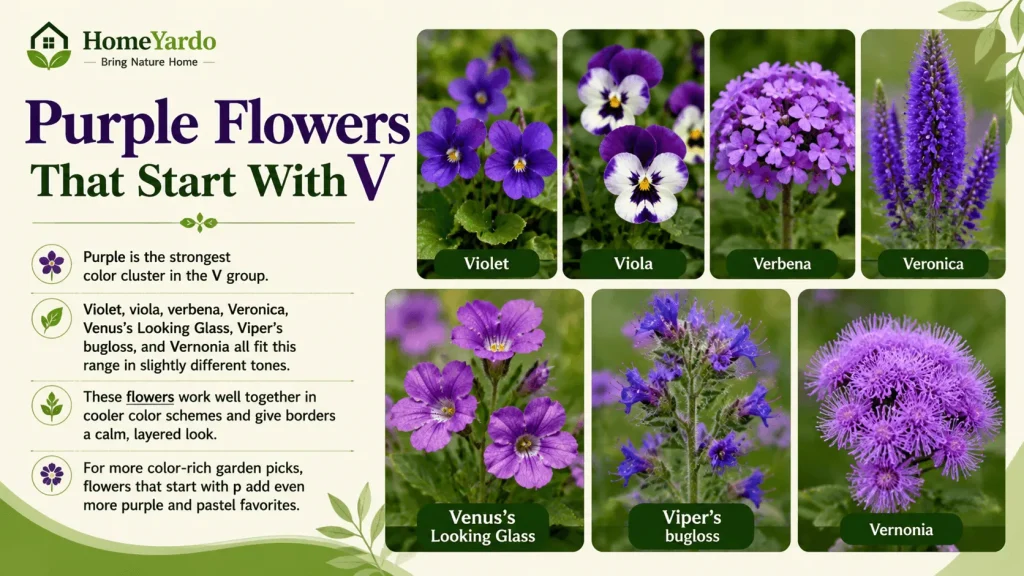
Purple is the strongest color cluster in the V group. Violet, viola, verbena, Veronica, Venus’s Looking Glass, Viper’s bugloss, and Vernonia all fit this range in slightly different tones.
These flowers work well together in cooler color schemes and give borders a calm, layered look. For more color-rich garden picks, flowers that start with p add even more purple and pastel favorites.
White Flowers With V
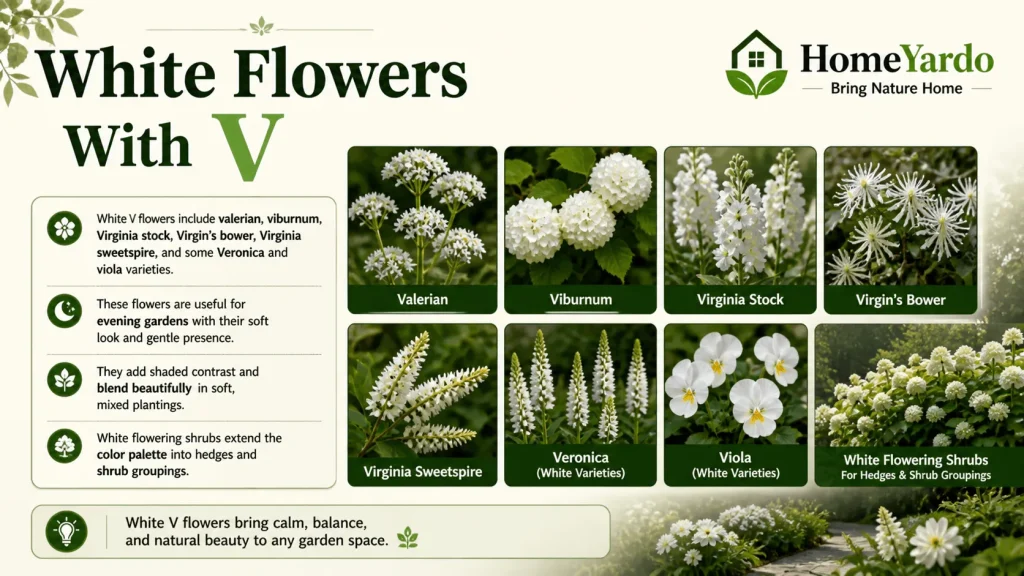
White V flowers include valerian, viburnum, Virginia stock, Virgin’s bower, Virginia sweetspire, and some Veronica and viola varieties. These are useful for evening gardens, shaded contrast, and softer mixed planting.
White flowering shrubs also help carry the color palette beyond the low flower layer and into hedges or shrub groupings.
Yellow Flowers With V
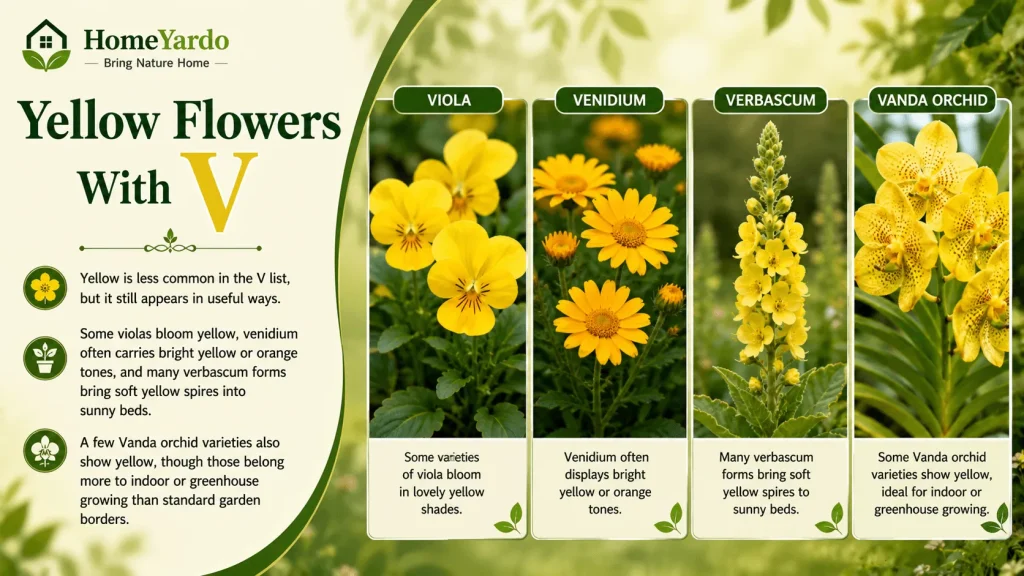
Yellow is less common in the V list, but it still appears in useful ways. Some violas bloom yellow, venidium often carries bright yellow or orange tones, and many verbascum forms bring soft yellow spires into sunny beds.
A few Vanda orchid varieties also show yellow, though those belong more to indoor or greenhouse growing than standard garden borders.
Pink And Mixed Tones
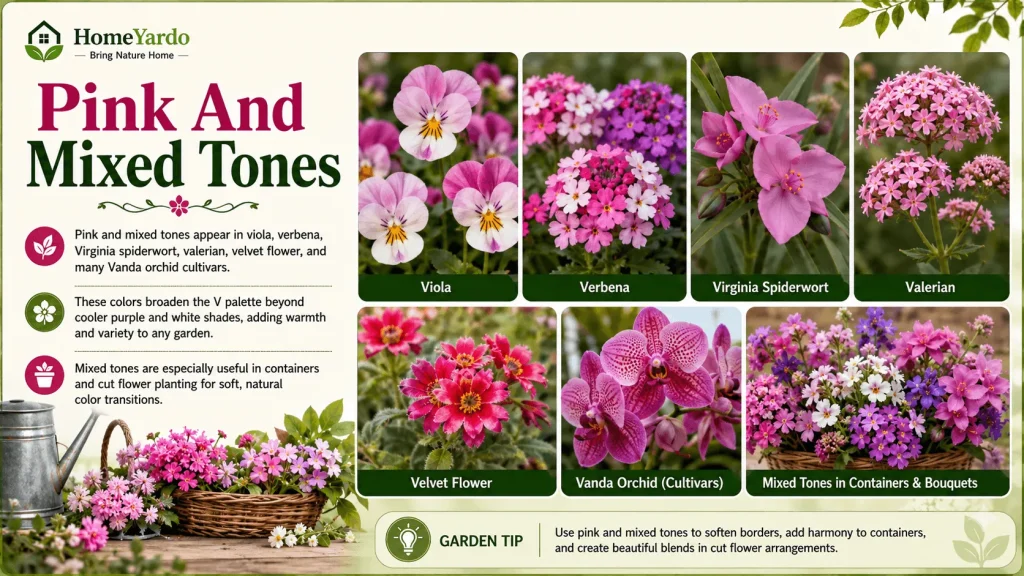
Pink and mixed tones appear in viola, verbena, Virginia spiderwort, valerian, velvet flower, and many Vanda orchid cultivars. These help broaden the V palette beyond the cooler purple and white range.
Mixed tones are especially useful in containers and cut flower planting, where a softer transition between colors looks more natural.
Best V Flowers And Types Of Flowers That Start With V
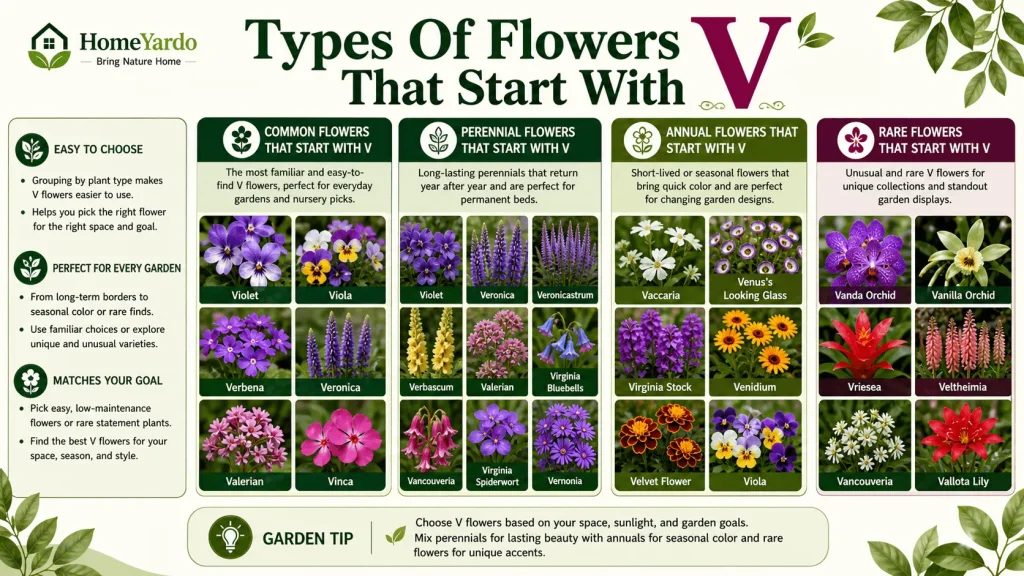
Grouping the V flowers by plant type makes the list easier to use in real planting plans. It becomes clearer which names are best for long-term borders, seasonal color, easy recognition, or more unusual collections.
Common Flowers That Start With V
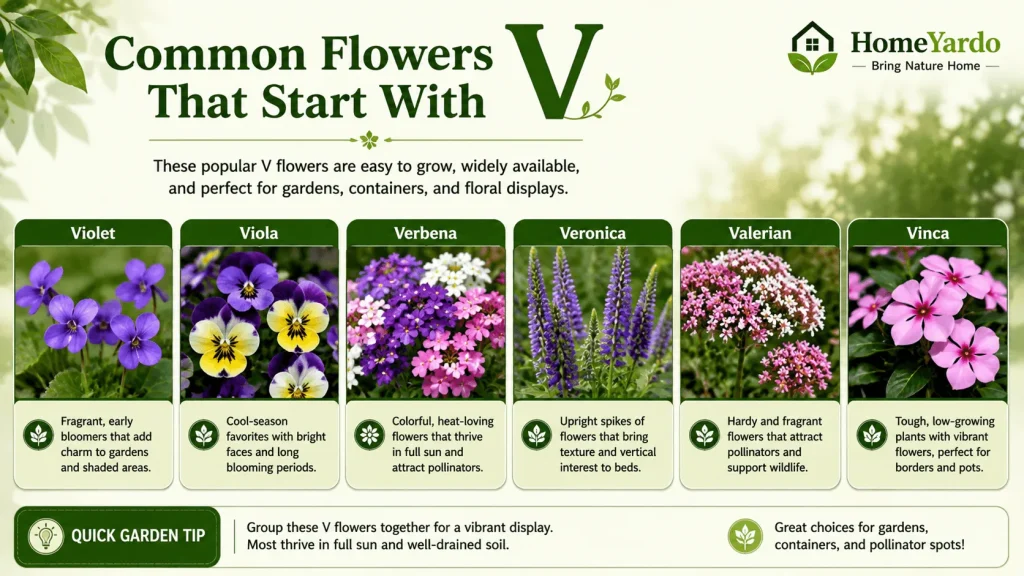
The most familiar names are violet, viola, verbena, Veronica, valerian, and vinca. These are the V flowers most likely to appear in everyday gardening, nursery stock, or general flower naming lists.
They are also the easiest starting point when the goal is a recognizable and easy-to-place flower rather than a specialist plant.
Perennial Flowers That Start With V
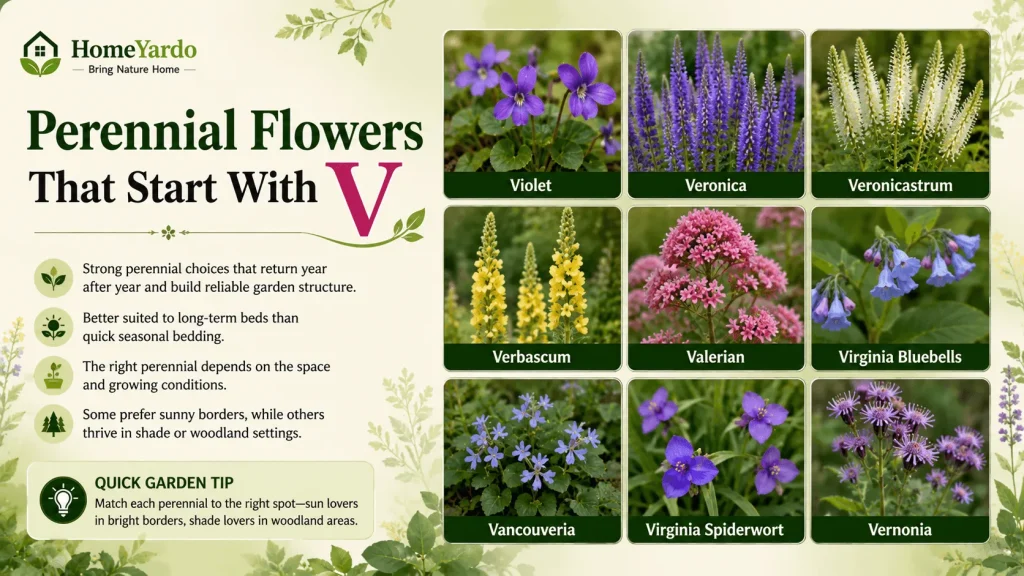
Strong perennial options include violet, Veronica, Veronicastrum, Verbascum, valerian, Virginia bluebells, Vancouveria, Virginia spiderwort, and Vernonia. These are better suited to long-term beds than quick seasonal bedding.
The right perennial depends on the space. Veronica suits neat sunny borders, while Virginia bluebells and Vancouveria are much better in shade or woodland style planting.
Annual Flowers That Start With V Or Short-Lived Picks
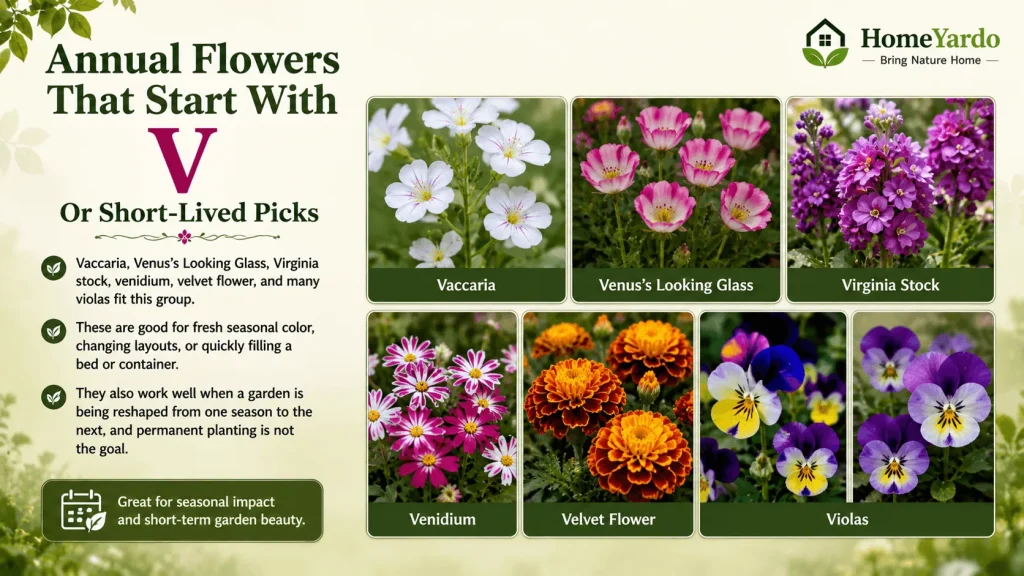
Vaccaria, Venus’s Looking Glass, Virginia stock, venidium, velvet flower, and many violas fit this group. These are good for fresh seasonal color, changing layouts, or quickly filling a bed or container.
They also work well when a garden is being reshaped from one season to the next, and permanent planting is not the goal.
Rare Flowers That Start With V
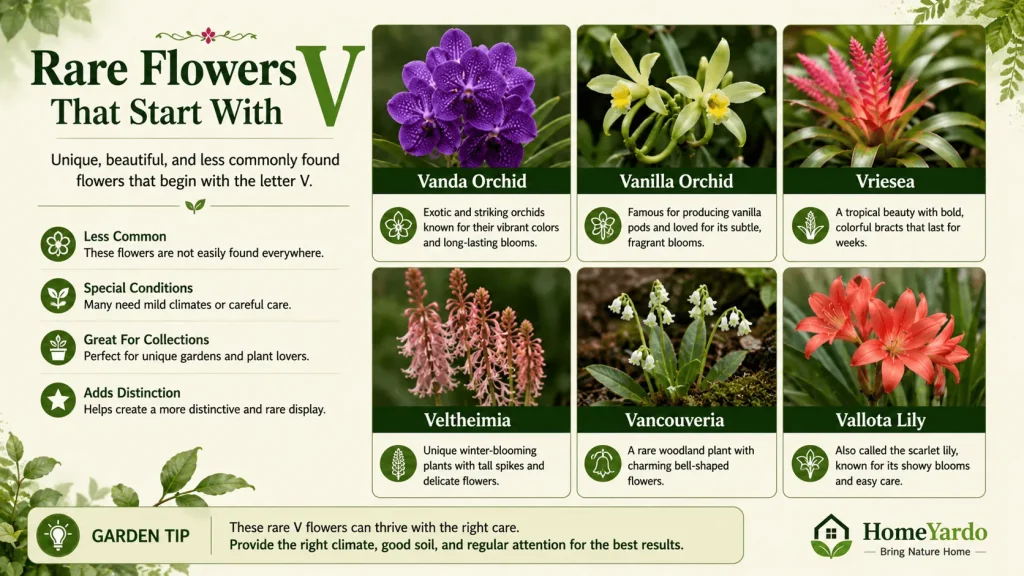
The rarer V flower names include Vanda orchid, vanilla orchid, Vriesea, Veltheimia, Vancouveria, and Vallota lily. Some are harder to find locally. Others need mild conditions or a more careful routine.
That rarity can be useful when the aim is a more distinctive planting or a small collection with less common flowers.
Container Flowers With V
Containers make it easier to enjoy V flowers in smaller spaces and give more control over soil, drainage, and display. Many of the best choices stay compact, flower freely, or hold up well in sunny pots.
Best V Flowers For Containers
Viola is one of the strongest V flowers for containers because it stays neat and flowers well through cool weather. Verbena is another favorite, especially in mixed pots where a fuller or trailing habit is useful.
Vinca handles summer heat better than many softer bedding flowers and works well in sunny patio containers. Vallota lily and Veltheimia are better for statement pots where the plant can be shown off on its own.
Container Tips
Choose containers with dependable drainage and enough depth for the plant’s root habit. Compact flowers such as viola and vinca can stay in smaller pots, while verbena and Vallota lily benefit from a little more room.
Match the plant to the light. A sun-loving venidium will not bloom the same way as a shade-loving violet. Water also dries out faster in pots, so container planting always needs closer watching than open ground.
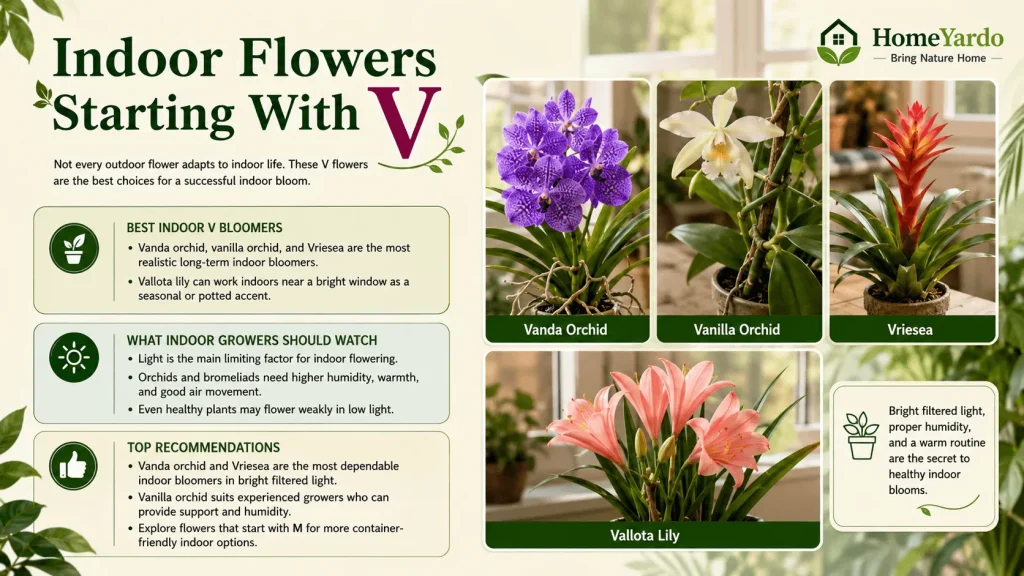
Indoor Flowers Starting With V
Indoor growing is different from container growing outdoors. A plant that handles a patio pot may still struggle in a room with low light or dry air.
Best Indoor Or Houseplant-Friendly V Bloomers
Vanda orchid, vanilla orchid, and Vriesea are the most realistic long-term indoor V bloomers in the list. They suit bright filtered light and a warm routine better than most outdoor flowers do.
Vallota lily can also work indoors near a bright window, though it behaves better as a seasonal or potted accent than as a classic long-term houseplant.
What Indoor Growers Should Watch
Light is the main limit indoors. A healthy plant may still flower weakly if the room stays too dim. Orchids and bromeliads also care about humidity, warmth, and air movement more than ordinary bedding flowers do.
The most dependable indoor options are Vanda orchid and Vriesea in bright filtered light, with vanilla orchid suited to more experienced growers who can provide support and moisture in the air. Indoor growers may also want to browse flowers that start with m for more container-friendly flower names.
Fragrance, Symbolism, And Uses
Some flowers that start with the letter V are chosen mainly for color, while others bring scent, garden meaning, or a specific landscape role. Those details can help narrow the right match when the visual side alone is not enough.
Fragrant V Flowers
Violet has one of the softest and most familiar scents in the group. Valerian can also carry a light fragrance, while viburnum is often the strongest scented pick among the shrub forms.
Virginia stock gives a sweet, cool-season scent close to paths and front edges, and some vanilla orchid growing is valued as much for plant interest as for bloom.
Best Fragrant V Flowers For Paths, Patios, And Evening Gardens
For close-range path scent, violet is one of the best choices because the flowers sit low and are easier to enjoy at walking level. Virginia stock also works well near paths and cooler-season seating areas.
For patios and shrub borders, viburnum brings a stronger fragrance from a larger plant. Valerian suits cottage-style planting where scent blends into a softer, relaxed border look.
Meanings And Symbolism
Violet is often linked with modesty, faithfulness, and quiet affection. Veronica is commonly tied to loyalty, while Verbena has a long traditional link with healing and protective folklore.
These meanings do not need to guide the planting plan, though they add a thoughtful layer for gifts, memory spaces, or flower-themed displays.
Uses And Benefits
Verbena, Veronica, Vernonia, and Viper’s bugloss are useful where pollinator value matters. Viburnum and Virginia sweetspire help add flower interest to shrub planting, which brings structure and bloom at the same time.
Viola, violet, and Virginia stock work especially well in smaller spaces where low edging, cool-season color, or soft scent are part of the goal.
Growing Notes For Popular V Flowers
A few broad care notes can prevent the most common planting mistakes. Not every V flower wants the same light, soil, or moisture pattern, so grouping the basics helps keep the choices practical.
Sun And Soil Basics
Verbena, Veronica, Veronicastrum, Venidium, vitex, and Viper’s bugloss prefer stronger light and usually bloom better with open sun and soil that drains well. Verbascum also handles leaner, drier ground better than many softer border flowers.
Virginia bluebells, Vancouveria, and violet lean more toward part shade and moisture-holding soil. Viburnum and Virginia sweetspire are more flexible, though both perform best when the ground does not stay hard and dry for long.
Watering And Feeding
Woodland and moisture-loving plants need steadier water while they establish. Full sun annuals and many border perennials can cope with drier spells once rooted, though container plants always dry out faster than garden beds.
Orchids and bromeliads need a different routine. Their success depends less on heavy feeding and more on correct light, airflow, humidity, and the right kind of moisture.
Deadheading, Self-Seeding, And Spread Control
Verbena can flower longer with regular cleanup of spent blooms. Valerian, vetch, and Vaccaria may self-seed if the conditions suit them, which can be helpful in looser planting or untidy in smaller formal beds.
Vinca and some vigorous climbers or shrubs also need enough space, because strong growers can overtake slower nearby plants if they are packed too tightly.
Pollinators And Wildlife Value
Verbena, Veronica, Veronicastrum, Vernonia, and Viper’s bugloss are among the best V plants for bees and butterflies. Their flower forms and bloom timing help keep activity going across much of the season.
Vetch and Virgin’s bower can also add wildlife value, especially in informal or meadow-style planting, where the garden is allowed to move a little more naturally.
Common Watch Outs
Overwatering is one of the easiest ways to damage orchids and bromeliads indoors. Another common problem is choosing the wrong light level, such as putting woodland flowers into hard afternoon sun or expecting heavy bloom from an indoor plant in a dim room.
Vigorous growers, such as vetch and vinca, in the right climate, or a strong vine, also need space planning from the start. A good match is easier to manage than a beautiful mismatch.
Plants Vs Flowers That Start With V
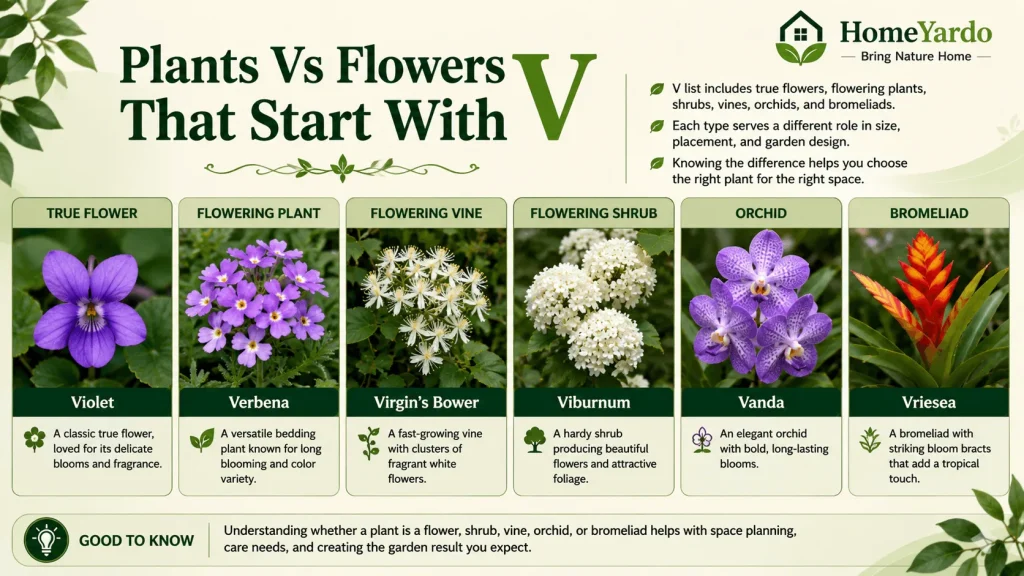
The V list becomes easier to trust when the categories are kept simple. A true flower, a flowering plant, a flowering shrub, a flowering vine, an orchid, and a bromeliad can all have strong ornamental blooms, though they do not fill the same role.
Violet is a true flower. Verbena is a flowering plant often grown like a bedding flower. Virgin’s bower is a flowering vine. Viburnum is a flowering shrub. Vanda is an orchid. Vriesea is a bromeliad with showy bloom bracts.
That difference matters because it changes size, placement, care, and the kind of result a gardener should expect.
Conclusion
The letter V may not be the biggest flower group, but it holds more variety than it first seems. There are cool spring bloomers, sunny annuals, late-season pollinator plants, flowering shrubs, tropical orchids, and indoor display choices all within the same list.
The best pick depends on the setting. Violet suits shade and scent. Verbena suits heat and long bloom. Viburnum brings structure and fragrance. The Vanda orchid gives indoor color with a tropical feel. That range is what makes the V group worth exploring.
FAQ’s
The total depends on how the list is built. A strict list with only true flowers will be shorter, while a broader list may also include flowering shrubs, vines, orchids, and indoor bloomers. The most useful approach is to count them clearly and label each type honestly.
The most common V flower names are usually violet, viola, verbena, Veronica, valerian, and vinca. These are the names most often seen in everyday gardening, plant shops, and alphabet flower lists. They are also easier to grow or recognize than rarer entries such as the Vanda orchid or Veltheimia. For a simple starting point, these familiar names make the best first picks.
Violet is often the most popular answer because the name is widely known and closely linked with flower color. In practical garden use, Verbena is also one of the strongest V flowers because it blooms for a long time and fits many sunny spaces. Popularity can mean different things, such as name recognition, garden use, or nursery availability. That is why both violet and verbena usually stand out in V flower lists.
Violet is one of the best-known fragrant V flowers and is valued for its soft, classic scent. Viburnum can also be strongly scented, especially in spring, while Virginia stock and valerian add a lighter fragrance in the garden. The best choice depends on whether the goal is a close-range scent or a larger flowering shrub with more impact. In smaller spaces, low-growing fragrant flowers are often easier to enjoy.
Several V flowers return year after year, including violet, Veronica, veronicastrum, verbascum, valerian, Virginia bluebells, and Vernonia. Some V plants are tender or short-lived, so it is important to check the type rather than assume they all behave the same way. Perennials are usually the better choice for long-term borders and repeat seasonal structure.
Annuals and tropical bloomers are more useful when the goal is fast seasonal color.
Yes, a few V flowers and flowering plants can be grown indoors with the right conditions. Vanda orchid, vanilla orchid, and Vriesea are the clearest indoor-friendly choices, while Vallota lily can work near bright light as a potted accent. Indoor growing usually needs stronger light, steadier warmth, and better humidity than many outdoor flowers need. That is why not every V flower that grows in a pot is a true indoor plant.
Viola, verbena, Veronica, vinca, and Virginia stock are among the easiest V flowers for beginners. They are simpler to place in beds or containers and do not need the same close attention as orchids or tropical specialty plants. These flowers also cover different needs, from cool-season color to heat tolerance and pollinator value. For a first planting, the easiest choice is usually the one that matches the light and season well.
Some of the rarer V flower names include Vanda orchid, vanilla orchid, Vriesea, Veltheimia, Vancouveria, Vallota lily, and velvet flower. These feel less common because they are harder to source, more climate-specific, or better suited to collectors than everyday bedding displays. A few are also more familiar with indoor or specialty growing than with standard outdoor borders. That makes them interesting additions when the goal is a less ordinary flower list.
Several V flowers bloom in purple or purple-blue shades, including violet, viola, verbena, Veronica, Venus’s Looking Glass, Viper’s bugloss, and Vernonia. Purple is one of the strongest color themes within the V group, which makes it easy to build a cool-toned planting palette. The shades can range from soft lavender to deeper blue-purple, depending on the plant and cultivar. That variety gives the group more range than the letter V first suggests.
Viburnum and vitex are better described as flowering shrubs or small trees rather than standard flower border plants. They still appear in many V flower lists because their common names begin with V and their blooms are highly ornamental. The difference matters because their size, structure, and use in the landscape are very different from a plant like viola or verbena. A well-organized list should include them with clear type labels.
A flower is one type of blooming plant, but a broader V list may also include shrubs, vines, orchids, and indoor plants with showy blooms. That is why a violet, a viburnum, and a Vriesea can all appear in the same guide even though they do not grow the same way. The key difference is plant type, not just the bloom itself. Clear categories make the list much easier to use in a garden or indoor setting.
Yes, a few fragrant V flowers fit small gardens very well. Violet and Virginia stock are especially useful because their scent is easier to enjoy at close range near paths, edges, or seating areas. Valerian can also work in softer cottage-style planting, while viburnum suits small gardens only if there is room for a shrub. In compact spaces, fragrance is usually best when the flowers sit near where people pass or pause.
References