How To Choose The Right Diffuser For Your Home

A home can look tidy and still feel flat. Scent is one of the quickest ways to change that. A soft, pleasant fragrance in the lounge or bedroom makes a space feel welcoming, and it is something people notice the moment they walk in.
This article explains the main types of diffusers, how to match one to your room, where to put it and how to look after it. The aim is a space that feels calm and smells good without being overpowering.
Choosing A Diffuser For Your Home

Choosing a diffuser for your home starts with how you want to use it. Some people want a steady scent that fills a room all day. Others want a short burst while they read or get ready for bed. The right type depends on that, along with the size of the space and how much attention you want to give it.
Fragrance is only one way to personalize your home, alongside lighting, artwork, furniture, textiles, and other details that shape how a room feels.
Think about where you will use it too. A diffuser in a bedroom has different needs from one in an open-plan living area, and a bathroom or entry may only need a light scent. A little planning stops you buying something that is too strong, too weak or too much work.
Types Of diffusers
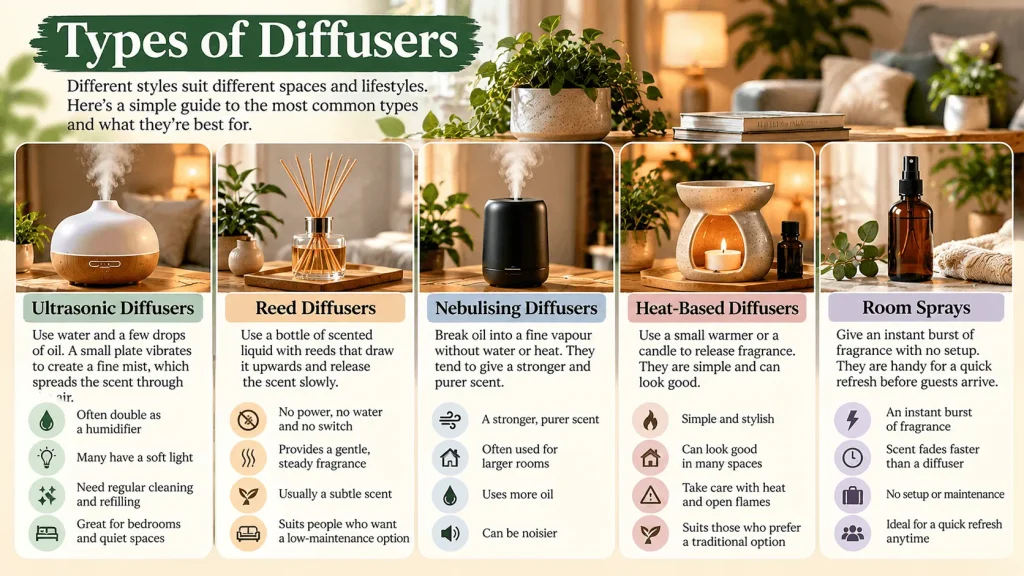
There are several styles, and each one suits a different way of living.
Ultrasonic diffusers use water and a few drops of oil. A small plate vibrates to create a fine mist, which spreads the scent through the air. Many of them double as a humidifier and some have a soft light, so they suit bedrooms and quiet spaces. They need regular cleaning and refilling.
Reed diffusers use a bottle of scented liquid with reeds that draw it upwards and release the scent slowly. There is no power, no water and no switch, so they suit people who want a gentle, steady fragrance with no effort. The scent is usually subtle.
Nebulising diffusers break oil into a fine vapour without water or heat. They tend to give a stronger and purer scent, so they are often used for bigger rooms. They use more oil and can be noisier.
Heat-based diffusers use a small warmer or a candle to release fragrance. They are simple and can look good, but you need to take care with heat and with any open flame.
Room sprays give an instant burst of fragrance with no setup. They are handy for a quick refresh before guests arrive, though the scent fades faster than a diffuser.
Matching the diffuser to the room
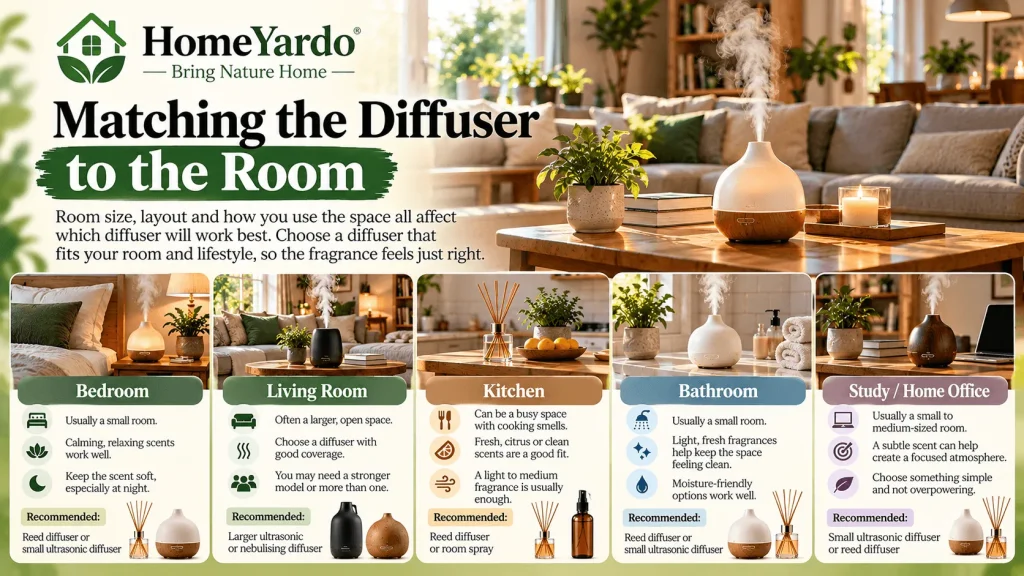
Room size matters more than many people expect. A small diffuser in a large open space may be barely noticeable, and a strong one in a small room can be overwhelming. If you are changing more than the fragrance, our guide on how to plan a room makeover explains how lighting, furniture, surfaces, accessories, and room function can be considered together.
For a small room such as a bedroom, bathroom or study, a reed diffuser or a small ultrasonic model is usually enough. For a larger lounge or an open-plan area, look for a diffuser designed to cover a bigger space, or use more than one in different spots.
Choosing Scents

Scent is personal, so pick something you enjoy. Fresh and citrus scents suit kitchens and bathrooms, while woody and soft floral scents often suit lounges and bedrooms. Light, clean fragrances work well in small rooms, and warmer ones suit larger, cosier spaces. Scent can also work alongside colour psychology in interior design when you are trying to create a comfortable bedroom, welcoming living room, or fresh-feeling bathroom.
Start light. It is easier to add scent than to remove it. Try a new fragrance in a small amount and give it a few days to see how you feel about it, since a scent that seems nice at first can feel heavy after a while.
Essential oils or fragrance oils

Fragrance oils, which are blended to produce a specific scent, or essential oils, which are derived from plants, can be used in diffusers. While fragrance oils offer a greater variety of scents, essential oils are more appealing to those who prefer natural ingredients.
Make use of the type for which the diffuser is intended. Certain models are only compatible with specific oils, and using the incorrect one can harm the gadget or produce subpar results. Use the recommended amount after reading the product’s instructions.
Where to put your diffuser
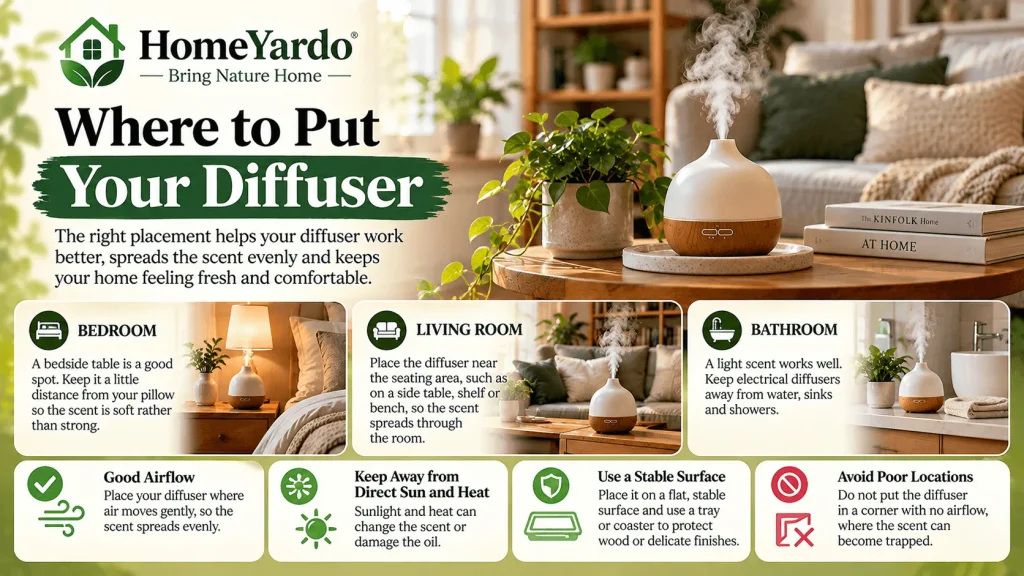
Place the diffuser where air moves gently, such as on a side table, a shelf or a bench, so the scent spreads through the room. Avoid putting it in a corner with no airflow, where the scent stays trapped.
Keep it away from direct sun and heat, which can change the scent or damage the oil. Place it on a stable, flat surface, and avoid wood or delicate finishes that could be marked by drips or moisture. A small tray or coaster underneath helps.
For a bedroom, a bedside table is fine, but keep a little distance from your pillow so the scent is soft rather than strong. In a lounge, a spot near the seating works well. In a bathroom, keep electrical diffusers away from water.
Caring for your diffuser
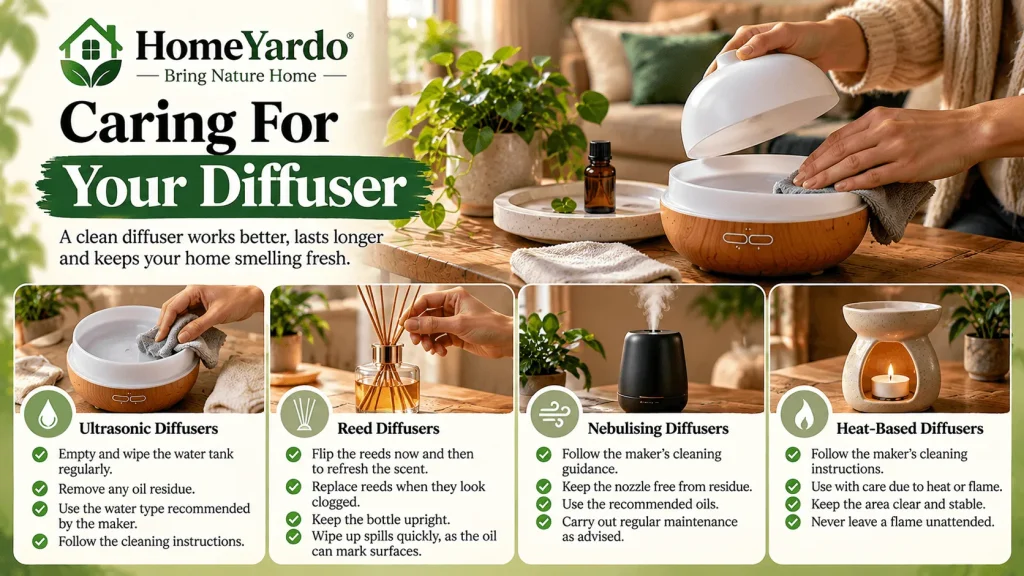
A clean diffuser works better and smells better.
For ultrasonic models, empty and wipe the water tank regularly, and follow the cleaning instructions from the maker. Old water and oil residue can build up and affect the scent. Use the water type the instructions recommend.
For reed diffusers, flip the reeds now and then to refresh the scent, and replace them when they look clogged. Keep the bottle upright, and wipe up spills quickly, as the oil can mark surfaces.
For nebulisers and heat-based models, follow the maker’s cleaning and safety guidance, and never leave a flame unattended.
Safety around children and pets

Scents are not harmless for everyone, so take care.
Keep diffusers and oils out of reach of children and pets, since the oils can be harmful if swallowed or spilled. Some pets are sensitive to certain oils and to strong fragrance, so check with a vet if you are unsure.
Use fragrance in a well-ventilated space and take a break from it if anyone feels unwell, gets a headache or has trouble breathing. If someone in the home is pregnant, has asthma or has other health concerns, ask a health professional before using essential oils.
Follow the maker’s instructions for amounts and running times, and do not leave devices with heat or flame running when no one is home.
Making your home smell the way you want
Choose a diffuser that suits your room and your routine, pick a scent you enjoy and start light. Place it where air moves gently, keep it clean and follow the safety advice, especially around children and pets. A little care gives you a space that feels calm and welcoming. Adjust the amount over a few days until the scent feels just right.
Key Takeaways
- The right diffuser depends on the size of the room, how you want the scent to behave and how much care you are happy to give it.
- Ultrasonic, reed, nebuliser and heat-based diffusers each work differently, and room sprays suit a quick refresh.
- Place the diffuser where air moves gently, and start with a light scent that you can build up.
- Keep it clean, follow the maker’s instructions and take care around children, pets and anyone sensitive to fragrance.
FAQ’s
A reed diffuser or a small ultrasonic model usually works well, as both give a soft scent. Choose a light fragrance and keep the diffuser a little away from your pillow.
It depends on the model and the room. A small diffuser suits a bedroom or study, while a larger open space may need a stronger model or more than one. Check the product guidance.
Take care. Keep devices and oils out of reach, use them in a well-ventilated room and check with a vet or health professional if you are unsure.