Entry And Storm Doors: Choosing The Perfect Combination For Your Home
Your front door does more than welcome visitors. It helps keep your home secure, protects against changing weather, and creates the first impression people have of your property. But choosing an attractive entry door is only part of the decision.
Pairing the right entry door with a compatible storm door can provide weather protection, better ventilation, and a more coordinated entrance. The challenge is knowing which materials, styles, and features work well together.
When exploring replacement options, homeowners can compare what Mammoth Door & Construction, LLC offers and consider how both doors will function as a complete entrance.
The best combination balances curb appeal, security, durability, maintenance, and everyday comfort without adding features your home doesn’t need.
What Is the Difference Between Entry Doors and Storm Doors?
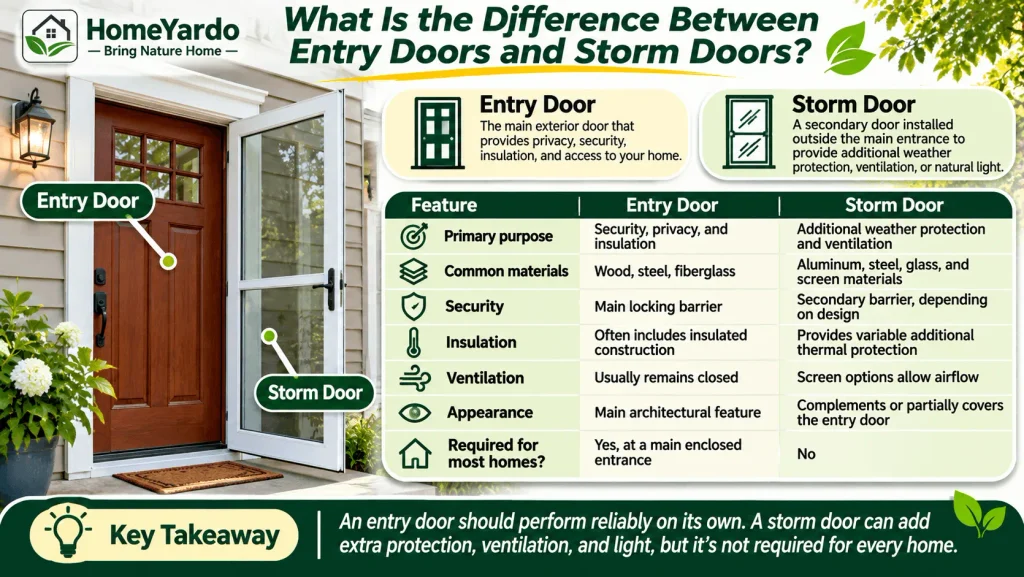
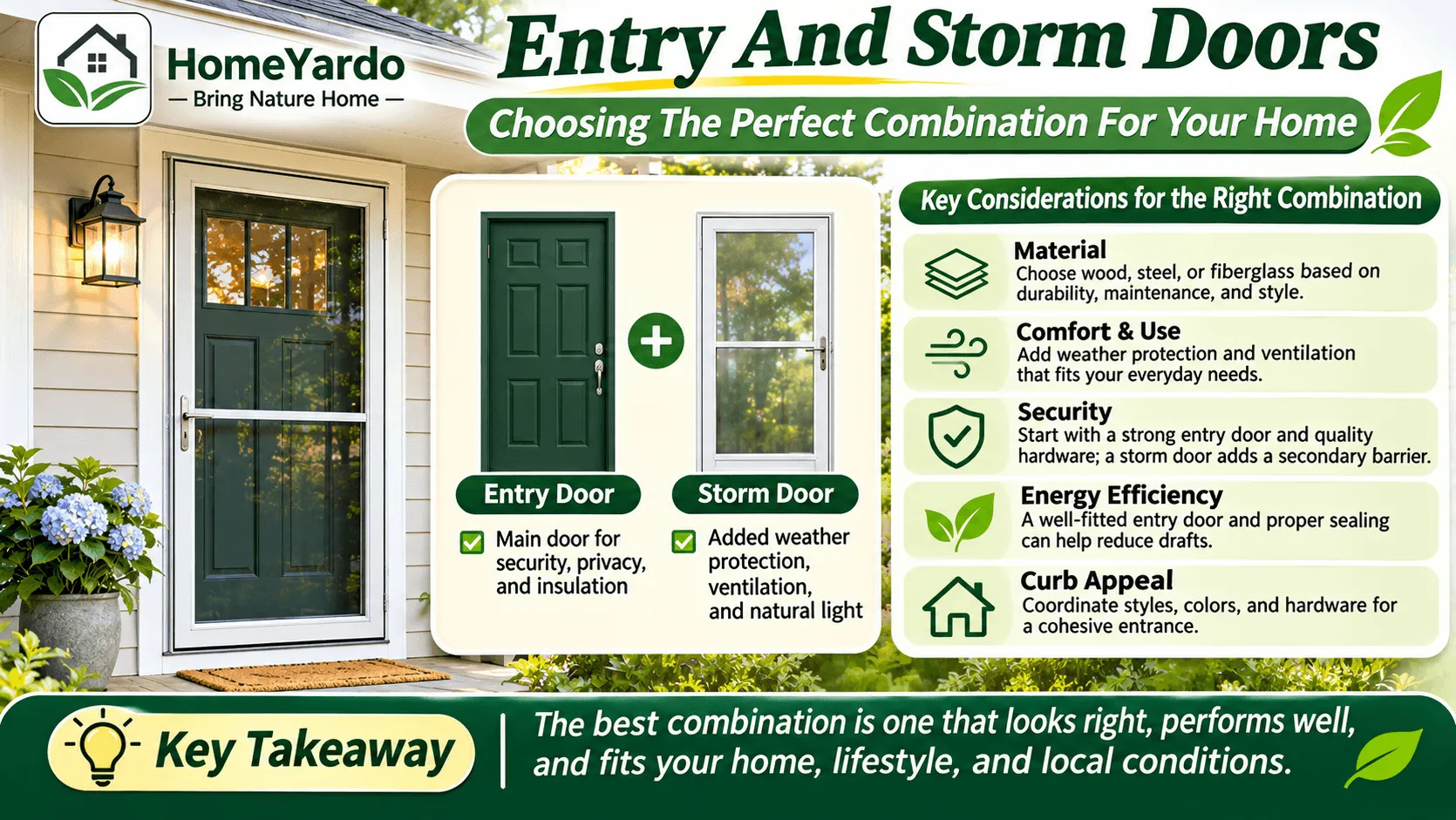
An entry door is the main exterior door that provides privacy, security, insulation, and access to your home. A storm door is a secondary door installed outside the main entrance to provide additional weather protection, ventilation, or natural light.
Although both doors occupy the same entrance, they perform different jobs.
| Feature | Entry door | Storm door |
|---|---|---|
| Primary purpose | Security, privacy, and insulation | Additional weather protection and ventilation |
| Common materials | Wood, steel, fiberglass | Aluminum, steel, glass, and screen materials |
| Security | Main locking barrier | Secondary barrier, depending on design |
| Insulation | Often includes insulated construction | Provides variable additional thermal protection |
| Ventilation | Usually remains closed | Screen options allow airflow |
| Appearance | Main architectural feature | Complements or partially covers the entry door |
| Required for most homes? | Yes, at a main enclosed entrance | No |
An entry door needs to perform reliably on its own. A storm door should complement that performance rather than compensate for a damaged or poorly fitted main door.
For many households, pairing the two makes sense. Others may find that a high-quality entry door provides everything they need.
How to Choose the Right Entry Door Material
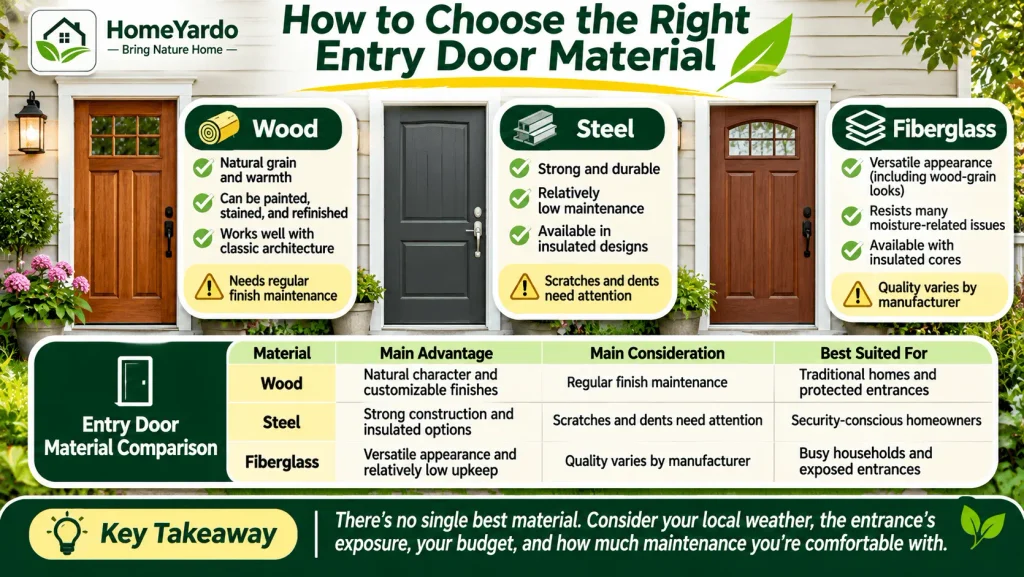
Entry door material influences durability, maintenance, security, and the appearance of your entrance. Wood, steel, and fiberglass are common residential choices, but their advantages depend on the door’s construction and the conditions around your home.
Wood Entry Doors
Wood offers natural grain, warmth, and a traditional appearance. It works particularly well with classic architecture, detailed trim, and homes where the entrance is a prominent design feature.
Wood doors can be painted, stained, and refinished, giving homeowners flexibility when updating exterior colors.
However, exposure to moisture, direct sunlight, and temperature changes can affect wood over time. Proper finishing and regular inspections help prevent swelling, cracking, and deterioration.
Steel Entry Doors
Steel doors are popular for their strength, relatively low maintenance requirements, and availability in insulated designs.
Many residential steel doors use a foam-insulated core with a metal exterior. Their performance also depends on the quality of the frame, hardware, weatherstripping, and installation.
Although durable, steel finishes can become scratched or dented. Any exposed metal should be repaired promptly to limit corrosion.
Fiberglass Entry Doors
Fiberglass doors offer considerable design flexibility. Some feature smooth painted surfaces, while others imitate natural wood grain.
They generally resist many moisture-related problems associated with wood and are available with insulated cores.
Fiberglass can be an especially practical choice for homeowners who want the appearance of wood without the same refinishing requirements.
Entry Door Material Comparison
| Material | Main advantage | Main consideration | Best suited for |
|---|---|---|---|
| Wood | Natural character and customizable finishes | Regular finish maintenance | Traditional homes and protected entrances |
| Steel | Strong construction and insulated options | Scratches and dents need attention | Security-conscious homeowners |
| Fiberglass | Versatile appearance and relatively low upkeep | Quality varies by manufacturer | Busy households and exposed entrances |
No single material is best for every property. Consider local weather, the entrance’s exposure, the available budget, and how much maintenance you are comfortable handling.
How Storm Doors Improve Comfort And Everyday Living
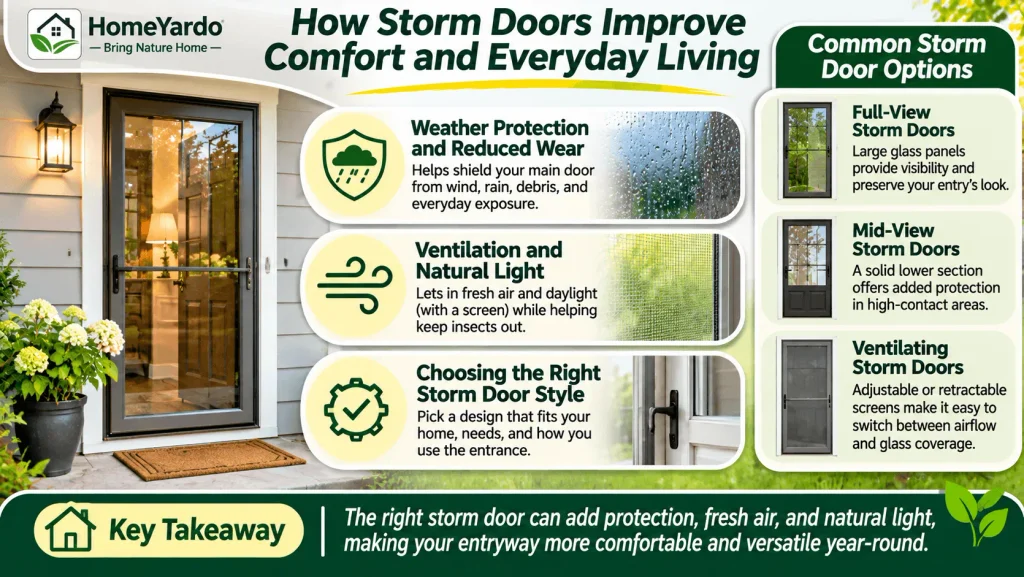
Storm doors can make an entrance more useful throughout the year, particularly when homeowners want greater control over fresh air, visibility, and weather exposure.
Their value depends on the design and how the entrance is used.
Weather Protection and Reduced Wear
A properly installed storm door can help shield the main entrance from wind-driven rain, debris, and some everyday exposure.
This may be helpful for wooden entry doors or entrances without substantial overhead protection.
However, a storm door is not a substitute for correct exterior flashing, drainage, or maintenance. Water should never become trapped against the main door or surrounding frame.
Ventilation and Natural Light
A storm door with an integrated screen allows homeowners to open the main entry door during pleasant weather while maintaining a screened barrier against insects.
Full-glass designs can bring daylight into a foyer or hallway, particularly where nearby windows are limited.
Keep in mind that screening is not the same as security. An open main entry door may still reduce privacy and security, even when the storm door is closed.
Choosing the Right Storm Door Style
Common options include:
- Full-view storm doors: Large glass panels provide visibility and preserve the appearance of the main entry door.
- Mid-view storm doors: A solid lower section provides added protection in high-contact areas.
- Ventilating storm doors: Adjustable or retractable screens make it easier to switch between airflow and glass coverage.
Some models also include pet-access features, self-storing screens, and adjustable closing mechanisms.
Choose features based on how your household uses the entrance rather than selecting the most elaborate model available.
How To Match Entry and Storm Doors For Better Curb Appeal
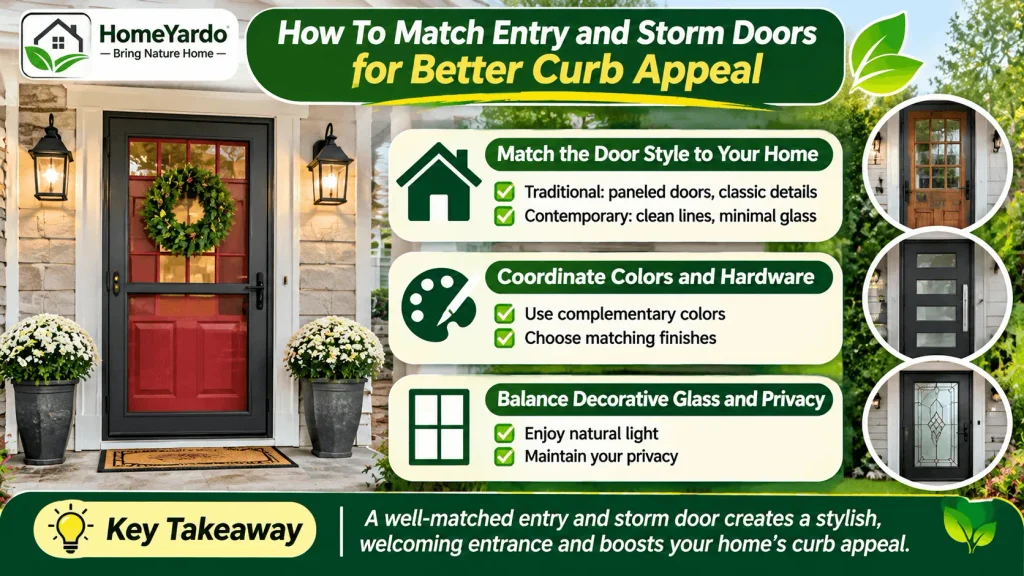
Your entry door and storm door should look like parts of the same design rather than separate additions.
A good pairing considers the home’s architectural style, frame proportions, colors, decorative glass, and hardware finishes.
Match the Door Style to Your Home
Traditional homes often look attractive with paneled entry doors, classic hardware, and simple storm door frames.
Contemporary properties may benefit from smooth door surfaces, clean lines, narrow frames, and understated glass details.
A full-view storm door can work particularly well when the main entrance has decorative panels or distinctive wood grain worth displaying.
Coordinate Colors and Hardware
Matching both doors exactly is not always necessary. A storm door in a neutral finish can frame a bold entry door without making the entrance look busy.
Black, bronze, white, and other common frame finishes can complement different exterior materials.
Hardware should also look coordinated. Handles, hinges, knockers, and locksets do not need to be identical, but their finishes should feel intentional.
Balance Decorative Glass and Privacy
Glass inserts can change the character of an entrance.
Clear glass allows greater visibility and natural light, while frosted, textured, or decorative glazing can offer more privacy.
Before choosing a glass-heavy combination, consider whether visitors can see directly into the main living space and how much sunlight reaches the entrance.
The goal is an attractive entrance that remains comfortable to use.
Security and Hardware: What Should You Look For?
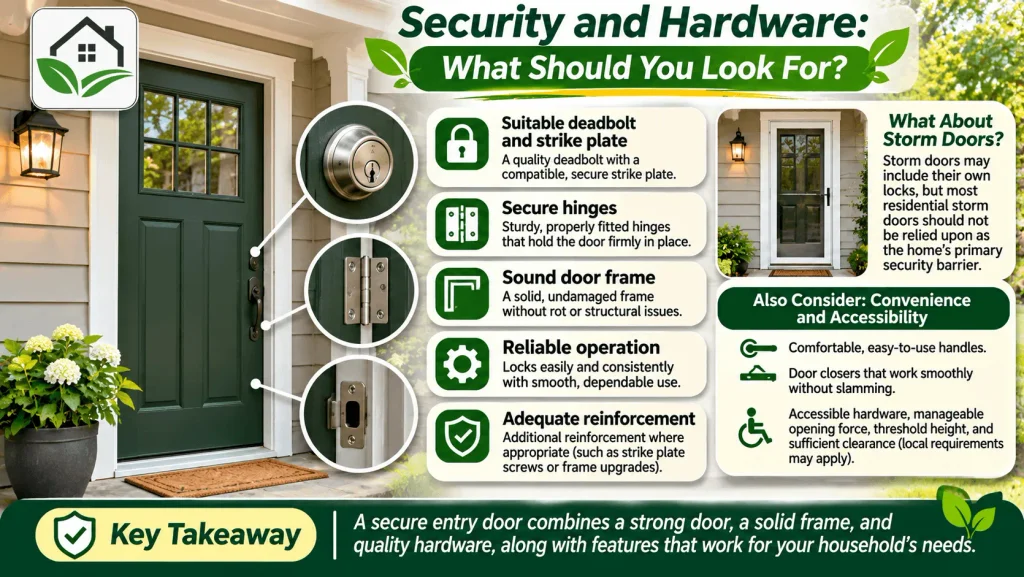
Security should begin with the main entry door, its frame, and its locking system.
Even a strong door can perform poorly when installed in a damaged frame or fitted with weak hardware.
When evaluating an entry door, consider the following:
- A suitable deadbolt and compatible strike plate
- Secure hinges and properly fitted hardware
- A sound door frame without rot or structural damage
- Reliable locking and smooth operation
- Adequate reinforcement where appropriate
Storm doors may include their own locks, but most conventional residential storm doors should not be relied upon as the home’s primary security barrier.
Hardware also affects convenience. Handles should be comfortable to operate, and door closers should work smoothly without slamming.
For households with limited mobility, consider accessible hardware, manageable opening force, threshold height, and sufficient clearance. Local accessibility requirements may apply to certain entrances.
Do Entry and Storm Doors Improve Energy Efficiency?
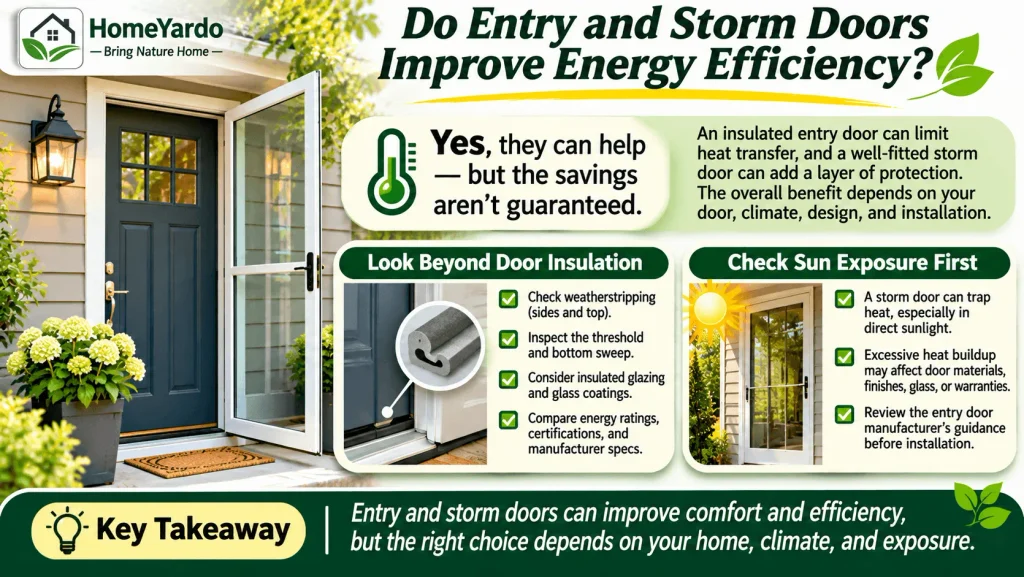
An insulated entry door can help limit unwanted heat transfer, while good weatherstripping and a properly fitted threshold can reduce drafts.
However, adding a storm door does not automatically produce substantial energy savings.
The results depend on the existing door’s performance, the climate, the storm door design, and installation quality.
Look Beyond Door Insulation
A high-quality door can still allow uncomfortable drafts if its seals are damaged or its frame is poorly fitted.
Check the weatherstripping around the sides and top of the door, along with the threshold and bottom sweep.
Insulated glazing and suitable glass coatings may also improve thermal performance, depending on the product.
When comparing replacement doors, look for relevant energy-performance ratings, product certifications, and manufacturer specifications rather than relying on appearance alone.
Check Sun Exposure Before Adding a Storm Door
A storm door can trap heat between its glass and the main entry door, particularly when exposed to strong direct sunlight.
Excessive heat buildup may affect certain entry door materials, finishes, glass components, or warranties.
Before installation, review the entry door manufacturer’s recommendations and confirm whether the selected storm door is compatible with the location.
For some sun-exposed entrances, omitting the storm door may be the better option.
What to Check Before Installing Entry and Storm Doors
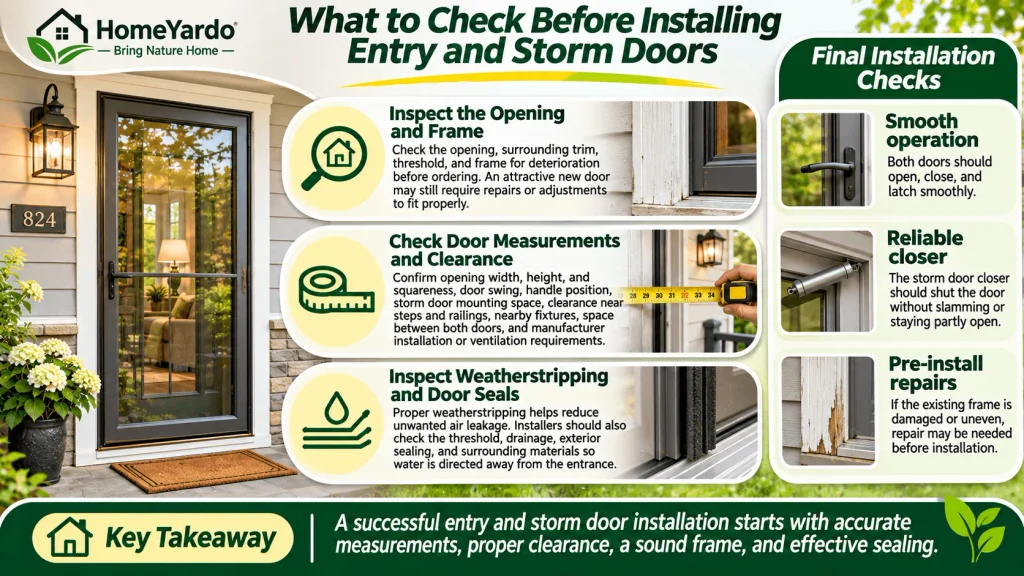
Proper installation affects how both doors perform, how long their components last, and how comfortably they operate.
A door that looks attractive in a showroom may not fit your existing entrance without adjustments.
Before ordering, inspect the opening, surrounding trim, threshold, and frame for deterioration.
Check Door Measurements and Clearance
Make sure the installer confirms:
- Opening width, height, and squareness
- Door swing and handle position
- Storm door mounting space
- Clearance around exterior steps and railings
- Porch lights, doorbells, and nearby fixtures
- Sufficient space between the two doors
- Manufacturer requirements for installation and ventilation
If the existing frame is damaged or uneven, it may need repair before the new door assembly can be installed.
Inspect Weatherstripping and Door Seals
Sealing is another important part of the installation process.
Properly fitted Weatherstripping helps limit unwanted air leakage around an exterior door.
Installers should also check the threshold, drainage, exterior sealing, and surrounding materials to ensure water is directed away from the entrance.
Once the work is complete, both doors should open, close, and latch smoothly.
The storm door closer should shut the door reliably without slamming or leaving it partly open.
When Should You Replace Your Entry or Storm Door?
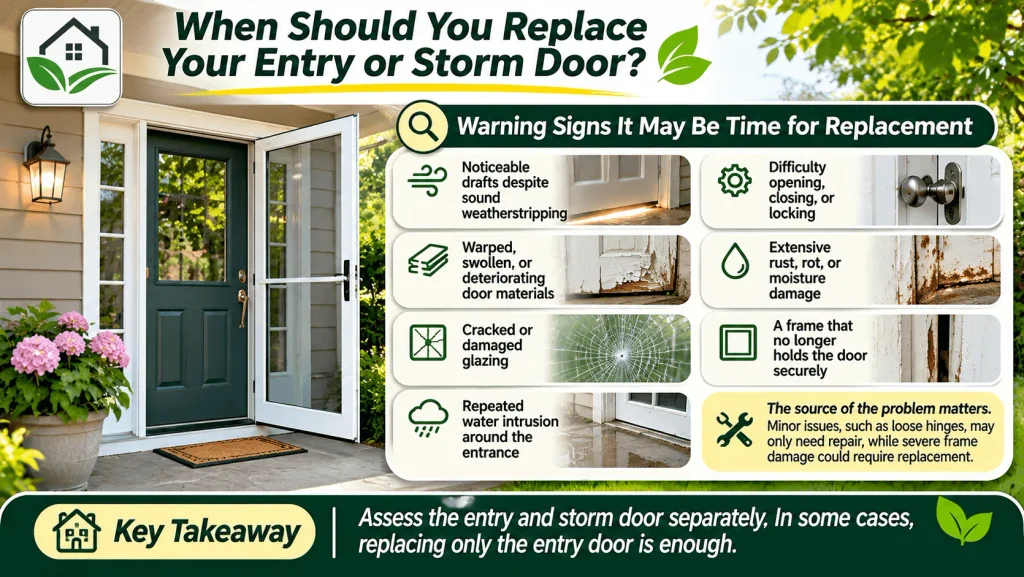
A door does not always need replacement because its finish looks dated. Minor adjustments, hardware repairs, or refinishing may restore normal operation.
However, persistent functional problems deserve closer inspection.
Common warning signs include:
- Noticeable drafts despite sound weatherstripping
- Difficulty opening, closing, or locking
- Warped, swollen, or deteriorating door materials
- Extensive rust, rot, or moisture damage
- Cracked or damaged glazing
- A frame that no longer holds the door securely
- Repeated water intrusion around the entrance
The source of the problem matters.
A door that sticks because of loose hinges may only need adjustment. A door that no longer fits because of severe frame deterioration could require more substantial repairs.
Before replacing both doors, assess each one separately. Sometimes replacing the entry door while retaining a compatible storm door is sufficient.
How to Choose the Best Entry and Storm Door Combination
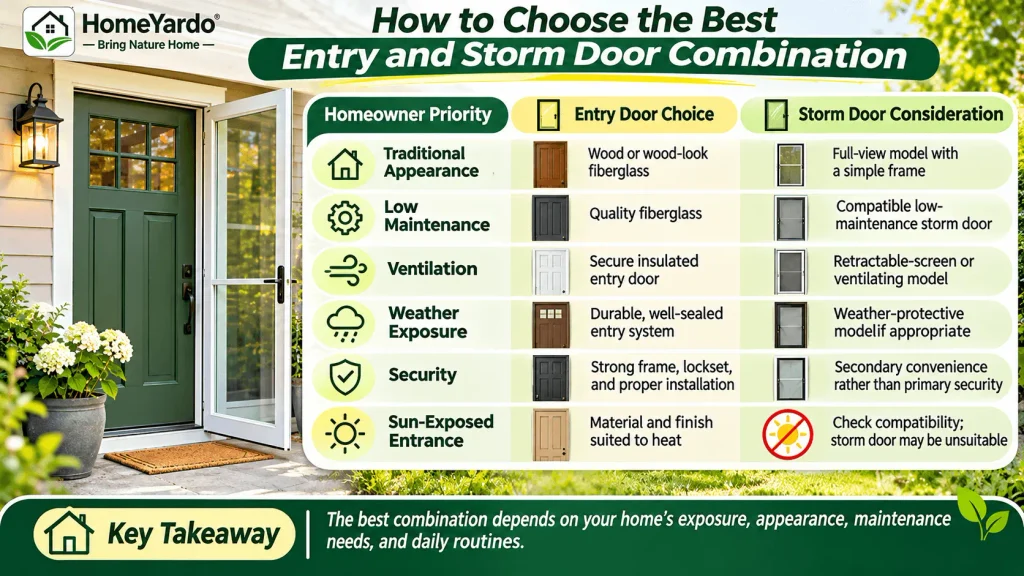
The right combination depends on your home’s exposure, appearance, maintenance needs, and daily routines.
Use the following comparison as a starting point.
| Homeowner priority | Entry door choice | Storm door consideration |
|---|---|---|
| Traditional appearance | Wood or wood-look fiberglass | Full-view model with a simple frame |
| Low maintenance | Quality fiberglass | Compatible low-maintenance storm door |
| Ventilation | Secure insulated entry door | Retractable-screen or ventilating model |
| Weather exposure | Durable, well-sealed entry system | Weather-protective model if appropriate |
| Security | Strong frame, lockset, and proper installation | Secondary convenience rather than primary security |
| Sun-exposed entrance | Material and finish suited to heat | Check compatibility; storm door may be unsuitable |
There is no universal combination that works for every house.
A shaded traditional entrance may benefit from a wooden door and full-view storm door, while a busy household could prefer a fiberglass entry door and a ventilating storm door.
A strongly sun-exposed entrance may be better served by a suitable entry door without an additional glass storm door.
Before purchasing, request a clear installation quote, review product warranties, and confirm that the two doors are compatible.
Final Takeaway
Choosing entry and storm doors is about finding the right balance between appearance and everyday performance.
The main entry door should provide dependable security, privacy, and insulation. A suitable storm door can offer additional protection, ventilation, and daylight when the design and location support it.
Compare materials, coordinate the finishes, examine installation requirements, and consider how sunlight and weather affect your entrance.
The best combination is not necessarily the most expensive. It is the one that looks right on your home, works comfortably for your household, and continues to perform well over time.
Frequently Asked Questions
Not necessarily. A well-insulated, properly installed entry door can provide the security and weather resistance your home needs. A storm door is most useful when you want additional ventilation, daylight, or protection from certain outdoor conditions.
No. Compatibility depends on the entry door material, manufacturer requirements, mounting space, clearance, and sun exposure. Some manufacturers discourage storm doors over certain products because trapped heat may damage the door or finish.
Fiberglass, steel, and wood can all be suitable. Fiberglass is often chosen for relatively low maintenance, steel for strong construction, and wood for its natural appearance. Construction quality, exposure, and installation matter as much as the material.
Neither is universally better. Full-view doors emphasize glass coverage and visibility, while ventilating models offer greater airflow flexibility. The better choice depends on whether appearance, ventilation, or protection is the priority.
They may provide some benefit in suitable conditions, but savings are not guaranteed. Properly fitted entry doors, insulation, weatherstripping, and thresholds are often more important to overall performance.
A lockable storm door can provide an additional physical barrier, but it should not replace a secure main entry door with a suitable lockset and properly installed frame.
They do not have to match exactly. Coordinated or complementary finishes often look better than identical colors, especially when you want the entry door to remain the main visual feature.
Consider replacing both when they are damaged, poorly fitted, incompatible, or no longer meet your needs. If one remains in good condition, replacing only the other may be sufficient.
Yes, under certain conditions. Heat buildup between the doors, trapped moisture, or improper installation can affect finishes or components. Always check product compatibility and installation instructions.
Professional installation is useful when the opening is uneven, the frame is damaged, or both doors need coordinated fitting. Correct installation helps ensure that the doors operate properly, seal effectively, and meet applicable manufacturer requirements.