7 Ways To Make Your Home Personal And Cohesive
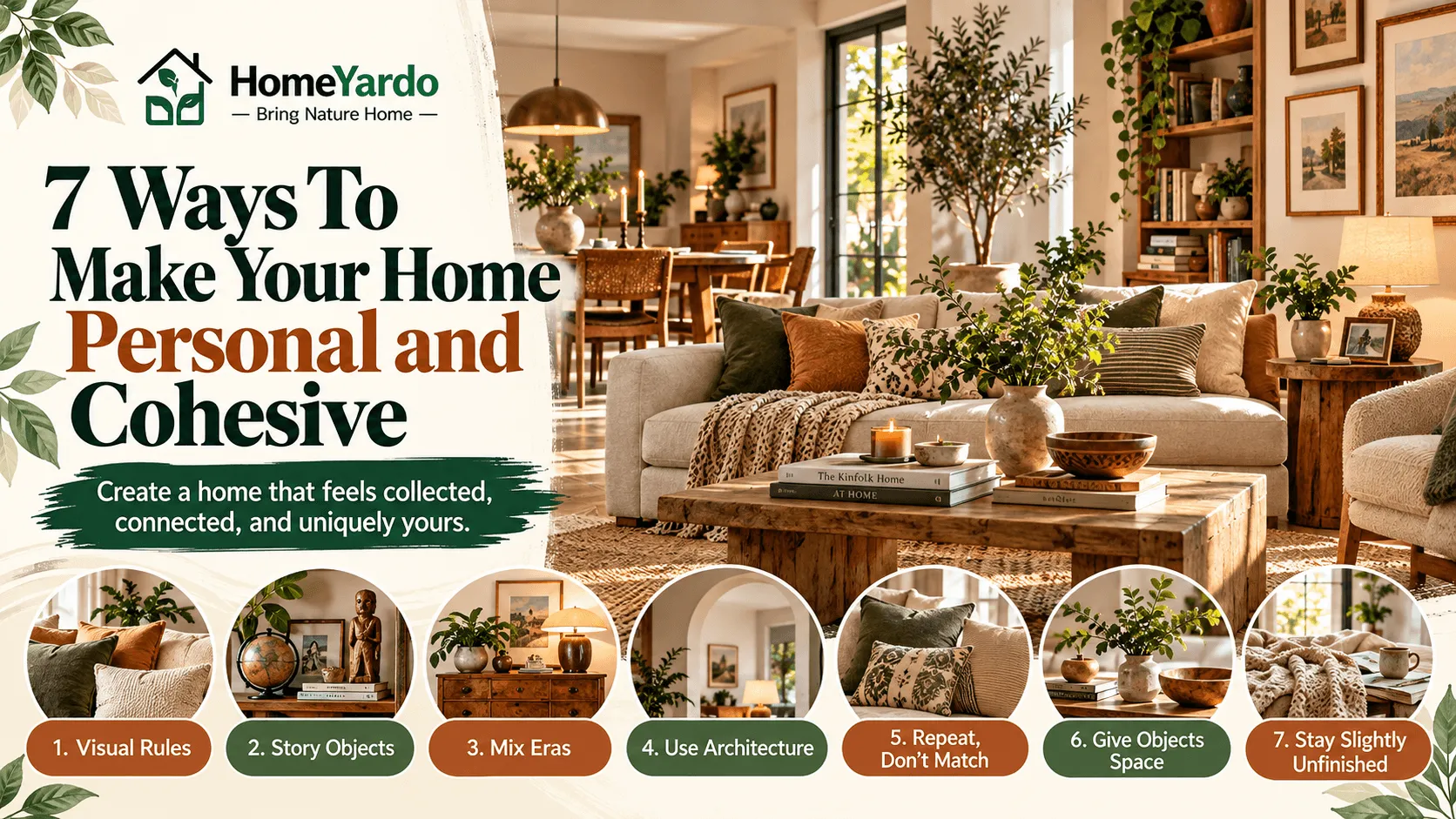
There is a certain type of room that appears attractive in photos but feels oddly unremarkable in person. The furniture is functional. The hues work together. The area could belong to nearly anyone, but nothing is obviously wrong.
On the other end of the spectrum is a house full of items that its owners truly cherish, but with so many unrelated hues, finishes, souvenirs, artwork, and furniture designs vying for attention that none of them really matter.
Just as a cohesive home doesn’t have to resemble a furniture showroom, a personal home doesn’t have to be disorganized.
The most intriguing interiors are typically found in the middle of those two extremes. They contain enough variation to feel lived in and enough repetition to feel connected. A modern lamp can be placed next to a family heirloom. The artwork doesn’t have to match the couch. A clean-lined dining table purchased a year ago can coexist with a chair discovered while traveling.
Developing a framework that is robust enough to keep those differences together is the key.
Here are seven methods for doing it.
1. Establish a Few Visual Rules, Then Give Yourself Room to Break Them
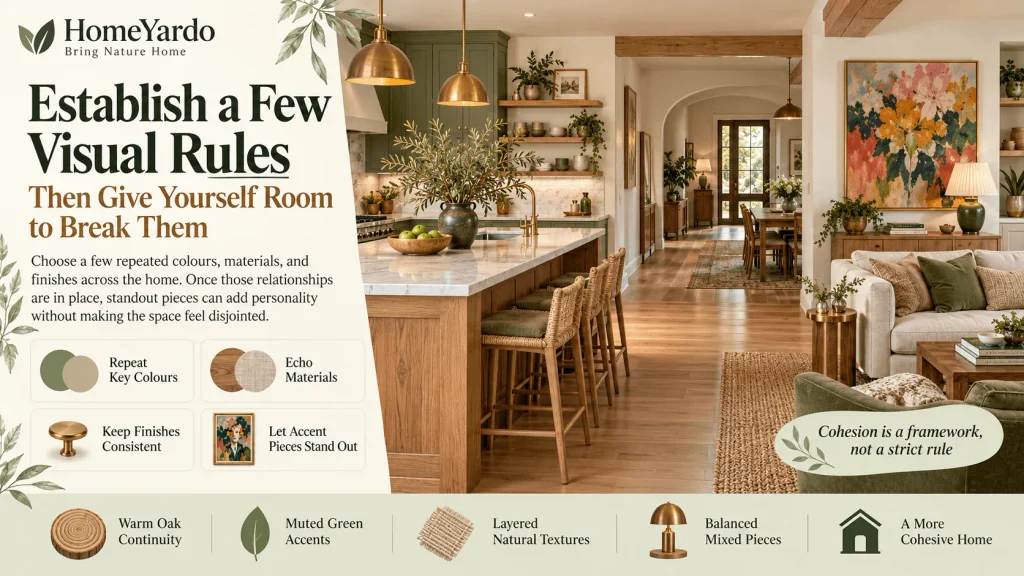
When you stop trying to make every object match, cohesion becomes easier to achieve.
Rather, choose the components that will maintain consistency throughout the house. This could be a small family of colors, a recurrent wood tone, comparable metals, or a material that appears in multiple rooms, like linen, oak, stone, or aged brass.
These turn into the house’s serene backdrop.
For instance, warm oak may reappear in a picture frame in the hallway and a side table in the living room if it first appears in the kitchen. A subdued shade of green used on cabinets might be used again in upholstery or artwork.
HomeYardo’s guide to creating a cohesive home interior explores this idea through repeated colors, materials, and finishes across connected spaces.
Individual pieces have a lot more freedom once those fundamental relationships are established. A room that already has a larger visual structure is less likely to feel disjointed by an odd flea-market lamp or vibrant painting.
Consider cohesion as a framework rather than a rule that all things must follow.
2. Choose Things For Their Stories, Not Just Their Style

Personalizing a home often goes wrong when “personal” becomes another decorating category.
You do not necessarily need monogrammed accessories, custom signs, or a wall covered in family photographs. Some of the strongest personal details are objects that would mean very little to somebody else.
It could be a ceramic bowl bought on a trip, a painting by a friend, your grandmother’s side table, an old record collection, a stack of books you actually read, or a slightly battered chair that has followed you through three apartments.
These objects bring something difficult to buy new: history.
Architectural Digest’s advice on decorating with meaningful antiques makes a similar point. Pieces connected to personal history can add narrative to a room, while mixing older and newer objects helps prevent the interior from feeling tied to a single moment or trend.
The important distinction is between displaying something because it fills a blank space and displaying it because you would miss it if it disappeared.
A home becomes more personal when the second category gradually outweighs the first.
3. Mix Eras Instead Of Buying An Entire “Look”
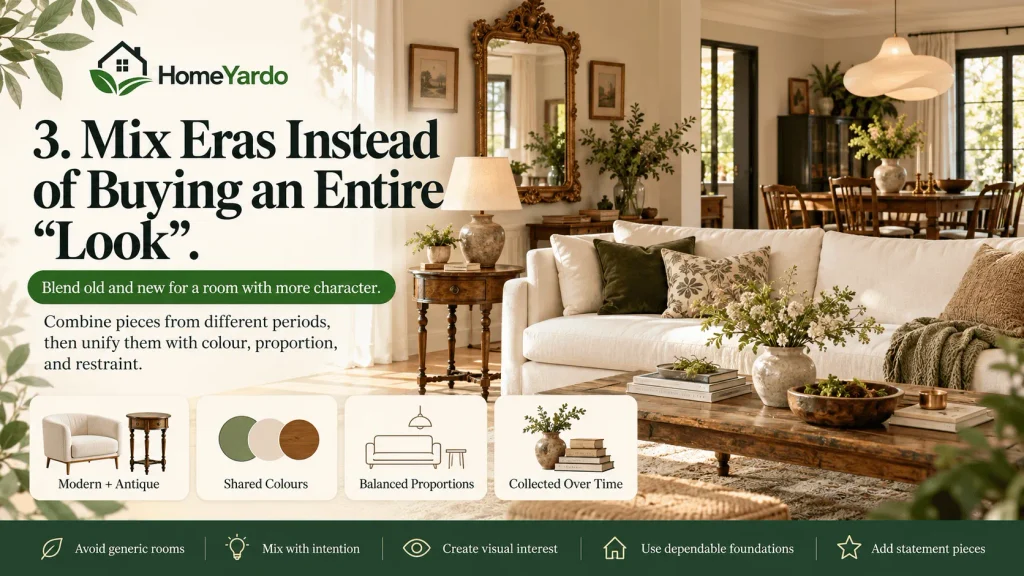
One of the fastest ways to make a room feel generic is to buy most of it from the same collection.
Matching furniture solves an immediate problem: everything coordinates. But it can also remove the small tensions that make an interior interesting.
Try mixing pieces from different periods instead.
An antique side table can complement a modern sofa. A contemporary pendant can be placed underneath a conventional dining table. An elaborate mirror passed down from a relative can fit into a simple bedroom.
It is not necessary to classify each piece according to its design era. It’s important that the contrast appears intentional.
Finding a connection between seemingly unrelated objects is one method of keeping the mix under control. Maybe they have the same warm undertone, a recurring color, or comparable proportions. Maybe one is purposefully simple while the other is visually complex.
This is where restraint matters. Architectural Digest’s discussion of layering a collected interior describes a useful approach: establish dependable foundations first, then introduce heirlooms and more expressive statement pieces.
The result is less like purchasing a complete outfit and more like building a wardrobe over time.
4. Let the Architecture And Location Participate

Individual style is inextricably linked to the structure that surrounds it.
In a city apartment, a design choice that seems perfectly natural in a coastal house might seem forced. This also holds true for light, views, ceiling height, architectural details, climate, and local materials.
Look for hints that are already present in the house rather than forcing a style on it.
A room with lots of windows and a good view of the landscape might require less decoration rather than more. Instead of smoothing out every flaw, an older house might benefit from retaining its unique proportions or original millwork. Natural materials, antique furniture, and handcrafted items can add coziness to a modern home without overpowering the architecture.
This becomes especially important during larger renovations, when dozens of individual choices need to work together. Homeowners in Northern California, for example, might work with a Marin County interior designer to develop an interior around the home’s architecture, surroundings, existing pieces, and the way they actually live, rather than applying a predetermined style room by room.
This idea is applicable everywhere: examine the house before making decisions about its future.
The final interior is much more difficult to duplicate elsewhere when location, architecture, and personality are allowed to interact.
5. Repeat, Rather Than Match
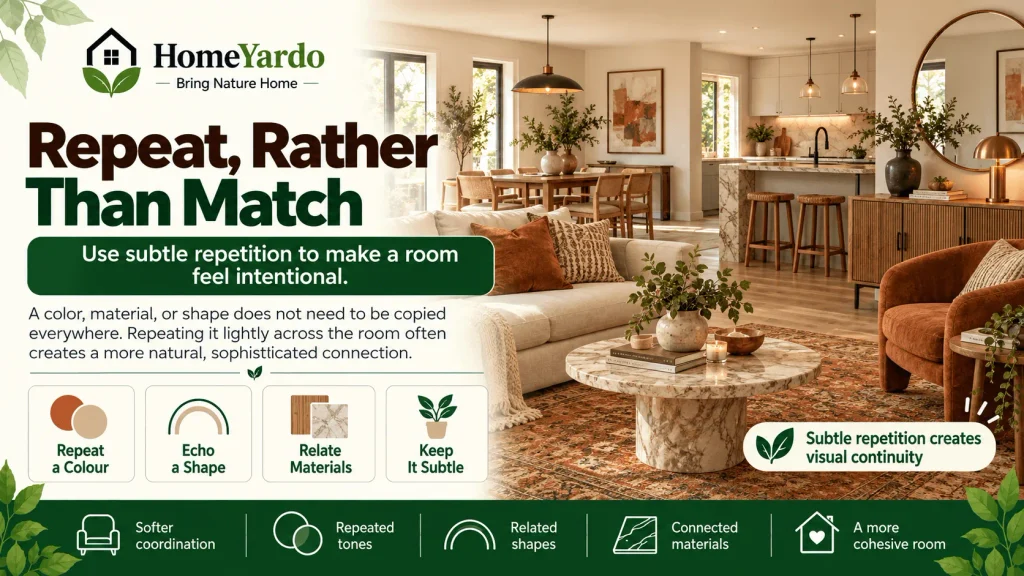
One of the simplest ways to give seemingly unrelated objects a sense of purpose is through repetition.
Let’s say you adore a rust-colored vintage rug. It doesn’t require rust-colored chairs, cushions, curtains, or artwork to fit in. It may be more convincing to use a much lighter touch, such as a small textile in a nearby area or a painting across the room with a similar tone.
The same idea applies to materials and shapes.
A round mirror could be related to a curved chair. A vintage lamp with black metal could look good with modern cabinet hardware. Without utilizing the same material, a veined stone table could mimic the hues of the kitchen countertop.
These connections don’t have to be clear-cut.
In fact, when you gradually notice a home, it often feels more sophisticated. Making someone recognize the color scheme as soon as they walk in is not the aim. It’s just to provide the eye with enough recurrent information so that the entire room makes sense.
If you are starting with an empty or particularly disconnected room, planning a room makeover before purchasing individual pieces can also help you identify which elements should repeat and where you have room for something unexpected.
6. Give Important Objects Enough Space To Matter

Personal objects lose some of their power when every surface is full.
A collection of ceramics can look beautiful when grouped intentionally on one shelf. Spread across every table, windowsill, and cabinet, the same collection may simply register as clutter.
The solution is not necessarily to own less. It is to edit what is visible at any one time.
Choose a few places where personal objects can become focal points. Leave some surrounding space quiet. Rotate smaller collections occasionally rather than displaying everything simultaneously.
The same applies to artwork.
A meaningful painting does not always need companions on either side. An unusual chair can be more striking when it is not surrounded by three other statement pieces. An inherited cabinet may deserve to be the most detailed object in the room.
Negative space gives the things you care about visual importance.
It also creates a useful balance between personality and cohesion: expressive pieces can be genuinely expressive because calmer areas give the eye somewhere to rest.
7. Allow The Home To Stay Slightly Unfinished
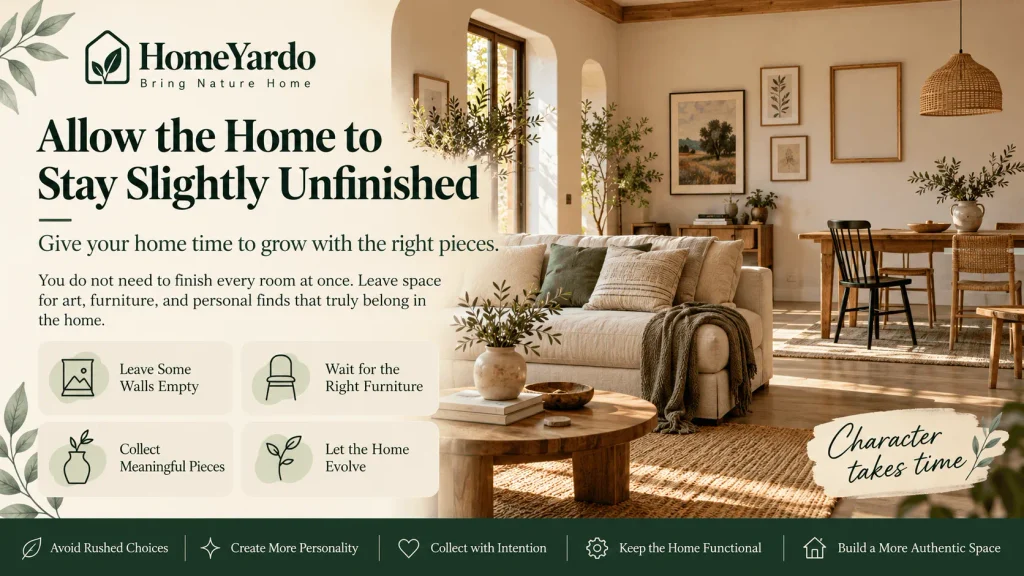
The simplest yet possibly most challenging decorating tip is that you don’t have to finish everything right away.
After moving or remodeling, there’s a great temptation to finish every room, fill every blank wall, and fix every unadorned nook at once. This frequently results in purchasing items just because they are suitable and readily available.
Character-rich homes typically take longer.
Until you come across art that you truly want to look at, leave a wall empty. Instead of purchasing the first suitable set of dining chairs, wait for the right ones. Take something with you when you travel. Allow a family member to present you with a piece that you would never have selected on your own. As your preferences and habits evolve, gradually replace items.
Living in partially furnished rooms indefinitely is not what this entails. It entails separating the components that give a house personality from those that are necessary for its operation.
Often, it is better to find the latter than to order them.
Cohesion Does Not Mean Perfection
An interior cannot be considered cohesive if all of the items are from the same era, style, or color scheme. It is one in which the connections between those items make sense.
There is a lot of space for individuality in that.
Establish a few visual pillars. Save the parts that tell stories. Combine the old and the new. Take note of the setting and architecture. Give unique objects enough space to stand out by subtly repeating colors and materials.
Above all, avoid the temptation to finish your house at the expense of personalizing it.
Rarely are rooms with flawless details the ones that people remember. They are the ones where the decisions show something about the locals.
FAQs
Use objects that connect to your experiences, interests, family, travels, hobbies, or routines. Artwork, books, inherited furniture, handmade pieces, photographs, vintage finds, and collections can add personality without requiring a full redesign.
Create a consistent visual background using a limited set of colors, materials, wood tones, or finishes. Group collections, leave some surfaces clear, and give meaningful objects enough surrounding space to stand out.
Look for one or two relationships between contrasting pieces. Similar colors, proportions, materials, undertones, shapes, or finishes can help furniture and decor from different periods feel intentional together.
No. Different rooms can have their own character while still sharing selected colors, materials, wood tones, or finishes. Repeating a few elements across adjoining spaces helps create continuity.