What to Know Before Replacing Kitchen Cabinet Doors
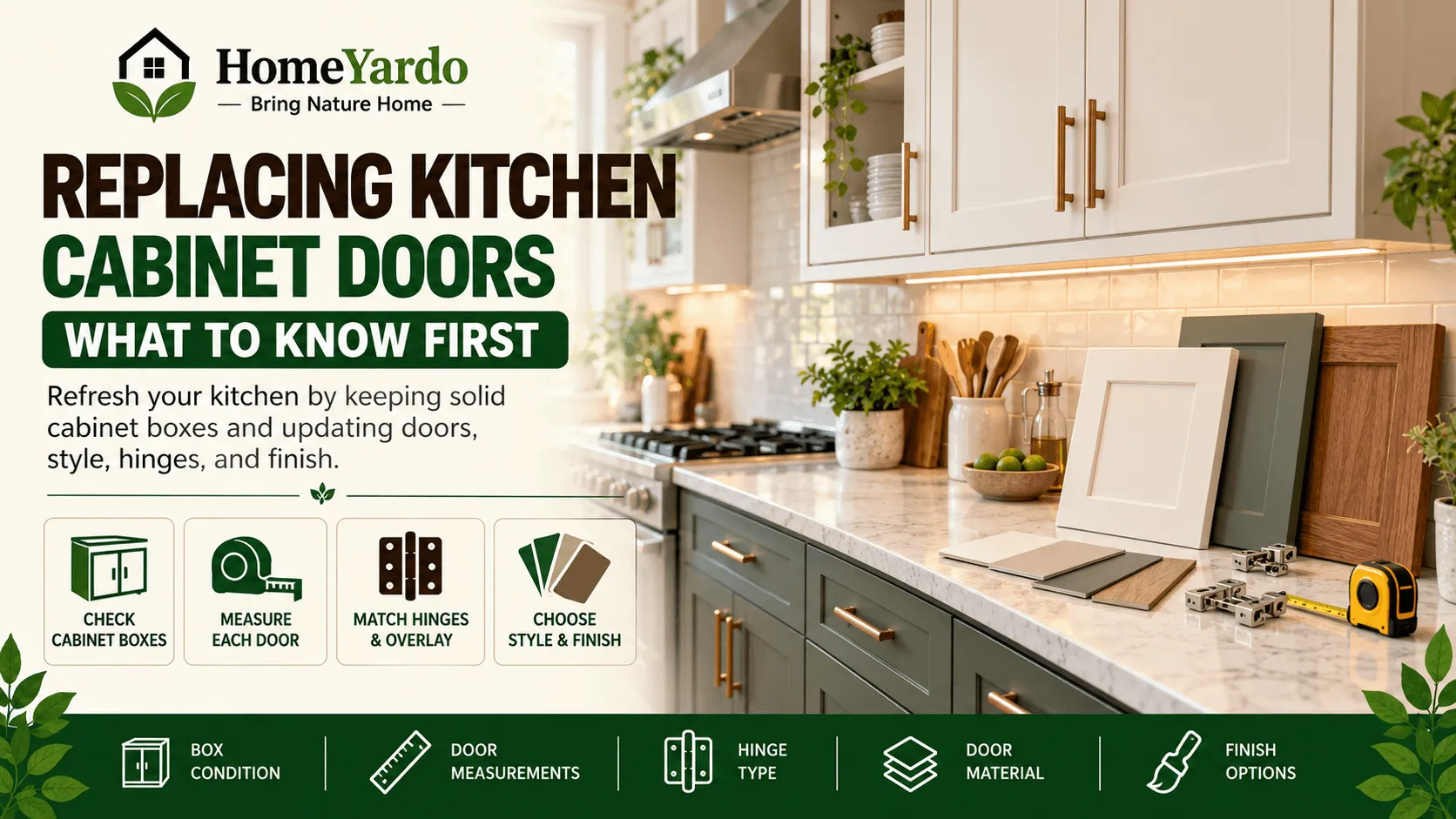
Replacing kitchen cabinet doors can refresh an outdated kitchen without removing cabinet boxes, changing the layout, or turning the room into a full remodeling project. It works particularly well when the existing cabinets are structurally sound but the doors are worn, dated, or no longer suit the look you want.
The doors themselves are only part of the decision, though. Cabinet condition, measurements, door construction, materials, hinges, finishes, and installation all affect whether the finished project looks intentional and works properly.
Before ordering replacement doors, work through these decisions in order.
Quick Answer: What Should You Check Before Replacing Kitchen Cabinet Doors?
Start by checking whether the existing cabinet boxes are straight, secure, dry, and worth keeping. Then identify the cabinet construction and current door configuration before measuring each opening and door individually.
Before placing an order, confirm:
- cabinet box condition
- door dimensions
- overlay or inset configuration
- hinge type and boring requirements
- door style
- material
- paint or stain finish
- drawer-front requirements
- installation method
If the boxes are badly swollen, warped, loose, or poorly configured for the kitchen, replacing the doors alone may not solve the underlying problem.
Is Replacing Kitchen Cabinet Doors the Right Move?
Start with the cabinets rather than the doors.
Look inside and around the cabinet boxes for swelling, water damage, loose joints, sagging shelves, damaged face frames, separating panels, or cabinets that have shifted noticeably out of level.
Minor cosmetic wear does not necessarily justify replacing an entire cabinet system. Structural deterioration is different.
When the cabinet boxes remain solid and the existing layout works well, replacing only the doors lets you retain much of the existing cabinetry while changing one of the kitchen’s most visible surfaces.
If the project is becoming larger than a door update, these kitchen remodeling ideas can help you think through cabinetry, storage, layout, and other changes before deciding how much of the existing kitchen to keep.
If your project is expanding beyond the doors, HomeYardo’s kitchen remodeling ideas can help you consider cabinetry alongside storage, lighting, layout, and other kitchen improvements.
Understand Your Existing Cabinet Construction
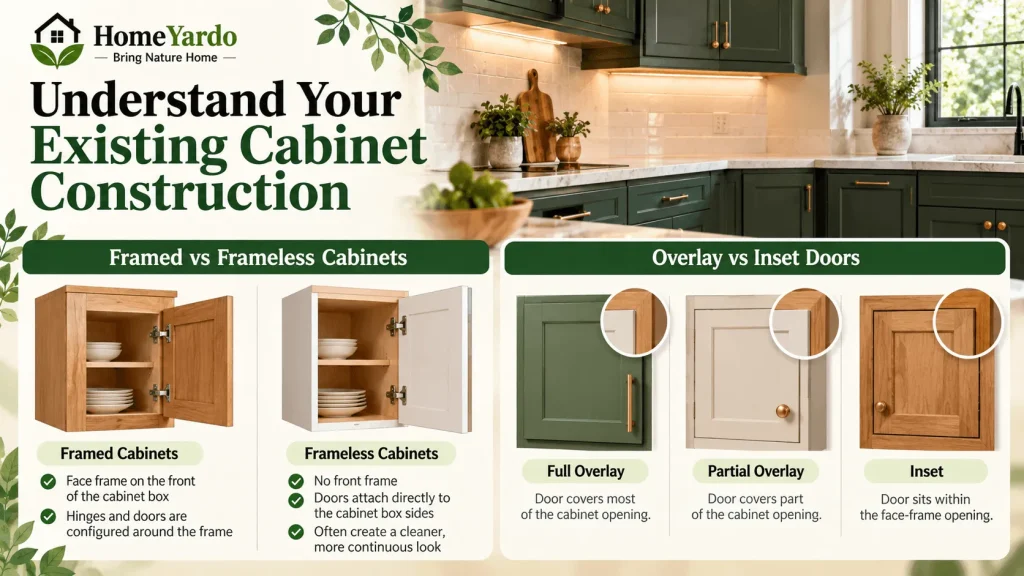
Not every replacement door attaches to every cabinet in the same way.
Before ordering, identify whether you have framed or frameless cabinets and whether the doors use full overlay, partial overlay, or inset construction.
Framed vs Frameless Cabinets
Face-frame cabinets have a frame attached to the front of the cabinet box. Hinges and doors are configured around that frame.
Frameless cabinets do not have the same front frame. Their doors typically attach directly to the sides of the cabinet box and often create a cleaner, more continuous appearance.
Knowing which construction you have helps determine compatible hinges, door dimensions, and overlay requirements.
Overlay vs Inset Doors
Overlay doors sit over some or most of the cabinet opening. Inset doors sit within the face-frame opening.
Changing from one configuration to another can involve more than ordering doors in a different size. Clearances, hinge placement, frame condition, and installation tolerances may also change.
If you want to change the door configuration rather than simply replace like with like, confirm the requirements before ordering.
Choose a Kitchen Cabinet Door Style That Fits the Room
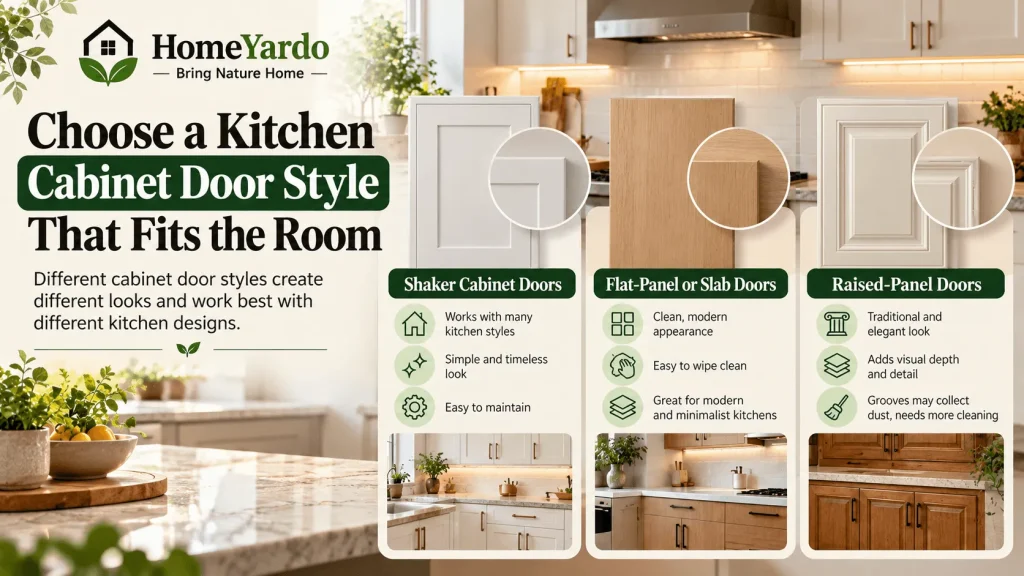
Cabinet doors occupy a large portion of the visible kitchen, so their profile has a strong effect on the room.
Shaker, slab, and raised-panel doors cover many common design preferences, but each creates a different appearance and requires slightly different maintenance.
Shaker Cabinet Doors
Shaker doors use a frame surrounding a recessed center panel. Their relatively simple geometry works with many transitional, traditional, farmhouse, and contemporary kitchens.
They also offer enough detail to create visual interest without the more elaborate routed profiles found on some traditional doors.
Flat-Panel or Slab Doors
Slab doors provide a flat, uninterrupted surface and work particularly well in modern and minimalist kitchens.
Their simple surfaces are easy to wipe clean. Installation alignment becomes particularly noticeable, however, because there are few decorative details to disguise uneven gaps between adjacent doors.
Raised-Panel Doors
Raised-panel doors have a dimensional center panel surrounded by a frame and are commonly associated with traditional kitchens.
The additional profiles create more visual depth, but grooves and routed details can collect dust and cooking residue more readily than a flat door.
Choose according to both the appearance you want and the amount of cleaning and maintenance you are comfortable with.
Compare Cabinet Door Materials Before Ordering
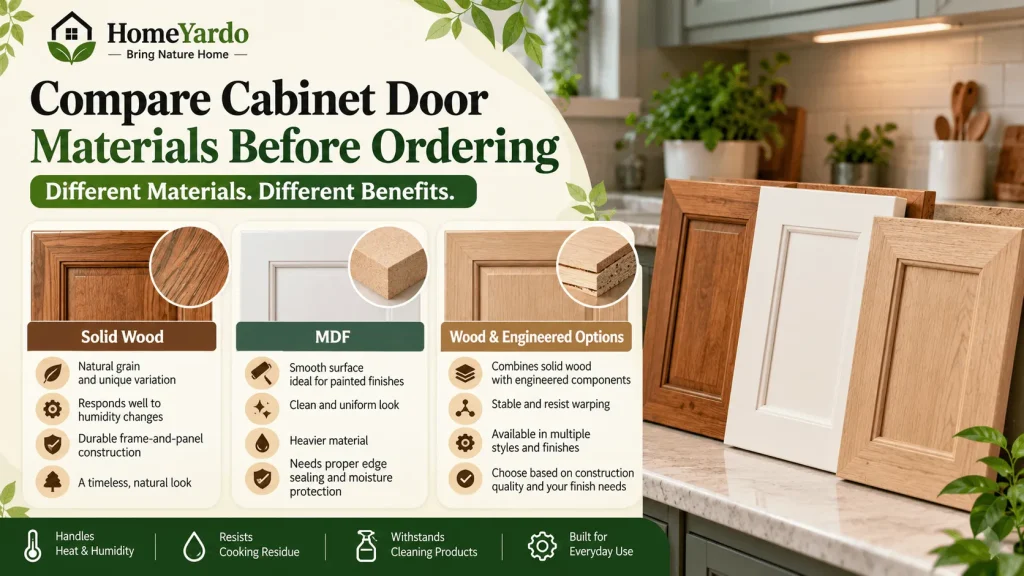
Kitchen doors regularly encounter heat, humidity, cooking residue, cleaning products, and repeated handling. Material selection should account for those conditions as well as appearance.
Solid Wood
Solid wood provides natural grain and variation that manufactured materials cannot reproduce exactly.
Wood also responds naturally to changes in indoor humidity. Well-made frame-and-panel doors account for this movement through their construction rather than treating the door as one rigid piece.
Quality kitchen cabinet doors from a dedicated manufacturer like Cabinet Doors are built with the construction details that allow solid wood to perform well in kitchen environments without warping or cracking.
MDF
MDF is commonly used for painted cabinet doors because its smooth surface does not have natural wood grain showing through the paint.
That can produce a clean, uniform painted finish.
MDF is relatively heavy, however, and exposed or damaged areas should be protected from excessive moisture. Edge sealing and finish quality therefore deserve attention when comparing painted doors.
Wood and Engineered Options
Depending on the door design and manufacturer, you may also encounter products combining solid-wood components with engineered center panels or other stable substrates.
Do not judge the door solely by the material name. Ask how the door is constructed, which parts use each material, and whether that construction is suitable for your preferred finish.
Measure Before You Order Replacement Cabinet Doors
Incorrect measurements can turn a straightforward upgrade into an expensive reorder.
Do not assume that every door that appears identical actually has identical dimensions, especially in older or custom kitchens.
Measure each required door and drawer front individually and record its location.
Your ordering method will depend on whether the manufacturer asks for the finished door dimensions or cabinet-opening dimensions. Those are not interchangeable.
Also confirm:
- width and height
- door thickness
- required overlay
- gaps between adjacent doors
- paired-door clearances
- hinge location
- hinge-cup boring specifications
- drawer-front dimensions
Follow the measurement method specified by the door manufacturer rather than applying a generic formula to every cabinet system.
Check Your Hinges and Hardware
A new cabinet door still needs to open, close, and align correctly.
Existing hinges may be reusable when the replacement doors match the current dimensions, thickness, overlay, and hinge configuration. A change in any of those specifications may require different hardware.
Concealed European-style hinges, for example, commonly require bored cup holes in specific positions. Ordering doors with compatible hinge boring can reduce installation work, but the boring dimensions must match the hardware being used.
This is also a good time to decide whether you want soft-close hinges or new handles and pulls.
Changing handle dimensions can create another consideration. Existing doors may have drilled holes that do not match the new hardware, while new undrilled doors give you more freedom to select a different handle size.
Decide Between Factory-Finished and Unfinished Doors
Replacement kitchen cabinet doors may be available unfinished, primed, painted, or stained.
Factory finishing can provide consistent coverage because the coating is applied under controlled production conditions. It can also save considerable preparation and finishing time during installation.
Unfinished or primed doors provide greater flexibility when you want to match an unusual existing color or finish the doors yourself.
Think about the complete project rather than the initial door price. Sanding, primer, paint or stain, application equipment, drying time, and labor all contribute to the cost of finishing doors after delivery.
If you are keeping visible cabinet frames, remember that the new doors and old cabinet surfaces also need to look intentional together.
Think About the Whole Kitchen, Not Just the Doors
A cabinet door sample can look excellent on its own and still feel wrong once installed beside the countertop, backsplash, flooring, wall color, and appliances.
Treat the door as one part of the kitchen’s overall material palette.
HomeYardo’s guide to creating a cohesive home interior explains how cabinetry, hardware, flooring, lighting, and nearby finishes can work together rather than appearing as unrelated individual choices.
You do not necessarily need to replace every surrounding surface. Sometimes new doors, updated handles, and a coordinated wall color are enough to make existing countertops or flooring feel more intentional.
Should You Replace the Drawer Fronts Too?
Usually, yes, if the goal is a visually consistent cabinet update.
Keeping old drawer fronts beside completely new doors can make the project appear unfinished, particularly when the new door profile or finish is noticeably different.
Check whether the drawer fronts are separate pieces attached to drawer boxes or integrated into the drawer construction before ordering replacements.
Also count false drawer fronts, such as fixed panels beneath some sinks, so they are not accidentally omitted from the order.
Replacement Doors vs New Cabinets
Replacing doors makes the most sense when the cabinet structure and layout already work.
New cabinets become more reasonable when you need to relocate storage, change cabinet dimensions, repair widespread structural damage, or redesign how the kitchen functions.
If poor storage is the real problem, changing the doors alone will not create more usable cabinet space. Before committing to a cosmetic update, consider whether kitchen storage solutions could solve some of the frustrations you currently have.
The decision should follow the underlying problem. Keep good cabinet boxes when appearance is the main issue. Consider more extensive remodeling when structure, storage, or layout is the problem.
Make a Final Checklist Before Ordering
Once the design choices are settled, check the entire order one more time.
Confirm that every door and drawer front has been counted, labeled, and measured. Verify the material, profile, finish, edge details, hinge requirements, and boring specifications.
It is also worth checking manufacturer tolerances, production times, shipping policies, and what happens if a door arrives damaged or does not match the submitted specification.
Ordering a sample door or finish sample can be useful when color, wood grain, profile depth, or surface quality is difficult to judge from a screen.
A few minutes spent checking specifications is much easier than discovering a measurement or hardware problem during installation.
Final Thoughts
Replacing kitchen cabinet doors can give a kitchen a noticeably different appearance without removing cabinet boxes that still have years of useful life left.
The best results come from treating it as more than a style change. Check the cabinets first, identify their construction, measure carefully, choose a suitable material, confirm hinge compatibility, and decide how the new doors will relate to the rest of the kitchen.
When those decisions are made before the order is placed, cabinet door replacement becomes a much more predictable home improvement project.
FAQ’s
Yes, when the cabinet boxes are structurally sound, the layout works well, and the main problem is the appearance or condition of the existing doors. Cabinets with serious water damage, warping, or structural problems may require more extensive replacement.
In many cases, yes. The existing boxes must be in suitable condition, and the replacement doors need to match the cabinet construction, required dimensions, overlay, and hinge setup.
Replacing only doors can involve fewer materials and less demolition than replacing complete cabinets. The actual project cost depends on door material, finish, hardware, number of doors, installation, and whether drawer fronts or cabinet frames also need work.
There is no single best material for every kitchen. Solid wood is popular for natural grain and stained finishes, while MDF is commonly chosen for smooth painted doors. Construction quality and moisture protection matter alongside the material itself.
Possibly. Existing hinges may work when the new doors have compatible dimensions, thickness, overlay, boring, and mounting requirements. Confirm compatibility before ordering.
Measure according to the replacement-door manufacturer’s instructions. Some manufacturers require finished door dimensions, while others calculate door sizes from cabinet openings and overlay specifications. Measure each door rather than assuming similar-looking doors are identical.
Usually. Matching drawer fronts help create a consistent finished appearance. Remember to include false drawer fronts and other fixed decorative panels when counting pieces.
Some manufacturers offer hinge-cup boring as an ordering option. You will need to provide or select specifications compatible with the hinges and cabinet configuration being used.
DIY finishing provides more control over color and may suit experienced homeowners, while factory-finished doors can save preparation time and provide consistent coverage. Compare the complete cost and workload rather than the door price alone.
Consider complete cabinet replacement when boxes are badly damaged, the existing layout does not work, storage needs have changed substantially, or you want to relocate or resize cabinetry.