
Dumpster Rental Considerations for Large Facility Maintenance Projects
A dumpster rental for facility maintenance projects needs more planning than simply choosing a container and finding an empty spot outside.
Large facilities may remain fully operational while flooring is replaced, lighting is upgraded, equipment areas are cleaned, offices are refreshed, shelving is removed, or exterior repairs are completed. Employees, forklifts, deliveries, contractors, emergency access, production schedules, and loading docks may all be moving around the same project.
The waste plan has to work around them.
For facility managers, that means thinking about debris type, weight, placement, loading routes, service access, safety, and pickup timing before demolition or removal work starts.
What Should Facility Managers Plan Before Renting a Dumpster?
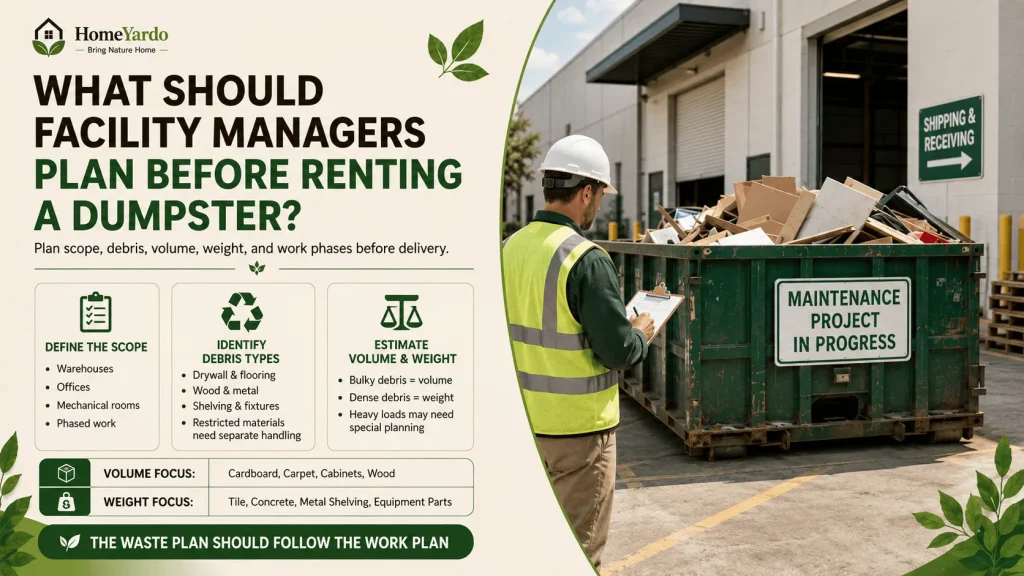
Facility managers should establish the project scope, likely waste streams, approximate debris volume, heavy materials, work phases, and operational restrictions before arranging a dumpster.
Those decisions influence container selection, placement, service frequency, and which materials can actually be loaded.
Define the Maintenance Scope
Start by identifying exactly what the maintenance project includes.
A facility-wide lighting replacement creates a very different waste stream from warehouse rack removal, restroom renovation, flooring replacement, machinery-area cleanup, office refurbishment, or exterior concrete repairs.
Document the areas involved and the work expected in each one. That may include:
- Warehouses
- Production areas
- Mechanical rooms
- Offices
- Restrooms
- Storage rooms
- Loading areas
- Utility spaces
- Exterior service yards
Also determine whether the work will occur simultaneously or in phases.
A phased project may need several dumpster exchanges rather than one container sitting on the property throughout the entire maintenance schedule.
The waste plan should follow the work plan, not the other way around.
Identify Debris Types Before Work Begins
Knowing what will be removed is as important as knowing how much.
Common facility-maintenance debris may include drywall, flooring, ceiling materials, fixtures, packaging, wood, shelving, piping, insulation, metal, cabinets, pallets, damaged equipment components, and general cleanup material.
But not every discarded item should automatically enter the same dumpster.
Maintenance involving electrical systems, lighting, chemicals, equipment, batteries, oils, aerosols, or older building components can create materials subject to separate handling or disposal requirements.
EPA identifies batteries, certain lamps, mercury-containing equipment, pesticides, and aerosol cans among the materials that can fall under federal universal-waste regulations. State requirements can differ, so facility managers should confirm applicable rules and the dumpster provider’s prohibited-material list before work begins.
That matters particularly during lighting, electrical, mechanical, and equipment-maintenance projects.
Estimate Volume and Weight
Dumpster planning involves two different measurements: volume and weight.
Bulky debris may fill a container before it becomes particularly heavy. Dense debris can create the opposite problem.
Consider these examples:
| Debris | Main Planning Concern |
|---|---|
| Cardboard and packaging | Volume |
| Drywall | Volume and weight |
| Carpet | Volume |
| Tile | Weight |
| Concrete or masonry | High weight |
| Metal shelving | Weight and awkward dimensions |
| Cabinets and fixtures | Volume |
| Equipment components | Weight and disposal restrictions |
| Wood | Volume and protruding pieces |
A container can look half-empty and still approach its allowable weight when dense material is involved.
Discuss unusually heavy debris with the rental company before loading rather than discovering the problem at pickup.
Where Should a Dumpster Be Placed at a Large Facility?
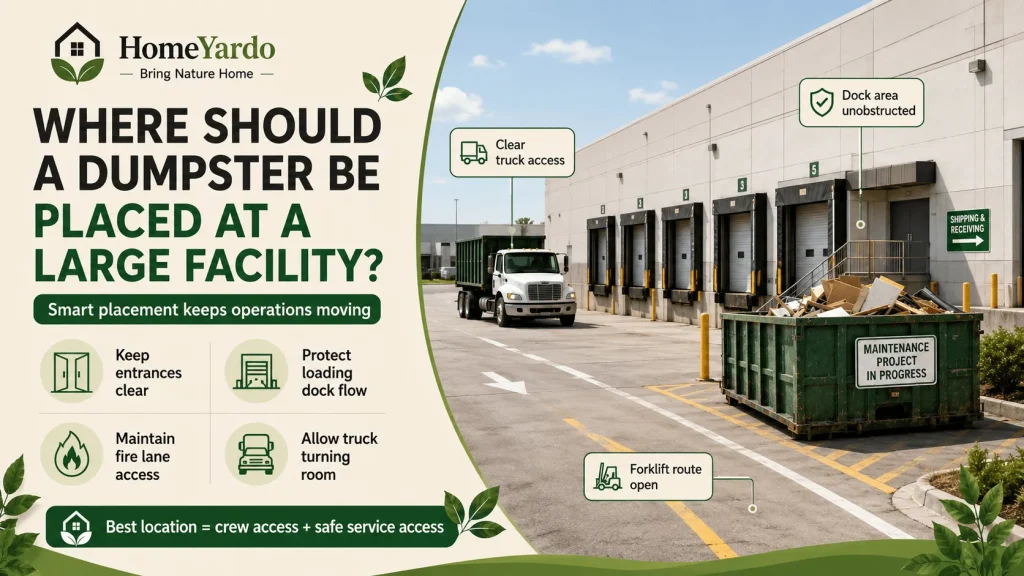
The best dumpster location provides maintenance crews with practical access while keeping employee traffic, deliveries, emergency routes, equipment movement, and service-truck access working normally. This type of facility planning is also important when coordinating storage areas, loading docks, traffic routes, and staging space; see our guide to warehouse planning for more on organizing these areas.
The closest available location is not automatically the best one.
Choose Placement Around Facility Flow
Study how the property works during an ordinary business day.
A dumpster should generally avoid blocking:
- Employee entrances
- Visitor access
- Accessible parking
- Fire lanes
- Loading docks
- Dock doors
- Existing trash compactors
- Delivery routes
- Forklift lanes
- Emergency access
- Gates
- Equipment paths
Working with Waste Removal USA can help maintenance managers coordinate dumpster rental placement and service timing around large facility needs.
Before delivery, confirm that the proposed location has enough room for both the container and the truck that must deliver, service, and remove it.
A dumpster that crews can reach but the collection truck cannot safely service is badly placed.
Protect Loading Dock and Service Access
Loading docks are often among the busiest areas of a commercial or industrial property.
Incoming deliveries, outgoing shipments, vendor vehicles, maintenance supplies, returns, trailers, pallets, forklifts, and equipment transfers may all converge there.
A dumpster placed beside a dock without reviewing that traffic can turn a convenient location into an operational obstruction.
Check:
- Delivery schedules
- Trailer staging areas
- Forklift routes
- Dock-door usage
- Turning areas
- Vendor arrival windows
- Waste-service access
If the service yard must support both logistics and debris removal, plan dumpster loading or collection during a lower-traffic period.
Confirm Dumpster-Truck Access
Facility managers sometimes plan only for the dumpster footprint.
The service vehicle matters too.
The truck needs adequate approach space, turning room, overhead clearance, surface strength, and access during both delivery and pickup. Parked trailers, temporary storage, pallets, construction equipment, gates, or employee vehicles can make an otherwise suitable location inaccessible.
Ask the provider what access conditions are required before choosing the final position.
How Should Debris Move Through an Active Facility?
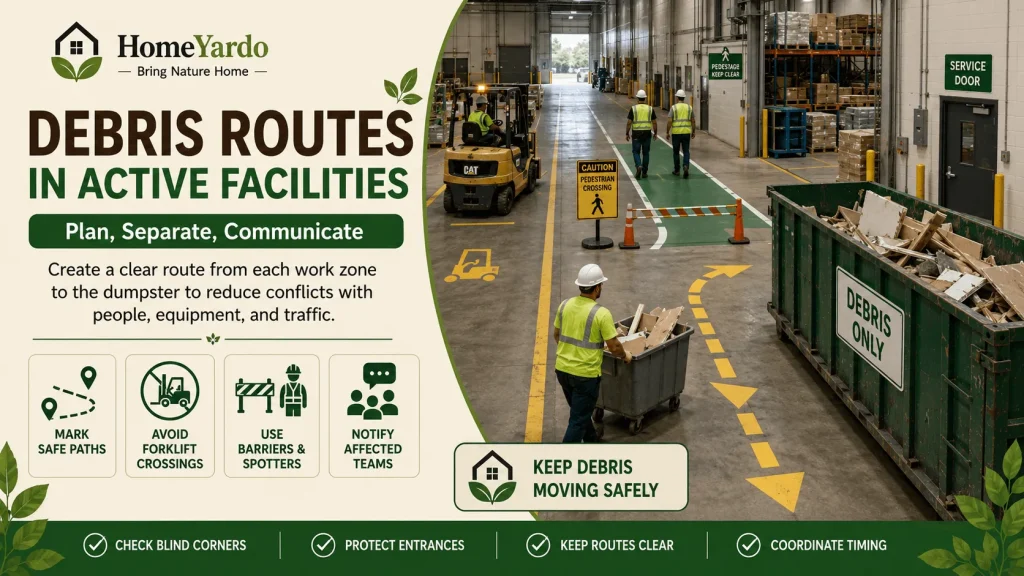
Create a defined debris route from each work zone to the dumpster before material removal begins.
That route should reduce interaction with employees, visitors, production equipment, stored inventory, and vehicle traffic.
Plan Internal Debris Routes
A large-facility debris route may run through corridors, warehouses, mechanical spaces, production areas, offices, stairwells, service doors, elevators, or exterior lanes.
Walk the proposed route before work starts.
Look for:
- Employee traffic
- Forklift intersections
- Blind corners
- Stored inventory
- Electrical cords
- Pallets
- Active workstations
- Doorway restrictions
- Floor transitions
- Security-controlled areas
Where possible, separate debris movement from peak employee and equipment traffic.
If crews must cross an active operational area, scheduling, barriers, spotters, carts, or temporary access controls may be appropriate depending on the facility’s own safety procedures.
A debris route should be treated as part of project logistics, not improvised every time someone carries material outside.
Coordinate With Employees and Department Leads
Maintenance work often affects people who have nothing to do with the project.
Department supervisors can identify conflicts that are easy to miss during initial planning: a recurring shipment, shift change, staff meeting, production run, visitor period, inventory count, or scheduled equipment move.
Tell affected teams:
- Where the dumpster will be
- Which work areas are restricted
- When debris will be moved
- Which entrances remain available
- Whether parking changes
- Whether dock access changes
- How long the disruption is expected to last
Simple communication can prevent employees from parking where a service truck needs to operate or placing materials in a planned debris route.
How Should Maintenance Waste Be Separated?
Project debris should be separated according to the facility’s existing waste systems, recycling practices, rental-provider restrictions, and applicable disposal requirements.
A roll-off dumpster should not become the default destination for everything removed during maintenance.
Separate Project Debris From Daily Waste
Many large properties already use several waste streams, such as:
- General trash
- Cardboard recycling
- Scrap metal
- Pallet storage
- Front-load dumpsters
- Trash compactors
- Equipment recycling
- Specialized waste containers
Use those established systems where appropriate rather than filling the project dumpster with materials that already have another destination.
The maintenance dumpster should have a defined purpose.
If several departments or contractors are involved, post or distribute clear instructions about what belongs in it.
Identify Materials That May Need Special Handling
This is one of the most important distinctions in facility cleanup.
Routine construction and maintenance debris may be acceptable in a roll-off container, while other materials may be restricted by the rental company or regulated separately.
EPA notes that construction, demolition, and renovation work can produce waste containing substances such as mercury, lead, used oil, or ignitable materials. Federal universal-waste rules also cover certain batteries, lamps, pesticides, mercury-containing equipment, and aerosol cans.
Local and state requirements can be more restrictive.
For that reason, facility managers should identify questionable materials before crews begin loading. Check the provider’s prohibited-material policy and consult the appropriate environmental or safety personnel when regulated waste may be present.
Don’t use the dumpster as the place where uncertain materials go while someone figures them out later.
Watch Heavy Materials and Weight Limits
Flooring work, restroom renovation, concrete repair, rack removal, machinery cleanup, and exterior maintenance can generate dense material quickly.
Common examples include:
- Tile
- Concrete
- Masonry
- Metal fixtures
- Pipe
- Shelving
- Equipment parts
- Cabinets
- Wet construction materials
Track these materials separately when planning the load.
If a project contains a large quantity of dense debris, tell the rental provider what it is rather than estimating based only on container size.
How Can Dumpster Service Be Planned Around Operations?
Dumpster delivery, exchanges, and pickup should be treated as scheduled facility activities.
Each service visit introduces a large truck into an operating property and requires reliable access to the container.
Work Around Production and Service Schedules
Some facilities cannot stop operations because maintenance is underway. The same scheduling approach applies to building systems that require ongoing service; see our guide to seasonal commercial HVAC maintenance for planning inspections and service around facility operations.
Manufacturing plants, warehouses, distribution centers, hotels, office campuses, schools, healthcare properties, and municipal buildings may operate throughout all or most of the project.
For industrial environments, Manufacturing Plant Cleanup planning may require close attention to production equipment, work zones, employee movement, and loading schedules.
Apply the same principle to dumpster service.
Where possible, schedule delivery or swap-outs away from:
- Shift changes
- Major deliveries
- Peak shipping periods
- Visitor peaks
- Production changeovers
- School arrival or dismissal
- Scheduled equipment movements
Waste service should fit into facility operations rather than forcing normal operations to work around an unexpected truck.
Coordinate Vendors and Contractors
Outside contractors may each have different assumptions about cleanup.
Before work begins, establish:
- Who may use the dumpster
- Which materials are permitted
- Which materials must be separated
- Where temporary debris staging is allowed
- Which routes crews should use
- Who monitors fill level
- Who requests an exchange
- Who cleans the dumpster area
If several trades share one container, someone should own the waste plan.
Otherwise, it is easy for one crew to fill the container with bulky packaging before another crew begins removing heavier project debris.
Monitor Fill Levels and Arrange Swap-Outs
Do not wait for the dumpster to become unusable before arranging service.
Once a container is full, crews often begin staging debris somewhere else. That creates double handling and can turn hallways, storage rooms, mechanical areas, or service yards into temporary waste zones.
Check the container regularly.
For phased maintenance, a useful approach is to connect waste-service decisions with project milestones. A flooring-removal phase, equipment-removal phase, and office-refurbishment phase may each produce different loading patterns.
Schedule a swap before the next phase begins if capacity is already limited.
What Safety Issues Should Facility Managers Consider?
Dumpster and debris planning should preserve emergency access, designated exit routes, fire-protection equipment, operational traffic paths, and the facility’s established safety controls.
Waste convenience does not override emergency access.
Keep Emergency and Safety Routes Open
OSHA requires workplace exit routes to remain free and unobstructed, with materials or equipment kept out of those routes.
That makes debris staging an operational safety issue, not merely a housekeeping issue.
During the project, check access to areas such as:
- Exit routes
- Fire exits
- Emergency lanes
- Fire doors
- Electrical panels
- Sprinkler equipment
- Alarm equipment
- Eyewash stations
- First-aid equipment
- Emergency shutoffs
The exact requirements affecting a facility depend on the workplace and the work being performed, so the facility’s safety procedures and applicable regulations should guide the final plan.
But one rule is straightforward: a temporary pile of maintenance debris should never become a permanent obstruction.
Keep the Dumpster Area Controlled and Clean
The space around the container should not turn into a secondary debris pile.
Loose packaging, nails, metal pieces, sharp scraps, broken components, dust, and material placed beside the dumpster can expose workers, pedestrians, vehicles, and tires to avoidable hazards.
Require crews to load materials fully inside the container when permitted and practical.
Inspect the surrounding pavement periodically, especially when the dumpster is near employee parking, loading zones, service yards, or other active areas.
Wind matters too. Light packaging and loose debris can travel much farther across a property than anyone expects.
How Should the Dumpster Be Managed at Project Closeout?
Dumpster removal should be part of the maintenance project’s closeout plan.
When the work phase is complete:
- Complete the last debris load.
- Check that no prohibited materials were left for disposal.
- Clear the debris route.
- Sweep or clean temporary staging areas.
- Inspect the area around the dumpster.
- Confirm that parked vehicles or equipment will not prevent pickup.
- Arrange removal at the agreed service time.
- Restore any temporarily changed traffic or access procedures.
If another maintenance phase will not begin for some time, leaving an unused dumpster in an active service area may create unnecessary space and access problems.
Close the waste operation when the work that generated the waste is complete.
Common Dumpster Rental Planning Mistakes
The most common mistakes usually happen before the first piece of debris reaches the container.
One is choosing a location because it appears empty without checking what happens there throughout the day. A quiet service lane at 9 a.m. may become a trailer-staging area at noon.
Another is ignoring weight. Dense flooring, masonry, concrete, shelving, or equipment components can use available weight capacity faster than visible dumpster space.
Mixing maintenance debris with regulated, restricted, recyclable, or reusable materials can also create problems.
And waiting until the dumpster is completely full to request service can stop cleanup at exactly the wrong point in the project.
Treat the dumpster as one component of facility logistics, alongside labor, deliveries, equipment access, and scheduling.
Facility Maintenance Dumpster Rental Checklist
Before the dumpster arrives, confirm:
| Planning Item | Question to Answer |
|---|---|
| Project scope | Which areas and maintenance tasks will generate waste? |
| Debris type | What materials will be removed? |
| Restricted waste | Does anything need separate handling? |
| Volume | How much physical space may the debris occupy? |
| Weight | Are concrete, tile, metal, masonry, or other dense materials involved? |
| Placement | Can crews reach the container without disrupting operations? |
| Truck access | Can the service vehicle safely deliver and retrieve it? |
| Loading docks | Will the location interfere with shipping or receiving? |
| Debris route | How will waste move from each work area to the container? |
| Emergency access | Are exits and safety equipment completely unobstructed? |
| Contractors | Does every crew understand the disposal rules? |
| Fill monitoring | Who checks capacity and requests service? |
| Service timing | When can swaps occur with the least disruption? |
| Closeout | Who checks the site after final removal? |
A ten-minute review of these questions before delivery can prevent hours of operational friction later.
Plan Waste Removal as Part of the Maintenance Project
Dumpster rental for a large facility works best when waste management is planned alongside the maintenance work itself.
Define the debris before work begins. Choose placement based on real traffic patterns. Protect docks and emergency access. Establish debris routes. Separate materials that do not belong in the project container. Watch weight as well as volume. And schedule service before capacity becomes a problem.
A dumpster should make a maintenance project easier to manage.
When placement, access, waste separation, and service timing are planned early, it can do exactly that without becoming another obstacle inside an already busy facility.
FAQ’s
There is no single best size. The right container depends on debris type, volume, weight, available space, service access, and how quickly waste is generated. A large container may suit bulky renovation debris, while dense materials may require a different loading approach. Discuss the actual waste stream with the provider before ordering.
Choose a stable, accessible location that maintenance crews and the service truck can reach without blocking loading docks, entrances, emergency routes, parking access, equipment lanes, or regular waste systems. Review how the area operates throughout the day rather than choosing placement based on how it looks during one site visit.
No. Rental-company restrictions and disposal regulations can apply to certain materials. Batteries, some lamps, mercury-containing equipment, chemicals, oils, aerosols, and other materials may need separate handling. Identify unusual waste before loading and confirm requirements with the provider and applicable environmental or facility-safety personnel.
Review delivery and shipping schedules before choosing the container location. Preserve truck-turning areas, trailer staging, forklift paths, and dock-door access. If a service yard must be shared, schedule dumpster delivery and exchanges during lower-traffic windows and keep the service vehicle’s approach clear.
Service frequency should follow the rate at which the project generates debris. Monitor fill level throughout the work and request an exchange before the container becomes unusable. Multi-phase maintenance projects may benefit from planned exchanges between phases instead of relying on one container for the entire project.
Dumpster capacity is limited by both physical volume and allowable weight. Tile, concrete, masonry, metal, wet materials, shelving, and equipment components can create substantial weight without filling the container visually. Identifying dense debris early helps the rental provider recommend an appropriate disposal plan.
They can when the waste plan allows it, but all contractors should receive the same loading rules. Define permitted materials, restricted waste, debris routes, staging locations, and responsibility for monitoring the container. Without common rules, one trade can create disposal problems for everyone else working on the project.
Keep exit routes, emergency access, fire-protection equipment, employee travel paths, and operational vehicle routes clear. OSHA requires workplace exit routes to remain unobstructed. Facility managers should also control loose debris around the container and follow site-specific safety procedures throughout loading, service, and removal.