
Commercial HVAC Maintenance: A Seasonal Plan for Reliable Buildings

Commercial HVAC maintenance works best when it follows how the building and its equipment actually operate. Weather changes, occupancy patterns, equipment age, operating hours, controls, and the consequences of downtime should all influence the maintenance plan.
A seasonal maintenance plan gives facility managers a repeatable process for preparing equipment before peak demand, documenting developing problems, prioritizing repairs, and planning equipment replacement before an unexpected failure forces the decision.
Key Takeaways
- Schedule inspections before periods of heavy heating or cooling demand.
- Adjust maintenance frequency according to equipment age, runtime, condition, manufacturer guidance, and operational importance.
- Include controls, sensors, airflow, drains, electrical components, coils, motors, and operating schedules in routine reviews.
- Keep service records organized so recurring problems can be identified over time.
- Use performance and repair history to support budgeting and replacement decisions.
- Refrigerant-related work should be handled by appropriately qualified personnel.
What Is Commercial HVAC Maintenance?
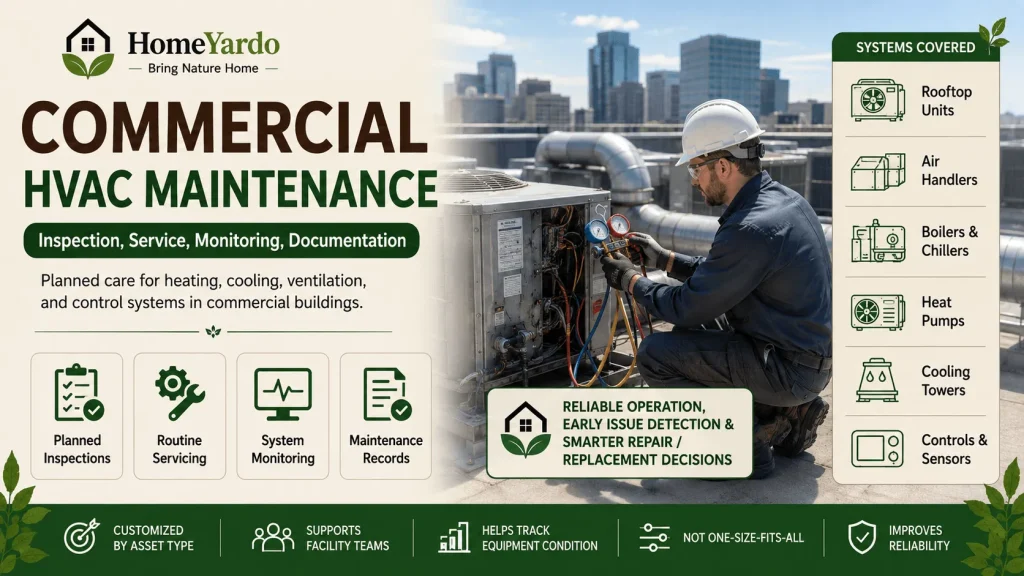
Commercial HVAC maintenance is the planned inspection, servicing, monitoring, and documentation of heating, cooling, ventilation, and control systems used in commercial buildings.
A maintenance program may cover rooftop units, split systems, air handlers, boilers, chillers, heat pumps, cooling towers, pumps, exhaust systems, makeup-air equipment, thermostats, sensors, dampers, and building automation controls. Facilities that use mechanical ventilation can also review heat recovery ventilation as part of their broader understanding of ventilation systems.
The same schedule should not automatically be applied to every asset. A newer unit serving a small office may require a different level of attention than aging equipment supporting a server room, healthcare space, kitchen, hotel, laboratory, or production area.
The aim is not simply to complete service visits. A useful maintenance program should help the facility team understand equipment condition, identify developing problems, maintain reliable operation, and decide when adjustment, repair, or replacement should be considered.
Why Seasonal HVAC Maintenance Matters in Commercial Buildings

Commercial HVAC systems experience different operating stresses throughout the year.
Cooling equipment works harder during hot weather, while heating components become more important as temperatures fall. Humidity changes can influence comfort, condensation, ventilation, and indoor conditions. Building use can also change quickly because of extended operating hours, additional occupants, tenant improvements, special events, or new equipment loads.
Seasonal planning allows maintenance teams to prepare systems before these changes become demanding.
Seasonal planning allows maintenance teams to prepare systems before these changes become demanding. It can also help identify developing problems that could contribute to equipment failure. Preventing AC breakdowns can help homeowners understand some of the warning signs and routine maintenance steps, but they can contribute to longer runtimes, unstable temperatures, increased equipment stress, or repeated comfort complaints.
Build and Maintain a Complete HVAC Equipment Register
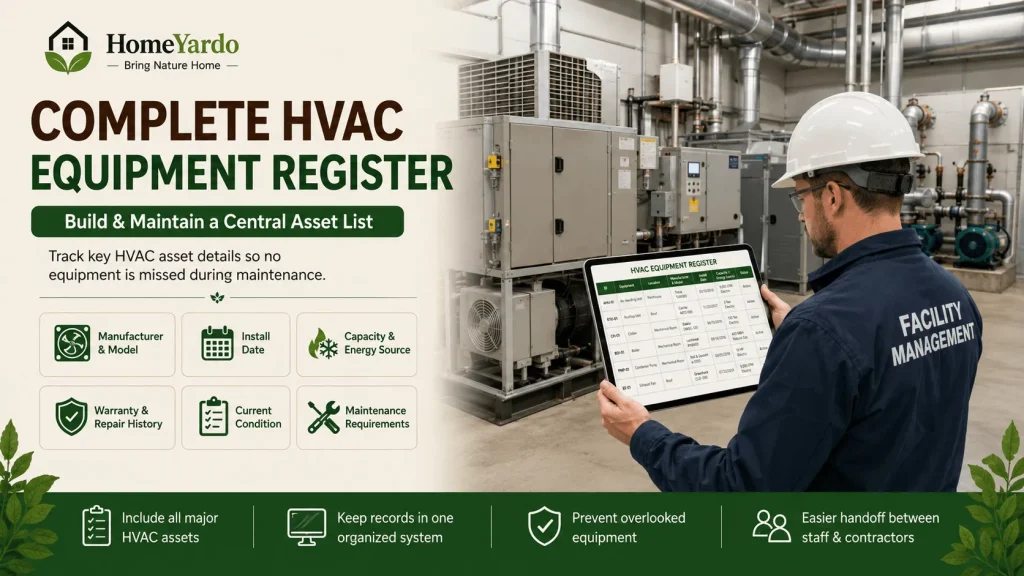
A commercial maintenance program should start with an accurate list of the equipment being managed.
For each major asset, record information such as:
- Manufacturer and model
- Asset or equipment identification number
- Installation or commissioning date
- Rated capacity
- Fuel or energy source
- Building area or process served
- Warranty information
- Previous repairs
- Current condition
- Known operating concerns
- Manufacturer-recommended maintenance requirements
Depending on the property, the equipment register may include rooftop units, air-handling units, fan coils, boilers, furnaces, heat pumps, chillers, cooling towers, pumps, valves, exhaust fans, makeup-air units, kitchen ventilation equipment, motors, belts, dampers, sensors, thermostats, and automation controls.
Keeping this information in one organized system reduces the chance that equipment will be overlooked when employees, contractors, or service providers change.
Prioritize Maintenance Based on Equipment Risk
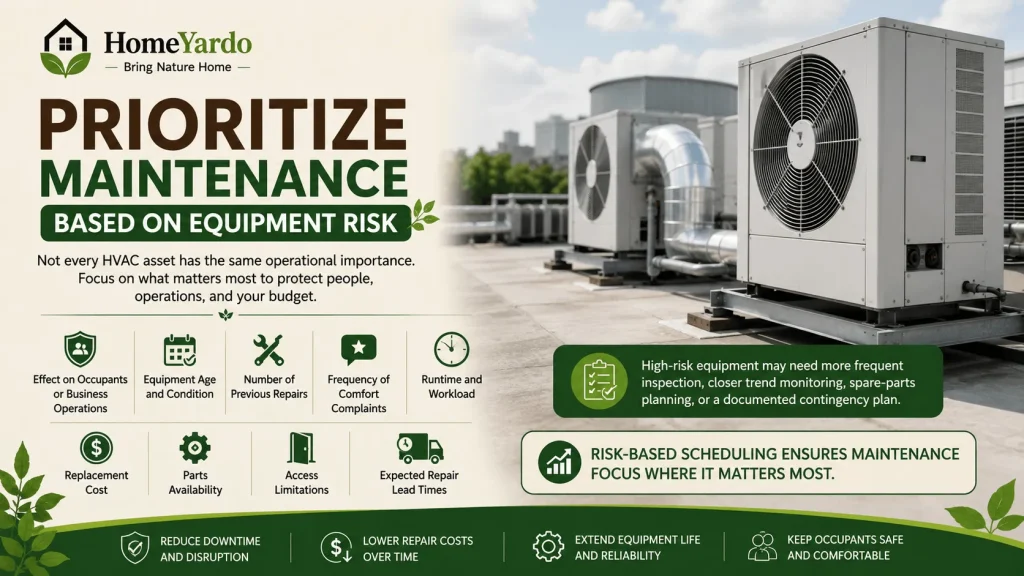
Not every HVAC asset has the same operational importance.
Equipment serving a general office may create inconvenience when it fails, while failure in a server room, medical area, food facility, school kitchen, hotel, laboratory, or production space may have much greater consequences.
Facility teams can prioritize equipment by considering:
- The effect of failure on occupants or business operations
- Equipment age and current condition
- Number of previous repairs
- Frequency of comfort complaints
- Runtime and workload
- Replacement cost
- Parts availability
- Access limitations
- Expected repair lead times
High-risk equipment may need more frequent inspection, closer trend monitoring, spare-parts planning, or a documented contingency plan.
Risk-based scheduling helps prevent maintenance resources from being distributed equally across equipment that does not carry equal consequences.
Commercial HVAC Seasonal Maintenance Calendar
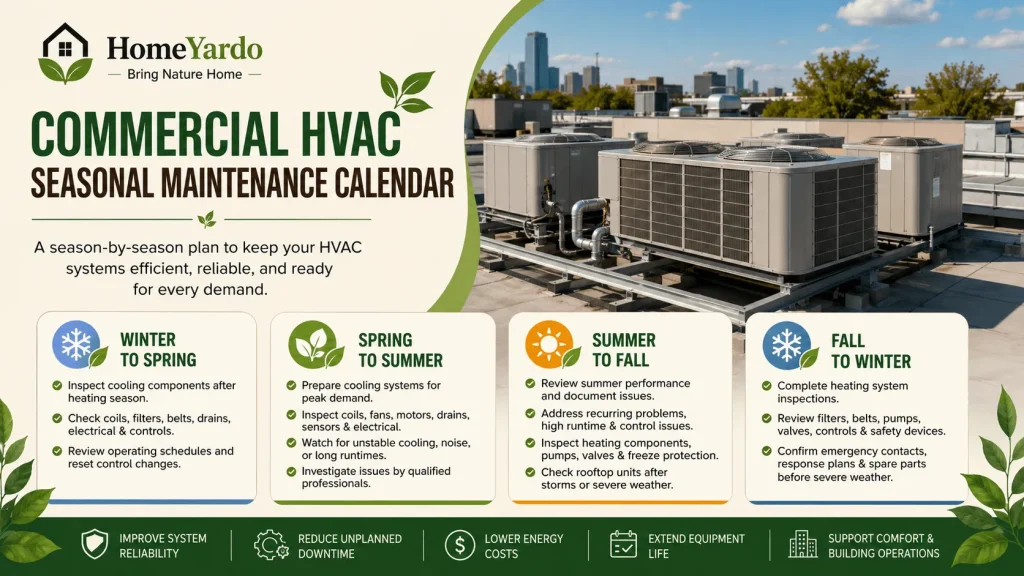
A seasonal schedule creates a useful framework, but it should still be adjusted for local climate, equipment design, manufacturer instructions, and building operation. For residential systems, seasonal HVAC tune-ups follow a similar principle, with cooling checks generally planned before summer and heating checks before winter.
Winter to Spring
Before cooling demand increases, review equipment that may have received limited attention during heating season.
Inspect accessible coils, filters, belts, motors, condensate drains, electrical components, outdoor equipment, dampers, sensors, and cooling controls. Check whether any unresolved cooling complaints from the previous year still require attention.
This is also a useful time to review operating schedules and confirm that temporary winter control changes have not carried into cooling season.
Spring to Summer
Before sustained hot-weather operation begins, confirm that cooling equipment is ready for heavier demand.
Outdoor units should be kept free from obstructing debris. Accessible coils, drains, fans, motors, controls, sensors, and electrical components should be reviewed according to the equipment and service plan.
Pay attention to signs of unstable cooling, short cycling, abnormal noise, unexpected temperature differences, condensate problems, or unusually long runtimes.
Suspected refrigerant, electrical, or mechanical problems should be investigated by appropriately qualified personnel rather than addressed through repeated temporary adjustments.
Summer to Fall
As cooling demand begins to decline, review how the system performed during summer and prepare heating equipment for the colder season.
Recurring cooling complaints, emergency calls, high runtime, controls issues, and temporary summer repairs should be documented and resolved where possible.
Heating components, pumps, valves, controls, freeze-protection measures, and relevant safety devices should also be inspected based on equipment type.
Rooftop equipment may warrant an exterior visual review after storms or severe weather where it is safe and appropriate to do so.
Fall to Winter
Complete heating-related checks before cold-weather demand becomes sustained.
Review filters, airflow paths, belts, bearings, pumps, valves, controls, heating components, and applicable safety devices.
Facility teams should also confirm emergency contacts, after-hours response arrangements, escalation procedures, and availability of important replacement parts before severe weather creates urgent demand.
What Should Be Checked During a Routine HVAC Maintenance Visit?
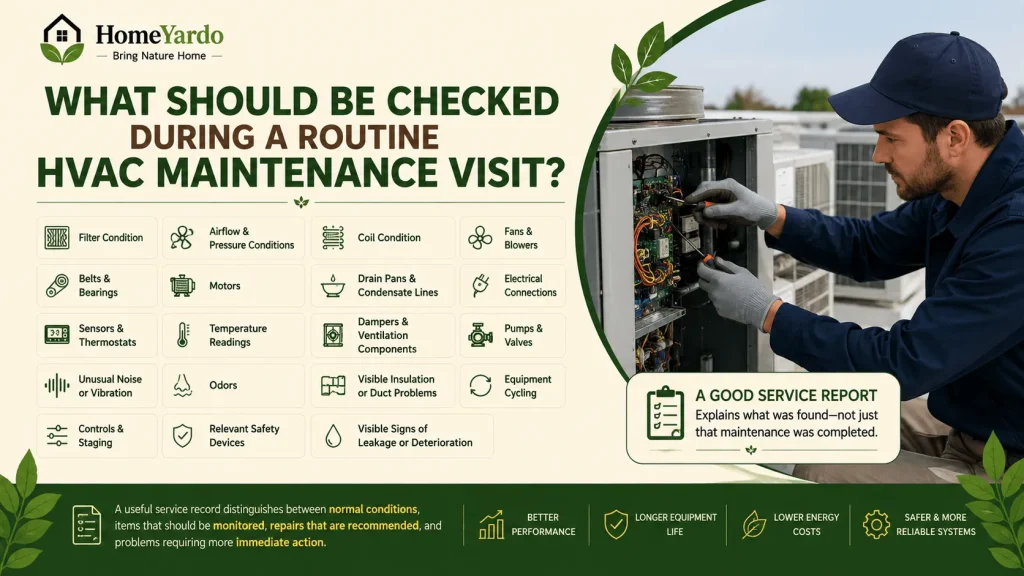
The exact inspection scope depends on the equipment, manufacturer recommendations, service agreement, operating environment, and building requirements.
A routine service report may include checks of:
- Filter condition
- Airflow and pressure conditions
- Coil condition
- Fans and blowers
- Belts and bearings
- Motors
- Drain pans and condensate lines
- Electrical connections
- Sensors and thermostats
- Temperature readings
- Dampers and ventilation components
- Pumps and valves
- Unusual noise or vibration
- Odors
- Visible insulation or duct problems
- Equipment cycling
- Controls and staging
- Relevant safety devices
- Visible signs of leakage or deterioration
The report should explain what was found rather than simply state that maintenance was completed.
A useful service record distinguishes between normal conditions, items that should be monitored, repairs that are recommended, and problems requiring more immediate action.
Review HVAC Controls, Sensors, and Operating Schedules
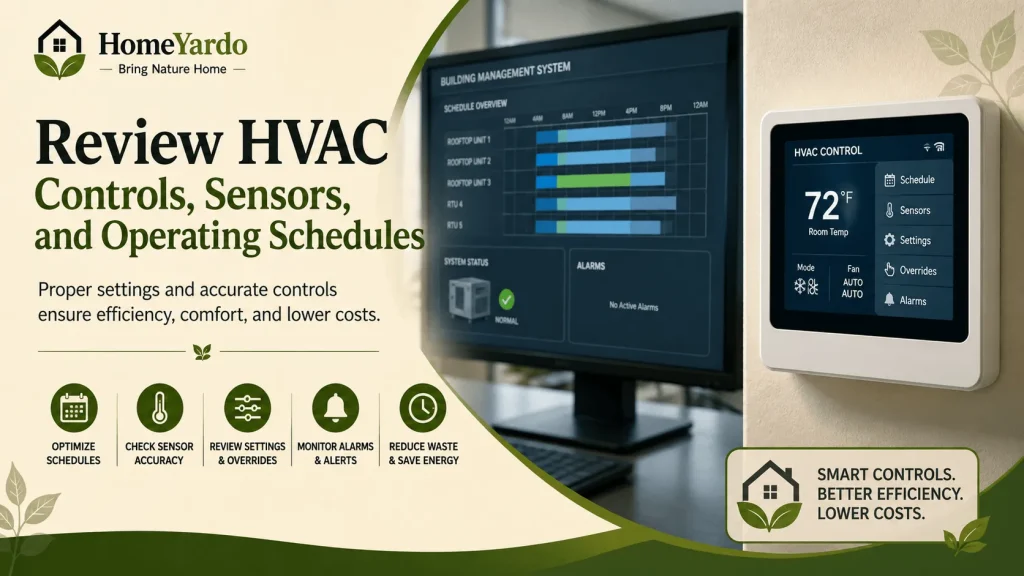
Mechanical condition is only one part of HVAC performance.
Equipment can be working as designed and still operate inefficiently because of incorrect schedules, overrides, sensor problems, or poor control settings.
Review occupied and unoccupied schedules, setbacks, holiday settings, economizer operation where applicable, fan schedules, equipment staging, sensor accuracy, overrides, alarms, and temporary control changes.
Consider a commercial office where several rooftop units start hours before employees arrive and continue running well after the building closes. The equipment may have no mechanical defect, but the schedule still creates unnecessary runtime.
Controls should therefore be included in routine HVAC maintenance rather than reviewed only after a complaint or failure.
Use Condition-Based Monitoring Where It Adds Value
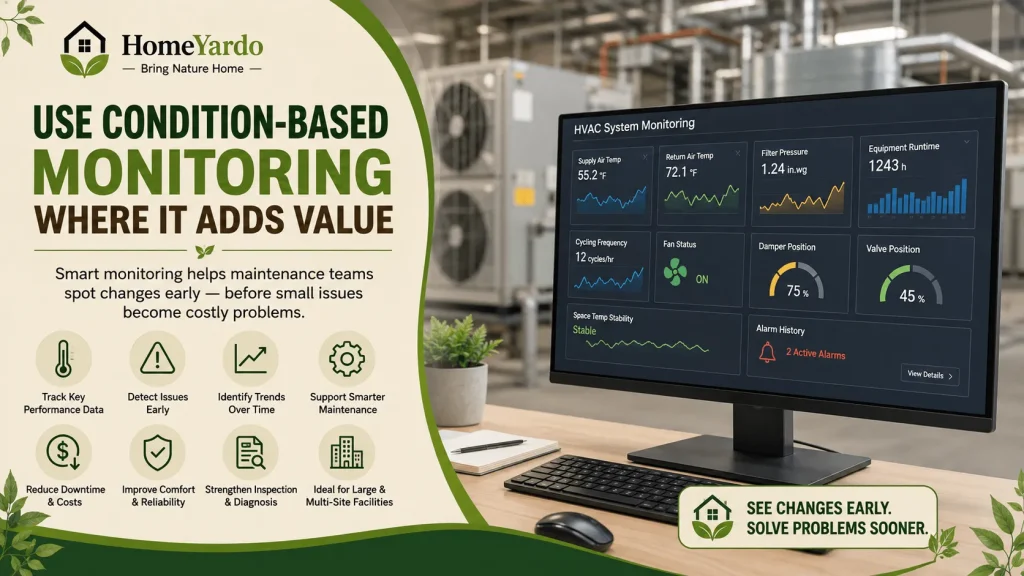
Larger facilities and multi-site portfolios may benefit from monitoring equipment condition between scheduled inspections.
Building automation systems, runtime reports, trend logs, pressure readings, temperature data, and fault alerts can help maintenance teams spot changes before occupants report a problem.
Depending on system capabilities, useful data may include:
- Supply-air temperature
- Return-air temperature
- Filter pressure
- Equipment runtime
- Cycling frequency
- Fan status
- Damper position
- Valve position
- Space-temperature stability
- Alarm history
Trend information becomes more useful when teams know what normal operation looks like. A single reading may have limited meaning, but a gradual change over several weeks can indicate that equipment behavior is moving away from its normal baseline.
Monitoring should support inspection and diagnosis, not replace them.
Keep Refrigerant Work and Documentation Organized
Refrigerant-related work requires proper handling and documentation.
Facility managers should keep relevant service reports, equipment details, refrigerant usage records where required, leak findings, repair documentation, invoices, and other applicable records in an accessible system.
The EPA’s guidance on managing refrigeration and air-conditioning equipment provides information about technician certification, refrigerant handling, leak-related requirements, and recordkeeping.
Because requirements may depend on the equipment and situation, building owners should confirm which rules apply to their systems rather than relying solely on a general maintenance checklist.
Track HVAC Performance, Repairs, and Costs
A strong maintenance program should measure outcomes rather than count completed work orders alone.
Useful information to track includes:
- Emergency service calls
- Repeat failures
- Response times
- Preventive maintenance completion
- Equipment downtime
- Recurring occupant complaints
- Control faults
- Repair spending by asset
- Temporary repairs
- Outstanding recommendations
- Weather-adjusted energy use where available
These records can reveal equipment that is becoming more expensive or unreliable over time.
A single repair does not necessarily justify replacement. The case becomes stronger when repeated failures, increasing repair costs, limited parts availability, poor performance, long downtime, and equipment age begin occurring together.
Maintenance history gives facility managers stronger evidence for comparing continued repair with planned replacement.
Choose the Right Commercial HVAC Maintenance Structure
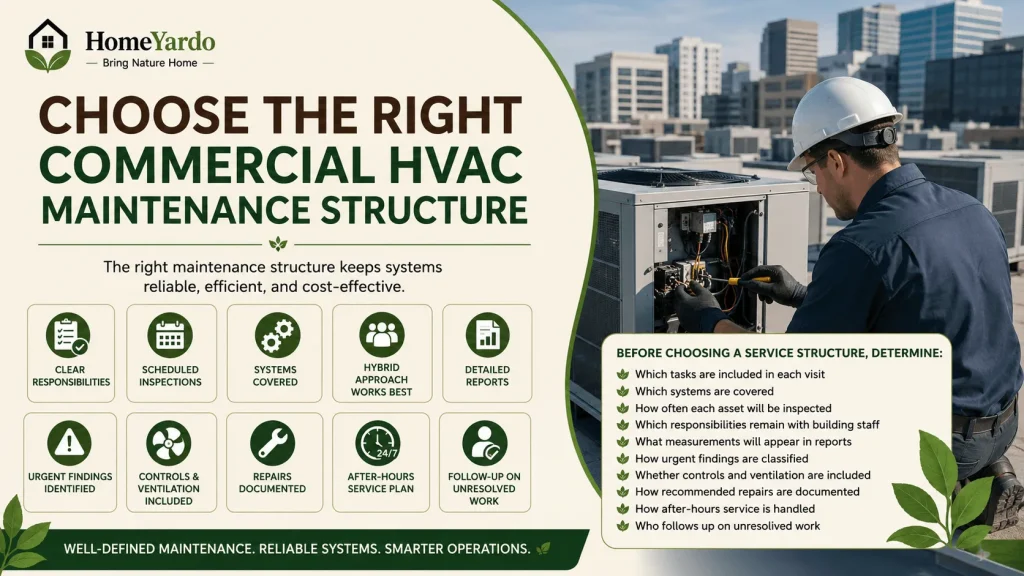
Commercial properties generally use in-house maintenance staff, outside HVAC contractors, or a combination of both.
Building staff may handle routine observations, basic checks, filter monitoring, recordkeeping, and other tasks that fall within their training and responsibilities.
Qualified HVAC professionals may be needed for specialized diagnostics, refrigerant work, complex controls, electrical or mechanical repairs, testing, and equipment-specific servicing.
A hybrid arrangement often works well when responsibilities are clearly documented.
Before choosing a service structure, determine:
- Which tasks are included in each visit
- Which systems are covered
- How often each asset will be inspected
- Which responsibilities remain with building staff
- What measurements will appear in reports
- How urgent findings are classified
- Whether controls and ventilation are included
- How recommended repairs are documented
- How after-hours service is handled
- Who follows up on unresolved work
Clear responsibilities reduce the chance that important maintenance tasks fall between the building team and service provider.
What Should Be Verified After Commercial HVAC Service?
Maintenance should not end when the technician leaves.
Where appropriate, the building team or service provider should confirm that:
- Equipment starts and stops normally
- Heating or cooling responds to controls
- Supply conditions appear consistent with normal operation
- Condensate drains are functioning
- Reported noise or vibration has been addressed
- Controls and alarms operate as intended
- Equipment panels are secured
- Work areas have been left safe and orderly
- Service findings are documented
- Recommended repairs are prioritized
- Outstanding issues have a follow-up plan
This creates a clear endpoint for the maintenance visit and reduces the chance that an identified problem remains buried in a service note or invoice without action.
Common Commercial HVAC Maintenance Mistakes
Even an active maintenance program can lose value when planning and documentation are weak.
Common mistakes include:
- Giving every unit the same maintenance interval
- Ignoring recurring comfort complaints
- Treating repeat failures as unrelated events
- Replacing filters without considering airflow or pressure conditions
- Ignoring operating schedules and sensor accuracy
- Leaving temporary repairs undocumented
- Deferring repairs without assigning a review date
- Waiting for complete failure before considering replacement
- Storing maintenance records across disconnected emails and spreadsheets
- Closing work orders without confirming equipment operation
Avoiding these mistakes makes maintenance history more useful for both daily operations and longer-term planning.
Commercial HVAC Maintenance Checklist
A practical maintenance program can be organized around six recurring actions.
- Inventory: Keep an accurate record of equipment, location, age, condition, service area, and repair history.
- Prioritize: Give greater attention to equipment with heavy use, repeat failures, high operational consequences, or limited replacement options.
- Inspect: Schedule equipment-specific checks according to season, condition, manufacturer requirements, and building needs.
- Review controls: Check schedules, setpoints, sensors, alarms, overrides, staging, and related control functions.
- Document: Record readings, deficiencies, repairs, recommendations, and applicable refrigerant-related activity.
- Reassess: Use downtime, service history, complaints, repair costs, and performance data to determine whether equipment should continue to be maintained, repaired, upgraded, or considered for replacement.
This checklist should support equipment-specific maintenance procedures rather than replace manufacturer instructions or qualified professional service.
Conclusion
Commercial HVAC maintenance is most effective when it is seasonal, documented, and matched to the way the building operates.
An organized program combines an accurate equipment register, risk-based scheduling, routine inspections, controls review, service verification, maintenance records, and realistic repair and replacement planning.
No maintenance plan can prevent every unexpected mechanical failure. It can, however, make changing equipment conditions easier to identify, give teams more time to address developing problems, and provide better information when repair or replacement decisions need to be made.
FAQ’s
There is no universal interval for every commercial HVAC system. Frequency should be based on equipment type, manufacturer recommendations, runtime, operating environment, age, condition, and the consequences of failure. High-use or critical systems may need more frequent attention.
Depending on the system, maintenance may include filters, coils, fans, belts, motors, electrical components, condensate systems, airflow, temperature readings, controls, sensors, dampers, pumps, valves, safety devices, and general operating performance.
It is a structured record of the inspection and service tasks required for an HVAC asset. A useful checklist identifies the equipment, tasks completed, readings taken, deficiencies found, repairs performed, and follow-up work still required.
Seasonal maintenance helps prepare heating and cooling equipment before periods of heavier demand. It also gives facility teams time to identify deficiencies and schedule repairs before weather conditions place additional stress on the equipment.
No. Equipment age, workload, condition, repair history, operational importance, environment, and manufacturer requirements can all justify different inspection frequencies.
Useful records include equipment details, service dates, inspection findings, measurements, repair history, controls changes, warranties, invoices, recurring faults, unresolved recommendations, and refrigerant-related documentation where applicable.
No. Automation can provide alarms, runtime data, trends, and indications of abnormal operation, but it cannot replace physical inspection, equipment-specific servicing, or professional diagnosis.
Replacement should be considered using the equipment’s overall history rather than age alone. Repeated failures, rising repair costs, poor reliability, long downtime, difficult parts availability, and declining performance can collectively make planned replacement more reasonable than continued repairs.