Commercial Painting Project Planning for Property Managers

Commercial painting project planning becomes more complicated when a property must remain occupied and operational during the work. Property managers have to coordinate painters around tenants, employees, customers, deliveries, building access, security, ventilation, drying times, and other activities that cannot simply stop because painting has started.
A successful project therefore begins well before the first surface is prepared. Before starting a larger renovation or maintenance project, property managers can also review our home improvement guide for broader planning considerations.
Key Takeaways
- Inspect surfaces and operational constraints before requesting final proposals.
- Divide occupied properties into manageable work zones instead of closing large areas at once.
- Schedule painting around tenant activity, customer traffic, deliveries, and required access.
- Account for surface preparation, ventilation, coating cure times, weather, and access equipment when setting the timeline.
- Define safety responsibilities and keep emergency exits and required routes accessible.
- Compare contractors based on scope, preparation, scheduling, safety, supervision, and warranty—not price alone.
- Establish inspection and reopening criteria for every completed phase.
For property managers evaluating regional contractors, Mb Coatings provides commercial painting service information covering interior, exterior, industrial, and specialty coating work. With more than 15 years of experience serving commercial properties across Southern California, including Los Angeles County, Orange County, Ventura County, San Diego County, and the Inland Empire, the company illustrates why communication, safety, surface preparation, and scheduling matter on active sites.
The objective is not simply to apply a new finish. A properly managed project should improve and protect the property without creating avoidable interference with the people who use it.
What Makes Painting an Occupied Commercial Property Different?
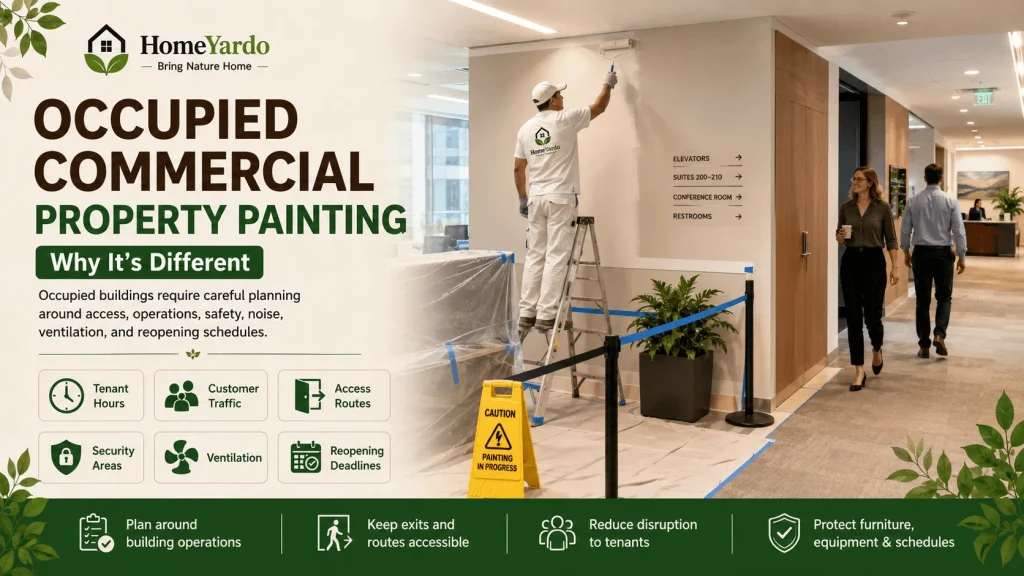
An empty building gives a painting crew considerably more control over access and scheduling. An occupied commercial property does not.
A property manager may need to account for:
- Tenant operating hours
- Employee work areas
- Customer and visitor traffic
- Deliveries and loading areas
- Elevators and stairwells
- Accessible entrances and routes
- Emergency exits
- Security-controlled spaces
- Furniture, inventory, and equipment
- Odor and ventilation concerns
- Noise-sensitive operations
- Cleaning and reopening deadlines
The constraints also vary by property type. An office building may permit evening corridor work, while a retail property may require overnight painting and full customer access by opening time. Warehouses, schools, restaurants, clinics, and mixed-use buildings can each present different access and operational requirements.
The project plan should therefore be based on how the building actually operates rather than on painting square footage alone.
Start With a Complete Building Walkthrough

Conduct a walkthrough before the scope, budget, and schedule are finalized.
The purpose is to identify both surface conditions and operational constraints.
Document:
- Interior and exterior walls
- Ceilings and soffits
- Trim and doors
- Railings and metalwork
- Peeling, blistering, or flaking coatings
- Cracks and damaged substrates
- Stains and possible moisture intrusion
- Corrosion
- Mildew or biological growth
- High-traffic and frequently cleaned surfaces
- High ceilings and difficult access points
- Stairwells, rooftops, and loading areas
- Furniture and equipment requiring protection
- Landscaping near exterior work
- Tenant and public access routes
Photographs should be tied to locations wherever possible. This makes it easier to build a consistent scope and compare contractor proposals.
Check for Problems That Paint Will Not Fix
A new coating should not be treated as a repair for an underlying building problem.
Investigate active leaks, recurring condensation, damaged drywall, deteriorating masonry, corrosion, loose coatings, and substrate movement before repainting. Moisture around windows can also point to problems that should be addressed before coating work begins; see our guide to window replacement and planning when window condition is part of the problem. Covering these conditions without correcting their cause can lead to staining, blistering, peeling, or premature coating failure.
Older properties may also require additional investigation before painted surfaces are disturbed.
Where applicable, property managers should review whether lead-related requirements apply. The EPA explains lead-related renovation requirements for property managers and work involving certain pre-1978 residential buildings and child-occupied facilities.
Requirements vary by property type, jurisdiction, building age, and work being performed, so regulatory questions should be confirmed before work begins.
Map Building Operations Before Setting the Schedule
A painting schedule should be built around property activity rather than imposed on top of it.
Create an operational map showing:
| Building Activity | Planning Question |
|---|---|
| Tenant hours | When are occupied areas least active? |
| Customer traffic | Which periods have the lowest visitor volume? |
| Deliveries | Which loading areas and corridors must remain available? |
| Cleaning | When can areas be cleaned before and after coating? |
| Security | Who provides contractor access outside normal hours? |
| Elevators | Can equipment movement conflict with tenant use? |
| Emergency access | Which routes must remain continuously available? |
| HVAC | Can ventilation requirements be supported during the work? |
This information helps determine whether painting should occur during normal hours, evenings, overnight periods, weekends, or a combination of these.
Build the Schedule Around Building Activity
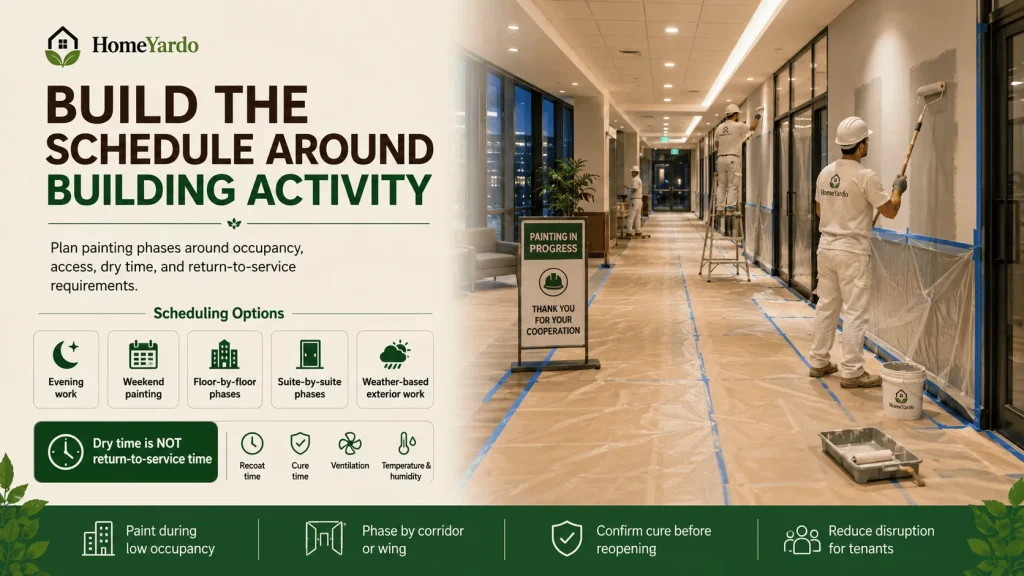
Different spaces may require different scheduling strategies.
Scheduling Options to Consider
- Evening work
- Overnight work
- Weekend painting
- Floor-by-floor phases
- Suite-by-suite phases
- Corridor or wing phases
- Exterior elevation phases
- Short daytime work windows during low occupancy
- Temporary relocation from enclosed work areas
- Weather-dependent exterior work
An office property, for example, might repaint one corridor after business hours and return it to service after the coating has reached the required condition and the area has been inspected.
A retail property may schedule preparation and painting after closing, with cleanup and barrier removal completed before customers return.
Do Not Confuse Dry Time With Return-to-Service Time
A coating that feels dry may not necessarily be ready for normal traffic, cleaning, furniture contact, or repeated handling.
Property managers should confirm the manufacturer’s requirements for:
- Recoat time
- Dry-to-touch time
- Handling time
- Cure time
- Ventilation
- Temperature
- Humidity
- Return to normal use
These requirements should be incorporated into each phase rather than estimated after the coating has been applied.
Use Phased Work to Keep More of the Property Open
Dividing a large commercial painting project into controlled zones can reduce the amount of space unavailable at one time.
Each phase should have:
- A defined work area
- Scheduled start and completion times
- Contractor access instructions
- Occupant notification requirements
- Surface protection requirements
- Temporary barriers and signs
- Alternate routes where necessary
- Preparation and coating tasks
- Required drying or curing period
- Inspection and cleanup requirements
- Reopening approval
A phased project may take more calendar days than an unrestricted project. That does not automatically make it less efficient.
Keeping most of a building operational can be more valuable than completing the painting faster while causing extensive closures.
Establish a Zone Reopening Standard
A useful way to prevent rushed handoffs is to define what must happen before a painted area returns to normal use.
Before reopening a zone, confirm that:
- Required coating work is complete.
- Surfaces have reached the appropriate return-to-service condition.
- Tools, masking materials, and waste have been removed.
- Floors and nearby finishes are clean.
- Furniture and equipment have been returned correctly.
- Required doors, exits, and walkways are unobstructed.
- Signs and temporary barriers have been removed where appropriate.
- Touch-ups or defects have been documented.
- The property manager or designated representative has inspected the area.
This creates a measurable endpoint for every phase rather than relying on a contractor simply reporting that an area is finished.
Choose Coatings for the Actual Space

Commercial coating selection should account for how the surface will be used after the project is complete.
Consider:
- Frequency of cleaning
- Foot and equipment traffic
- Repeated touching or scuffing
- Moisture exposure
- UV and weather exposure
- Temperature changes
- Chemical exposure
- Required appearance
- Maintenance frequency
- Ventilation limitations
A low initial material price can lose its advantage if a finish requires frequent touch-ups or does not tolerate the property’s cleaning routine.
Match Performance to the Area
For commercial areas where floor durability is also part of the project, managers can compare epoxy resin flooring and other floor coating systems based on traffic, moisture, cleaning requirements, and surface preparation.
Exterior surfaces need coating systems compatible with the substrate and local exposure conditions.
Where appropriate, managers may also need to consider specialty systems for:
- Waterproofing
- Corrosion control
- Anti-graffiti protection
- Fire-protection applications
- Industrial environments
- High-moisture areas
Product selection should follow the substrate, exposure conditions, manufacturer specifications, and project requirements rather than relying on a single coating type throughout the building.
Plan Ventilation and Occupant Comfort
For buildings where ongoing ventilation is also a concern, property managers can learn more about heat recovery ventilation and how mechanical ventilation manages indoor air exchange.
Before work starts, identify:
- HVAC intake and return locations
- Operable windows
- Enclosed rooms
- Areas with limited air movement
- Occupants who cannot easily be relocated
- Adjacent spaces that could receive odors
- Manufacturer ventilation requirements
Low-odor or low-VOC products may be useful where appropriate, but product labels do not replace ventilation planning or manufacturer instructions.
The contractor and property manager should agree on how work areas will be isolated, ventilated, and returned to normal use.
Protect Occupants, Workers, and Property
The safety plan should reflect the actual site and work being performed.
Depending on the project, planning may address:
- Warning signs and barriers
- Ladders
- Scaffolds
- Lifts
- Fall hazards
- Falling-object exposure
- Personal protective equipment
- Electrical hazards
- Chemical storage and handling
- Ventilation
- Restricted access
- Public walkways
- Emergency exits
Property managers can use OSHA guidance on walking-working surfaces when discussing access, walking surfaces, inspections, and fall-related hazards around applicable workplaces.
Applicable OSHA requirements depend on the work environment and activity. The contractor remains responsible for complying with relevant workplace safety requirements, while property managers should make sure site coordination does not create avoidable conflicts or blocked routes.
Protect Business-Critical Areas Before Painting Starts
Protection requirements should be written into the scope instead of decided after crews arrive.
Depending on the property, protection may be required for:
- Flooring
- Furniture
- Merchandise
- Machinery
- Computers and electronics
- Signage
- Glass
- Fixtures
- Elevators
- Door hardware
- Landscaping
- Parked vehicles
- Adjacent tenant property
Sensitive or high-value areas should be photographed before work begins. The project team should also establish who is responsible for moving items and who approves the protection setup.
Communicate Before Work Begins
Occupants are more likely to accommodate temporary disruption when they know what will happen and when.
Send an initial project announcement before the first phase, followed by targeted reminders for affected areas.
Notices should state:
- Work location
- Date
- Working hours
- Expected duration
- Temporary closures
- Alternate entrances or routes
- Possible noise or odor
- Access restrictions
- Items occupants need to move
- Contact information for questions
Avoid sending only one building-wide notice for a project lasting several weeks. Phase-specific reminders are more useful because they tell occupants when the work will directly affect them.
Create an Escalation Plan for Unexpected Disruption
Not every site condition can be predicted during the walkthrough.
Before the project starts, determine who can make decisions when crews encounter:
- Hidden moisture
- Damaged substrates
- Unexpected tenant activity
- Access conflicts
- Weather delays
- Material shortages
- Security problems
- Additional repair requirements
- Complaints about noise or odor
The contractor should know who can authorize changes and when written approval is required.
This prevents field crews from making scope or schedule decisions without property-management oversight.
Prepare a Clear Scope of Work
A strong scope gives contractors the same bidding assumptions and provides a reference when questions arise during the project.
Include:
- Building and work-area identification
- Surfaces to be painted
- Approximate quantities or square footage
- Existing surface conditions
- Required repairs
- Preparation standards
- Primer requirements
- Coating system
- Colors
- Sheens
- Number of coats
- Protection requirements
- Access equipment
- Approved working hours
- Ventilation requirements
- Cleanup expectations
- Inspection procedures
- Punch-list requirements
- Warranty expectations
- Final approval process
The scope should also state what is excluded.
Without defined exclusions, managers can have difficulty determining whether unexpected work belongs in the original contract or requires a legitimate change order.
Define the Change-Order Process Before Work Starts
Commercial painting projects can uncover conditions that were not visible during bidding.
Common examples include:
- Concealed moisture damage
- Rotted or deteriorated material
- Unexpected corrosion
- Loose previous coatings
- Additional access equipment
- Tenant-requested color changes
- Schedule changes
- Previously inaccessible surfaces
Require written documentation showing the condition, proposed corrective work, schedule effect, and cost before additional work proceeds, except where immediate action is required for safety or property protection.
A consistent change-order process makes the final project cost easier to track and reduces disagreements.
Compare Commercial Painting Contractors on More Than Price
Bid comparison should look beyond the total at the bottom of the proposal.
Review:
| Factor | What to Check |
|---|---|
| Relevant experience | Similar occupied commercial properties |
| Scope | Repairs, preparation, coating, and cleanup included |
| Insurance | Appropriate current coverage |
| Licensing | Requirements applicable to the location and work |
| Safety | Site-specific procedures and responsibilities |
| Supervision | Who will manage daily work? |
| Materials | Product and system information |
| Scheduling | Ability to meet phased or off-hours requirements |
| References | Comparable completed projects |
| Warranty | Coverage, exclusions, and duration |
| Change orders | Written approval procedure |
| Cleanup | Daily and final expectations |
An unusually low proposal deserves closer review. It may reflect differences in preparation, number of coats, access equipment, labor hours, materials, or cleanup rather than genuine savings.
Hold a Pre-Construction Meeting
For a larger occupied-property project, hold a coordination meeting before crews mobilize.
Review:
- Final scope
- Approved colors and samples
- Phase sequence
- Daily work hours
- Building access
- Keys and security procedures
- Parking and loading
- Material storage
- Occupant notifications
- Protection requirements
- Safety responsibilities
- Ventilation
- Daily cleanup
- Inspection process
- Change-order authority
- Emergency contacts
The objective is to resolve operational questions before they become field problems.
Track Progress Throughout the Project
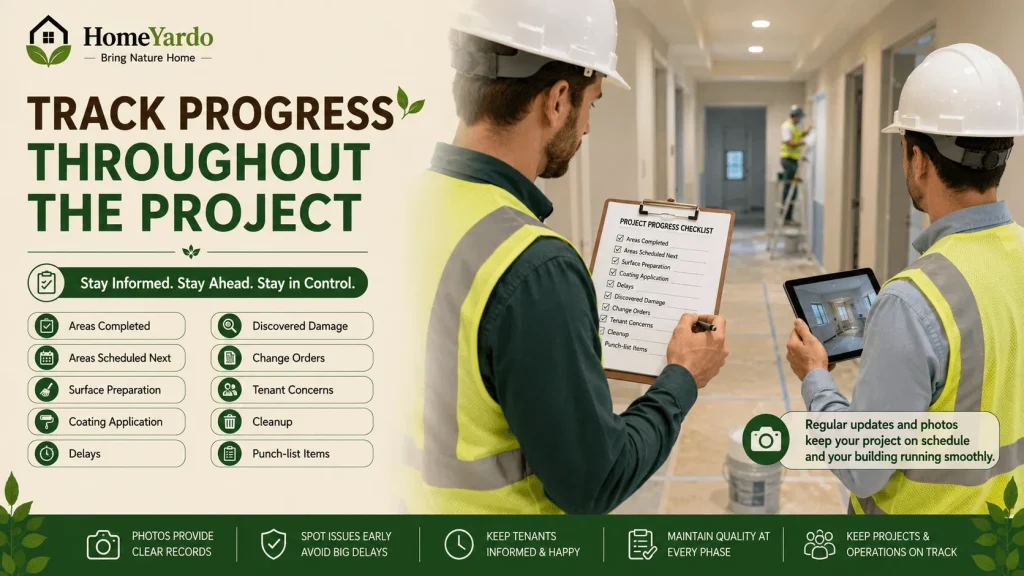
Large projects should not wait until final completion for quality and schedule review.
Short progress meetings and written updates can track:
- Areas completed
- Areas scheduled next
- Surface preparation
- Coating application
- Delays
- Discovered damage
- Change orders
- Tenant concerns
- Cleanup
- Punch-list items
Photographs provide a useful record, particularly for surface preparation, concealed repairs, and completed phases.
Property managers should also verify that one delayed zone does not unintentionally disrupt the sequence for other tenants or building operations.
What Should Be Checked Before Final Approval?
Final inspection should cover more than appearance.
Confirm that:
- Contracted surfaces are complete.
- Approved colors and finishes were used.
- Coverage is reasonably uniform.
- Visible defects have been addressed.
- Overspray and unwanted paint have been removed.
- Doors, hardware, signs, and fixtures operate normally.
- Floors and adjacent surfaces are clean.
- Property protection has been removed.
- Waste and unused contractor materials have been cleared.
- Punch-list work is documented and completed.
- Required warranty and product information has been provided.
For phased projects, use the same inspection standard throughout the job rather than postponing all quality control until the last day.
Final Planning Checklist for Property Managers
Before authorizing work, verify that you have:
- Inspected and documented existing surface conditions.
- Identified active building problems that need repair before coating.
- Mapped tenant, customer, staff, and delivery schedules.
- Divided the project into manageable work zones.
- Confirmed coating and preparation specifications.
- Accounted for drying, curing, ventilation, and weather.
- Established access and safety requirements.
- Protected property, equipment, and adjacent finishes.
- Created an occupant communication schedule.
- Prepared a detailed written scope.
- Defined the change-order process.
- Compared contractors using consistent criteria.
- Established inspection and zone-reopening standards.
- Created a final punch-list and closeout process.
Conclusion
Commercial painting project planning works best when the building’s operations are treated as part of the project rather than as an obstacle to the painting crew.
A thorough walkthrough identifies surface and access problems early. Phased scheduling limits closures. Appropriate coatings support long-term performance. Written scopes, safety coordination, occupant notices, inspections, and controlled change orders keep the work accountable from the first phase through final closeout.
For property managers, the most successful project is therefore not necessarily the one completed in the fewest calendar days. It is the one that achieves the required finish and protection while allowing tenants, employees, customers, and building services to continue operating with the least practical disruption.
FAQ’s
Often, yes. Phased scheduling can allow unaffected parts of a commercial property to remain operational while painting occurs in controlled work zones. Whether a specific area can remain occupied depends on access, ventilation, coating requirements, safety conditions, and the activities taking place nearby.
Start by identifying low-traffic periods and dividing the building into smaller work zones. Combine this with advance occupant notices, protected access routes, suitable ventilation, daily cleanup, and defined reopening requirements.
No. Overnight work can reduce contact with tenants or customers, but it can create higher labor costs and additional requirements for security, lighting, building access, supervision, and morning cleanup. The best schedule depends on how the property operates.
Phases can be organized by floor, suite, corridor, wing, department, exterior elevation, or another clearly defined zone. Each phase should have its own work window, access plan, protection requirements, drying period, inspection, cleanup, and reopening point.
The notice period should reflect the extent of the disruption and any applicable lease or property requirements. Provide an early general notice for the overall project and a shorter reminder before work begins in each affected zone.
It should identify the surfaces, preparation, repairs, primers, coatings, colors, sheens, coats, access equipment, protection, working hours, cleanup, inspections, exclusions, change-order procedures, and final acceptance requirements.
The moisture source should be identified and addressed before the affected surface is coated. Painting over an actively damp or deteriorating substrate can lead to staining, blistering, peeling, or premature failure.
Compare the underlying scope rather than price alone. Check preparation, repairs, materials, number of coats, access equipment, scheduling, supervision, protection, cleanup, warranty terms, insurance, licensing requirements, and experience with occupied properties.
Low-VOC or low-odor coatings may be appropriate where occupant comfort and ventilation are concerns, but selection should also consider substrate compatibility, durability, cleaning requirements, manufacturer instructions, and the building’s use.
Check coating coverage and appearance, adjacent surfaces, doors and hardware, cleanup, damaged or missed areas, completed repairs, punch-list items, and required documentation. For phased work, complete this review before each zone returns to normal use.