Heated Mats Canada: Winter Safety Solutions For Homeowners
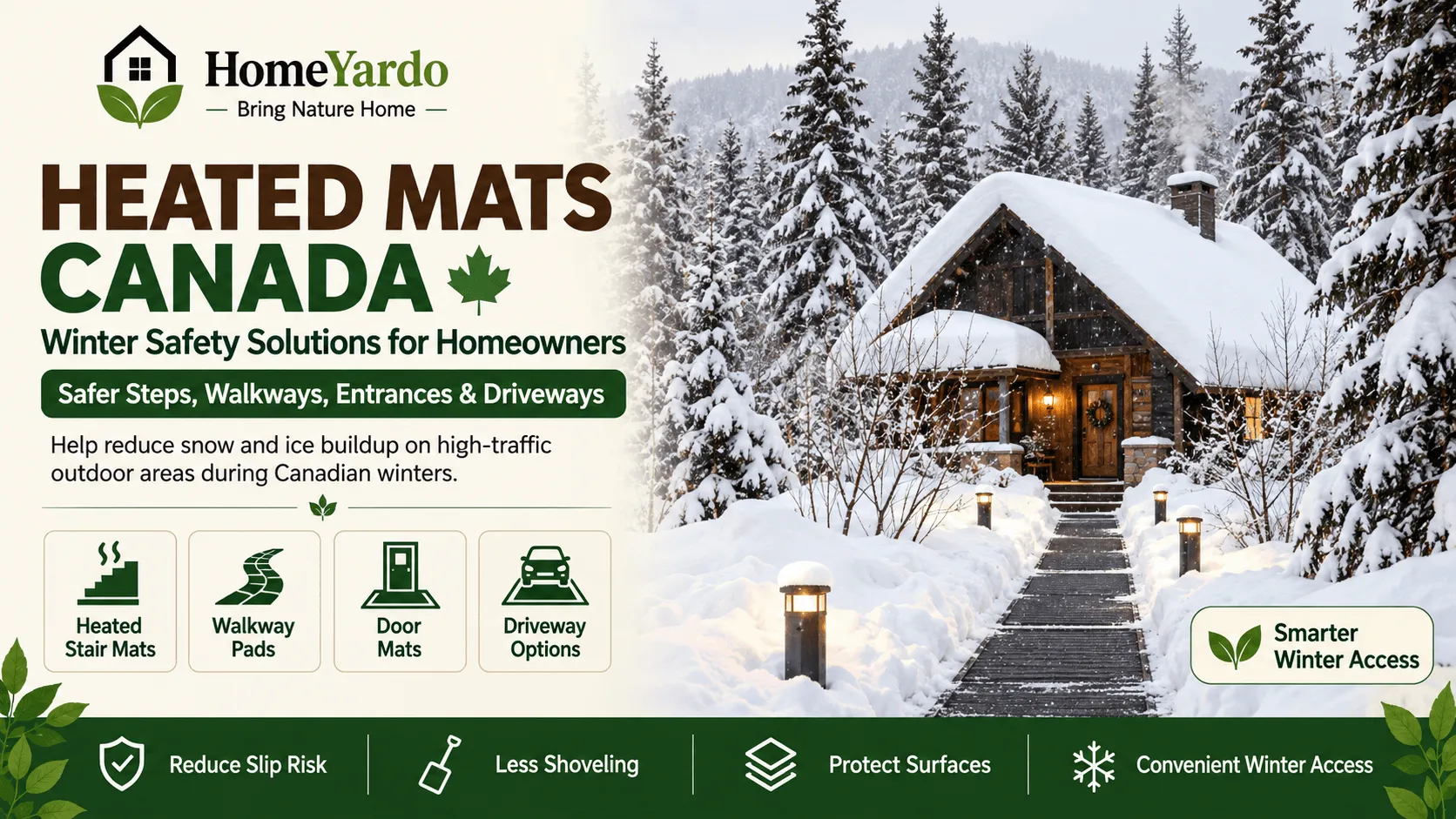
Canadian winters can turn an ordinary front entrance into a slippery obstacle course. Snow-covered walkways, icy stairs, and frozen driveways create daily maintenance challenges, particularly when temperatures fluctuate around freezing.
Heated outdoor mats offer homeowners another way to manage these conditions. Instead of repeatedly clearing the same surfaces, electrically heated mats melt accumulating snow and ice in selected areas.
They are particularly useful around entrances, steps, and frequently used pathways. Reducing ice accumulation can help lower slipping risks and make winter property maintenance more manageable.
Winter weather can also contribute to serious injuries. The clinical effects of winter storms, including falls and other weather-related health concerns, are discussed in this comprehensive resource.
For Canadian homeowners, heated mats offer several practical benefits:
- Winter safety: Help reduce snow and ice accumulation in frequently used areas.
- Less manual maintenance: Reduce repeated shoveling and the need to apply ice-melting products.
- Surface protection: Limit the use of de-icing chemicals that may damage certain surfaces and surrounding vegetation.
- Convenience: Keep selected access routes more manageable during changing winter conditions.
However, heated mats cannot guarantee completely dry or ice-free surfaces. Meltwater can refreeze outside heated areas, and performance depends on weather conditions, product specifications, and correct installation.
Understanding how these systems operate is the starting point for selecting an appropriate solution.
Preparing your property for freezing temperatures involves more than clearing snow. Alongside installing heated mats, consider winterizing outdoor faucets and sprinkler systems to help prevent damage to exterior plumbing.
How Do Heated Outdoor Mats Work?
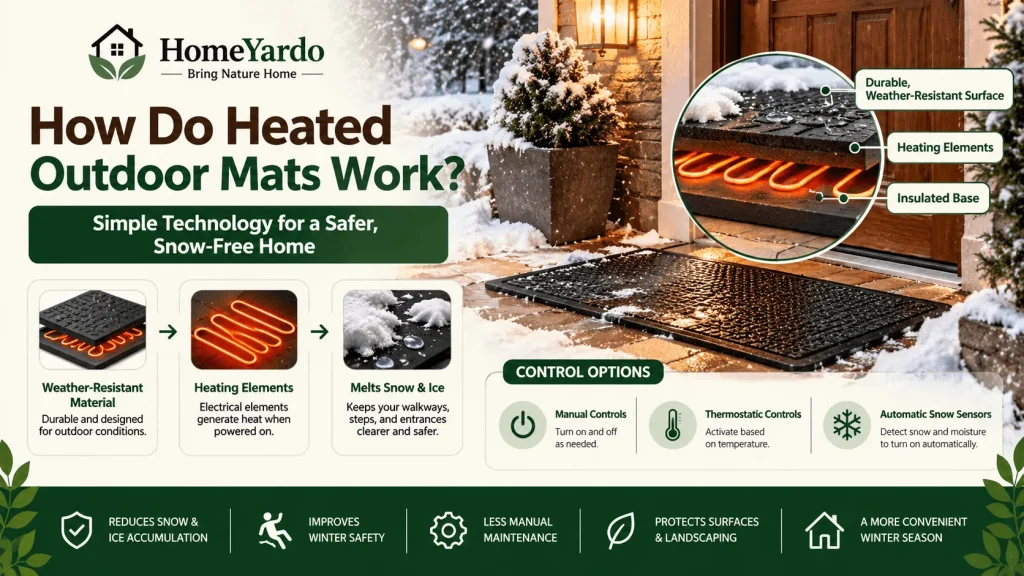
Heated mats contain electrical heating elements enclosed in weather-resistant materials. When connected to an appropriate power supply, these elements generate heat that helps melt snow and ice on the mat’s surface.
Unlike permanently installed driveway heating systems, many residential heated mats are portable. Homeowners can position them on suitable existing surfaces without excavating or replacing concrete.
Most systems operate using one of three control methods.
Manual controls: The homeowner switches the heating system on and off as required.
Thermostatic controls: Compatible equipment uses temperature readings to activate or deactivate heating.
Automatic snow sensors: More advanced systems can detect suitable temperature and moisture conditions before activating.
The correct option depends on the installation, product compatibility, and the homeowner’s preferred level of automation.
Performance varies between manufacturers and models. Outdoor temperature, snowfall intensity, wind exposure, and the condition of the underlying surface can all influence melting.
Heated Stair Mats: Safer Access During Winter

Outdoor stairs are particularly challenging during Canadian winters.
Their narrow surfaces, changing elevations, and exposure to freezing precipitation can make climbing or descending difficult. Snow removal also takes additional care because clearing one step does not necessarily prevent ice from developing again.
Heated stair mats help manage these conditions by warming individual steps.
Most residential products feature a textured surface intended to provide traction while their internal heating elements melt accumulating snow and ice.
What Should Homeowners Look for in Heated Stair Mats?
Consider the following features before selecting a system:
- Correct dimensions: Each mat should fit the intended step without creating an avoidable tripping hazard.
- Surface traction: Choose products designed specifically for outdoor pedestrian use.
- Electrical protection: Select equipment with appropriate electrical certification and ground-fault protection.
- Secure placement: Follow the manufacturer’s instructions for fastening or positioning mats.
- Compatible connections: Confirm that all stair mats, cables, and power units can safely operate together.
Portable systems may be suitable for straightforward residential installations. However, damaged stairs, poor drainage, or unsuitable electrical infrastructure should be addressed before installation.
Heated stair mats are especially useful for frequently used entrance steps, but surrounding landings and untreated stairs still require attention.
Heated Walkway Pads: Keeping Pathways Accessible
A clear front entrance offers limited protection if the walkway leading to it remains covered in ice.
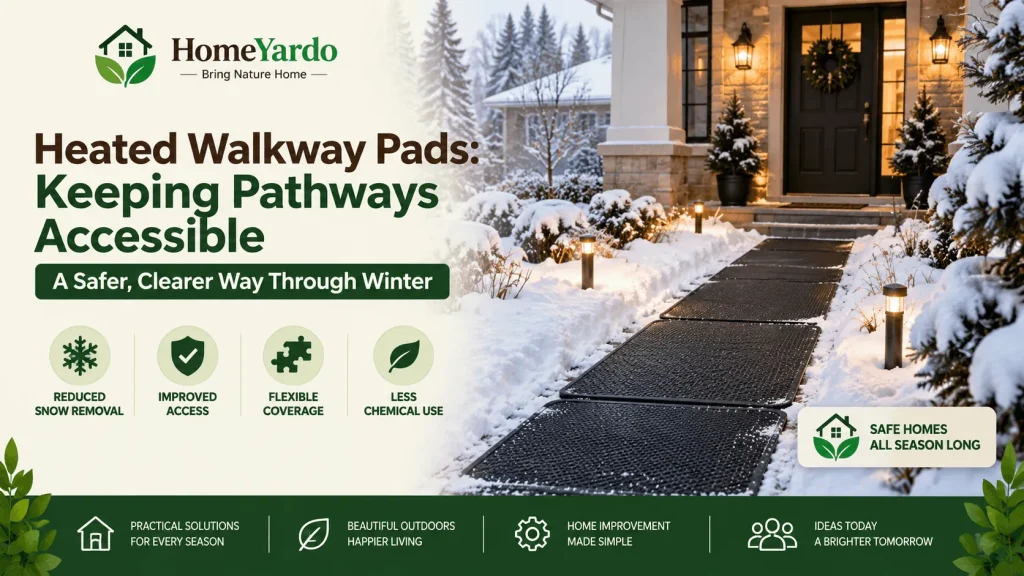
Heated walkway pads help homeowners maintain selected pedestrian routes connecting driveways, entrances, garages, and other outdoor areas.
These systems generally use modular sections that can be arranged according to the property’s layout.
Benefits of Heated Walkway Pads
Reduced snow removal: Heated pads can reduce the frequency of manual clearing on covered pathways.
Improved access: They help maintain frequently used routes for residents, guests, delivery workers, and other visitors.
Flexible coverage: Modular designs allow homeowners to concentrate heating on areas requiring regular access.
Reduced chemical use: Electric snow-melting systems can decrease reliance on conventional de-icing products.
However, homeowners should consider the complete walking route rather than installing an isolated heated section.
A mat that ends before an untreated, icy surface may leave a hazardous transition.
Drainage also matters. Meltwater should have somewhere to go without creating additional ice around the perimeter.
Sidewalk Heating Mats: Managing Larger Outdoor Areas
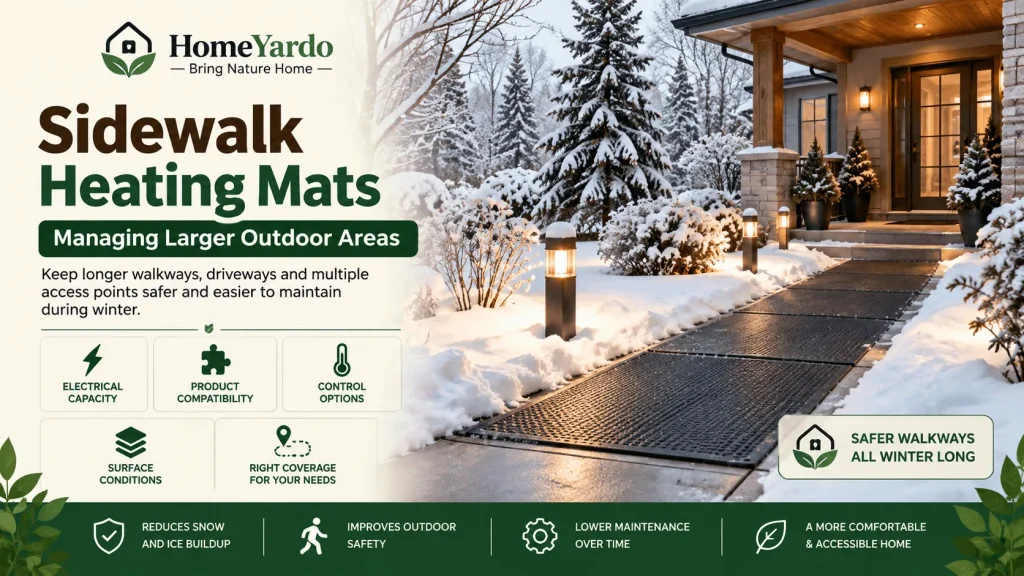
Sidewalk heating mats provide a practical option for properties with longer pedestrian routes or multiple outdoor access points.
Although they perform a similar function to heated walkway pads, the term is often used for larger arrangements covering extended sidewalk sections.
Homeowners can use interconnected mats to create a heated route without installing an entirely new sidewalk.
Important Operating Considerations
Before purchasing sidewalk heating mats, evaluate the following factors.
Electrical capacity
Every mat contributes to the system’s electrical load. Confirm the combined current requirements before connecting multiple sections.
Product compatibility
Only connect products and accessories specifically approved for use together.
Control options
Manual controls are straightforward, while compatible thermostats and snow sensors can reduce unnecessary operating time.
Surface conditions
Concrete, stone, wood, composite decking, and other surfaces have different requirements. Follow the manufacturer’s compatibility guidance.
Coverage
Prioritize frequently used sections instead of assuming that the entire sidewalk requires heating.
The system should also allow maintenance personnel to inspect connections and access the surrounding surface when necessary.
For larger installations, an electrician can help assess circuit capacity and applicable installation requirements.
Snow Melting Door Mats: Protecting Residential Entrances
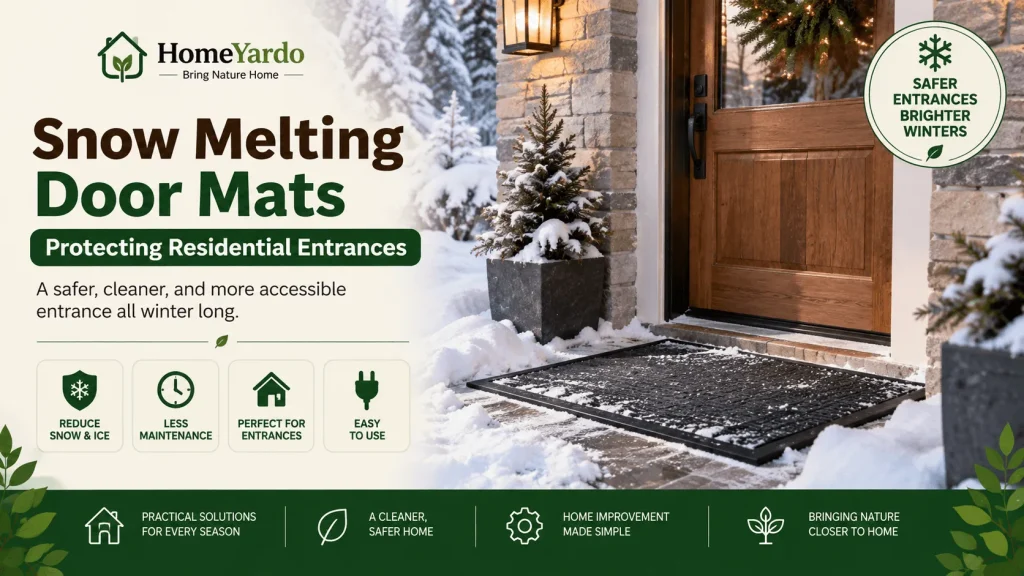
Front entrances experience frequent traffic and are often exposed to snow falling from roofs, nearby landscaping, or changing weather conditions.
An outdoor snow-melting door mat helps reduce accumulation directly outside the entrance.
These compact products are useful where homeowners need targeted heating rather than a complete walkway system.
Why Consider Heated Entrance Mats?
Heated entrance mats have several advantages.
- They provide localized snow and ice management.
- Many portable models require relatively little preparation.
- Compact dimensions suit entrances where larger mats may be impractical.
- Suitable products can operate during winter weather when connected according to the manufacturer’s instructions.
Choose a mat that fits the available entrance space and allows the door to open freely.
An important distinction is that outdoor snow-melting mats are not necessarily designed to absorb moisture.
Homeowners who want to control water tracked indoors should use a separate indoor entrance mat intended for that purpose.
Check the manufacturer’s instructions before combining entrance products or placing anything over an electrically heated mat.
Driveway Heating Mats: Maintaining Vehicle Access
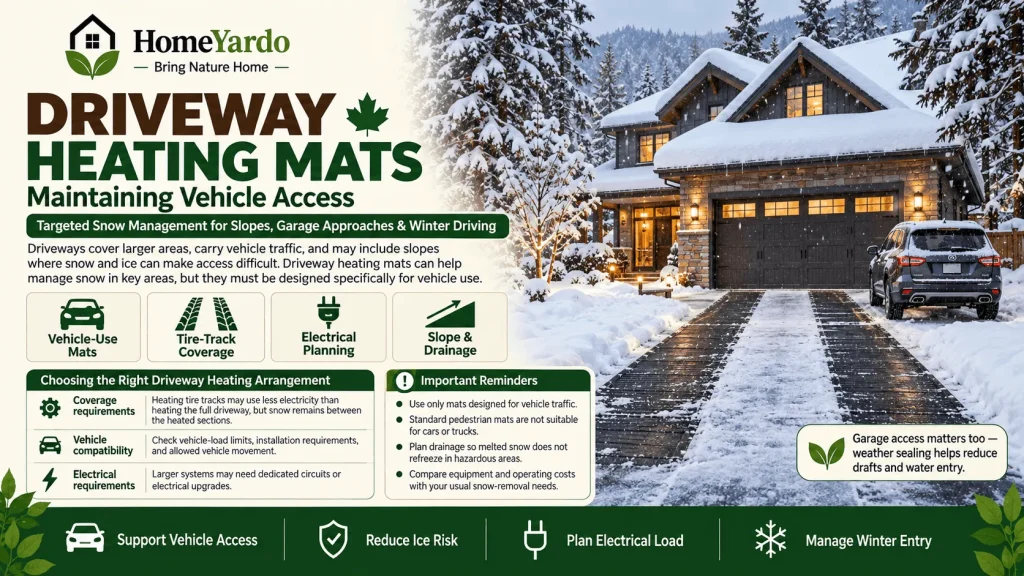
Driveways present a different winter-maintenance challenge.
They cover larger areas, experience vehicle traffic, and may contain slopes where snow and ice make access difficult.
Driveway heating mats offer targeted snow management, but they must be designed specifically for vehicle use. Driveway heating mats can help manage snow near your garage entrance, but protecting the garage itself requires attention. Proper garage door weather stripping can help reduce drafts and water entering through gaps around the door.
Standard pedestrian mats should never be assumed to withstand the weight or movement of cars and trucks.
Choosing the Right Driveway Heating Arrangement
Homeowners should consider three factors.
Coverage requirements
Heating selected tire tracks may require less electricity than covering an entire driveway.
However, this arrangement will not clear snow from the spaces between the heated sections.
Vehicle compatibility
Check the manufacturer’s stated vehicle-load limitations, installation requirements, and permitted vehicle movements.
Electrical requirements
Driveway systems can have substantial electrical demands. Larger installations may require dedicated circuits or other electrical modifications.
Driveway slope and drainage should also be evaluated.
Water produced by melting snow must be directed away from locations where it could refreeze and create another hazard.
Before purchasing a driveway system, compare the cost of equipment and operation with the property’s existing snow-removal requirements.
Installation Considerations for Heated Outdoor Mats
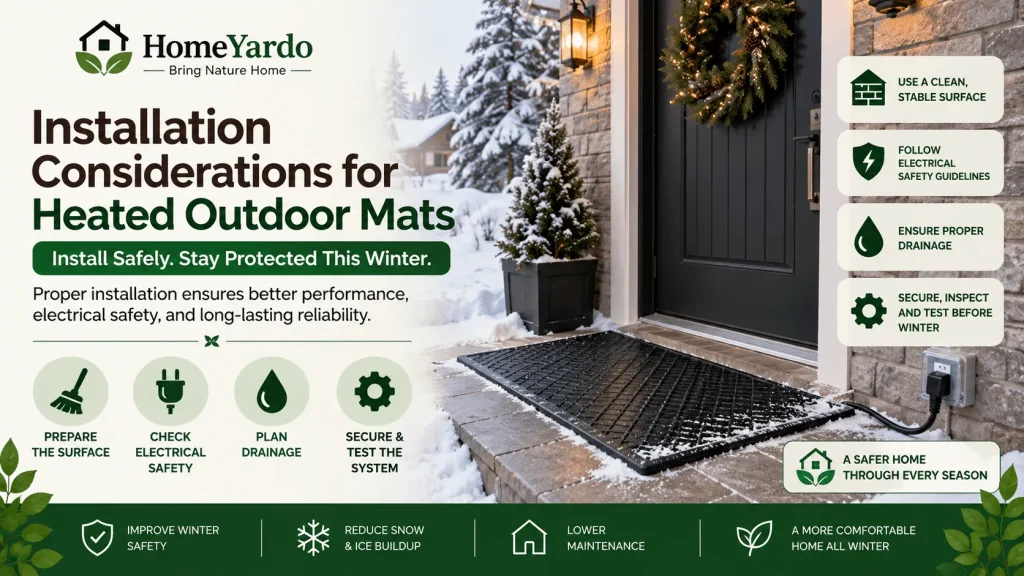
Correct installation affects heating performance, electrical safety, and the usable life of outdoor mats.
Although portable products are generally easier to install than permanent snow-melting systems, homeowners should never overlook the manufacturer’s installation instructions.
Prepare the Installation Surface
Begin by inspecting the area where the mats will be installed.
The surface should meet the product’s installation requirements and be free of obstacles that could damage the mat or create an uneven walking surface.
Check whether the manufacturer permits installation on concrete, timber, stone, composite decking, or other existing materials.
Certain surfaces may require a protective barrier or additional preparation.
Check Electrical Safety
Electrical safety deserves particular attention because heated mats operate outdoors in wet and freezing conditions.
Select equipment that carries electrical certification appropriate for use in Canada.
Ensure the system has the ground-fault protection required by its manufacturer and applicable electrical requirements.
Before installation, confirm that the available electrical supply can support the combined load.
Never exceed the manufacturer’s limits when connecting multiple mats.
Permanent wiring, circuit modifications, and other regulated electrical work should be completed by appropriately licensed professionals.
Larger heated mat installations may require additional electrical capacity. If your existing system cannot support the additional load, consider whether a whole-home electrical upgrade is necessary. Have a qualified electrician assess the requirements before installation.
Plan Drainage And Prevent Refreezing
Heated mats convert snow and ice into water, so drainage remains important.
Inspect the surrounding surface to understand where that water will travel.
Pay particular attention to sloping walkways, stair landings, and areas where meltwater could collect.
If water reaches an untreated section and refreezes, the property may develop another slipping hazard.
Secure and Test the System
Follow the product instructions for securing mats and protecting their connections.
Avoid placing cables where they could be damaged by foot traffic, doors, vehicles, or snow-removal equipment.
Before the winter season, inspect the mats for visible damage and test the system according to the manufacturer’s instructions.
Do not operate equipment with damaged insulation, exposed wiring, or defective electrical components.
How Much Electricity Do Heated Mats Use?
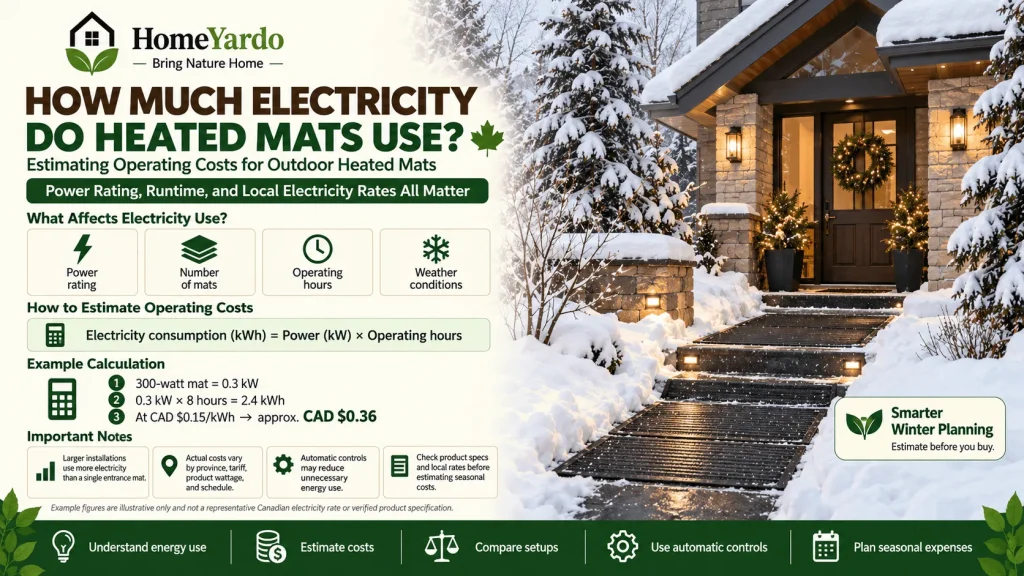
Operating costs are an important consideration when choosing heated outdoor mats.
Electricity consumption depends on the system’s power rating, the number of connected mats, and how long they operate.
A larger installation generally requires more electricity than a small entrance mat.
How to Estimate Operating Costs
Homeowners can calculate approximate electricity consumption using this formula:
Electricity consumption (kWh) = Power (kW) × Operating hours
For example, a hypothetical 300-watt heated mat operating for eight hours consumes:
0.3 kW × 8 hours = 2.4 kWh
At an illustrative electricity rate of CAD $0.15 per kWh, the energy cost would be approximately CAD $0.36.
This is an example rather than a representative Canadian electricity rate or a verified product specification.
Actual costs vary by province, electricity tariff, product wattage, weather conditions, and operating schedule.
Automatic controls may reduce unnecessary energy use by limiting operation to selected conditions.
Homeowners should review the product’s electrical specifications and their local electricity rates before estimating seasonal expenses.
Selecting Heated Mats for Canadian Winter Conditions

Canada experiences considerable differences in winter weather.
Coastal areas may receive frequent wet snowfall, while inland regions can experience prolonged freezing temperatures and substantial temperature fluctuations.
Homeowners should choose equipment according to local conditions rather than assuming every heated mat performs identically.
What Features Should You Compare?
Several product characteristics deserve attention.
Temperature rating
Check the manufacturer’s stated operating-temperature range and any limitations affecting cold-weather performance.
Snow-melting capacity
Where manufacturers publish melting-performance specifications, review the conditions under which those figures were established.
Material durability
Outdoor mats should be designed to withstand their intended exposure to moisture, freezing conditions, and regular use.
Electrical specifications
Compare voltage, wattage, current requirements, certification, and compatible power accessories.
Control options
Decide whether manual operation is sufficient or whether compatible temperature controls and snow sensors would be useful.
Warranty and support
Review warranty coverage, replacement-part availability, and the manufacturer’s installation documentation.
Heated Mat Brands Available to Canadian Homeowners
Canadian homeowners can compare several manufacturers and product ranges.
Options include HotFlake from KEMF, HeatTrak, and Summerstep.
Before purchasing, confirm current product availability and the specifications of the particular model.
Compare equipment using documented performance, electrical requirements, installation limitations, and warranty conditions rather than relying exclusively on promotional claims.
A product suitable for residential stairs may not be appropriate for a long sidewalk or driveway.
Choose equipment designed for the intended location and environmental conditions.
Making Winter Access Safer With Heated Mats
Heated mats provide Canadian homeowners with a practical way to reduce snow and ice accumulation around frequently used outdoor spaces.
Stair mats, walkway pads, sidewalk systems, entrance mats, and vehicle-rated driveway products address different access requirements.
The most suitable arrangement depends on the property’s layout, winter conditions, electrical infrastructure, and available budget.
Before purchasing, review product certification, installation requirements, drainage, and operating costs.
A properly selected system can reduce winter-maintenance demands while helping homeowners maintain safer access throughout the colder months.
FAQ’s
Heated outdoor mats designed for winter use can help manage snow and ice when installed and operated correctly. Choose appropriately certified equipment, follow the manufacturer’s instructions, and use the specified electrical protection.
Some products are designed for extended outdoor installation throughout the winter season. However, this capability varies between manufacturers. Check the product documentation for operating, inspection, and storage requirements.
Performance depends on snowfall intensity, outdoor temperature, product heating capacity, and installation conditions. Heavy snowfall may accumulate faster than some mats can melt it. Review the manufacturer’s documented performance specifications.
Operating costs depend on wattage, electricity prices, and operating hours. Small entrance installations generally consume less total electricity than extensive walkway or driveway systems when used for comparable periods.
Many portable residential systems are designed for installation without modifying existing electrical infrastructure. However, permanent wiring, unsuitable outlets, additional circuit requirements, and larger installations may require a licensed electrician.