How to Choose the Right Home Water Filtration System
Clean drinking water matters in every household, but the water reaching one home can be quite different from the water reaching another. Source water, local treatment, plumbing materials, mineral content, and other factors can all affect taste, smell, appearance, and water quality.
That is why choosing a home water filtration system should start with your water rather than with a particular filter.
Some households simply want to improve chlorine taste or odour. Others may be dealing with sediment, hardness, dissolved minerals, metals, or a contaminant identified through local reporting or water testing.
The right filtration system is therefore not necessarily the largest, most expensive, or most complicated. It is the system designed for the issue you actually have, sized for your household, independently tested for the claims that matter to you, and practical enough to maintain over time.
How Do You Choose the Right Home Water Filtration System?
Start by answering four questions:
- What do you want to reduce or remove from the water?
- Do you need filtration at one tap or throughout the house?
- How much filtered water does your household normally use?
- What installation and ongoing maintenance can you realistically manage?
Once those questions are clear, comparing filtration technologies becomes much easier.
Understand What Is Actually in Your Tap Water
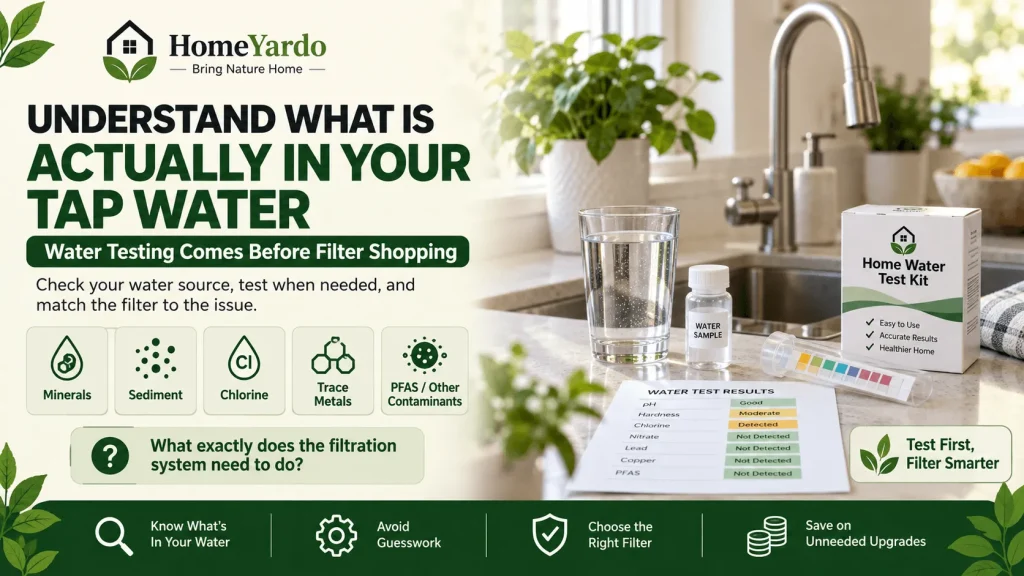
Before buying a filter, find out what is already in your water.
Depending on your local supply and household plumbing, tap water may contain minerals, sediment, disinfectant residuals such as chlorine, fluoride where fluoridation is used, or trace metals.
Some locations may also have concerns involving contaminants such as PFAS, particularly where monitoring has identified them.
Do not assume that an unusual taste, smell, or appearance automatically tells you what is present. Different water-quality issues can produce similar symptoms.
Start with your local water supplier’s latest water-quality report where one is available.
If you use a private well, have an older plumbing system, or are concerned about a specific contaminant, suitable water testing can provide more useful information than choosing a filtration system based on guesswork.
A quality water purifier can provide an additional treatment step, but only when its filtration method matches the substances you actually want to address.
Water Testing Comes Before Filter Shopping
Testing can help answer an important question:
What exactly does the filtration system need to do?
That distinction matters because a filter intended primarily to improve chlorine taste may not be designed for lead, fluoride, microorganisms, PFAS, or other substances.
Likewise, buying an advanced system to address a problem that is not present can add installation costs, replacement costs, and maintenance without providing a useful benefit.
What Are the Main Types of Home Water Filtration Systems?
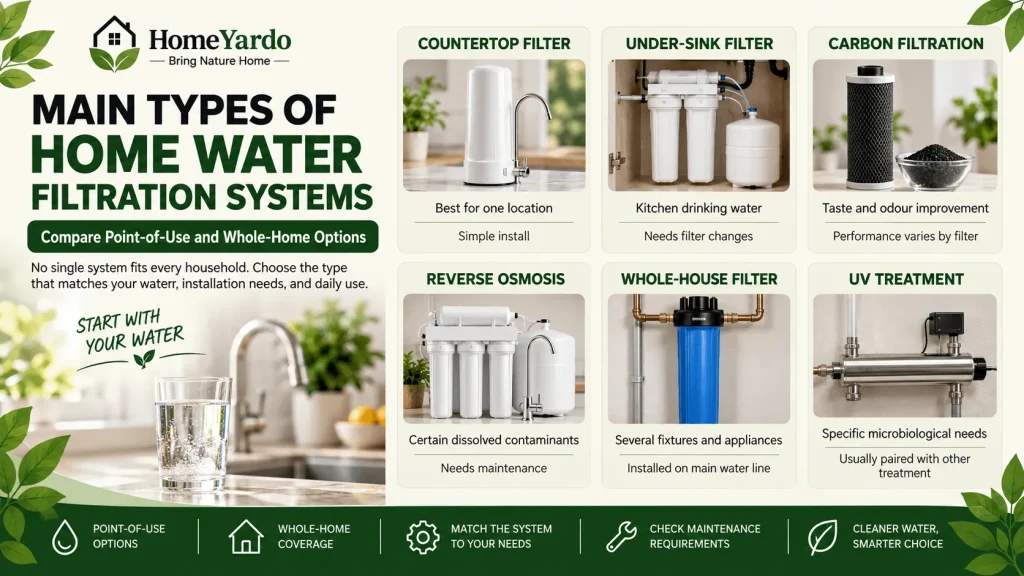
There is no single filtration technology that is suitable for every household.
The main options differ in where they are installed, how much water they treat, the filtration media they use, and the substances they are designed to reduce.
| System Type | Best Suited For | Installation | Main Consideration |
|---|---|---|---|
| Countertop filter | Drinking water at one location | Simple | Limited capacity |
| Under-sink filter | Kitchen drinking and cooking water | Moderate | Requires filter changes |
| Carbon filtration | Taste, odour and certain filtration needs | Varies | Performance depends on the filter |
| Reverse osmosis | Certain dissolved contaminants | Usually under sink | Produces reject water and needs maintenance |
| Whole-house filter | Water supplied to several fixtures | Main water line | Higher installation and servicing needs |
| UV treatment | Specific microbiological treatment needs | Plumbing installation | Usually works alongside other treatment |
Countertop and Benchtop Water Filters
Countertop or benchtop systems are point-of-use filters designed to treat water at a particular location.
Many connect to a kitchen tap or use a self-contained reservoir.
They can be useful for renters, apartments, smaller households, or anyone who wants filtered drinking water without making major plumbing changes.
Their main limitation is capacity. They are normally designed for drinking and cooking water rather than supplying every fixture in the house.
Under-Sink Water Filters
Under-sink filters are installed beneath the kitchen sink and usually supply filtered water through either the main faucet or a separate drinking-water tap.
Depending on the model, these systems may use carbon filtration, multiple filter stages, reverse osmosis, or another treatment method.
They can provide higher capacity than many countertop systems while keeping the equipment out of sight.
Before choosing one, check:
- available cabinet space;
- required water pressure;
- flow rate;
- cartridge replacement frequency;
- whether a separate faucet is needed; and
- whether professional installation is recommended.
Carbon Water Filters
Activated-carbon filtration is commonly used when households want to improve taste and odour or reduce certain substances that the particular filter is certified to address.
Carbon filters are available in pitchers, faucet-mounted filters, under-sink units, and larger systems.
The important point is that “carbon filter” describes the treatment material, not a guarantee that every model removes the same substances.
Always check the specific performance claims for the product.
Reverse Osmosis Systems
Reverse osmosis, often shortened to RO, uses pressure to move water through a semi-permeable membrane.
These systems may reduce a range of dissolved substances, but performance varies between models.
A reverse-osmosis system should therefore be selected according to its documented contaminant-reduction claims rather than simply because it uses RO technology.
Some systems include pre-filters, carbon stages, a storage tank, and post-filtration.
They also create a separate reject-water stream, so water efficiency should be considered when comparing models.
Whole-House Water Filtration Systems
Whole-house systems, also called point-of-entry systems, treat water close to where the main supply enters the property.
Instead of filtering only drinking water, they can treat water supplied to several taps, showers, and appliances.
This approach may make sense when the concern affects water throughout the property, such as sediment or another issue that needs treatment before water is distributed around the house.
Whole-house systems generally require more installation planning than point-of-use filters.
Flow rate is especially important because the system must be able to supply several fixtures without creating an unacceptable pressure drop.
Point-of-Use vs Whole-House Filtration: Which Do You Need?
One of the easiest ways to narrow down your choices is to decide where the water needs to be treated.
A point-of-use system treats water at a specific location, such as the kitchen sink.
A point-of-entry or whole-house system treats water before it is distributed throughout the property.
If your concern only relates to drinking and cooking water, installing filtration at the kitchen may be more practical.
If the issue affects showers, appliances, bathrooms, or several taps, whole-house treatment may deserve consideration.
Avoid paying to treat every gallon entering the house when only one drinking-water outlet needs filtration.
At the same time, do not rely on one kitchen filter when the problem you are trying to solve affects the entire plumbing system.
Water Filters and Water Softeners Are Not the Same Thing
This is an important distinction when comparing home water-treatment equipment.
A water filter is designed to reduce particular substances using filtration or another treatment process.
A water softener is primarily designed to address hardness minerals such as calcium and magnesium.
Hard water can contribute to scale deposits on fixtures, appliances, and plumbing, but a softener should not automatically be treated as a substitute for a contaminant-reduction filter.
Some homes may need filtration, some may need water softening, and others may benefit from a treatment setup that addresses both issues separately.
Key Features to Compare Before Buying
Once you know the type of system you need, compare individual models according to their actual performance and ownership requirements.
Contaminant-Reduction Claims
This should be one of the first specifications you check.
Do not rely on broad terms such as “pure,” “advanced,” or “multi-stage.”
Look for clear information explaining which substances the system has been tested to reduce and under what conditions.
Filtration Stages
Multi-stage systems use different filter media or treatment methods for different purposes.
One stage may capture sediment, while another may address chlorine, taste, odour, or another substance.
More filtration stages do not automatically mean better water treatment.
A well-designed two-stage system that addresses the specific problem can be more appropriate than a six-stage system filled with treatment processes you do not need.
Certifications and Independent Testing
Third-party certification can help verify that a product has been tested against defined performance requirements.
Organisations such as NSF certify drinking-water treatment products against standards covering different treatment technologies and reduction claims.
Do not stop after seeing a certification mark.
Check the standard and the specific claim attached to the certification. A product certified for one purpose should not automatically be assumed to address every possible contaminant.
Flow Rate
Flow rate describes how quickly filtered water can be supplied.
A low-capacity filter may be perfectly acceptable for filling drinking glasses but frustrating if it is expected to supply a busy kitchen.
Whole-house systems need enough flow for multiple fixtures that may operate at the same time.
Compare the rated flow with how your household actually uses water.
Storage Capacity
Some filtration systems, particularly certain reverse-osmosis units, use a storage tank.
Tank size and recovery rate affect how much filtered water is available during periods of heavier use.
Households that cook frequently or have several people drawing drinking water may need greater capacity than a single-person household.
Filter Lifespan
Every replaceable filter has a service life.
Manufacturers may specify replacement according to time, water volume, or both.
Actual lifespan can also be affected by incoming water quality and household consumption.
A cheaper system that requires frequent expensive cartridges may cost more over several years than a higher-priced unit with more economical replacement filters.
How to Match a Water Filtration System to Your Household
Instead of starting with brands, start with your household’s situation.
If Your Main Concern Is Taste or Odour
A suitable carbon-based filtration system may be enough when the objective is improving taste or reducing chlorine-related odour.
Check the product’s specific performance claims rather than assuming every carbon filter performs identically.
If Testing Identifies a Specific Contaminant
Choose a system that has documented reduction performance for that substance.
Do not assume that reverse osmosis, carbon filtration, or any other technology automatically handles every contaminant.
The product’s certified claim matters more than the marketing category.
If You Only Need Drinking Water Filtered
A countertop or under-sink system will often be more practical than treating the entire home’s water supply.
This keeps treatment focused on the water being used for drinking and cooking.
If Water Needs Treatment Throughout the Home
A whole-house system may be more appropriate when the problem affects several fixtures or appliances.
Installation should account for pressure, flow, plumbing layout, filter access, drainage where required, and ongoing servicing.
If You Rent Your Home
Permanent plumbing modifications may not be practical or permitted.
Countertop units and other non-permanent point-of-use options can provide a simpler alternative.
Consider Your Household’s Water Usage
Household size matters mainly because it affects how much water the filtration system must process.
A larger family may:
- use filters more quickly;
- need a higher flow rate;
- require greater storage capacity; and
- replace cartridges more frequently.
Check the manufacturer’s rated capacity rather than choosing a system based only on the number of people living in the property.
Actual water habits can vary considerably between households of the same size.
Calculate the Real Cost of the System
The purchase price is only one part of the cost of owning a filtration system.
Also consider:
| Cost | What to Check |
|---|---|
| Initial equipment | Filter unit, housing, tank or treatment components |
| Installation | DIY requirements or professional plumbing |
| Replacement filters | Price and replacement frequency |
| Membranes | Replacement schedule for systems such as RO |
| Servicing | Periodic professional maintenance if required |
| Water use | Reject water from certain treatment technologies |
| Additional parts | Faucets, fittings, valves or pre-filters |
Calculate approximate yearly maintenance costs before purchasing.
A system that fits your household budget should remain affordable to operate, not merely affordable to install.
Think About Installation Before You Buy
Check where the system will physically go.
An under-sink unit may require more cabinet space than expected. A whole-house system requires accessible plumbing and enough room to change cartridges or service equipment.
Some installations may also need:
- a drain connection;
- electrical power;
- a dedicated drinking-water faucet;
- adequate incoming pressure; or
- modifications to existing plumbing.
If filtration forms part of a larger renovation, include it while planning your home improvement project rather than trying to find space for the equipment after cabinets, plumbing, and finishes have already been installed.
Do Not Ignore Water Pressure and Plumbing Condition
A filtration system becomes part of the home’s plumbing, so the condition of that plumbing matters.
Unusually low pressure, sediment, unexplained water use, leaking fixtures, or old pipework should be investigated rather than automatically blamed on the filter.
If you suspect unexplained water consumption, HomeYardo’s guide on how to check your water meter for leaks can help determine whether water is moving when no fixtures should be using it.
A filtration system is intended to treat water. It should not be expected to correct unrelated plumbing faults.
Maintenance and Long-Term Care
Buying a filter is only the beginning.
Every filtration system needs some level of maintenance if it is to continue working as intended.
Replace cartridges, membranes, UV lamps, or other service components according to the manufacturer’s instructions.
Keep a simple record showing:
- installation date;
- filter replacement dates;
- next scheduled service;
- model and cartridge numbers; and
- any noticeable change in pressure, flow, taste, or odour.
Do not keep using a filter indefinitely simply because the water still looks clear.
Filter media have a finite service capacity, and overdue maintenance can reduce performance.
Watch for Changes in Flow or Pressure
A noticeable reduction in flow may indicate a filter approaching the end of its service life, but it can also result from plumbing or pressure problems.
Check the system according to its manufacturer’s troubleshooting guidance.
If water use appears unusually high rather than simply slow, investigate plumbing leaks as a separate issue. A hidden leak or toilet leak will not be fixed by installing a filtration system.
Common Mistakes When Choosing a Water Filter
Several purchasing mistakes are easy to avoid.
The most common is choosing a filter before identifying the water-quality issue.
Another is assuming that more filtration stages always mean better filtration.
Other mistakes include overlooking replacement-filter costs, buying too little capacity, ignoring installation requirements, and assuming one certification means the unit removes every possible contaminant.
The safest buying process is simple:
identify the concern → confirm what treatment is appropriate → verify the product’s performance claim → calculate capacity and ongoing cost → plan for maintenance.
That approach makes comparison much easier than relying on marketing language alone.
Final Thoughts
Choosing the right home water filtration system begins with understanding the water you already have.
Identify the problem before choosing the equipment. Decide whether treatment is needed at one tap or throughout the property. Compare certified contaminant-reduction claims, flow rate, capacity, installation requirements, filter lifespan, and ongoing ownership costs.
Most importantly, choose a system you can maintain properly.
A simpler filter matched correctly to your water and serviced on schedule is often more useful than a complicated treatment system selected without knowing what problem it is supposed to solve.
FAQ’s
There is no single best home water filtration system for every property. The right option depends on your water quality, contaminants of concern, household water use, installation needs, and maintenance budget. Choose a system based on verified treatment requirements rather than brand or price alone.
Start with your local water-quality report and, when necessary, appropriate water testing. Identify what you want the filter to reduce, then choose a system with documented performance for that specific purpose.
Neither is automatically better. Countertop filters are generally easier to install and move, while under-sink systems may offer greater capacity and keep the equipment out of sight. The better choice depends on available space, filtration needs, water use, and whether plumbing modifications are acceptable.
Reverse osmosis and conventional filtration serve different purposes. RO can reduce certain dissolved substances that some other filters may not address, but it also has different installation, maintenance, flow, and water-efficiency considerations. Choose it when its treatment capabilities match the water-quality issue you need to address.
A whole-house system may be worth considering when water needs treatment across multiple taps, showers, or appliances. If your goal is simply filtered drinking water at the kitchen sink, a point-of-use system may be more practical.
Check the independent certification standard as well as the specific contaminant-reduction claim. Certification for chlorine taste or odour, for example, should not automatically be interpreted as certification for unrelated contaminants.
Replacement intervals depend on the system, filter material, rated capacity, incoming water quality, and household water use. Follow the manufacturer’s specified replacement schedule rather than relying only on changes in taste or appearance.
No. More stages only help when those stages perform treatment your water actually needs. A simpler system matched correctly to your water can be more appropriate than a complex system with unnecessary treatment stages.
A water filter is designed to reduce specific substances from water. A water softener primarily reduces hardness minerals such as calcium and magnesium. They solve different water-quality problems, although some homes may use both.
Maintenance costs depend on the technology and model. Include replacement cartridges, membranes, professional servicing where required, and other consumable components when comparing systems. Calculate the expected annual cost rather than considering only the purchase price.
Testing can be useful when you are concerned about a particular contaminant, use private-well water, have unusual plumbing conditions, or cannot get sufficient information from a local water-quality report. It prevents you from selecting treatment based solely on assumptions.