How to Actually Know How Much Water Your Garden Is Using and Why It Matters
Most gardeners have a rough sense of how often they water. They know they run the sprinklers for about twenty minutes three times a week, or that they hand-water the vegetable beds every evening in summer. What almost none of them know is how much water that actually represents in measurable terms, and that gap between routine and reality is where a significant amount of water and money disappears without anyone noticing.
Understanding your garden’s actual water consumption is not a complicated undertaking, but it does require moving beyond time-based assumptions and into measurement. The difference between the two is the difference between managing your irrigation and simply maintaining a habit.
Why Time-Based Watering Misleads You
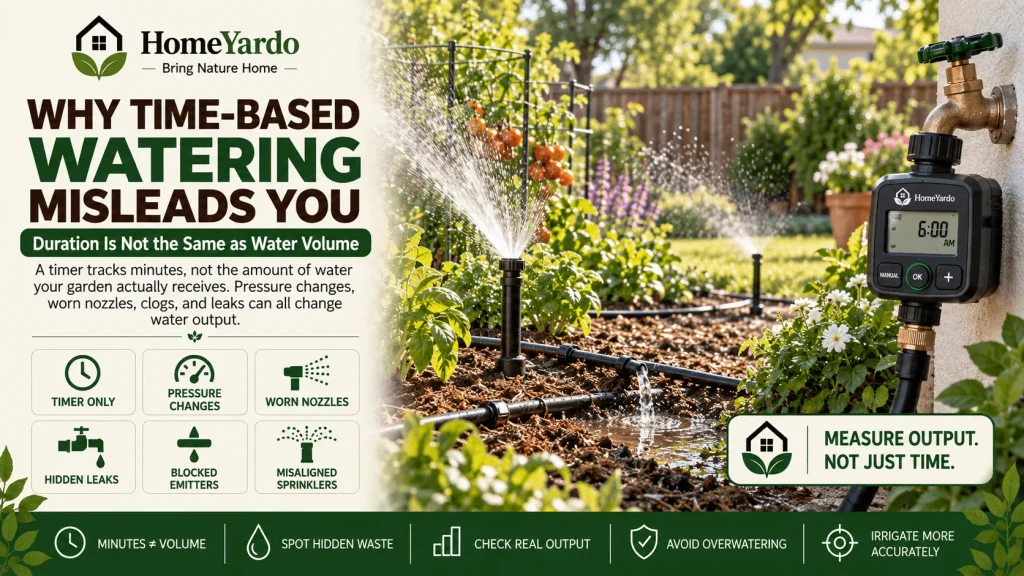
The most common approach to garden irrigation is time-based. You set a timer, run the system for a defined period, and assume the garden received what it needed. This approach has a fundamental problem: it measures duration, not volume, and the relationship between the two is not fixed.
Water pressure varies between homes and even between different times of day on the same supply line. A sprinkler running at lower pressure delivers significantly less water per minute than the same sprinkler at full pressure. Emitters and nozzles wear over time, changing their output characteristics. Hoses develop partial blockages. All of these factors mean that twenty minutes of irrigation today may deliver a different volume than twenty minutes of irrigation six months ago or at a different point in the same watering cycle.
Beyond the variability problem, time-based watering provides no feedback loop. If a zone in your irrigation system develops a leak, a blocked nozzle, or a misaligned sprinkler head, you will not know from the timer. Checking your water meter can also help identify unexplained water use caused by leaks. You will continue running the system for the same duration while the water either goes nowhere useful or floods a single spot. Measurement catches these problems. Duration alone does not.
What You Actually Need to Measure
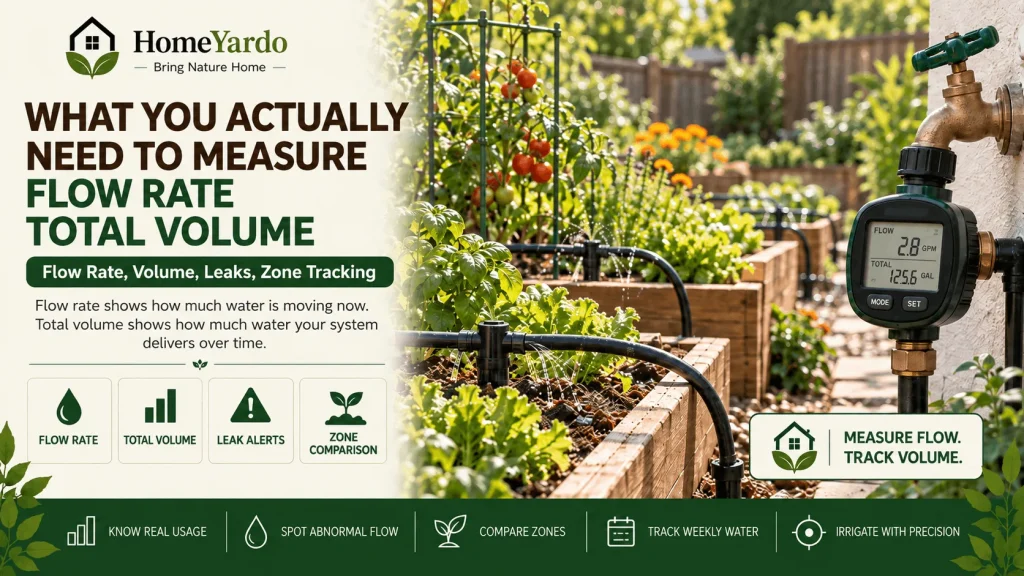
Effective irrigation management requires knowing the flow rate through your system and the total volume delivered over a given period. Flow rate tells you how much water is moving through a line or a zone at any given moment. Volume tells you what was delivered across a full irrigation event or a full watering week.
Both pieces of information are useful for different purposes. Flow rate lets you identify anomalies in real time. A zone that normally runs at a consistent flow rate and suddenly shows a significant deviation has either developed a leak or lost an emitter. Volume data lets you track consumption over time, compare usage between zones, and calculate whether your irrigation is actually aligned with the water requirements of what you are growing.
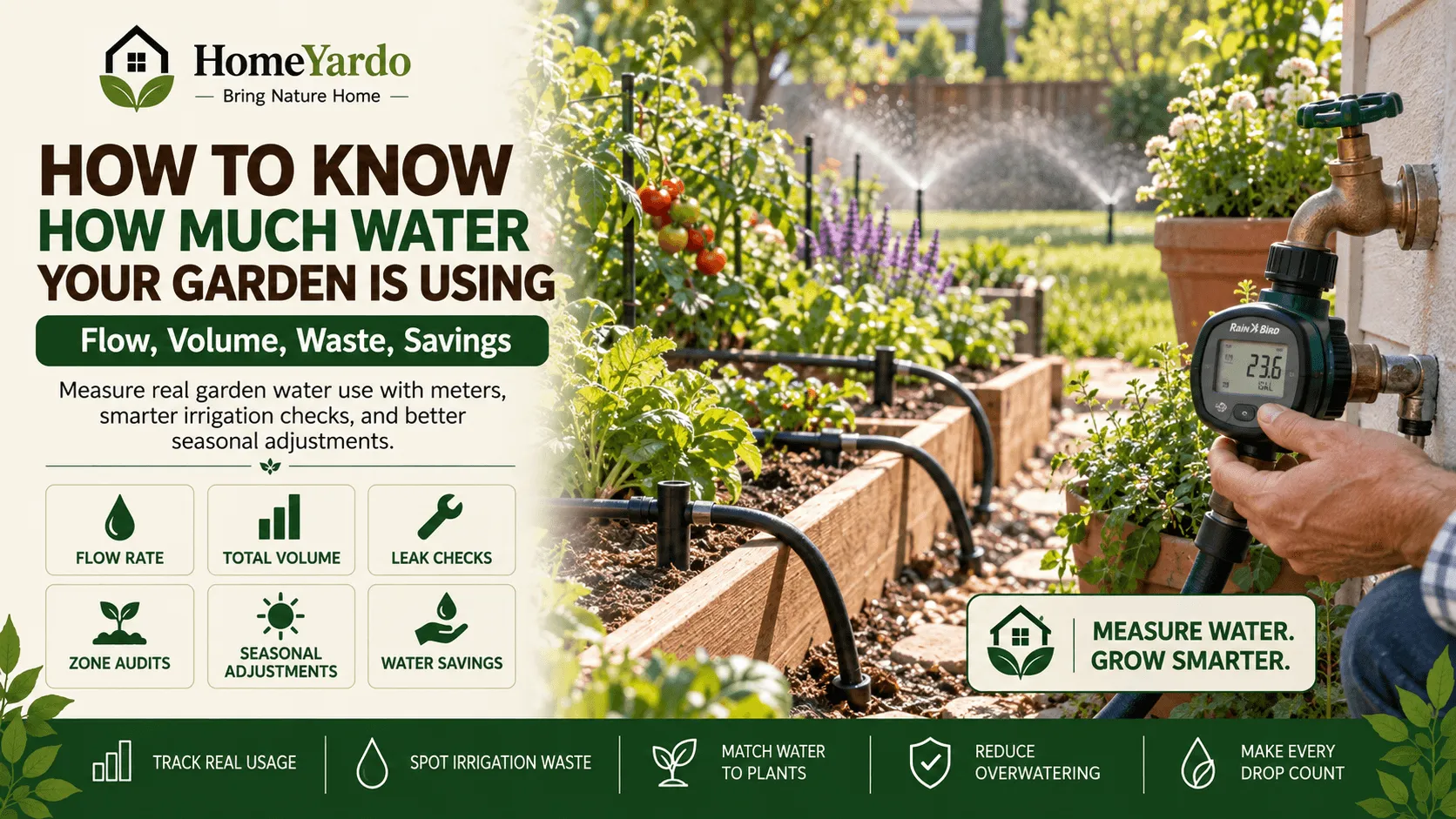
A water flow meter installed on your garden supply line or at individual zone entry points gives you both. These devices measure the water passing through them continuously and typically provide both instantaneous flow rate and cumulative volume readings. Installing one at the main hose connection or at the input to each irrigation zone transforms your understanding of what your garden system is actually doing.
Matching Water Delivery to Plant Requirements
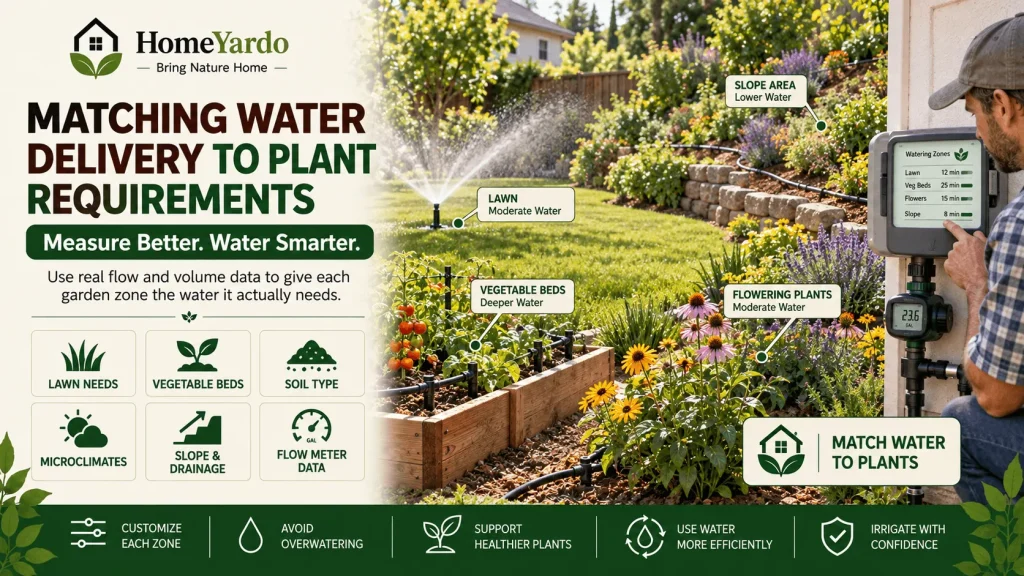
One of the practical applications of knowing your actual water volumes is the ability to match what you deliver to what your plants genuinely need. Different plants, soil types, and microclimates within a garden have substantially different water requirements, and grouping plants according to their water needs can make irrigation easier to manage.
Lawn areas, for example, typically require around 25 millimetres of water per week during active growing season, depending on grass type and local conditions. A vegetable bed with deep-rooted crops needs less frequent but deeper irrigation than a bed of shallow-rooted annuals. Plant selection also affects watering requirements, especially in sunny, hot, or dry garden areas. A sloped area with fast drainage needs a different approach than a flat bed with moisture-retaining soil.
None of these distinctions can be managed precisely without knowing what your system is delivering. A flow meter makes that calculation possible. Once you know that a specific zone delivers a particular volume per minute, you can calculate exactly how long to run it to meet the measured water requirement of what you are growing there, rather than relying on a general estimate that may be substantially over or under the actual need.
Identifying Waste in an Existing System
Established garden irrigation systems accumulate inefficiencies over time in ways that are not visible without measurement. Emitter wear changes output. Root intrusion affects underground lines. Connections that were tight when installed develop slow leaks. Sprinkler heads that were correctly adjusted when the system was new may have shifted to water paths or driveways rather than planting areas.
Running a measurement audit on an existing system means recording flow rates across all zones and comparing them to the baseline you would expect from the installed components. Zones that show higher than expected flow have something delivering excess water, either a leak, a failed emitter that is stuck open, or a broken line. Zones that show lower than expected flow have a blockage or a partially closed valve somewhere in the circuit.
This kind of audit is not possible without measurement data. With it, you can identify and address specific inefficiencies rather than guessing at why parts of the garden are overwatered, underwatered, or consuming more than expected.
Seasonal Adjustment and Long-Term Tracking
Water requirements change across the seasons in ways that fixed irrigation schedules do not automatically account for. A schedule calibrated for midsummer peak demand delivers too much water in spring and autumn when evapotranspiration rates are lower and rainfall is typically higher. Running the same schedule year-round, which a large proportion of irrigation systems do, leads to chronic overwatering across the shoulder seasons and corresponding waste.
Tracking your actual water delivery volumes across the year gives you the data to make meaningful seasonal adjustments. If your flow meter data shows consistent delivery of a specific weekly volume and your soil moisture readings or plant condition suggests that volume is excessive in cooler months, you have the information needed to reduce run times in a calibrated way rather than making a subjective guess.
Over multiple seasons, this data becomes genuinely valuable. You develop an understanding of exactly how your specific garden system performs under different conditions and can manage it with a precision that guesswork-based approaches cannot match.
The Connection Between Measurement and Conservation
Water conservation in garden contexts is often discussed in terms of general practices: water in the morning, use mulch, choose drought-tolerant plants. These are all useful principles, but they operate at the level of habit rather than measurement. Measurement adds a dimension that habits alone cannot provide.
When you know how much water your garden uses in measurable terms, conservation becomes a specific target rather than a general intention. You can set a weekly volume limit and track whether you are meeting it. You can compare your usage against the water requirements of what you are growing and identify where you have room to reduce without affecting plant health. You can see the actual impact of changes you make to your irrigation practices rather than estimating whether they made a difference.
The gardens that use water most efficiently are not necessarily the ones with the most sophisticated irrigation equipment. They are the ones where the people managing them know what their system is doing and make decisions based on that knowledge rather than routine.
FAQ’s
Record the amount of water used during an irrigation cycle with a water meter or flow meter. If you know the flow rate, multiply it by the run time. A system flowing at 5 gallons per minute for 20 minutes would use approximately 100 gallons.
You can use your home’s existing water meter before and after an irrigation cycle, provided no other water is being used during the test. A bucket-and-stopwatch test can also estimate the flow rate from a hose.
Measure the flow rate for each sprinkler zone and multiply it by the zone’s operating time. A dedicated irrigation meter or whole-house water meter can also show total consumption.
Flow rate describes how quickly water moves through the system, such as gallons per minute. Volume describes the total amount of water used during the watering period.
A flow meter can show abnormal water movement or a change from the system’s normal flow rate. It can indicate that something needs investigation, but it usually cannot identify the exact location or cause of the problem by itself.
Possible causes include a damaged sprinkler head, broken pipe, leaking valve, equipment changes, pressure differences, or an emitter releasing more water than intended. Compare current flow with an earlier baseline and inspect the zone while it operates.
There is no single interval that suits every garden. Establish a baseline, then recheck after seasonal changes, irrigation repairs, equipment changes, unexplained increases in water consumption, or visible watering problems.
No. Plant type, root depth, soil, sun exposure, slope, climate, rainfall, and establishment stage all affect water needs. Irrigation zones work best when plants with similar requirements are grouped together.
Not necessarily. Water pressure, clogged nozzles, damaged emitters, leaks, and equipment changes can alter the amount delivered during the same run time.
Start by measuring current consumption. Then correct leaks and poor sprinkler coverage, group plants according to water needs, account for rainfall, monitor root-zone moisture, and adjust irrigation as weather and seasons change rather than simply shortening every watering cycle.