Where Does A Demolished House Go? Waste and Recycling
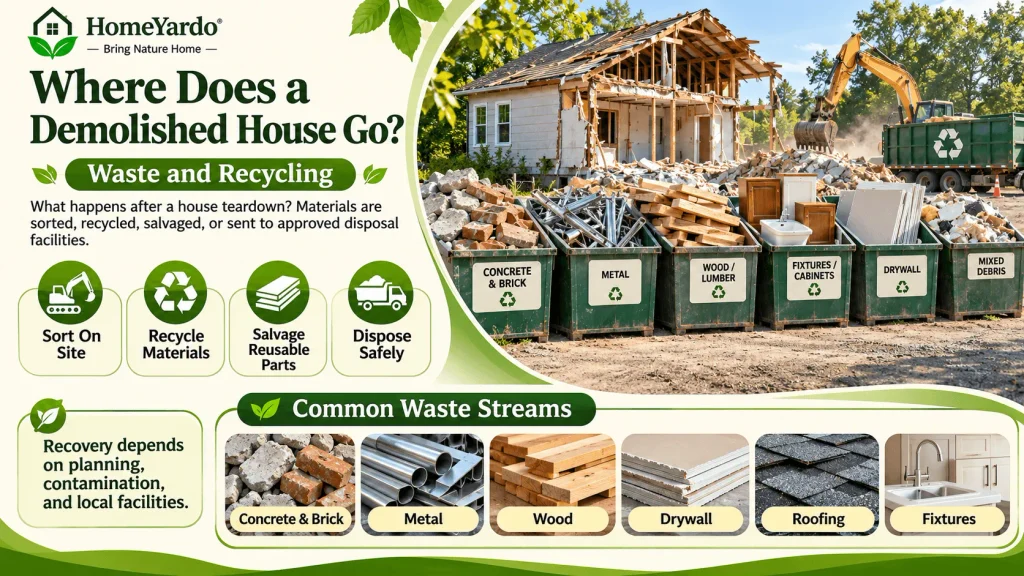
A house can take decades to build, yet a demolition crew may bring it down in just a few days. What happens afterward is less obvious. A single residential teardown can produce truckloads of concrete, brick, lumber, drywall, roofing materials, metal, and broken fixtures.
So, where does demolition waste go once a house is torn down?
A demolished house typically goes to several destinations, including construction waste sorting facilities, recycling plants, salvage businesses, and approved landfills. Concrete and metal may be recycled, reusable fixtures and timber can be salvaged, and contaminated or unrecoverable materials are sent to suitable disposal facilities.
For homeowners in Toronto and the Greater Toronto Area (GTA), understanding these destinations can help with demolition planning, waste disposal costs, material recovery, and the environmental impact of rebuilding.
The Scale of Construction and Demolition Waste
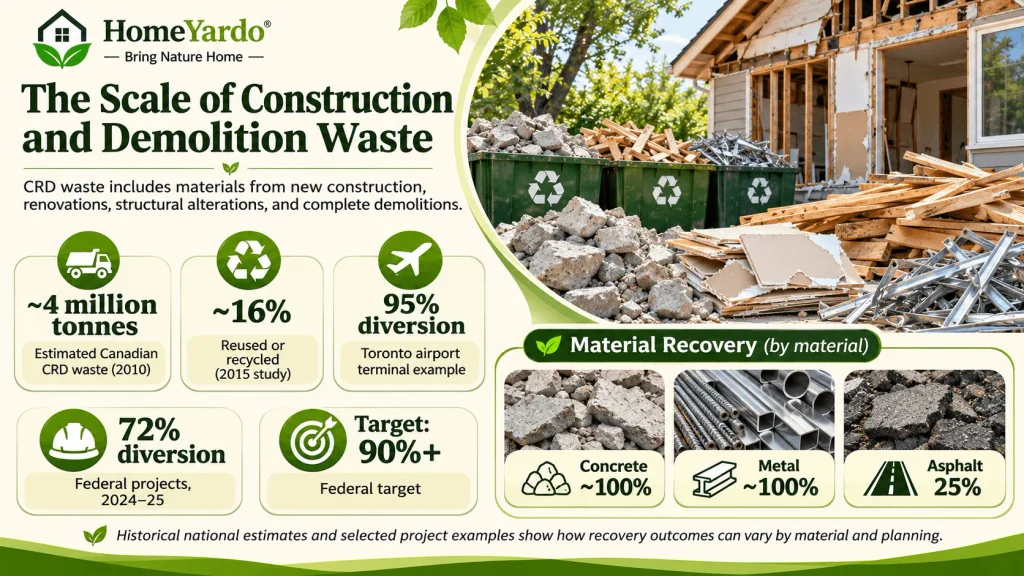
Construction, renovation, and demolition (CRD) waste represents one of Canada’s major solid waste streams. It includes materials removed during new construction, home renovations, structural alterations, and complete building demolitions.
A 2019 guidance document from the Canadian Council of Ministers of the Environment cites historical Canadian estimates of approximately four million tonnes of CRD waste generated in 2010. It also discusses a 2015 study indicating that only about 16% of these materials were reused or recycled.
These are historical national estimates, not current recycling rates for Toronto residential demolitions.
The same guidance highlights projects that achieved substantially higher diversion rates through careful planning and material recovery. One example involved a Toronto airport terminal project where approximately 95% of demolition waste was diverted from landfill.
Federal construction projects offer a more recent comparison. According to the Government of Canada’s reporting on construction, renovation and demolition projects, reporting federal operations achieved a 72% waste diversion rate during 2024–25, against a target of at least 90%.
The reported rates for concrete and metal were approximately 100%, while asphalt had a diversion rate of 25%.
Those figures apply to the federal projects covered by the report, not the average demolished house. They illustrate how recovery outcomes differ by material and available recycling infrastructure.
Where Does Demolition Waste Actually Go?
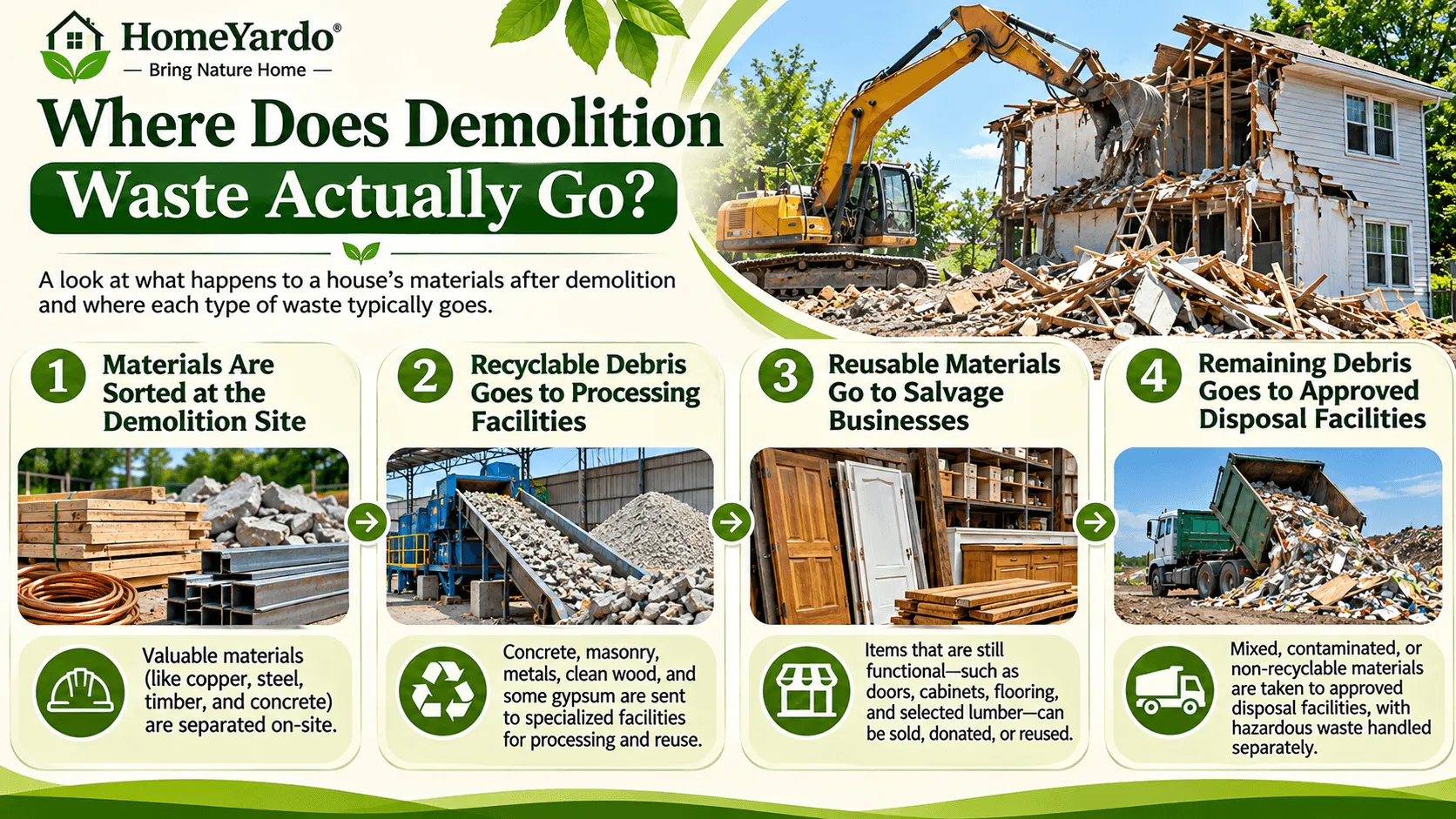
Once a house is demolished, its materials do not necessarily travel to one landfill. Different waste streams follow different routes depending on their condition, contamination, local recycling services, and the demolition contractor’s waste management arrangements.
A typical Toronto residential demolition may involve several stages.
1. Materials Are Sorted at the Demolition Site
Before or during demolition, crews may separate valuable materials such as copper, steel, reusable timber, and clean concrete.
Some items are removed before the structure comes down. Others are collected once heavy equipment has completed the main demolition.
On-site sorting helps prevent recyclable materials from becoming mixed with general debris.
2. Recyclable Debris Goes to Processing Facilities
Concrete, masonry, metals, clean wood, and some gypsum products can be transported to facilities equipped to process those materials.
The facility may crush, shred, screen, sort, or otherwise prepare the waste for use as recycled material.
Not every facility accepts every construction material. Acceptance depends on the material’s condition, local processing capacity, and contamination restrictions.
3. Reusable Materials Go to Salvage Businesses
Items that remain functional or structurally suitable may be sold, donated, or reused.
Examples include doors, cabinets, architectural hardware, hardwood flooring, and selected lumber.
Salvage businesses and building-material reuse centres can give these components another purpose without the energy and processing involved in manufacturing replacements.
4. Remaining Debris Goes to Approved Disposal Facilities
Some demolition debris cannot be practically recovered.
Mixed materials, contaminated products, damaged composites, and waste without a viable recycling option may need to go to approved disposal facilities.
Hazardous waste requires separate handling and must follow the applicable disposal requirements.
This is why the final destination of a demolished house depends heavily on how the project is planned and carried out.
Demolition and Deconstruction Are Not the Same Thing
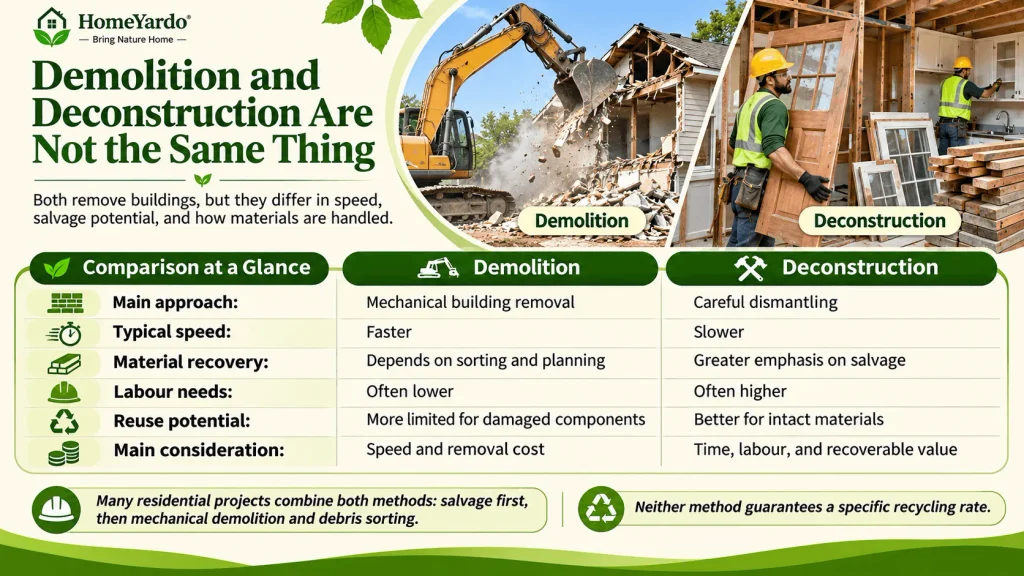
Demolition and deconstruction both remove existing buildings, but they differ in how materials are handled.
Conventional demolition generally uses heavy equipment to dismantle or bring down a structure. It is usually faster, although materials may become mixed, damaged, or more difficult to recover.
Deconstruction is a more selective process. Instead of breaking everything down at once, workers carefully remove components that can be reused or recycled.
A deconstruction crew may work through a house in roughly the reverse order of construction, starting with fixtures, interior finishes, and non-structural components before moving toward major structural elements.
| Factor | Conventional demolition | Deconstruction |
|---|---|---|
| Main approach | Mechanical building removal | Careful dismantling |
| Typical speed | Faster | Slower |
| Material recovery | Depends on sorting and planning | Greater emphasis on salvage |
| Labour needs | Often lower | Often higher |
| Reuse potential | More limited for damaged components | Better for intact materials |
| Main consideration | Speed and removal cost | Time, labour, and recoverable value |
Neither method guarantees a particular recycling rate.
Many residential projects use a combination of both approaches. Valuable fixtures and reusable materials are removed first, followed by mechanical demolition and sorting of the remaining debris.
For homeowners working with a tight rebuilding schedule, this combined method may offer a practical balance.
What Typically Gets Recovered From a Demolished House?
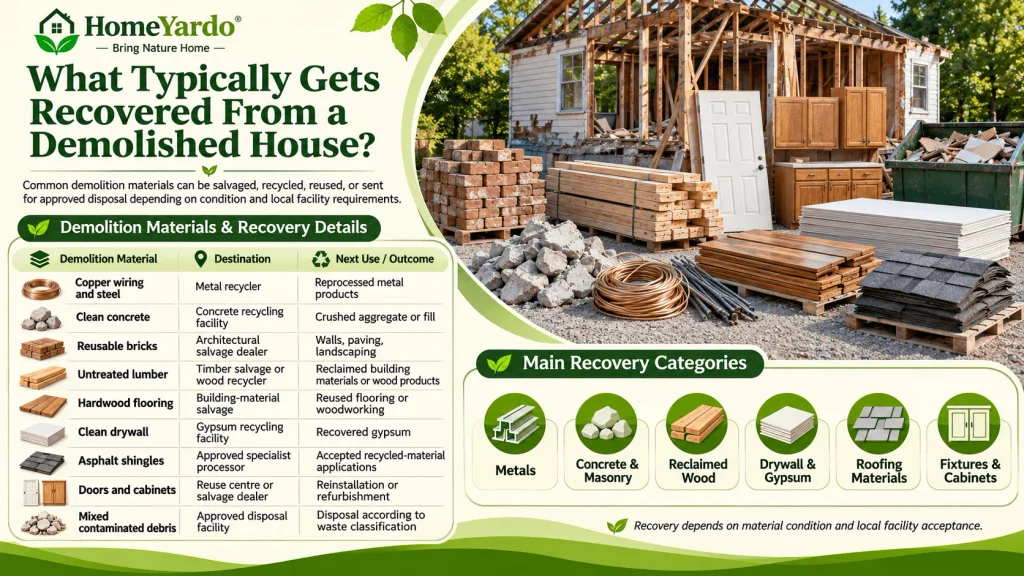
A Toronto home contains several categories of construction materials. Each has different recovery options, and not every item can be recycled in its original form.
The table below shows where common demolition materials may go.
| Demolition material | Possible destination | Common next use |
|---|---|---|
| Copper wiring and steel | Metal recycler | Reprocessed metal products |
| Clean concrete | Concrete recycling facility | Crushed aggregate or fill |
| Reusable bricks | Architectural salvage dealer | Walls, paving, landscaping |
| Untreated lumber | Timber salvage or wood recycler | Reclaimed building materials or wood products |
| Hardwood flooring | Building-material salvage | Reused flooring or woodworking |
| Clean drywall | Gypsum recycling facility | Recovered gypsum |
| Asphalt shingles | Approved specialist processor | Accepted recycled-material applications |
| Doors and cabinets | Reuse centre or salvage dealer | Reinstallation or refurbishment |
| Mixed contaminated debris | Approved disposal facility | Disposal according to waste classification |
These are possible destinations rather than guaranteed outcomes. Material condition and local facility requirements determine whether recovery is feasible.
Metals: Copper, Steel, and Aluminum
Metal is among the more recoverable materials in residential demolition.
Copper pipes, electrical wiring, steel supports, aluminum components, and ductwork can often be separated and delivered to scrap-metal processors.
Recycling metal reduces the need for virgin raw materials and can provide scrap value that helps offset some recovery costs.
Concrete and Masonry
Concrete foundations, basement slabs, walkways, and other clean concrete elements can often be crushed into aggregate for permitted construction applications.
Bricks may also be recovered, although the outcome depends on their condition and how easily mortar can be removed.
Whole-brick salvage is more practical when bricks remain intact and can be cleaned without excessive damage.
Wood and Reclaimed Timber
Older houses may contain solid lumber, hardwood flooring, trim, beams, and other wood components worth preserving.
Sound timber may be reused in suitable projects after its condition, previous treatments, and structural suitability have been assessed.
Lower-grade clean wood may be processed for other approved applications.
Painted, chemically treated, mould-damaged, or otherwise contaminated wood can require different handling.
Drywall and Gypsum
Drywall contains gypsum, which can be recovered by specialist processing facilities.
However, recycling becomes more difficult when drywall is mixed with insulation, paint residue, adhesives, wood, or other construction debris.
Keeping acceptable gypsum board separate can improve its recovery potential.
Roofing Materials and Asphalt Shingles
Roofing waste frequently includes asphalt shingles, underlayment, flashing, fasteners, and damaged wood.
Some facilities process asphalt shingles for approved recycling uses, but acceptance varies considerably by region and material condition.
Homeowners should not assume every roofing product will be accepted for recycling.
Fixtures, Doors, Windows, and Cabinets
Kitchen cabinets, sinks, doors, lighting fixtures, and architectural hardware may be suitable for salvage when they remain in usable condition.
Windows and other building components also need to meet the performance and safety requirements of their next application.
Removing these items before demolition generally gives them a better chance of being reused.
Hazardous Materials Must Be Identified Before Demolition
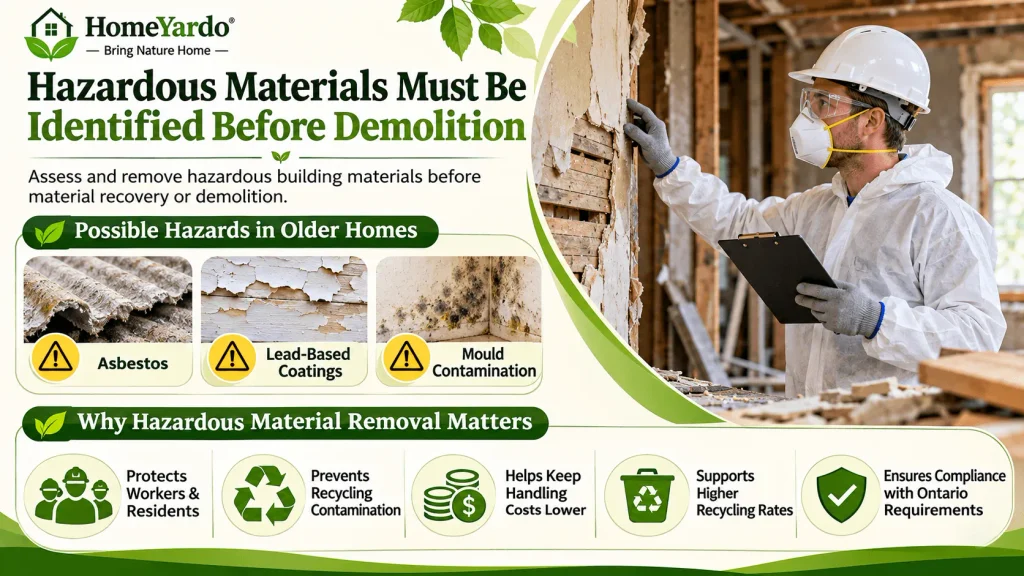
Material recovery should never begin by disturbing potentially hazardous building products without proper assessment.
Depending on the building’s age, renovation history, and materials, a Toronto-area house may contain asbestos-containing products, lead-based coatings, mould contamination, or other hazards.
Asbestos may be present in certain older insulation, flooring, ceiling products, and other building materials.
Lead-based coatings can also create exposure concerns when disturbed through cutting, sanding, breaking, or demolition.
Mould-damaged materials may require appropriate containment and handling based on the extent of contamination.
Why Hazardous Material Removal Matters
Hazardous materials create risks for demolition workers, nearby residents, transport personnel, and waste-processing facilities.
If unsuitable materials enter a general recycling load, they may contaminate otherwise recoverable debris.
This can increase handling costs and reduce recycling opportunities.
Suspected hazardous products should be assessed before demolition by appropriately qualified professionals. Required removal, containment, transport, and disposal procedures should follow applicable Ontario requirements.
Homeowners should not attempt to identify or remove suspected asbestos through visual inspection or ordinary DIY demolition.
Planning for Demolition Waste Diversion From The Start
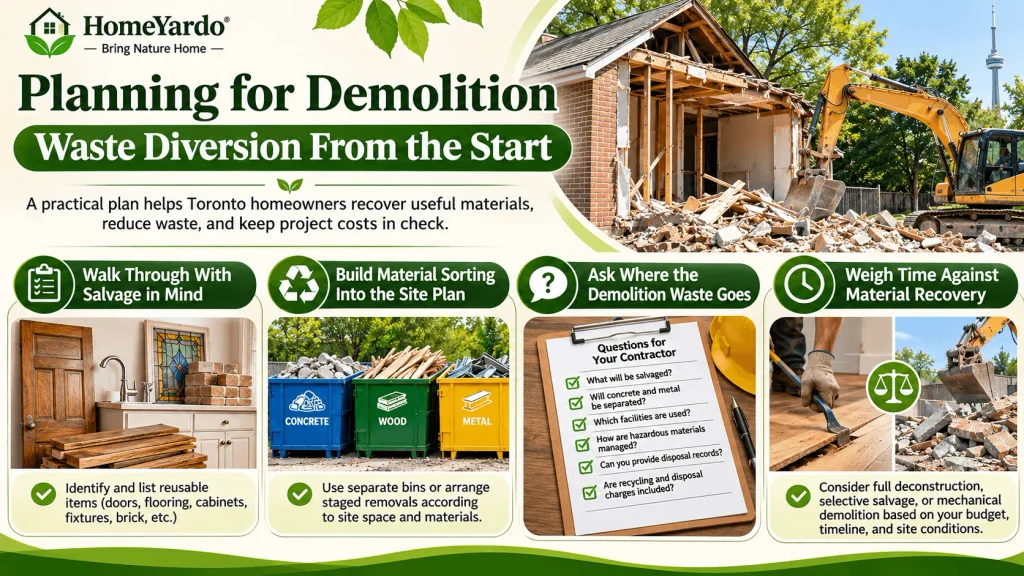
The amount of material recovered from a house is influenced by decisions made before demolition begins.
For Toronto homeowners, early planning can reduce avoidable waste and make project costs easier to understand.
Walk Through the House With Salvage in Mind
Before the demolition date, identify materials that may be worth keeping.
These could include original doors, hardwood flooring, decorative brick, kitchen cabinets, fixtures, or architectural features.
Make a written salvage inventory and discuss it with the contractor.
Items intended for reuse should be clearly identified before demolition work begins.
Build Material Sorting Into the Site Plan
Separate containers may be useful for concrete, metal, wood, and other accepted materials.
However, smaller Toronto properties may not have enough room for multiple large bins.
In those cases, contractors may arrange staged removals or transport mixed non-hazardous debris to a facility that offers suitable sorting services.
Sorting arrangements should account for site access, collection schedules, and the materials expected from the building.
Ask Where the Demolition Waste Goes
When comparing demolition contractors in Toronto, ask which materials they separate on site, which recycling facilities they use and whether they can provide disposal records.
Useful questions include:
- Which materials will be salvaged before demolition?
- Will clean concrete and metal be separated?
- Which facilities receive the demolition debris?
- How are hazardous materials assessed and managed?
- Can the contractor provide disposal receipts or weight records?
- Are recycling and disposal charges included in the quotation?
A contractor should be able to explain the proposed waste-handling process and identify which records can be provided.
Weigh Time Against Material Recovery
Full deconstruction can take longer than mechanical demolition, particularly when fixtures, flooring, and structural elements require careful removal.
That additional labour may affect the project schedule and overall cost.
Selective salvage can offer a middle ground. Recovering the most valuable or reusable materials before mechanical demolition may be practical without dismantling the entire building by hand.
The best approach depends on the structure, site conditions, available services, budget, and planned rebuilding schedule.
What Affects the Cost of Demolition Waste Disposal?
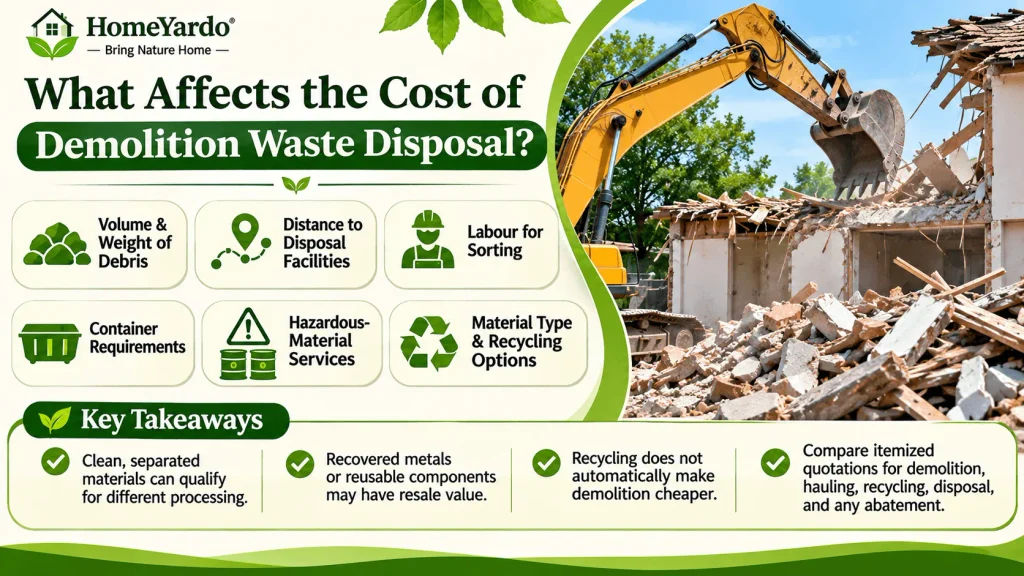
Waste handling is one part of the overall demolition budget, and different materials can carry different collection, transport, and processing costs.
The main factors include the volume and weight of debris, distance to suitable facilities, labour required for sorting, container requirements, and whether specialist hazardous-material services are needed.
Clean, separated materials may qualify for different processing arrangements than mixed loads. Recovered metals or reusable building components may also have resale value.
However, recycling does not automatically make demolition cheaper.
Extra labour, container hire, storage, and transportation can outweigh the financial value recovered from some materials.
Homeowners should compare itemized quotations that explain what is included in demolition, hauling, recycling, disposal, and any required abatement.
Salvage Can Help the Rebuild Too
Not everything recovered from the old house needs to leave the property.
Some materials can become part of a new home or landscape, provided they are safe and suitable for the intended use.
Reclaimed brick might be incorporated into a garden wall or outdoor feature. Original doors and hardware can preserve some of the former home’s character. Sound reclaimed timber may also be suitable for selected interior uses after appropriate assessment.
Keeping usable materials can reduce replacement purchases and preserve features that would otherwise be lost during demolition.
For larger home improvement projects, a clear waste plan can also make the work easier to organize. HomeYardo’s guide to managing household waste during home improvement projects explains how to plan collection, separation, and safe disposal during renovation work.
If the property includes a detached garage, shed, or other structure, backyard structure demolition may require separate arrangements for equipment access and debris removal.
The important step is deciding what to preserve before crews begin dismantling the building.
Final Takeaway
A demolished house does not simply disappear into a landfill. Its components can travel through several waste-management routes, including recycling plants, salvage businesses, material processors, and approved disposal facilities.
Concrete and metal are often suitable for recovery, while timber, brick, fixtures, and other components may be reused when their condition allows.
Contamination, limited recycling services, and poor separation can reduce the amount of material recovered.
For homeowners planning a teardown in Toronto or the GTA, the most useful approach is to identify hazardous materials, mark reusable components, discuss waste separation with the contractor, and request clear information about disposal destinations.
That planning can make demolition more transparent while giving valuable building materials a better chance of being used again.
Frequently Asked Questions
A demolished house is usually divided into different waste streams. Reusable materials may go to salvage dealers, recyclable debris to processing facilities, and unrecoverable or contaminated materials to approved disposal facilities. The destination depends on material type, condition, and local services.
No. Concrete, metal, certain wood products, and selected building materials may be recycled or reused. However, contaminated materials and debris without suitable recovery options may still require landfill disposal or other approved treatment.
Yes. Common recyclable materials include clean concrete, steel, aluminum, copper, and some wood and gypsum products. Recycling depends on local facility acceptance and whether the materials can be separated without contamination.
Clean concrete is often transported to a recycling facility, where it can be crushed and processed into aggregate for suitable construction applications. Concrete containing unacceptable contaminants may require additional handling or disposal.