5 Reasons Families Choose the NeoVolt Battery
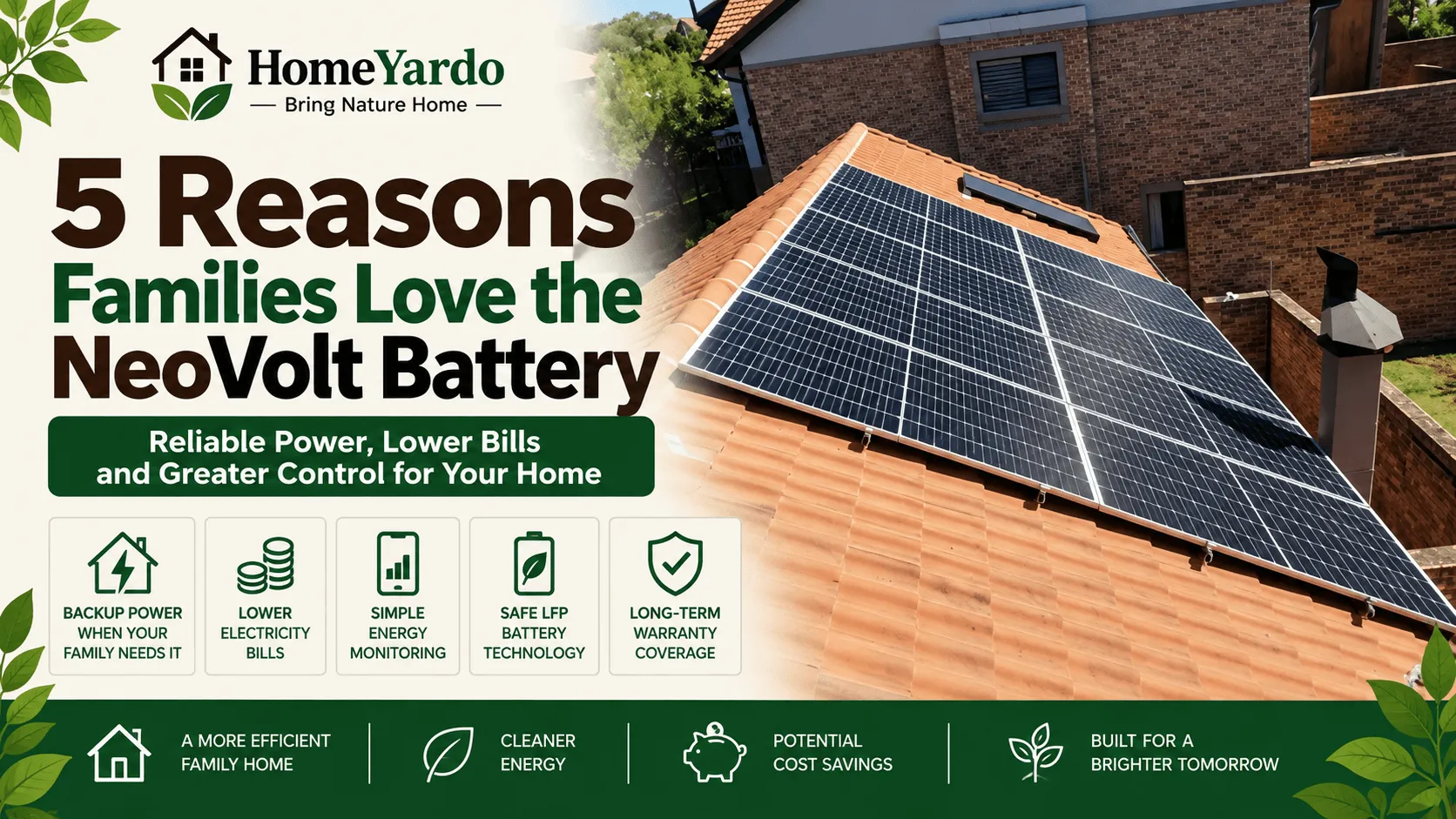
Household energy demands rarely are easy for a busy family. The fridge is running all the time, washing and dish machines are forever churning, devices need recharging and the evening peak in electricity demand typically coincides with the moment when solar generation begins to plummet.
That helps explain the increasing interest in home battery storage. Instead of sending all excess daytime solar electricity back to the grid, some of that energy can be stored in a battery for later use.
That sort of household energy management is what the NeoVolt is built around. Based on the model and system configuration, NeoVolt systems integrate solar storage, backup capability, monitoring and lithium iron phosphate battery technology.
Here are five reasons why it might be time for families to think about a NeoVolt solar battery, and a few checks to make before you buy one.
1. Backup Power When Your Family Needs It Most
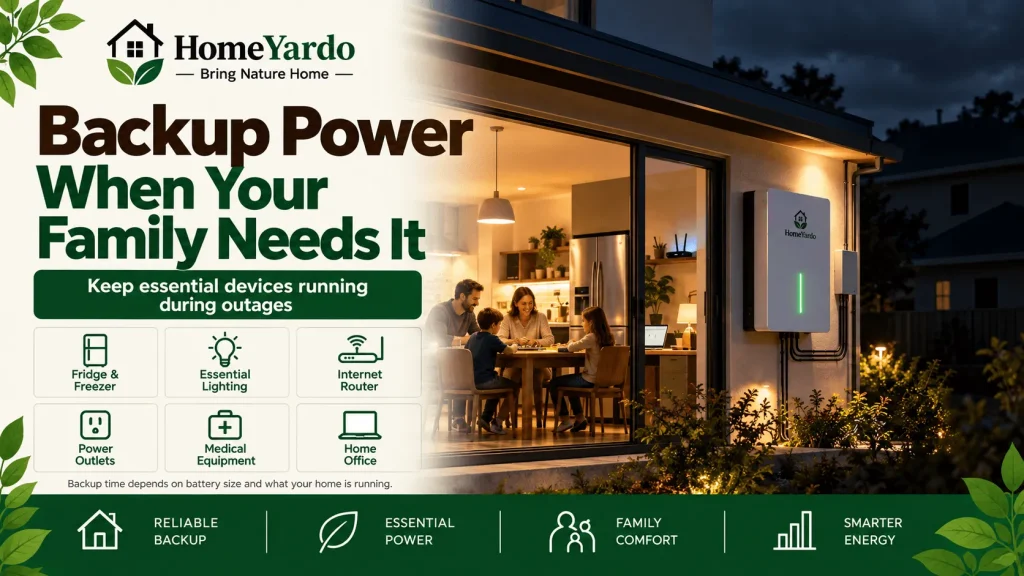
A blackout in a family house can be much more than a simple annoyance.
Electricity can be important for refrigeration, access to the internet, lighting, home-office equipment and several vital domestic appliances. Outage planning is even more important for families with medical equipment or other sensitive loads.
With a proper setup, the NeoVolt battery system can offer backup electricity when the grid power is not available. Instead of expecting the battery to run everything eternally, the homeowners should assess which household circuits need the most backup.
Typical priorities can be:
- Freezer and refrigerator
- Lighting essentials
- Router (Internet)
- Choice of power outlets
- Medical or accessibility devices
- Basic home office equipment.
How long does a NeoVolt battery last for a home?
There is no one answer, as the time a backup may operate depends on the capacity of the battery, the amount of energy stored, and the devices and appliances in use in the home.
A fridge, a couple of lights, an internet router all use a lot less electricity than an electric oven, pool pump, air conditioner or EV charging.
Prior to installation, have the installer calculate the projected backup duration at different realistic load levels. That offers families a far better sense of what they’re getting than just the kilowatt-hour rating of the battery.”
2. More Control of Solar Energy and Electric Costs

Solar panels usually provide their strongest output in the middle of the day, when a family may not be using a lot of electricity.
Excess solar energy could be exported to the grid without storage. Later in the evening the home could need to buy electricity back from its supplier.
A solar battery alters this pattern by storing surplus available solar production for later use.
This can improve solar self-consumption and minimize dependence on grid electricity for families with high nighttime electricity demand.
Could a NeoVolt Battery Slash Your Electricity Bill?
Potential savings vary widely from home to home.
Important Considerations are:
- The solar system is not small.
- battery size
- Electricity use daily
- Electricity demand in the evening
- Retail Price of Electricity
- Feed-in tariff (FiT)
- Battery settings
- Seasonal solar power generation
Therefore statements that every home will cut their electricity expenditure by a certain proportion should be taken with caution.
A preferable strategy is to study at least 12 months of electricity bills and household use statistics before deciding how large of a battery should be.
The end result should be a system sized to how the family actually consumes electricity, not the biggest battery they can afford.
3. Easy energy monitoring for everyday use
Most families don’t want to have to be energy analysts to comprehend their solar system.
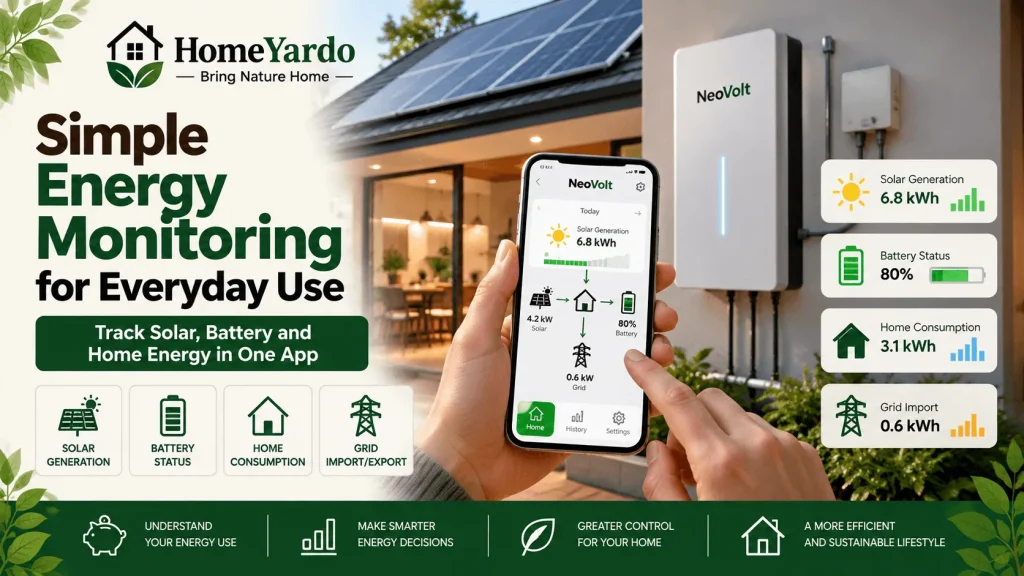
NeoVolt has a remote system monitoring function within their app, enabling users to view data such as solar generation, household consumption, and battery status.
That visibility can let families see whether their home is using solar, storage or grid electricity.
It can help simplify routine energy considerations.
Parents might note that electricity use spikes when a few appliances are operating simultaneously, or they might discover that using particular appliances when the solar panels are generating the most power decreases the amount of stored energy needed later.
What can battery monitoring teach families?
Some helpful monitoring data can help answer queries like:
- How much of the battery is charged by evening?
- How much solar power did we generate today?
- When do households consume the most electricity?
- How much electricity is coming from the grid?
- Are the high load appliances depleting the battery too soon?
Over time, this information can help homes manage appliance schedules and evaluate how their solar-and-battery system is performing in different seasons.
4. Lithium Iron Phosphate Battery Chemistry
Battery safety requires proper upkeep because residential energy storage devices may be left in place for many years.
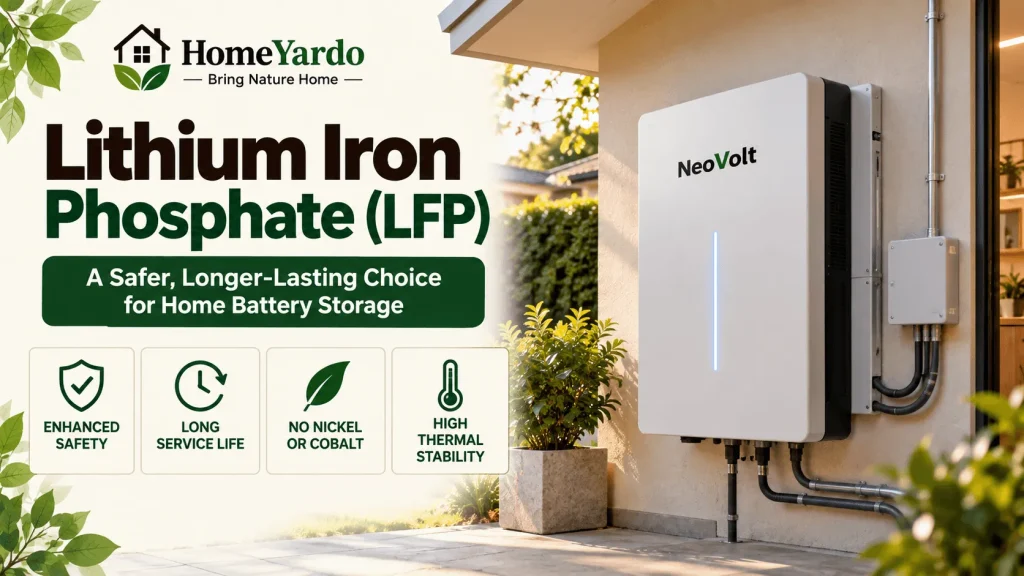
NeoVolt battery types employ lithium iron phosphate, also called LFP or LiFePO4 for short.
LFP chemistry is commonly utilized for stationary energy storage, because it has properties including thermal stability, long service life and resistance to several forms of thermal stress compared to numerous other lithium-ion chemistries.
It also eliminates the need for nickel and cobalt in LFP cathode chemistry.
But that doesn’t mean all batteries are safe.
Product certification, proper system design, installation location, ventilation requirements, electrical protection and skilled installation all matter.
Where to Place a Home Battery?
The position for installing the battery will depend on the battery model, site layout and relevant Australian standards.
A battery should not be simply placed wherever extra wall space happens to be available.
The installation should take into account:
- Manufacturer clearance specifications
- weathering
- Sunlight, straight
- Sources of heat
- Access for Service
- Protection from bodily harm
- Electrical and fire safety requirements, as applicable
The NeoVolt requirements also differ from system to system, so homeowners should review the technical literature for the specific model being recommended, rather than assuming the specs for one NeoVolt battery apply to all models.
5. Extended Warranty Coverage
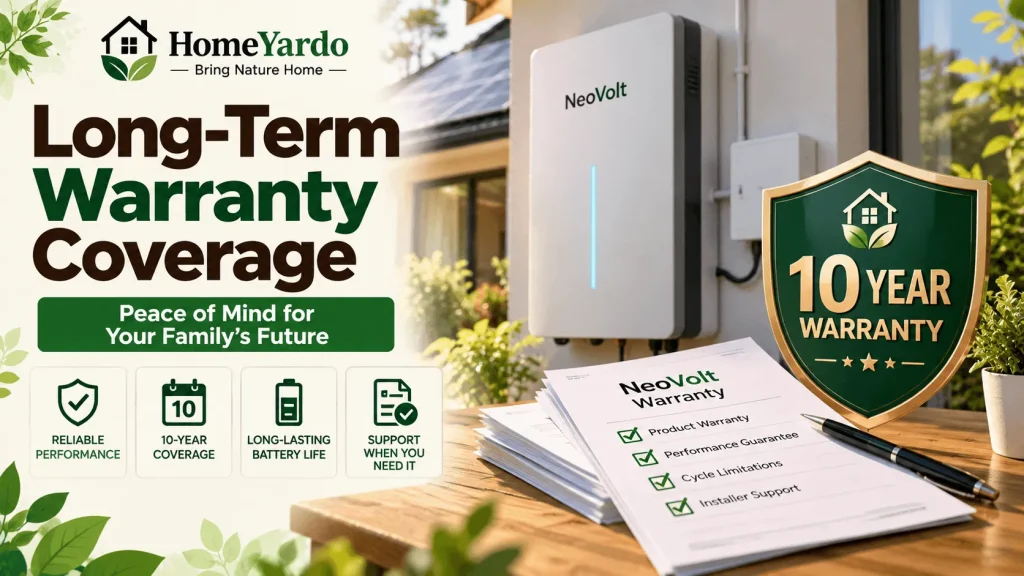
Because a house battery is a long-term investment, warranty terms demand almost as much scrutiny as price and capacity.
NeoVolt offers a warranty on its home battery products, although the warranty and performance conditions will vary according to the battery model and warranty agreement.
Some NeoVolt paperwork makes promises on capacity retention for 10 years under certain operational conditions.
This gives homeowners a better yardstick for long term performance expectations.
What to look for in a battery warranty
Don’t only glance at the amount of years on the brochure.
See:
- Product warranty period
- Battery performance / energy-retention warranty
- Restrictions on throughput or cycle
- Applications accepted
- Temperature operating conditions
- Registration requisites
- Labor coverage
- Costs of replacement or transport
- Installer responsibilities
- Who takes warranty claims in Australia
Families should also save their purchase invoice, installation papers, model and serial numbers, commissioning data, and warranty registration details.
Those records can matter years after the installation.
What Australian Families Should Know Before Buying a NeoVolt Battery
The features of a battery are important, but so is the status of the exact product that is being installed.
Instead of a vague mention of the brand in signing a contract, ask the installer for the complete NeoVolt model number.
Then confirm that a particular model is on the current Clean Energy Council Approved Products list and eligible for any incentive, Small-scale Technology Certificate or network scheme you choose to employ.
It is important since product list status can change.
As of September 2026, some variations of NEOVOLT BW-BAT-9.6P were suspended from the Clean Energy Council Approved Products list. The suspension was not due to a product recall or an acknowledged safety problem but instead for issues relating to product identification and certification documents. Models affected will not be eligible for STCs during the suspension.
Therefore, families interested in NeoVolt should check the status of the precise model just before purchase or installation.
Check Compatibility of Your Current Solar System
A battery must function as part of the entire electrical system.
Before you buy, have the installer check:
- Current Size of Solar Array
- Inverter type
- Battery and inverter compatibility
- Electrical capacity available
- Condition of Switchboard
- Specification for backup circuits
- Consumption pattern of household
- Future loads such as EV chargers
If a bigger electrical improvement is planned it may make sense to consider the solar, battery, switchboard and future domestic loads as one rather than distinct projects.
Compare Battery Capacity To Your Evening Energy Use
And a bigger battery isn’t always a better investment.
If there is a small amount of surplus solar output left in a household at sunset every day, a very big battery could be mostly empty for large parts of the year.
But if the home uses a lot of electricity in the evening, a little battery can be emptied long before the household goes to bed.
A useful assessment of batteries should compare excess solar power throughout the day with consumption in the evening and nite.
We can then decide if the proposed system is a good fit for the residence.
Check your electricity tariff prior to installation.
The economics of batteries also depend on the cost to the household of importing electricity and the price it may get for exported solar power.
The operation of a battery may also be influenced by time-of-use pricing. Sometimes the system is designed to store energy during pricey peaks or to charge when the cost of electricity is cheap.
That’s not to say switching tariff plans will always save you cash.
Before you switch, compare the new tariff with the current usage behavior of the household.
The International Energy Agency has mapped the expansion of battery storage as electrical grids incorporate more renewables-based power and flexible energy supplies. But the financial result at the household level still depends on individual use, the cost of equipment, and electricity prices.
Use an Appropriately Certified Installer
Battery storage involves high current electrical equipment and should be professionally designed and installed.
In Australia, the Small-scale Renewable Energy Scheme is now run by Solar Accreditation Australia, instead of the previous Clean Energy Council installer-accreditation scheme.
Before you proceed, check the installer’s current accreditation, electrical licence and experience with the specific combination of battery and inverter being recommended.
Ask for detailed documentation on system design, intended operation, backup configuration, commissioning and warranty support.
NeoVolt Battery: Is It the Right Choice for Your Family?
NeoVolt battery comes with a number of characteristics that can be suitable for family households, such as solar energy storage, back-up capacity, app-based monitoring, LFP battery chemistry and long-term warranty coverage.
Is it financially and practically viable? Depends on the house.
For example, a family that consumes a lot of electricity in the evenings and has excess solar during the day can use a battery quite differently than a household that uses most of its electricity when the sun is shining.
The same goes for the NeoVolt model. Before you commit to an installation, check current product approval, compatibility, warranty conditions and rebate eligibility.
When those pieces fit together, a well-sized home battery can give a family more control over when its solar electricity is utilized and usable backup power during grid outages.
FAQ’s
A NeoVolt battery may suit a family home when the household has enough solar generation, significant evening electricity consumption or a need for backup power. The right choice depends on battery capacity, household loads, installation costs and the exact NeoVolt model.
A correctly designed NeoVolt system may provide backup power during a grid outage. The appliances and circuits that remain powered depend on the system configuration, inverter capacity and available battery charge.
Current NeoVolt residential battery specifications include lithium iron phosphate, or LFP, battery chemistry. Homeowners should verify the specification sheet for the exact model being installed.
Battery service life depends on usage, temperature, depth of discharge, charging behaviour and the specific model. NeoVolt documentation for current products includes long-term warranty and capacity-retention provisions, but buyers should read the warranty applying to their exact battery.
NeoVolt residential products include long-term warranty coverage, and current documentation for several models includes 10-year or longer terms. Conditions vary between products, so check the current Australian warranty document before buying.
It can reduce the amount of grid electricity a household needs to buy by storing excess solar energy for later use. Actual savings depend on solar generation, household consumption, electricity tariffs, feed-in rates and system cost.
There is no universal family battery size. The installer should compare daytime excess solar production with evening and overnight electricity demand before recommending capacity.
NeoVolt offers app-based remote monitoring for supported systems. This can provide information about solar generation, battery status, household energy use and system operation.
Eligibility depends on the exact model and its current status on required approved-product lists. Several BW-BAT-9.6P variants were suspended from the Clean Energy Council Approved Products list in September 2026, so homeowners should check the exact model immediately before purchase.
Battery systems should be installed by appropriately licensed and accredited professionals. For relevant Australian solar and battery accreditation requirements, homeowners should check current Solar Accreditation Australia requirements and local electrical regulations.