How Static Pressure And Duct Design Affect AC Comfort
When one bedroom stays warm while the rest of the house feels cool, it’s easy to blame the air conditioner. You might lower the thermostat, adjust the vents, or wonder whether the system needs replacing.
But the problem may be hiding in the ductwork.
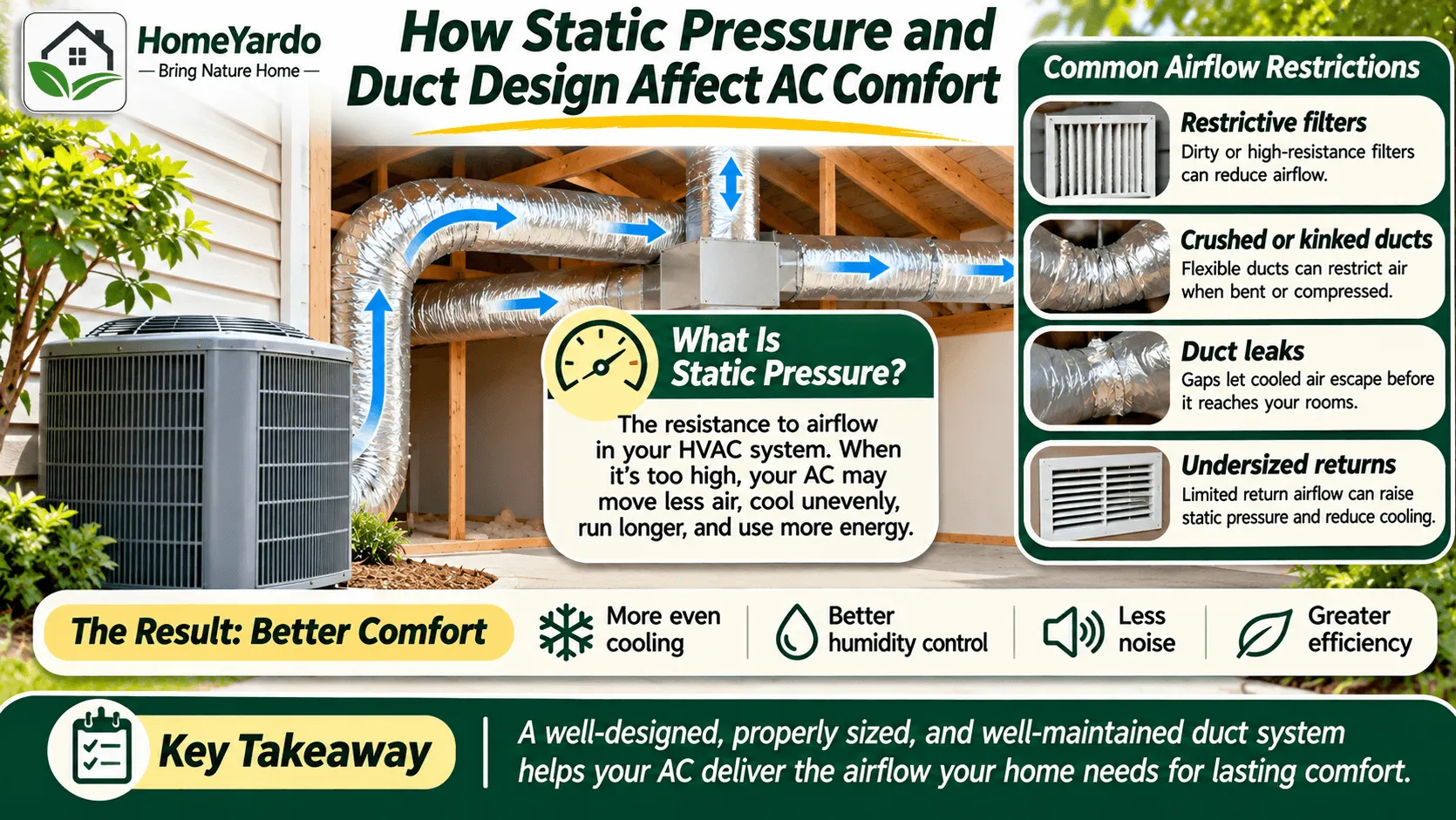
Your air conditioner needs enough air moving through the system to cool your home properly. That airflow is measured in cubic feet per minute (CFM). If restrictive filters, undersized ducts, or sharp bends create too much resistance, even a well-maintained AC unit may struggle to deliver comfortable temperatures.
This resistance is called HVAC static pressure, and it can affect cooling performance, humidity control, noise, and energy consumption.
Understanding how static pressure and duct design work together can help you recognize airflow problems, ask better questions during a service visit, and avoid replacing equipment when the duct system is the real concern.
What Is HVAC Static Pressure, And Why Does It Matter?
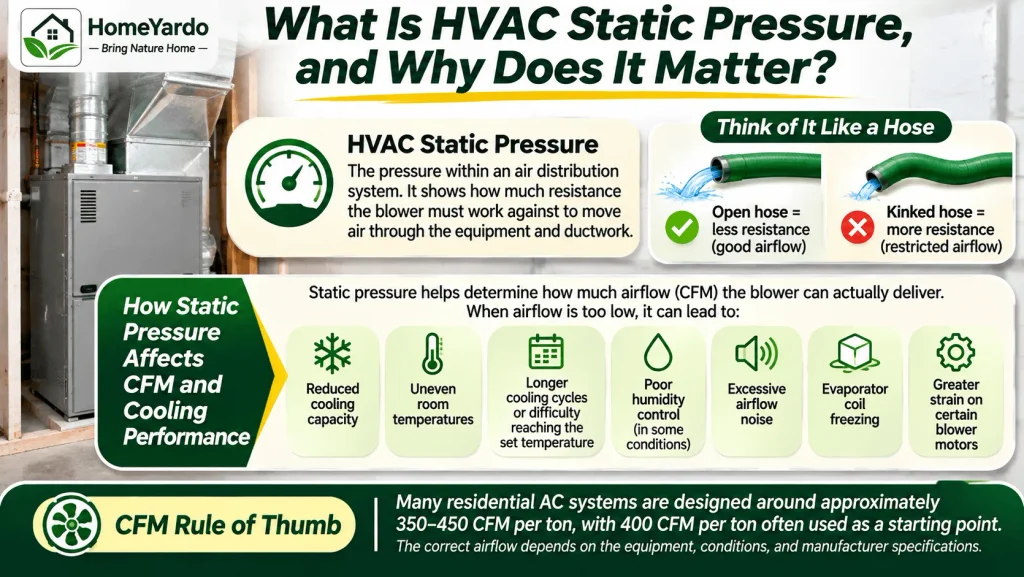
HVAC static pressure is the pressure within an air distribution system. Technicians use static pressure measurements to assess how much resistance the blower must work against to move air through the equipment and ductwork.
Think of airflow like water moving through a hose. A narrow or kinked hose restricts the flow. Ducts behave similarly when filters, fittings, or other components create excessive resistance.
An AC blower is designed to deliver airflow within a particular operating range. When resistance becomes too high, some blowers move less air. Others increase motor output to maintain airflow, potentially adding noise and electrical demand.
The result depends on the blower design and system conditions.
How Static Pressure Affects CFM and Cooling Performance
CFM describes how much air moves through the system each minute. Static pressure helps determine how much airflow the blower can actually deliver.
When airflow becomes insufficient, several problems may develop:
- Reduced cooling capacity and uneven room temperatures
- Longer cooling cycles or difficulty reaching the thermostat setting
- Poor humidity control under certain operating conditions
- Excessive airflow noise
- Evaporator coil freezing
- Greater strain on certain blower motors
Many conventional residential cooling systems are designed around approximately 350–450 CFM per ton, with 400 CFM per ton often used as a starting reference.
However, the correct airflow depends on the equipment, cooling conditions, humidity requirements, and manufacturer specifications.
A technician should verify the intended airflow rather than assume one number applies to every air conditioner.
Early Signs Your AC Has an Airflow Problem
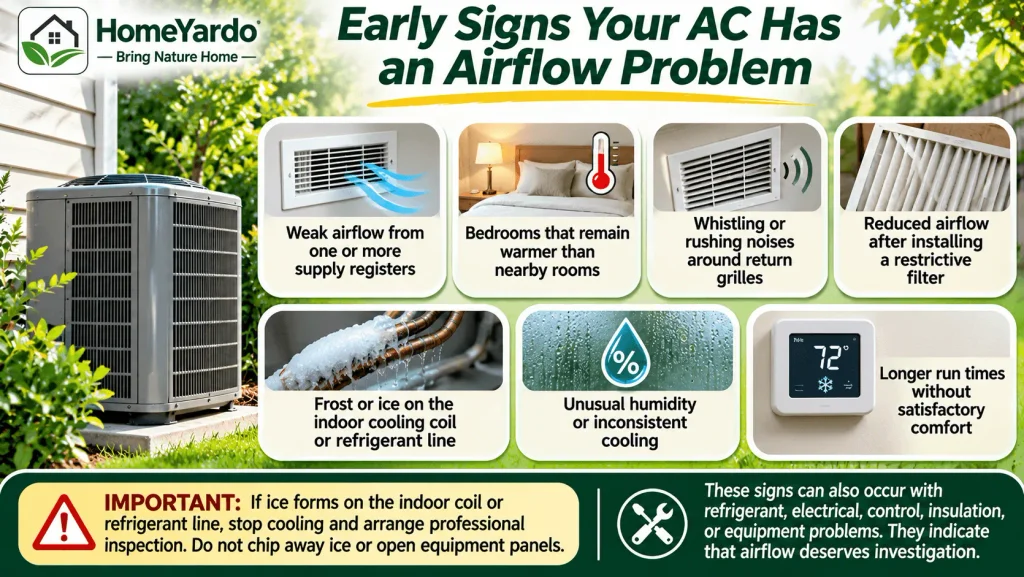
Airflow problems often appear gradually. A room that once cooled comfortably may start feeling warmer, or the system may become noticeably louder without an obvious equipment failure.
Common warning signs include:
- Weak airflow from one or more supply registers
- Bedrooms that remain warmer than nearby rooms
- Whistling or rushing noises around return grilles
- Reduced airflow after installing a restrictive filter
- Frost or ice on the indoor cooling coil or refrigerant line
- Unusual humidity or inconsistent cooling
- Longer run times without satisfactory comfort
These symptoms can overlap with other HVAC warning signs, so recognizing changes in airflow, cooling performance, and system noise can help you explain the problem before scheduling professional service. These symptoms can also occur with refrigerant, electrical, control, insulation, or equipment problems. They indicate that airflow deserves investigation, not that high static pressure has already been confirmed.
If the AC is struggling, a local HVAC company such as Compass HVAC Services LLC can perform testing to identify whether duct restrictions, airflow conditions, or another issue requires attention.
Important: If ice forms on the indoor coil or refrigerant line, stop cooling and arrange professional inspection. Continuing to run the system may worsen the problem. Do not chip away ice or open equipment panels.
How Duct Design Restricts AC Airflow
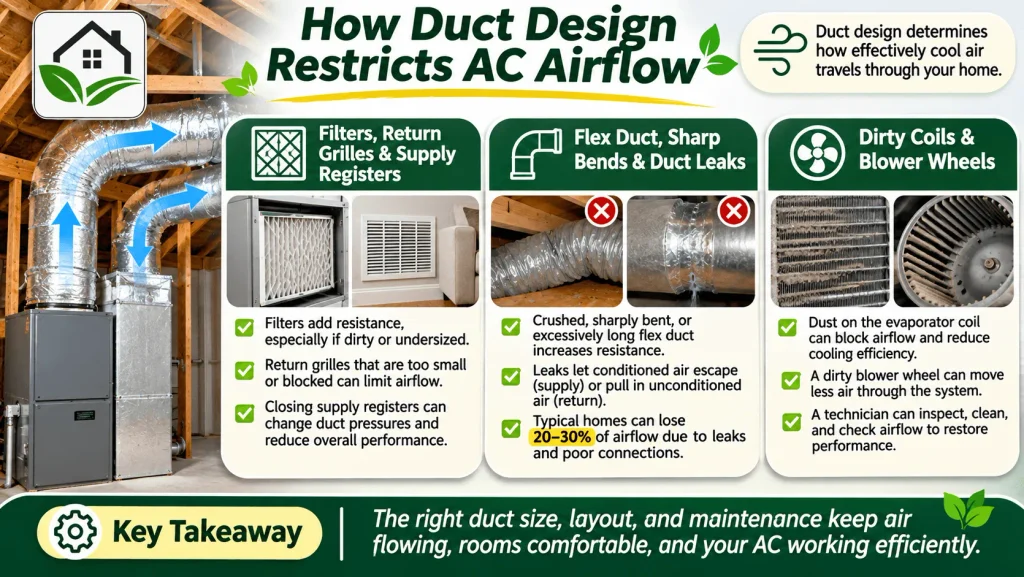
Ductwork does more than carry cool air from one place to another. Its dimensions, layout, fittings, and connections determine how effectively air travels throughout the home.
An efficient design provides enough supply airflow to each room while maintaining suitable return-air pathways.
Several common problems can interfere with that balance.
Filters, Return Grilles, and Supply Registers
Air filters are necessary for protecting HVAC equipment and controlling airborne particles. However, every filter introduces some resistance.
A high-efficiency filter installed in an undersized cabinet may create an excessive pressure drop, especially if the filter is dirty or the system requires high airflow.
A thicker media filter cabinet can sometimes offer a larger effective filter surface area and lower resistance at a comparable filtration rating. That benefit depends on the actual filter design and installation.
Return grilles create similar problems when they are too small or obstructed.
A sofa placed against a return grille may limit airflow. A decorative grille with a small open area can create noise and increase resistance.
Closing several supply registers to force air toward another room can also change duct pressures without delivering the desired improvement.
Before changing filtration or adjusting airflow, confirm that the equipment and duct system can handle the proposed configuration.
Flex Duct, Sharp Bends, and Duct Leaks
Flexible ductwork is common in residential attics and crawlspaces. It can perform well when properly sized, extended, supported, and installed with gentle bends.
Problems develop when flex duct is:
- Crushed beneath stored items or other materials
- Bent sharply around structural obstacles
- Installed with unnecessary extra length
- Compressed rather than fully extended
- Poorly supported or disconnected at fittings
These conditions increase resistance and may reduce airflow to distant rooms.
Duct leaks create another problem. Supply-side leaks allow conditioned air to escape before reaching its destination. Return-side leaks can draw unwanted air from attics, crawlspaces, or other unconditioned spaces.
According to ENERGY STAR, typical homes with forced-air systems may lose approximately 20–30% of air moving through their ducts because of leaks and poorly connected sections.
Sealing these leaks and correcting duct restrictions can improve comfort without increasing AC capacity.
Dirty Coils and Blower Wheels
Not every airflow restriction is inside the ductwork.
Dust buildup on the evaporator coil can obstruct airflow and reduce heat transfer. A dirty blower wheel may also become less effective at moving air.
Because these components are inside the equipment, their condition is not always apparent during a basic homeowner inspection.
A qualified technician can inspect the blower assembly and coil, determine whether cleaning is necessary, and check airflow afterward.
Cleaning the right component matters more than increasing blower speed to compensate for a restriction that remains unresolved.
How Technicians Measure Static Pressure and Airflow
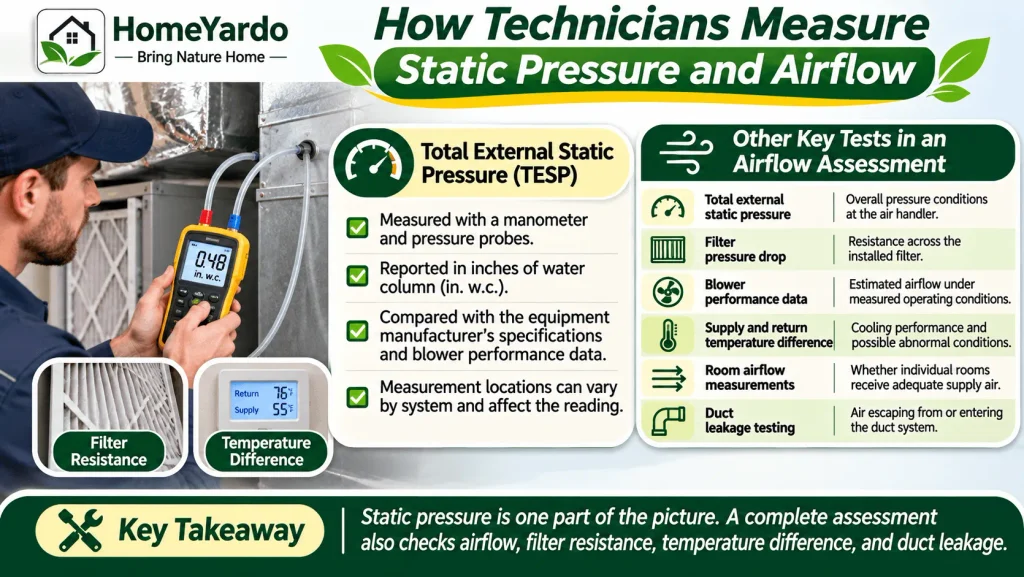
Static pressure problems should be measured rather than diagnosed from symptoms alone.
A technician may use several tests to determine how the blower, ducts, and cooling equipment are performing together. Before scheduling an inspection, reviewing an AC service visit checklist can help you prepare questions about static pressure measurements, airflow testing, duct restrictions, and the condition of your cooling equipment.
Total External Static Pressure (TESP)
Total external static pressure is measured using a manometer and pressure probes at appropriate locations around the air-moving equipment.
Readings are usually expressed in inches of water column (in. w.c.).
The technician compares the measurements with the equipment manufacturer’s specifications and blower performance information.
The correct measurement locations depend on the equipment configuration. Filters, coils, and other components may be included or excluded from the external pressure measurement depending on where the probes are placed.
A common mistake is assuming that 0.5 in. w.c. is the correct maximum for every HVAC system. Actual rated limits vary by equipment model.
A pressure reading is useful only when interpreted against the correct specifications.
Checking Airflow, Filter Resistance, and Temperature Difference
Static pressure is one part of a complete airflow assessment.
Depending on the system, a technician may also check:
| Measurement | What it helps identify |
|---|---|
| Total external static pressure | Overall pressure conditions at the air handler |
| Filter pressure drop | Resistance across the installed filter |
| Blower performance data | Estimated airflow under measured operating conditions |
| Supply and return temperature difference | Cooling performance and possible abnormal operating conditions |
| Room airflow measurements | Whether individual rooms receive adequate supply air |
| Duct leakage testing | Air escaping from or entering the duct system |
The temperature difference between return and supply air can provide helpful information, but it cannot independently confirm refrigerant charge or airflow.
A large temperature difference may sometimes accompany low airflow. A small difference can have several causes, including operating conditions and equipment faults.
Refrigerant diagnostics should be interpreted alongside verified airflow and the manufacturer’s charging procedures.
Simply adding refrigerant without establishing the cause of poor cooling may leave the original problem unresolved.
How To Fix High Static Pressure And Poor AC Airflow
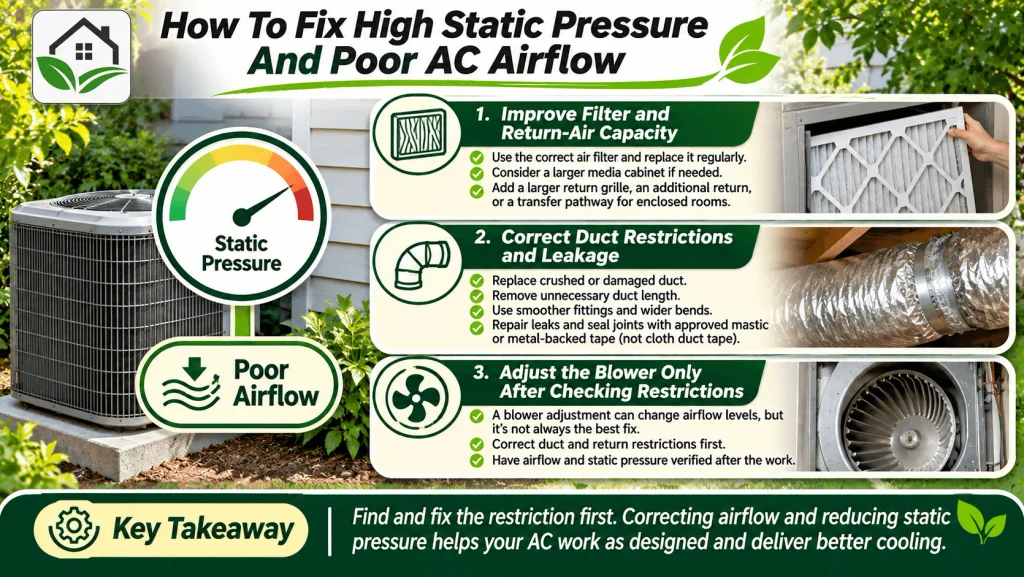
The best correction depends on where resistance occurs.
Replacing the air conditioner with a larger model will not solve an undersized return duct or a crushed supply branch. In some cases, it may make airflow problems worse.
A targeted approach starts with identifying the restriction. If you’re considering replacing your air conditioner, have the existing ductwork and airflow evaluated first. Correcting restrictions before installation can help ensure the new system delivers the cooling performance your home needs.
Improve Filter and Return-Air Capacity
Begin by checking whether the installed air filter matches the equipment requirements.
Replace a dirty filter with an appropriately rated product. If filtration requirements exceed what the existing filter cabinet can support, ask whether a properly sized media cabinet would reduce resistance.
A technician may also recommend a larger return grille, an additional return duct, or a return-air transfer pathway for an enclosed room.
These improvements should be based on measured airflow and pressure conditions rather than appearance alone.
Correct Duct Restrictions and Leakage
Duct improvements may include:
- Replacing crushed or damaged flexible duct
- Removing unnecessary duct length
- Using smoother fittings and wider bends
- Correcting improperly sized branches
- Repairing disconnected ducts
- Sealing accessible joints with approved mastic or appropriate metal-backed tape
- Improving return-air pathways
Cloth-backed household duct tape is not an appropriate long-term material for sealing HVAC duct joints.
For ducts running through unconditioned areas, insulation and airtight connections also help protect delivered air temperatures.
When a system has significant leakage, a professional may perform additional testing after repairs to confirm that the changes improved performance.
Adjust the Blower Only After Checking Restrictions
Some HVAC blowers can be adjusted to deliver different airflow levels. The correct setting depends on equipment capacity, operating conditions, and manufacturer instructions.
However, increasing blower speed is not always the best answer.
A higher setting may create more noise or electrical demand, particularly when the duct system remains restrictive. Certain electronically controlled blowers may already be working harder to maintain airflow.
Correcting undersized returns, damaged ducts, or obstructed components may provide a better long-term result.
After the work is completed, ask the technician to verify both airflow and static pressure.
Keep AC Airflow Stable Through the Seasons
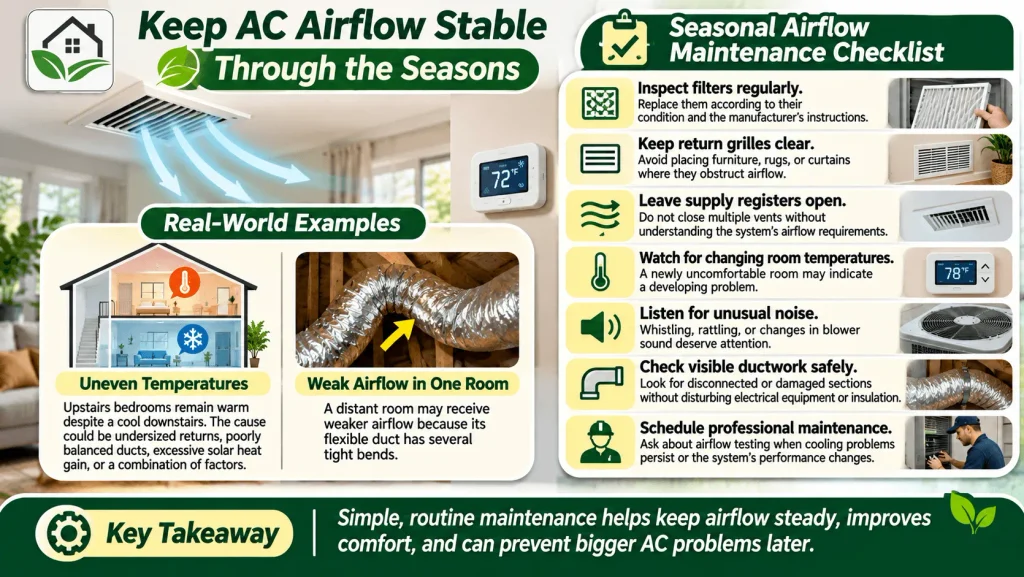
Good airflow requires ongoing attention, especially in homes where the AC operates for long periods.
Fortunately, several simple habits can help prevent avoidable restrictions.
Seasonal Airflow Maintenance Checklist
- Inspect filters regularly. Replace them according to their condition and the manufacturer’s instructions.
- Keep return grilles clear. Avoid placing furniture, rugs, or curtains where they obstruct airflow.
- Leave supply registers appropriately open. Do not close multiple vents without understanding the system’s airflow requirements.
- Watch for changing room temperatures. A newly uncomfortable room may indicate a developing problem.
- Listen for unusual noise. Whistling, rattling, or changes in blower sound deserve attention.
- Check visible ductwork safely. Look for disconnected or damaged sections without disturbing electrical equipment, insulation, or potentially hazardous materials.
- Schedule professional maintenance. Ask about airflow testing when cooling problems persist or the system’s performance changes.
Consider a two-story home where the upstairs bedrooms remain warm despite a cool downstairs living area.
The problem could involve undersized return pathways, poorly balanced ducts, excessive solar heat gain, or a combination of these factors.
In another home, a distant room may receive weak airflow because its flexible duct has several tight bends.
These examples show why a proper diagnosis matters. The same comfort complaint can have different causes, and the appropriate repair depends on what testing reveals.
Final Takeaway
Static pressure and duct design have a direct influence on how effectively an air conditioner delivers cool air throughout a home.
Restrictive filters, undersized returns, damaged ducts, dirty coils, and poor duct connections can all interfere with airflow. As resistance increases, cooling performance may suffer even when the AC equipment itself is functioning.
The most useful approach is to investigate airflow before assuming that a larger or newer air conditioner is necessary.
Ask for appropriate static pressure measurements, equipment airflow verification, and an inspection of the supply and return ductwork.
Correcting the actual restriction can improve temperature balance, reduce unnecessary noise, and help the existing cooling equipment perform as intended.
Frequently Asked Questions
Normal static pressure depends on the equipment and its rated operating range. Some residential air handlers are rated around 0.5 inches of water column, while others have different limits. A technician should compare measured total external static pressure with the manufacturer’s specifications rather than use one universal target.
Yes. Excessive resistance can reduce airflow in some systems, limiting heat transfer at the evaporator coil and reducing cooling performance. Severe airflow problems may contribute to coil freezing. However, poor cooling can also result from refrigerant, electrical, or equipment problems.
Duct size, length, routing, fittings, leakage, and return-air capacity influence how much conditioned air reaches each room. Poor duct design can create uneven temperatures, excess noise, and higher resistance. Properly designed ducts support the airflow required by the cooling equipment.
Yes. As dust accumulates, resistance across the filter generally increases. A filter that is too restrictive for the system can also create problems when new. Choose a filter compatible with the HVAC equipment and replace it when necessary.
Closing supply registers can increase resistance in parts of the duct system and change airflow distribution. Depending on the blower and duct design, it may also increase noise or reduce total airflow. Closing vents is not a dependable substitute for professional duct balancing.
High resistance may contribute to coil freezing when it causes airflow across the evaporator to become too low. The reduced airflow can allow coil temperatures to fall excessively. Other problems, including refrigerant faults, can produce similar symptoms, so professional diagnosis is important.
Properly increasing duct capacity can reduce resistance in an undersized system. However, larger ducts are not automatically better. Duct sizing must account for airflow requirements, friction losses, available space, fittings, and room-by-room heating and cooling needs.
Yes, duct performance should be evaluated before selecting replacement equipment, particularly when the home already has uneven cooling or weak airflow. Addressing restrictions and leakage can help a contractor choose suitable equipment and avoid carrying existing comfort problems into the new installation.