
Electric Carts: A Convenient Way to Make Outdoor Living Easier
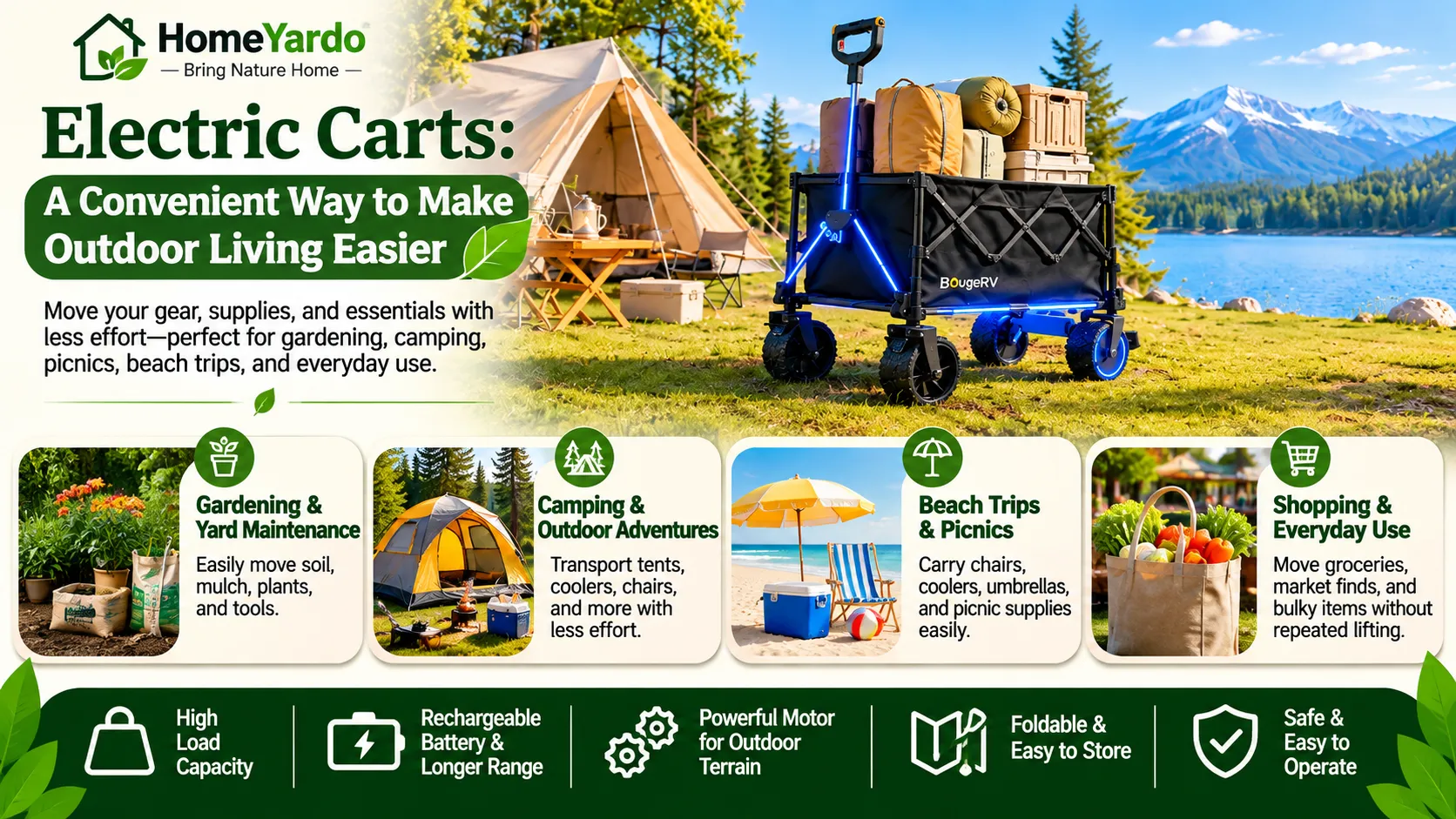
Electric carts make outdoor activities easier by reducing the physical effort needed to transport gardening supplies, camping equipment, groceries, and other heavy or bulky items. With battery-powered assistance and practical cargo space, these carts help homeowners and outdoor enthusiasts move belongings without making repeated trips.
Whether you’re carrying bags of soil across the yard, bringing chairs and coolers to a picnic, or moving camping equipment from your vehicle, transporting everything by hand can become tiring.
Motorized utility carts offer a practical alternative to traditional wagons and wheelbarrows. They combine electric drive systems with cargo-carrying designs, making them useful for yard maintenance, family outings, and everyday transportation.
However, not every model is designed for the same tasks. Some prioritize hauling capacity and stability, while others offer foldable frames for easier storage.
Understanding how these carts work, their common uses, and the features that matter can help you choose equipment suited to your needs.
How Do Electric Carts Work?
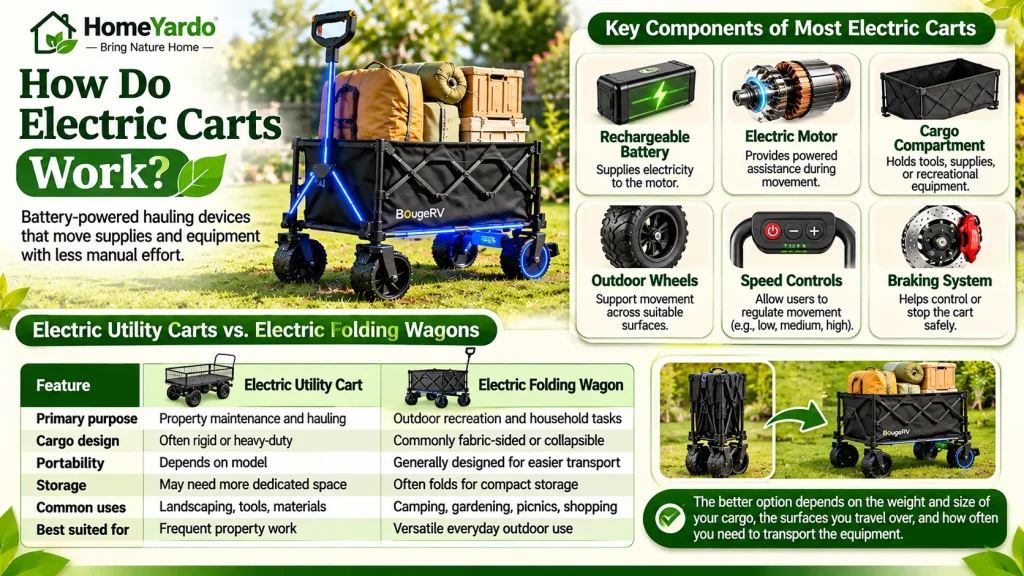
Electric carts are battery-powered hauling devices designed to move supplies and equipment with less manual pushing or pulling.
Unlike traditional garden wagons that rely entirely on physical effort, motorized models use an electric drive system to help move loaded cargo.
Most consumer models include:
- Rechargeable battery: Supplies electricity to the motor.
- Electric motor: Provides powered assistance during movement.
- Cargo compartment: Holds tools, supplies, or recreational equipment.
- Outdoor wheels: Support movement across suitable surfaces.
- Speed controls: Allow users to regulate movement.
- Braking system: Helps control or stop the cart.
Depending on the design, users may operate the motor through controls mounted on the handle. Some models also offer different speed settings and braking modes.
Electric Utility Carts vs. Electric Folding Wagons
Although these products serve similar purposes, their designs can differ considerably.
| Feature | Electric Utility Cart | Electric Folding Wagon |
|---|---|---|
| Primary purpose | Property maintenance and hauling | Outdoor recreation and household tasks |
| Cargo design | Often rigid or heavy-duty | Commonly fabric-sided or collapsible |
| Portability | Depends on model | Generally designed for easier transport |
| Storage | May need more dedicated space | Often folds for compact storage |
| Common uses | Landscaping, tools, materials | Camping, gardening, picnics, shopping |
| Best suited for | Frequent property work | Versatile everyday outdoor use |
The better option depends on the weight and size of your cargo, the surfaces you travel over, and how often you need to transport the equipment.
Everyday Uses for Electric Carts Around the Home and Outdoors
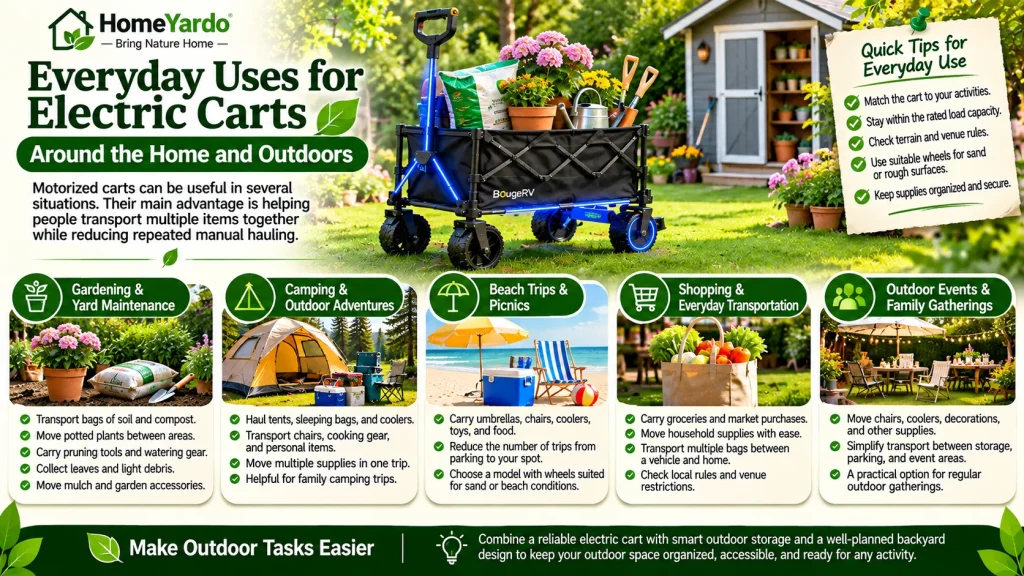
Motorized carts can be useful in several situations. Their main advantage is helping people transport multiple items together while reducing repeated manual hauling.
Gardening and Yard Maintenance
Gardening frequently involves moving soil, mulch, compost, plants, watering equipment, and hand tools.
Transporting these supplies individually can become tiring, especially when garden beds are located far from a garage or storage shed.
A powered cart can help move several supplies in one trip.
Common gardening uses include:
- Transporting bags of soil and compost.
- Moving potted plants between garden areas.
- Carrying pruning tools and watering equipment.
- Collecting leaves and light garden debris.
- Moving mulch and gardening accessories.
For homeowners maintaining larger yards, motorized assistance may make routine garden work more manageable.
However, the cart should only be loaded within its rated capacity, and loose materials should be secured or placed in suitable containers.
A well-organized yard also makes transporting equipment easier. Consider DIY outdoor storage ideas to keep frequently used tools and gardening supplies accessible between projects.
Camping and Outdoor Adventures
Camping trips often involve transporting tents, sleeping bags, coolers, folding chairs, cooking equipment, and personal belongings.
When parking areas are located away from campsites, carrying equipment by hand can require several trips.
A motorized wagon allows you to organize multiple items in one cargo area and transport them together.
This can be particularly useful for family camping trips where equipment needs to be shared among several people.
Before using a cart at a campground, check the route conditions and any restrictions on motorized equipment. Rough trails, narrow paths, and steep slopes may exceed the cart’s operating limits.
Beach Trips and Picnics
Beach outings, picnics, and park visits often involve bulky belongings such as umbrellas, folding chairs, coolers, toys, and food containers.
An electric wagon with suitable cargo capacity can reduce the number of trips needed between the parking area and your destination.
However, wheel design matters.
A model that works well on grass or compact gravel may struggle in loose, deep sand. Wider wheels can sometimes improve performance, but buyers should verify whether the manufacturer specifically approves the product for sandy conditions.
Shopping and Everyday Transportation
Electric wagons can also help carry groceries, farmers’ market purchases, and household supplies.
They may be useful when transporting multiple bags between a vehicle and home or moving equipment around a larger residential property.
Before using one in public shopping areas, check local rules and venue restrictions.
Outdoor Events and Family Gatherings
Outdoor concerts, sporting events, garden parties, and family gatherings often involve moving chairs, coolers, decorations, and other supplies.
A powered cargo wagon can simplify transportation between storage areas, parking spaces, and event locations.
For homeowners who regularly host outdoor gatherings, combining suitable transportation equipment with thoughtful backyard design ideas can make outdoor spaces more practical.
Important Features to Consider Before Buying an Electric Cart
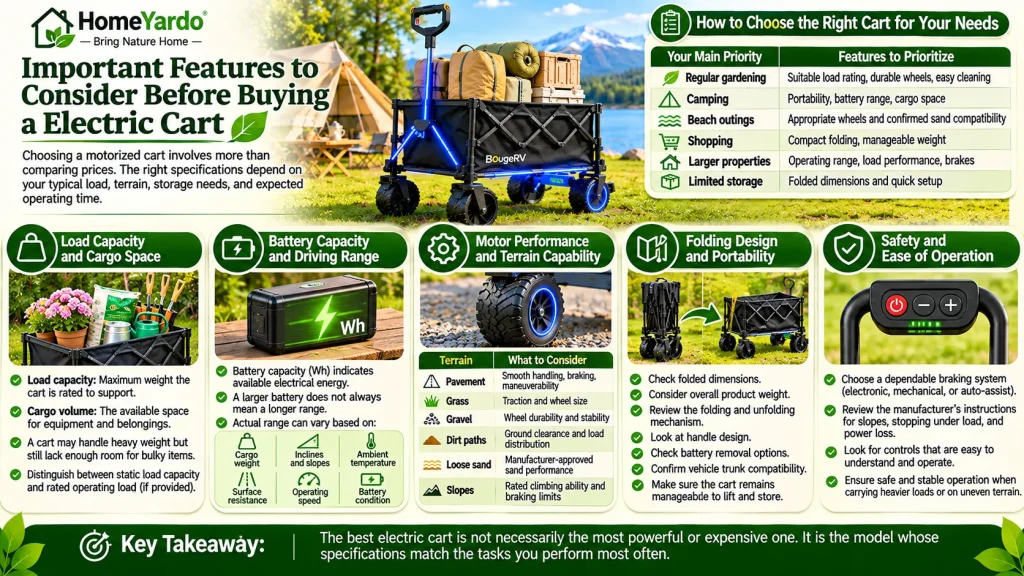
Choosing a motorized cart involves more than comparing prices or selecting the largest cargo compartment.
The right specifications depend on your typical load, terrain, storage requirements, and expected operating time.
Load Capacity and Cargo Space
Start by identifying what you normally need to transport.
A lightweight cart may be sufficient for picnic supplies, while heavier landscaping materials may require a more substantial model.
Two specifications deserve attention:
- Load capacity: The maximum weight the cart is rated to support under specified conditions.
- Cargo volume: The available space for carrying equipment and belongings.
These measurements are not interchangeable.
A cart may accommodate considerable weight but have insufficient room for large chairs, folded tents, or bulky equipment.
Also distinguish between static load capacity and the rated operating load where the manufacturer provides both.
Battery Capacity and Driving Range
Battery capacity influences how much electrical energy is available for operation.
Manufacturers commonly express battery capacity in watt-hours (Wh).
However, a larger battery does not automatically guarantee a longer operating range because motor efficiency, cargo weight, speed, and terrain also affect energy consumption.
Actual range can vary depending on:
- Total cargo weight.
- Surface resistance.
- Inclines and slopes.
- Operating speed.
- Ambient temperature.
- Battery condition.
When comparing models, look for range estimates measured with cargo rather than relying only on unloaded maximum-range figures.
Motor Performance and Terrain Capability
Motor power helps determine how a cart performs under load, but wattage alone does not establish how effectively it will climb slopes or move across difficult surfaces.
Wheel size, tire design, drivetrain configuration, weight distribution, and available traction are also important.
Consider your typical operating environment.
| Terrain | What to Consider |
|---|---|
| Pavement | Smooth handling, braking, maneuverability |
| Grass | Traction and wheel size |
| Gravel | Wheel durability and stability |
| Dirt paths | Ground clearance and load distribution |
| Loose sand | Manufacturer-approved sand performance |
| Slopes | Rated climbing ability and braking limits |
Never assume that an all-terrain label means the cart can safely operate on every outdoor surface.
Folding Design and Portability
Storage convenience is important for people with limited garage, shed, or vehicle space.
A foldable electric wagon can be useful if you frequently transport the cart between locations.
Before purchasing, check:
- Folded dimensions.
- Overall product weight.
- Folding and unfolding mechanism.
- Handle design.
- Battery removal options.
- Vehicle trunk compatibility.
A folding mechanism is only helpful if the cart remains manageable to lift and store.
Safety and Ease of Operation
A dependable braking system becomes especially important when carrying heavier loads or traveling over uneven surfaces.
Depending on the product, braking features may include electronic braking, mechanical brakes, or automatic stopping assistance.
Before purchase, review the manufacturer’s instructions for operating on slopes, stopping under load, and handling unexpected loss of power.
Choose a model with controls that are easy to understand and operate.
How to Choose the Right Cart for Your Needs
Use this simple checklist before comparing models.
| Your Main Priority | Features to Prioritize |
|---|---|
| Regular gardening | Suitable load rating, durable wheels, easy cleaning |
| Camping | Portability, battery range, cargo space |
| Beach outings | Appropriate wheels and confirmed sand compatibility |
| Shopping | Compact folding, manageable weight |
| Larger properties | Operating range, load performance, brakes |
| Limited storage | Folded dimensions and quick setup |
The best cart is not necessarily the most powerful or expensive one. It is the model whose specifications match the tasks you perform most often.
Why Consider an Electric Folding Wagon?
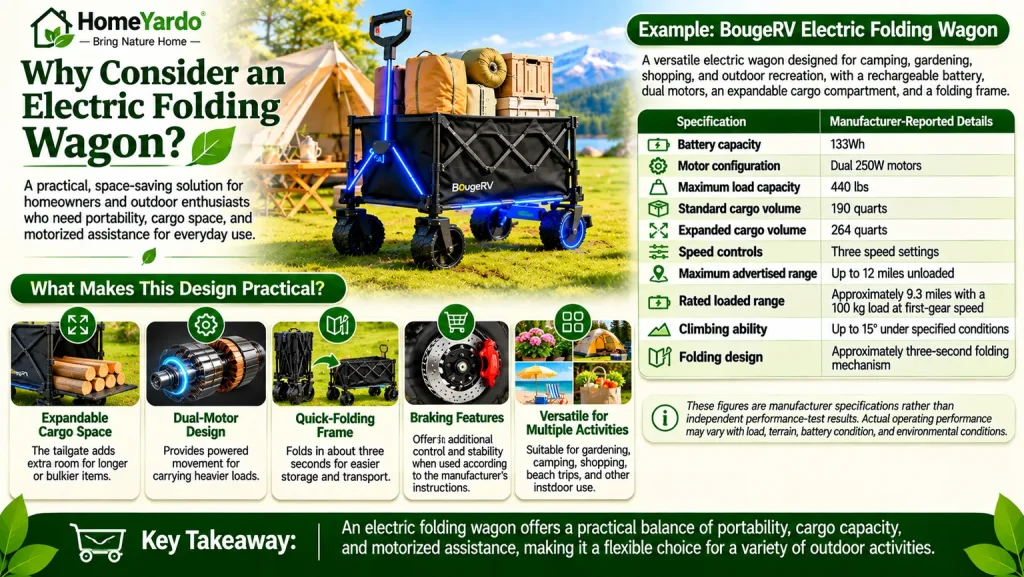
For homeowners and outdoor enthusiasts who need both portability and cargo-carrying capability, an electric folding wagon can offer a practical middle ground.
Unlike larger utility vehicles, these wagons are generally designed to fit into household storage spaces and vehicles.
Their collapsible construction can make them suitable for people who regularly move between gardening, shopping, camping, and recreational activities.
Example: BougeRV Electric Folding Wagon
One example is the BougeRV Electric Folding Wagon, designed for activities such as camping, gardening, shopping, and outdoor recreation.
According to the manufacturer’s published specifications, the model includes a rechargeable battery, dual motors, an expandable cargo compartment, and a folding frame.
Its stated specifications include:
| Specification | Manufacturer-Reported Details |
|---|---|
| Battery capacity | 133Wh |
| Motor configuration | Dual 250W motors |
| Maximum load capacity | 440 lbs |
| Standard cargo volume | 190 quarts |
| Expanded cargo volume | 264 quarts |
| Speed controls | Three speed settings |
| Maximum advertised range | Up to 12 miles unloaded |
| Rated loaded range | Approximately 9.3 miles with a 100 kg load at first-gear speed |
| Climbing ability | Up to 15° under specified conditions |
| Folding design | Approximately three-second folding mechanism |
These figures are manufacturer specifications rather than independent performance-test results. Actual operating performance may vary with load, terrain, battery condition, and environmental conditions.
What Makes This Design Practical?
The combination of motorized assistance and a collapsible cargo compartment may appeal to homeowners who want one piece of equipment for several different activities.
The expandable tailgate provides additional cargo room when transporting longer or bulkier items.
Its dual-motor design provides powered movement, while the braking features offer additional control when used according to the manufacturer’s operating instructions.
However, maximum cargo weight, climbing ability, and battery range should not be interpreted as performance guarantees under every condition.
For example, the advertised maximum range is based on unloaded operation, and carrying substantial weight may reduce the distance available between charges.
When evaluating an electric wagon cart, compare its cargo capacity, motor performance, battery specifications, folding design, and terrain limitations against your actual needs.
Editor’s note: Retain the client’s original destination URL for the anchor “electric wagon cart” if it differs from the manufacturer’s product page linked above.
Tips for Using and Maintaining Your Electric Cart
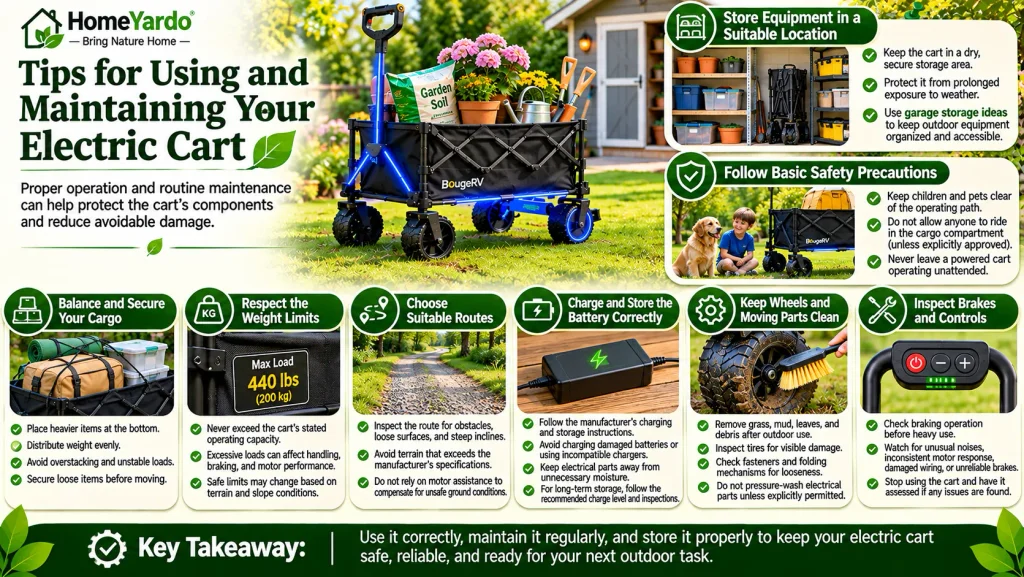
Proper operation and routine maintenance can help protect the cart’s components and reduce avoidable damage.
Balance and Secure Your Cargo
Place heavier items toward the bottom of the cargo compartment and distribute weight evenly.
Avoid stacking equipment so high that it obstructs visibility or becomes unstable.
Secure loose items before moving.
Respect the Manufacturer’s Weight Limits
Never exceed the cart’s stated operating capacity.
Excessive loads may affect handling, braking, motor performance, and structural components.
Remember that safe operating limits can change depending on terrain and slope conditions.
Choose Suitable Routes
Before transporting a heavy load, inspect the route for obstacles, loose surfaces, steep inclines, and narrow passages.
Avoid terrain that exceeds the manufacturer’s specifications.
Do not rely on motor assistance to compensate for unsafe ground conditions.
Charge and Store the Battery Correctly
Follow the manufacturer’s instructions for charging, storage temperatures, and approved charging accessories.
Avoid charging damaged batteries or using incompatible chargers.
Keep electrical components away from unnecessary moisture exposure unless the product is explicitly rated for those conditions.
For longer storage periods, follow the battery manufacturer’s recommendations for charge level and periodic inspection.
Keep Wheels and Moving Parts Clean
After outdoor use, remove grass, mud, leaves, and other debris from the wheels and accessible moving components.
Inspect tires for visible damage and check whether fasteners or folding mechanisms have loosened.
Do not pressure-wash electrical parts unless the manufacturer specifically permits it.
Inspect Brakes and Controls
Check braking operation before carrying heavy loads, particularly after prolonged storage.
If the cart develops unusual noises, inconsistent motor response, damaged wiring, or unreliable braking, stop using it until the problem has been assessed.
Store Equipment in a Suitable Location
Keep the cart in a dry, secure storage area and protect it from prolonged exposure to weather.
If your garage is crowded with gardening equipment and other household belongings, practical garage storage ideas can help create an accessible place for outdoor equipment.
Follow Basic Safety Precautions
Keep children and pets clear of the cart’s operating path.
Do not allow anyone to ride in the cargo compartment unless the manufacturer explicitly approves passenger transport.
Never leave a powered cart operating unattended.
Final Takeaway
Electric carts provide a practical way to transport gardening equipment, camping supplies, groceries, and recreational gear with less physical effort.
Their usefulness depends on choosing a design that matches your usual activities.
Heavy-duty utility carts may be better suited to frequent property maintenance, while folding electric wagons offer portability for camping, family outings, shopping, and general outdoor use.
Before choosing a model, compare its operating load limit, cargo space, battery range, motor performance, wheel design, braking features, and storage requirements.
Pay particular attention to how the manufacturer measures performance, because advertised maximum specifications may not reflect everyday operation with heavy loads.
A suitable cart can make outdoor work more manageable while providing convenient storage and transportation options for regular household activities.
FAQ’s
Electric carts are used to transport gardening supplies, camping equipment, groceries, tools, and outdoor recreational belongings. Their battery-powered motors reduce the manual effort required to move cargo.
Electric models can reduce pushing or pulling effort, particularly when carrying heavier loads. Traditional wagons are generally simpler, less expensive, and do not require charging. The better choice depends on how frequently you transport cargo and the surfaces involved.
Yes. Suitable models can carry soil, mulch, plants, garden tools, and other landscaping supplies. Always check the rated load capacity and whether the cart is appropriate for your yard’s terrain.
Battery runtime depends on capacity, cargo weight, speed, terrain, and operating conditions. Compare manufacturer-reported range estimates under realistic loads rather than relying solely on the maximum unloaded range.
Some models are designed for grass, gravel, and compact dirt paths. Performance depends on wheel design, traction, motor capability, and cargo weight. Check the manufacturer’s surface recommendations.
Some can operate on firm sand, but loose or deep sand presents greater resistance. Not every all-terrain wagon is suitable for beach use, so check the manufacturer’s specific recommendations.
An electric cart is a broad term for powered hauling equipment. An electric wagon usually refers to a cargo-oriented design, often with fabric sides and a collapsible frame. Product terminology varies between manufacturers.
Weight ratings vary by model. Some heavy-duty models advertise capacities of several hundred pounds. Check whether the specified limit refers to static loading or operation, and follow any restrictions for slopes or uneven terrain.
Some models are rated for limited inclines, but safe use depends on cargo weight, surface traction, braking performance, and the manufacturer’s instructions. Never exceed the stated slope limits.
Many folding models collapse into smaller dimensions for storage in garages, sheds, or vehicle trunks. Check the folded size and total product weight before purchasing.
Routine care includes removing debris, inspecting wheels and brakes, checking the frame and controls, and following proper battery charging and storage instructions. Follow the manufacturer’s maintenance schedule.
It may be worthwhile if you frequently move heavy or bulky supplies across suitable outdoor surfaces. Occasional users with lightweight loads may find a traditional garden wagon sufficient.