
A Practical Drain Maintenance Schedule Every Homeowner Actually Needs
Your shower drains a little slower than it did last month. You’ve noticed it. You’ve ignored it. Six weeks later, you’re standing in two inches of water wondering when this became a problem. That’s the most predictable drain failure story in home maintenance, and it almost always unfolds the same way: gradual buildup, zero action, then a sudden mess that costs real money to fix.
The good news is that drains are one of the easiest home systems to maintain. You don’t need special equipment for most of it, and the monthly routine takes less time than brewing a pot of coffee. This guide gives you a concrete schedule, a clear list of warning signs, and a decision framework for telling a DIY job from a professional one.
Why Ignoring Your Drain Is a Losing Game
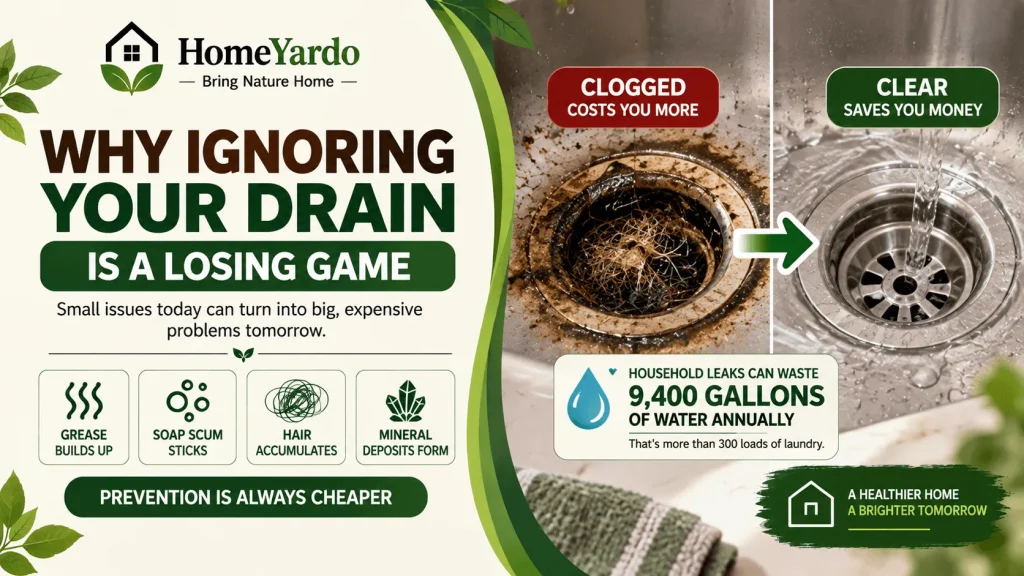
Most homeowners treat their drains as a plumbing feature that either works or doesn’t. That framing misses the point. Drains don’t fail all at once. They fail gradually, as layers of grease, soap scum, hair, and mineral deposits accumulate on the interior walls of your pipes. Each layer makes the next layer stick faster, and what starts as a minor slowdown becomes a full blockage over months, not days.
The real cost isn’t just the clog. According to the EPA’s WaterSense program, the average family can waste 180 gallons per week, or 9,400 gallons of water annually, from household leaks, equivalent to more than 300 loads of laundry. A slow drain that backs up into a leaking P-trap, or one that develops a hairline crack from the pressure of a stubborn clog, drops you right into that statistic without warning. Prevention is cheaper. Every time.
My honest take: the plumber’s bill you’re trying to avoid by ignoring a slow drain is exactly the bill you’ll pay when it completely blocks at 9 p.m. on a Saturday.
The Florida Factor: Hard Water Makes Every Drain Work Harder

If you own a home in South Florida, you’re dealing with a compounding variable that homeowners in most other states don’t face at the same level. Florida’s aquifer system runs through ancient limestone deposits, which means the water entering your pipes carries elevated concentrations of calcium and magnesium before it ever reaches your kitchen faucet.
That mineral content doesn’t just pass through harmlessly. When mineral-rich water flows through your pipes, it leaves behind scale buildup that can cause serious problems for your plumbing systems. In drains specifically, that scale coats the interior walls and creates a rough texture that catches hair, grease, and food particles far more aggressively than a smooth pipe would. Picture a Coral Springs kitchen drain that’s been running for eight or nine years without a single maintenance flush. The inner diameter of that pipe may have narrowed enough that a single night of bacon grease tips it from “slow” to “completely backed up.” That’s not dramatic, that’s just mineral physics at work over time.
South Florida homes need a slightly more aggressive maintenance schedule than homes in soft-water regions. Keep that in mind as you build your routine.
Your Drain Maintenance Schedule, Month by Month
The table below is what I’d actually follow. It’s organized by frequency, not by drain type, so you can batch tasks together instead of running a different checklist every week.
| Frequency | Task | Target Drain |
|---|---|---|
| Monthly | Hot water flush in two slow passes (full kettle) | Kitchen sink, bathroom sink |
| Monthly | Baking soda flush: half-cup down drain, follow with one cup white vinegar, cover, wait 15 minutes, then hot-water rinse | All interior drains |
| Monthly | Remove and rinse drain cover or strainer | Shower, bathtub |
| Quarterly | Run a zip-it or drain snake 4 to 6 inches to clear hair accumulation | Shower, bathtub |
| Quarterly | Remove P-trap under sink, clean interior, reinstall | Kitchen sink, bathroom sink |
| Annually | Full slow-drain audit across all fixtures | Whole home |
| Annually | Professional inspection or hydro-jetting of main line | Main sewer line (especially for Florida homes) |
One clarification on the baking soda flush: it’s not magic, and it won’t dissolve a serious clog. What it does is break up early-stage soap and grease film before it hardens into a full blockage. Done monthly, it’s genuinely effective. Done once every eight months when you remember, it’s almost pointless. Consistency is the whole strategy.
Four Warning Signs Your Drain Is Telling You Something

Slow drainage is the most obvious signal, but it’s not the only one. I use what I call the 4-Symptom Check to tell a surface clog from a deeper problem. Go through this list any time your drains feel off:
- Gurgling from a drain you’re not running. A drain that gurgles on its own is usually venting pressure from a blockage somewhere else in the line.
- Multiple drains slowing at the same time. A single slow drain is usually a local clog. Two or more slow drains simultaneously almost always point to a main-line issue.
- A sulfur or sewage odor that returns after flushing. Recurring odor means organic material is trapped somewhere a surface flush can’t reach.
- Water backing into a different fixture. If your toilet gurgles when you run the bathroom sink, or the tub fills when you flush, that’s a main-line blockage showing itself.
Symptoms three and four skip the DIY conversation entirely. They go straight to a professional call.
It’s also worth connecting drain maintenance to your broader water-efficiency picture. According to the EPA’s WaterSense Fix a Leak Week data, 9 percent of U.S. homes have leaks that waste 50 gallons or more per day. A compromised drain line, one that’s cracked or loose at a joint from years of pressure, contributes to that number in ways most homeowners never track until they see an unusual spike in their water bill. Add a monthly drain check to your water meter and leak-detection habit and you’ll catch both problems at once.
When to Stop DIY-ing and Call a Pro
Here’s a useful reference point: according to the U.S. Geological Survey, each person uses about 80 to 100 gallons of water per day for indoor home uses. In a household of four people, that’s 320 to 400 gallons of water moving through your pipes every single day. That daily volume is why a partial blockage compounds so fast, and why repeated DIY attempts on the same clog rarely hold long enough to matter.
Plumbing professionals broadly agree that most emergency clog calls they handle are the result of ignoring a slow drain for weeks. A consistent monthly routine, even a simple hot-water flush with baking soda, prevents the majority of blockages before they become urgent.
The Drain Health Decision Matrix below cuts through the guesswork. Match your symptom to the right response before you reach for the phone or the plunger:
| Symptom | Drain Affected | Recommended Action |
|---|---|---|
| Single slow drain, first time | Bathroom sink or shower | DIY: baking soda flush, then zip-it tool |
| Hair clog, partial drainage | Shower or tub | DIY: zip-it or drain snake, 4 to 6 inches |
| Same drain clogs again within two weeks | Any | Call a pro: the clog is deeper than surface level |
| Multiple slow drains at once | Whole home | Call a pro: likely main-line blockage |
| Foul odor from all drains | Whole home | Call a pro: possible main-line or vent stack issue |
| Water backing up into another fixture | Any | Call a pro immediately |
For homeowners across South Florida, professional Drain Cleaning in Coral Springs, FL is the right call any time two or more symptoms from that matrix appear together, or any time a DIY attempt hasn’t held for two weeks. Recurring clogs in the same spot are a sign that whatever is blocking that line sits deeper than a drain snake can reach.
Build the Habit, Not Just the Checklist
The schedule in this guide works because it’s short enough to actually do. Monthly drain maintenance runs ten minutes if you’re moving efficiently. Quarterly P-trap checks add another fifteen. That’s under three hours a year to dramatically reduce your odds of a backed-up sink, an emergency weekend plumber call, or water damage from a joint that finally gave out. In homes with basements, checking the sump pump should also be part of the wider water-maintenance routine.
Pick one Sunday a month. Make it the same Sunday every month. Do the baking soda flush on every drain in the house and clean the strainers while you’re at it. The homeowners who skip that habit are the same ones who are surprised when their drains fail. You don’t have to be one of them.
FAQ’s
There is no universal schedule requiring professional cleaning at fixed intervals. Homeowners should clean strainers and remove visible debris regularly while monitoring drainage performance each month. Professional cleaning is better based on symptoms, recurring problems, pipe condition, and a plumber’s findings.
Keep fats, oils, grease, and large food particles out of the drain. Use a sink strainer, wipe greasy cookware before washing it, and pay attention when the sink begins draining more slowly than normal.
Use a removable hair catcher or drain screen and clean it frequently. Mechanical prevention is usually more useful than waiting for hair to collect inside the drain line.
The mixture creates a fizzing reaction and may help disturb light residue, but it should not be treated as a dependable solution for substantial hair, grease, or deeper blockages. Mechanical removal is usually more effective for reachable material.
It depends on the plumbing and fixture materials. Hot tap water is a more conservative choice for ordinary maintenance. Avoid repeatedly pouring boiling water into plumbing unless the applicable manufacturer guidance confirms it is suitable.
The original blockage may not have been completely removed, or the restriction may be farther inside the branch or sewer line. Grease buildup, scale, roots, pipe damage, poor slope, or another defect can also contribute to recurring clogs.
Multiple affected fixtures can point to a restriction in piping they share rather than separate clogs at every fixture. This is a good reason to have the drainage system professionally evaluated.
The drainage system may be experiencing airflow or pressure changes caused by a partial blockage or venting issue. If gurgling occurs repeatedly or accompanies slow drainage or backups, arrange an inspection.
Consider professional service when a blockage repeatedly returns, several drains are affected, wastewater backs into another fixture, normal DIY cleaning does not restore flow, or you suspect a main-line problem.
No. Hydro-jetting should be selected according to pipe condition, the material causing the blockage, and professional assessment. It is not automatically required as annual household maintenance.
Hard water contains calcium and magnesium that can leave mineral scale on plumbing surfaces. USGS confirms that mineral-rich groundwater can produce scale, although the effect in an individual home depends on local water chemistry and plumbing conditions.
Repeated chemical treatment can mask the fact that a blockage has not actually been resolved. If the same drain repeatedly slows or blocks, identifying the underlying cause is usually a better approach.