How Often Should You Clean Your Roof? Signs, Timing, and Safe Methods

How often should you clean your roof? The answer depends on your roofing material, local climate, tree coverage, and whether moss, algae, or debris is beginning to accumulate. Some roofs remain relatively clean for years, while others need attention sooner because shaded areas stay damp for longer periods.
A roof does not need to look brand-new to protect your home. However, visible buildup can sometimes signal conditions that deserve closer attention.
The challenge is knowing which changes are harmless, which require cleaning, and which may indicate a roofing problem that cleaning cannot solve.
Understanding these differences can help homeowners avoid unnecessary treatments while keeping roof maintenance practical, safe, and appropriate for the materials installed.
Quick Answer: How Frequently Does a Roof Need Cleaning?
Most residential roofs do not need professional washing on a fixed annual schedule. Cleaning should be based on visible conditions, roof material, environmental exposure, and manufacturer recommendations.
A useful starting point is to visually check the roof from the ground in spring and fall, with another assessment after significant storms.
A roof exposed to constant shade, falling leaves, or persistent moisture may require cleaning more frequently than a roof in a sunny, relatively dry location.
| Roof Condition | Recommended Approach |
|---|---|
| Clean surface with no visible buildup | Continue routine visual monitoring |
| Light black algae streaks | Consider manufacturer-approved cleaning for appearance |
| Growing moss patches | Arrange professional assessment and suitable treatment |
| Leaves collecting in valleys | Arrange safe debris removal before buildup causes drainage problems |
| Persistent damp patches | Investigate drainage, shade, and possible defects |
| Missing shingles or active leaks | Contact a roofing contractor before scheduling cleaning |
| Heavy lichen on aging roofing | Obtain professional advice before attempting removal |
These recommendations are based on observable conditions rather than an arbitrary cleaning interval.
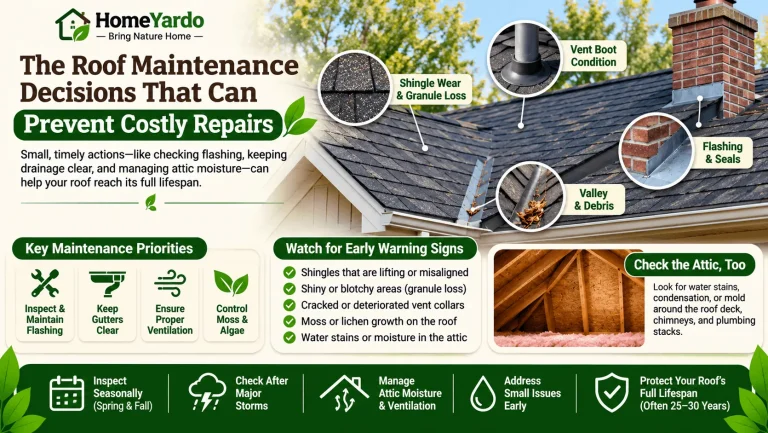
For a broader overview of preventive roof care, see HomeYardo’s guide to roof maintenance decisions that help prevent costly repairs.
What Determines How Often a Roof Needs Cleaning?
Two houses on the same street can have very different cleaning requirements. Roof design, surrounding vegetation, orientation, and weather exposure affect how quickly dirt and biological growth accumulate.

1. Local Climate and Humidity
Warm, humid conditions can support algae growth, particularly on roofing surfaces that remain damp after rainfall.
Coastal areas and regions with frequent rain may experience discoloration and organic growth sooner than dry inland locations.
However, humidity alone does not determine when a roof needs treatment.
A well-exposed roof with good drainage may stay relatively clean, while a nearby roof surrounded by trees could develop moss in shaded areas.
The condition of the roof matters more than the climate label.
2. Shade and Nearby Trees
Trees provide welcome shade around a home, but overhanging branches can also affect roof maintenance.
They may deposit leaves, pine needles, seeds, and small twigs onto roofing materials.
Accumulated debris can slow drying, particularly in valleys and around dormers or chimneys.
North-facing roof slopes in the Northern Hemisphere often receive less direct sunlight, making them more likely to remain damp long enough for moss to establish.
Homeowners dealing with repeated debris buildup may benefit from understanding how trees, gardens, and drainage affect roof lifespan.
The best response is not necessarily to remove healthy trees. Appropriate pruning, regular observation, and keeping drainage paths clear may help reduce recurring problems.
3. Roofing Material
Different roofing materials require different maintenance approaches.
Asphalt shingles have protective mineral granules that can be damaged by aggressive cleaning.
Metal roofing may have factory-applied finishes that require specific cleaning products.
Clay and concrete tiles can have coatings or porous surfaces that need careful treatment.
Slate and wood roofing also require methods appropriate for their individual properties.
A cleaning procedure suitable for one roof should never automatically be used on another.
4. Roof Design and Drainage
Steeper roof slopes generally encourage rainwater to move off the surface, although they can present greater access hazards for maintenance workers.
Complex roofs with multiple valleys, dormers, and changes in direction may collect more debris.
Leaves can settle in sheltered areas, while runoff from upper roof sections may concentrate on lower surfaces.
When water does not drain correctly, the solution may involve clearing debris or correcting a drainage defect rather than washing the entire roof.
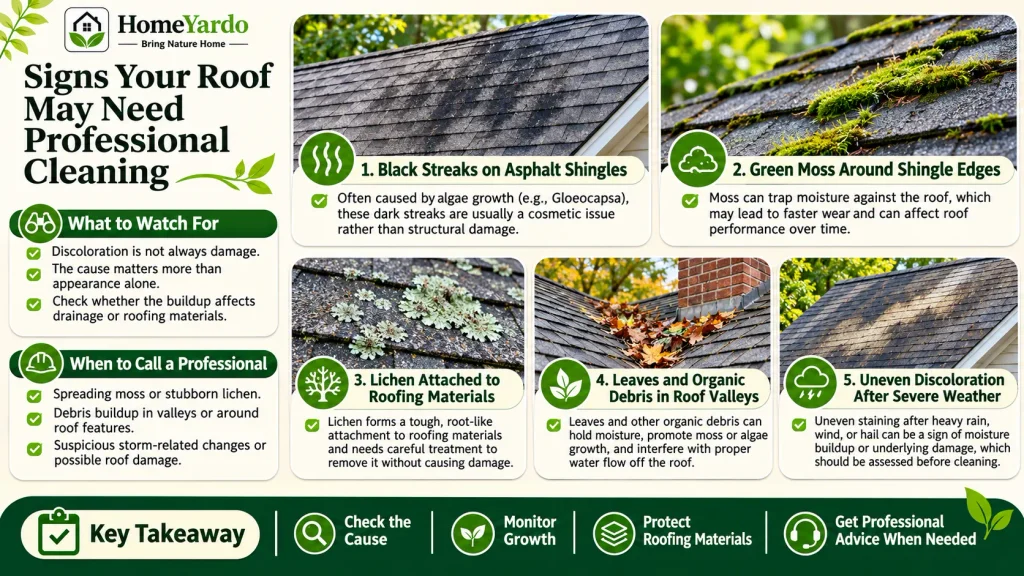
Signs Your Roof May Need Professional Cleaning
A roof can look discolored without being damaged. The important question is what has caused the change and whether it is affecting the roofing material.
Black Streaks on Asphalt Shingles
Dark streaks running down an asphalt shingle roof are frequently associated with algae, including the organism commonly known as Gloeocapsa magma.
These marks may begin as small patches before becoming more visible across a roof slope.
According to the Asphalt Roofing Manufacturers Association, algae discoloration is primarily an appearance concern on conventional asphalt shingles rather than evidence of structural failure.
That means black streaks do not automatically indicate a leaking or deteriorating roof.
However, homeowners who want to restore the roof’s appearance can consider a manufacturer-approved cleaning method.
Avoid assuming every dark stain is algae. Dirt, soot, shading, and other surface conditions may produce similar-looking marks.
Green Moss Around Shingle Edges
Moss deserves different attention.
It commonly develops in damp areas, particularly where sunlight is limited or organic debris collects.
Unlike algae staining, established moss can interfere with roof performance.
Heavy moss growth may contribute to lifting or curling shingle edges, trapping moisture, and allowing water to move into vulnerable areas.
If moss has spread across multiple sections of the roof, arrange a professional assessment rather than scraping or brushing it away.
Aggressive removal can dislodge protective granules or damage already weakened materials.
Lichen Attached to Roofing Materials
Lichen often appears as pale green, gray, white, or yellowish patches attached to a surface.
It may be harder to remove than ordinary dirt or algae because its structures adhere closely to the material beneath.
Trying to force established lichen off a shingle can damage the roof surface.
A suitable treatment may take time to produce visible results, and professional evaluation is especially important if the roofing is old, brittle, or deteriorated.
Leaves and Organic Debris in Roof Valleys
A collection of leaves may look harmless from the driveway.
But repeated debris buildup can hold moisture and interfere with water flow.
Roof valleys, areas behind chimneys, and transitions between roof sections deserve particular attention because runoff tends to concentrate there.
The immediate requirement may be targeted debris removal rather than a complete roof treatment.
Check the gutter system as well. HomeYardo’s guide to gutter warning signs explains what overflowing water, sagging sections, and recurring blockages may indicate.
Uneven Discoloration After Severe Weather
Storms can move debris, dislodge materials, and expose sections of a roof that were previously protected.
A newly visible patch should not automatically be treated as a cleaning problem.
If the area contains missing shingles, loose flashing, impact marks, or other physical damage, arrange a roofing assessment first.
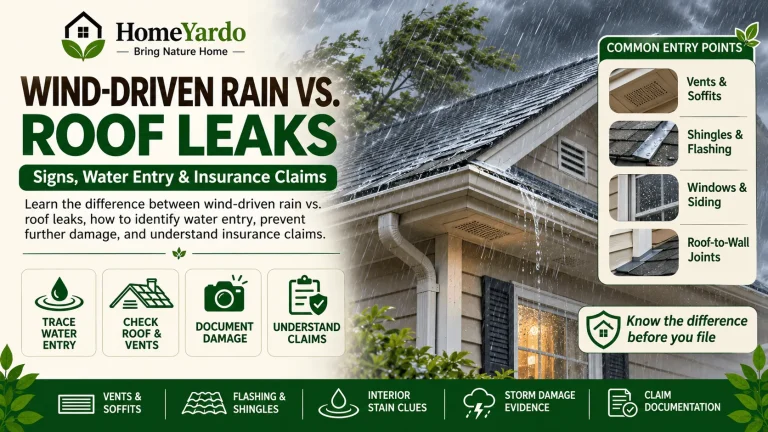
HomeYardo’s post-storm roof inspection guide explains how to recognize warning signs from a safe location.
Does Every Dirty Roof Need Cleaning?
No. A visibly dirty roof does not always need immediate professional treatment.
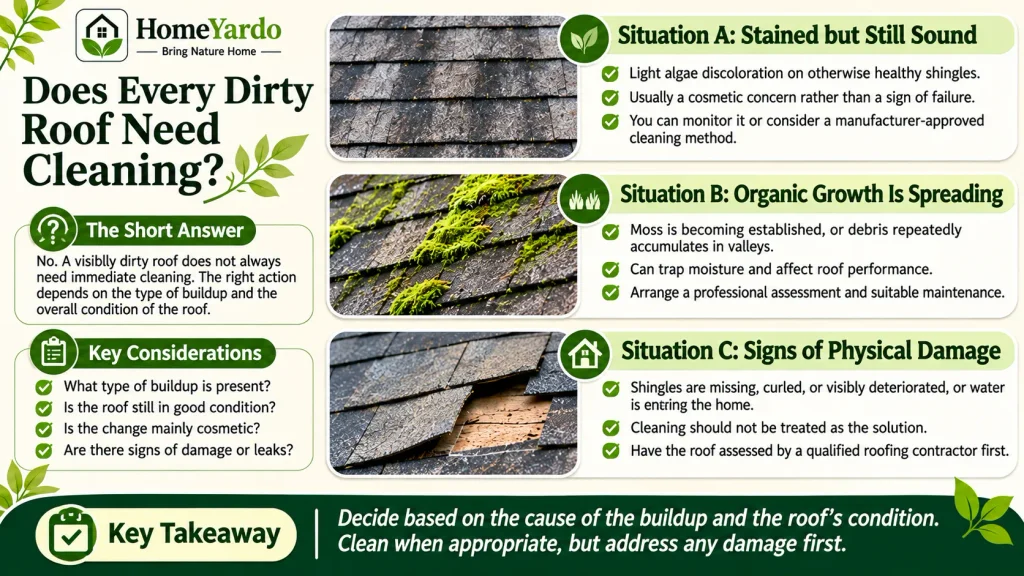
The appropriate action depends on the type of buildup and whether the roofing system remains in good condition.
Consider three common situations.
Situation A: The roof looks stained but remains sound.
Light algae discoloration on otherwise healthy asphalt shingles may primarily affect curb appeal. The homeowner can monitor it or consider an approved cleaning method.
Situation B: Organic growth is spreading.
Moss is becoming established around shingle edges, or heavy organic debris repeatedly accumulates in valleys. A professional assessment and suitable maintenance are reasonable.
Situation C: The roof shows physical damage.
Shingles are missing, surfaces are visibly deteriorated, or water is entering the home. Cleaning should not be treated as the solution until the damage has been assessed.
This distinction helps homeowners avoid paying for cosmetic work when the property actually requires a repair.
How Cleaning Needs Change With Climate and Exposure
There is no reliable nationwide timetable that applies to every residential roof.
Instead, use local conditions to determine how closely the roof should be monitored and when a professional assessment may be useful.
| Exposure | Typical Concern | Suggested Monitoring |
|---|---|---|
| Warm, humid climate | Algae and recurring discoloration | Check for changes during seasonal inspections |
| Wet, heavily shaded location | Moss and lichen growth | Pay particular attention to shaded roof slopes |
| Property surrounded by trees | Leaves, needles, and blocked drainage | Inspect after major leaf fall and severe weather |
| Dry, sunny location | Dust and ordinary surface dirt | Clean only when material condition or visible buildup warrants it |
| Snowy or freezing climate | Trapped debris, ice-related stress, and moisture | Assess safely after winter weather clears |
| Coastal environment | Moisture, salt exposure, and finish deterioration | Follow roofing material and coating manufacturer guidance |
These are monitoring priorities, not required washing frequencies.
A roof that remains free of problematic buildup may not need washing for several years.
Another roof could develop conditions requiring attention sooner.
Regular observation is more useful than automatically booking the same treatment every year.
What Is the Best Season to Clean a Roof?
Spring and fall are often practical times to evaluate roofing conditions, but neither season is universally best for every cleaning job.
The appropriate timing depends on weather conditions, surface moisture, material requirements, and the treatment being used.
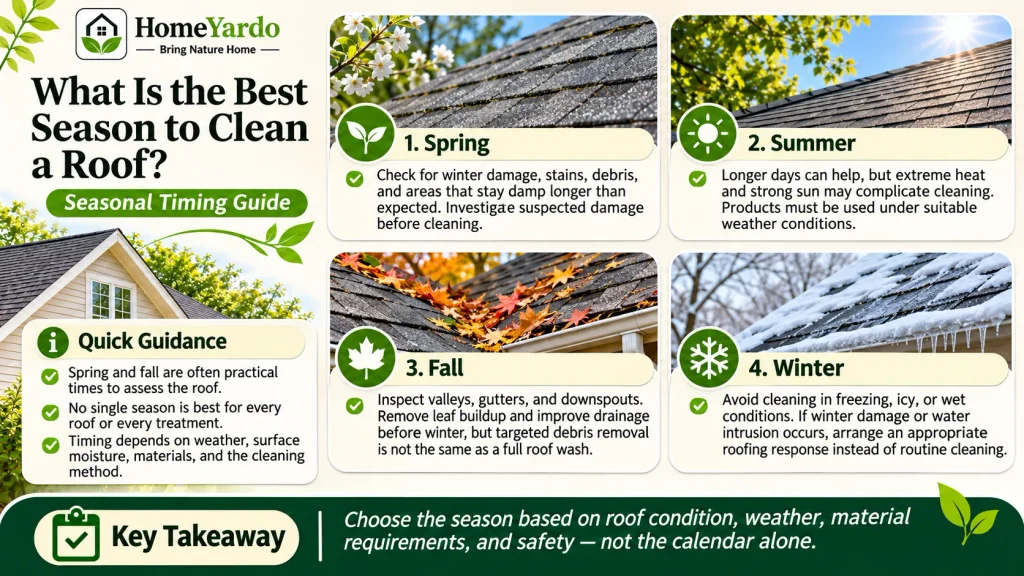
Spring: Review Winter Damage and New Growth
Spring provides an opportunity to check the roof after freezing conditions, snow, and winter storms.
Look for debris, stains, displaced materials, and areas where moisture seems to remain longer than expected.
If biological growth requires attention, a professional can determine whether conditions are suitable for treatment.
Any suspected winter damage should be investigated before cleaning begins.
Summer: Consider Heat and Drying Conditions
Summer offers longer daylight hours, but extreme heat can complicate roof cleaning.
Some cleaning products have specific temperature, application, and rinsing requirements.
Strong sunlight may cause solutions to dry too quickly, while intense heat can make working conditions more hazardous.
A qualified service provider should choose appropriate weather conditions rather than simply selecting the hottest or driest day.
Fall: Address Leaves and Drainage
Autumn is a practical time to inspect roof valleys, gutters, and downspouts.
Falling leaves may accumulate rapidly around roof features.
Clearing affected drainage paths before winter can reduce the risk of blockages and prolonged moisture exposure.
However, targeted debris removal should not be confused with a complete roof wash.
Winter: Avoid Hazardous Conditions
Cleaning during freezing weather can create serious slip hazards and may interfere with the intended treatment process.
Snow-covered, icy, and wet roofing should not be accessed by homeowners.
If significant water intrusion or storm damage occurs during winter, arrange an appropriate roofing response rather than waiting for a routine cleaning appointment.
Safe Roof Cleaning Methods Depend on Roofing Material
One of the most important roof maintenance decisions is choosing a method compatible with the installed material.
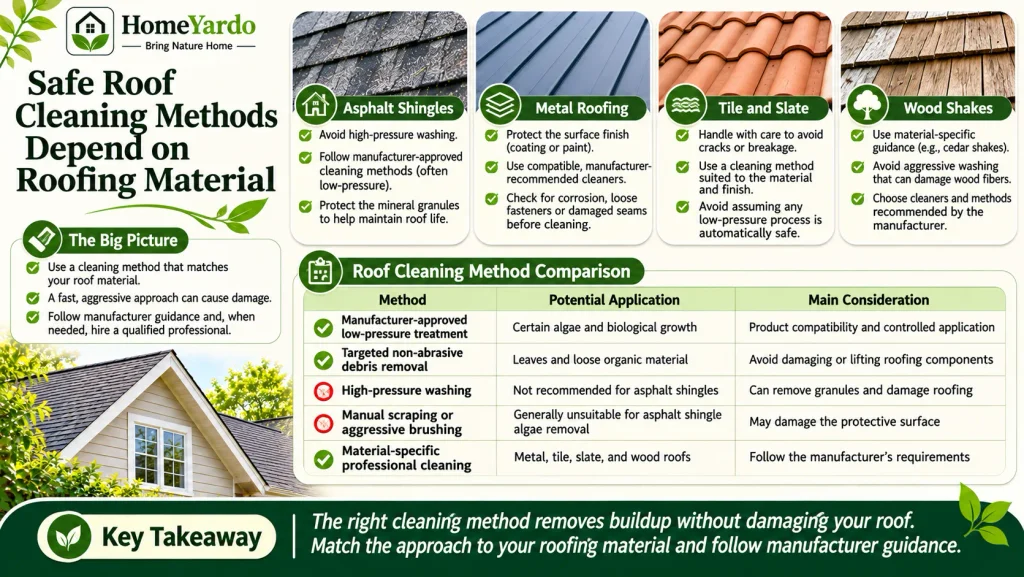
A technique that removes stains quickly is not necessarily safe for the roof.
Asphalt Shingles: Avoid High-Pressure Washing
Asphalt shingles depend on protective mineral granules to shield the underlying material from sunlight and weather exposure.
High-pressure cleaning can dislodge these granules and contribute to premature deterioration.
The Asphalt Roofing Manufacturers Association advises against using power washers, abrasive brushes, or brooms to remove algae from asphalt roofing.
When cleaning is appropriate, professionals should follow the shingle manufacturer’s current instructions for approved solutions, application, and rinsing.
The term soft washing generally describes a low-pressure chemical treatment, but it does not guarantee safety by itself.
The solution, concentration, application procedure, and roof condition all matter.
Metal Roofing: Protect the Surface Finish
Metal roofs may be coated, painted, or otherwise finished to protect the underlying material.
Some cleaners can affect those finishes if they are incompatible or improperly applied.
Before treatment, confirm the roofing manufacturer’s cleaning recommendations.
A professional should also identify existing corrosion, loose fasteners, damaged coatings, or compromised seams.
Cleaning cannot correct these defects.
Tile and Slate: Consider Surface and Access Risks
Clay tile, concrete tile, and slate roofing require careful handling.
Individual pieces can crack under inappropriate foot traffic or mechanical stress.
The cleaning method should account for the material, its finish, and the roof’s condition.
Avoid assuming that a low-pressure process is automatically safe for every tile or slate installation.
Wood Shakes: Use Material-Specific Guidance
Cedar shakes and other wood roofing products have different moisture and surface characteristics from asphalt or metal roofing.
Aggressive washing can damage wood fibers, while unsuitable chemicals may affect appearance or material performance.
Professional advice should consider the age and condition of the wood and the roofing manufacturer’s recommended maintenance practices.
Roof Cleaning Method Comparison
| Method | Potential Application | Main Consideration |
|---|---|---|
| Manufacturer-approved low-pressure treatment | Certain algae and biological growth | Product compatibility and controlled application |
| Targeted non-abrasive debris removal | Leaves and loose organic material | Avoid damaging or lifting roofing components |
| High-pressure washing | Not recommended for asphalt shingles | Can remove granules and damage roofing |
| Manual scraping or aggressive brushing | Generally unsuitable for asphalt shingle algae removal | May damage the protective surface |
| Material-specific professional cleaning | Metal, tile, slate, and wood roofs | Follow the manufacturer’s requirements |
The goal is to address the observed problem without creating a new one.
When to Hire a Professional Roof Cleaner
Professional assistance is particularly appropriate when the roof has established moss, extensive algae staining, difficult access, or roofing materials that require specialized treatment.
A reputable provider should assess the condition of the roof before recommending a cleaning method.
For example, Roof cleaning services from Clean Power Wash in the Salisbury, Maryland area describe a material-specific, low-pressure approach for treating biological growth. Its published process also addresses inspection, runoff management, and protection of nearby landscaping.
Regardless of the company selected, homeowners should ask how the proposed treatment will affect their specific roof covering.
Questions to Ask Before Booking
Before accepting a proposal, ask:
- What type of growth or buildup is present?
- Is the roofing material suitable for the proposed treatment?
- What cleaning products and application methods will be used?
- Are those methods consistent with the roof manufacturer’s guidance?
- How will gutters, plants, siding, and other exterior materials be protected?
- Does the roof show damage that should be repaired before cleaning?
- Are the company and workers appropriately insured?
- What results should be expected immediately, and what may take longer?
- What work is included in the written estimate?
A trustworthy contractor should be willing to explain these details without promising that every stain can be safely removed.
What Should Be Checked Before Roof Cleaning Begins?
Before treatment, the roof’s condition and surrounding areas should be evaluated.

Check for Existing Damage
Missing shingles, loose flashing, deteriorated sealants, and active leaks require attention before cosmetic cleaning.
If the surface is already fragile, even a gentle procedure may not be appropriate.
When defects are identified, a roofing contractor should explain whether repair, cleaning, or a different course of action makes sense.
Homeowners dealing with damage can use HomeYardo’s guide to planning a roof repair project to understand assessments, written scopes, and contractor responsibilities.
Confirm How Landscaping Will Be Protected
Roof cleaning runoff may reach flower beds, lawns, shrubs, downspouts, and exterior surfaces.
Depending on the approved treatment, the contractor may need to protect plants, manage runoff, and take precautions around sensitive materials.
Ask how nearby vegetation and drainage systems will be handled before work starts.
Environmental protection should be part of the agreed process, not an afterthought.
Review Warranty and Manufacturer Requirements
Some roofing warranties contain conditions related to cleaning methods, maintenance, and damage caused by improper treatment.
An unapproved procedure may create problems that are not covered by the product warranty.
Check the applicable warranty documents and manufacturer guidance rather than relying on a general claim that every soft-washing process is warranty-safe.
How to Keep a Roof Cleaner for Longer
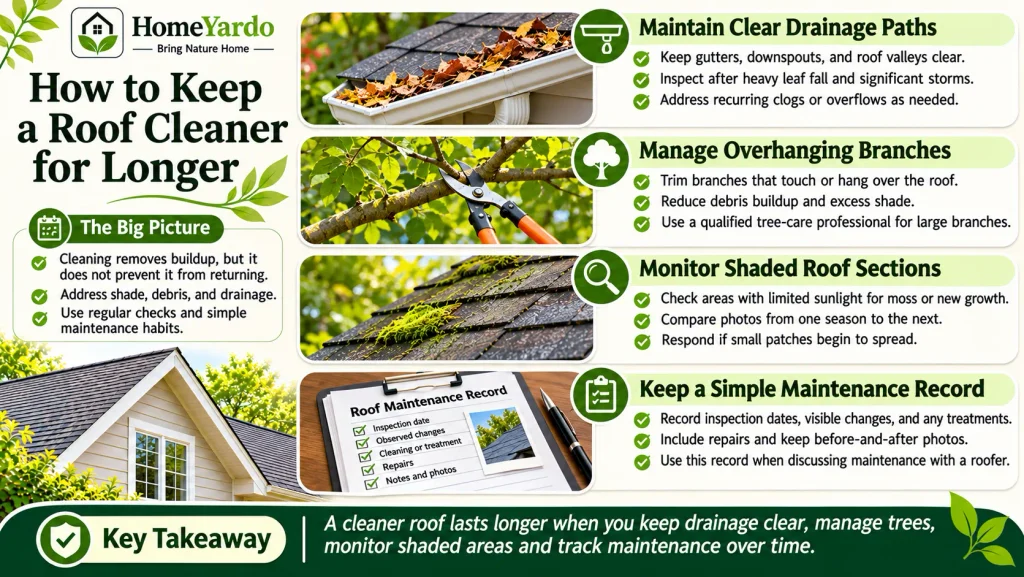
Cleaning removes existing buildup, but it does not change the conditions that caused the problem.
If shade, trapped debris, or poor drainage remain, algae or moss may eventually return.
A useful maintenance approach includes regular observation and addressing recurring contributing factors.
Maintain Clear Drainage Paths
Gutters, downspouts, and roof valleys should allow water to leave the roof as intended.
Inspect them after heavy leaf fall and significant storms.
Recurring clogs or overflowing gutters may require more than repeated cleaning.
Manage Overhanging Branches
Branches that touch roofing materials can cause abrasion, while overhanging vegetation may contribute to debris accumulation and shade.
Arrange suitable pruning where needed.
Avoid cutting large branches above the roof without a qualified tree-care professional.
Monitor Shaded Roof Sections
Areas receiving less direct sunlight may develop moss or other growth earlier than exposed sections.
Compare photographs from one season to the next.
A small patch that remains unchanged may call for a different response than spreading growth that is beginning to affect shingle edges.
Keep a Simple Maintenance Record
Record the date of each inspection, visible changes, professional treatments, and any repairs.
Photographs are particularly helpful for comparing recurring stains or buildup.
A short maintenance history also makes future conversations with roofers and cleaning contractors easier.
Common Roof Cleaning Mistakes to Avoid
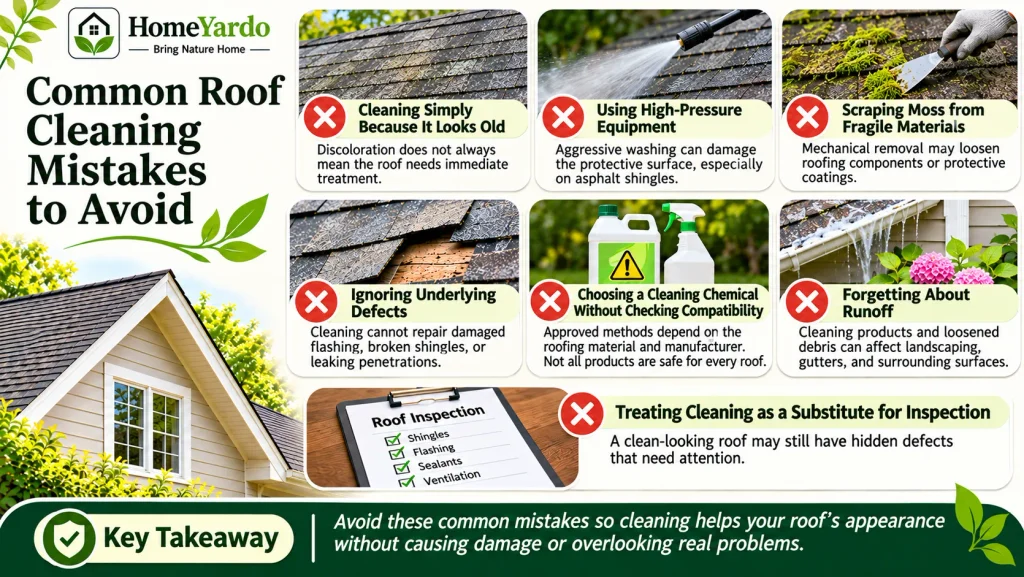
Several avoidable decisions can increase maintenance costs or cause damage.
Cleaning simply because the roof looks old. Discoloration does not always mean the roof needs immediate treatment.
Using high-pressure equipment on asphalt shingles. Aggressive washing can damage the protective surface.
Scraping moss from fragile materials. Mechanical removal may loosen roofing components or protective coatings.
Ignoring underlying defects. Cleaning cannot repair damaged flashing, broken shingles, or leaking penetrations.
Choosing a cleaning chemical without checking compatibility. Approved methods depend on the roofing material and manufacturer.
Forgetting about runoff. Cleaning products and loosened debris can affect landscaping, gutters, and surrounding surfaces.
Treating cleaning as a substitute for inspection. A clean-looking roof may still have hidden defects.
These mistakes often begin with the assumption that removing visible buildup is the same as restoring roof performance.
It is not.
When Cleaning Is No Longer the Right Solution
A roof may eventually reach a condition where cleaning offers little practical benefit.
Warning signs include widespread material deterioration, recurring leaks, significant granule loss, sagging areas, or damage affecting multiple roof components.
In these situations, a roofing contractor should assess the system before cleaning is considered.
An aging roof does not automatically require replacement, but it should not receive cosmetic treatment without considering whether the underlying materials remain sound.
HomeYardo’s guide to signs your roof needs replacement explains the warning signs that deserve further evaluation.
A roof’s condition—not the desire for a cleaner appearance—should guide the decision.
Final Takeaway
Roof cleaning works best as a response to actual conditions rather than a task assigned to every calendar year.
Light staining may be mainly cosmetic, while spreading moss, recurring debris, or persistent moisture can justify closer attention.
The right approach depends on the roofing material, local environment, manufacturer recommendations, and whether the surface is structurally sound.
Regular ground-level checks, appropriate professional assessments, clear drainage, and material-compatible cleaning can help homeowners maintain their roofs without unnecessary treatments.
Most importantly, cleaning should never replace needed repairs or create a greater safety risk than the buildup itself.
FAQ’s
There is no universal cleaning interval. Inspect the roof periodically and arrange manufacturer-approved treatment when algae, moss, or other buildup justifies it. Avoid high-pressure washing.
Not necessarily. An annual wash may be unnecessary for a clean, well-drained roof. Base cleaning decisions on visible conditions, roof material, environmental exposure, and manufacturer guidance rather than a fixed schedule.
Spring and fall can be convenient, but the best conditions depend on the roof material, weather, and treatment requirements. Avoid unsafe weather, freezing conditions, and any situation where cleaning products cannot be applied according to instructions.
Black streaks on asphalt shingles are often caused by algae and are generally a cosmetic concern. However, homeowners should not assume that every dark mark is algae without considering other possible causes.
Heavy moss growth can interfere with shingle edges, hold moisture, and contribute to roofing problems. Established moss should be assessed and treated using methods appropriate for the roof material.
For asphalt shingles, manufacturer-approved low-pressure treatment is generally more appropriate than high-pressure washing. However, the term soft washing alone does not establish that a chemical or process is safe for every roofing material.
Appropriate maintenance may help prevent avoidable problems associated with moss and debris buildup. However, cleaning does not reverse material aging, repair damaged components, or guarantee additional years of service.
Homeowners can safely monitor many visible conditions from the ground. Actual roof cleaning should generally be handled by qualified professionals using suitable access and fall-protection practices.
Ordinary rainfall may carry away loose dirt, but it does not reliably eliminate established moss or algae. Some professionally treated growth may gradually release over time, depending on the treatment and roof condition.
Have the leak assessed by a qualified roofer before arranging cosmetic cleaning. Water intrusion may indicate damaged flashing, roofing materials, or another defect that cleaning will not correct.
References
The following industry resources provide technical guidance on algae, moss, roof inspection, and cleaning methods.
- Asphalt Roofing Manufacturers Association — Algae Discoloration of Roofs
- Asphalt Roofing Manufacturers Association — Algae & Moss Prevention and Cleaning for Asphalt Roofing Systems
- Asphalt Roofing Manufacturers Association — Spring Roof Inspection Guidance
Editorial note: This article provides general home maintenance information. Roofing materials, warranties, and cleaning requirements vary. Follow manufacturer instructions and consult a qualified roofing or roof-cleaning professional before arranging treatment.